

Best SyncFutures.com Alternatives for Prop Traders in 2026
TradeDupe
14 min read
Explore the top syncfutures.com alternatives for prop traders in 2026. Discover efficient, low-latency options tailored to your trading needs.
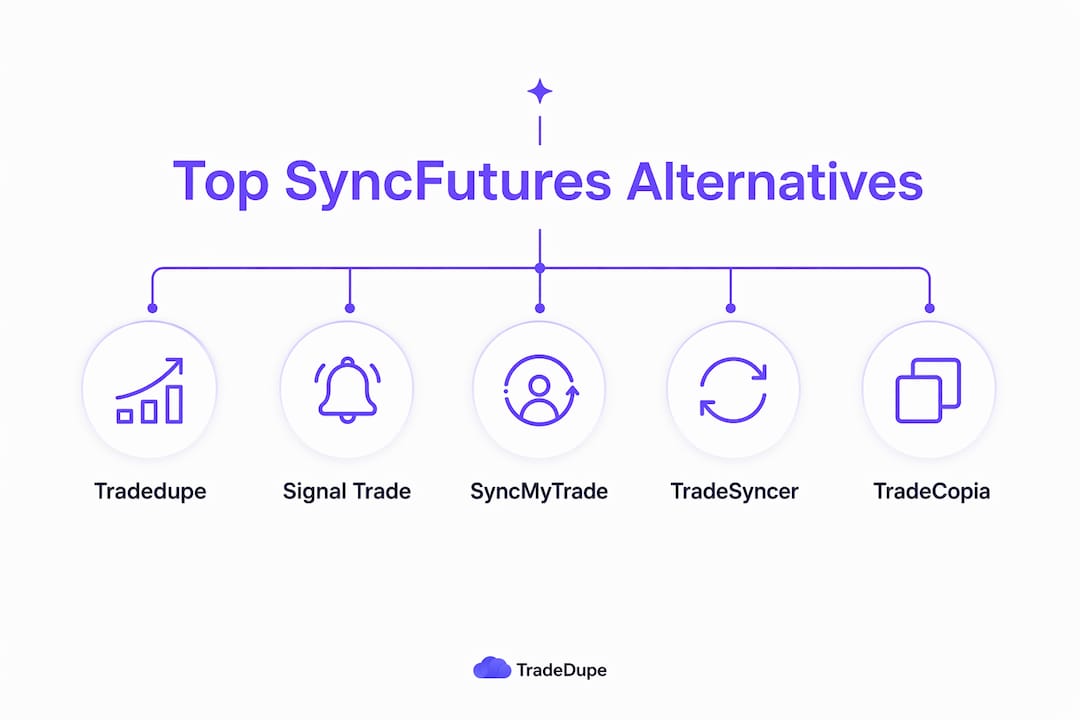
For Tradovate-native prop desks, Tradedupe is the clearest alternative to SyncFutures, with server-side execution and a reported median 34ms round-trip latency. For cross-broker cloud convenience, SyncMyTrade and Signal Trade App cover the widest broker range. For budget-conscious teams, Traders Connect keeps costs low. For local low-latency installs, TradeCopia is worth testing.
Why traders look past SyncFutures in the first place:
- No per-account toggle controls. SyncFutures is cloud-first with cross-broker support and a web dashboard, but it lacks the granular per-account stop controls that prop desks need when one follower account approaches a drawdown limit.
- Latency ceiling. Cloud-only architecture means you are subject to the 50–150ms range common in cloud copiers, which is acceptable for swing traders but a real cost for scalpers.
- Limited rogue-trade protection. Prop firms have strict drawdown rules. A copier without rogue-trade detection or auto-recovery puts every funded account at risk during connectivity drops or API errors.
*
Table of Contents
- How do these SyncFutures alternatives compare side by side?
- Profiles of the top SyncFutures alternatives for prop desks
- How to choose the right SyncFutures alternative for your prop desk
- Why latency, broker API stability, and prop-firm features actually affect your P&L
- Which alternative should most prop-firm traders choose?
- Key Takeaways
- A direct take on what actually matters when switching copiers
- Tradedupe is built for the prop-firm environment you are actually trading in
- Sources and further reading
How do these SyncFutures alternatives compare side by side?
| Platform | Best For | Pricing Model | Supported Platforms | Account/Connection Limits | Latency / Execution | Prop-Firm Features | Free Trial | Mobile Monitoring | Support |
|---|---|---|---|---|---|---|---|---|---|
| Tradedupe | Tradovate-native prop desks | Tiered monthly/annual subscription | Tradovate, Apex, Tradeify, Lucid Trading, Alpha Futures | Tiered; unlimited broker connections on higher plans | Server-side, median 34ms | Rogue-trade detection, auto-recovery, per-account toggles | Yes | Dashboard monitoring | Onboarding support included |
| Signal Trade App | Cross-platform signal distribution | Subscription | Multi-broker, web-based | Plan-dependent | Cloud-based | Basic prop presets | Not publicly listed | Mobile-focused dashboard | Web support |
| SyncMyTrade | Easy multi-broker setup | Subscription | Multi-broker | Plan-dependent | Cloud-based | Basic prop presets | Yes | Web dashboard | Standard |
| TradeSyncer | High account-count managers | Tiered subscription | Multi-platform | High limits on upper tiers | Cloud-based | Centralized controls | Yes | Web dashboard | Standard |
| TradeCopia | Low-latency local installs | Subscription / one-time license | Multi-broker | Plan-dependent | Cloud or local/VPS | Sizing multipliers | Yes | Limited | Standard |
| Traders Connect | Budget teams and small groups | Entry-level subscription | Multi-broker | Lower limits | Cloud-based | Basic group-copy features | Not publicly listed | Basic | Community-based |
| SyncFutures | Cross-broker cloud convenience | Subscription | Multi-broker, web dashboard | Plan-dependent | Cloud-based | Prop presets, web dashboard | Yes | Web dashboard | Standard |
> Note: Pricing tiers, account limits, and trial terms change frequently. Verify current figures directly with each vendor before committing to a plan.
Key dimensions to weigh before you shortlist:
- Execution method (server-side vs. cloud vs. local/VPS) is the single biggest performance variable.
- Prop-firm feature depth separates production-ready platforms from general-purpose copiers.
- Account/connection limits per plan determine whether you can scale without paying per-seat fees.
*
Profiles of the top SyncFutures alternatives for prop desks
Tradedupe
Tradedupe is built specifically for Tradovate and the prop-firm ecosystem around it — see the best sfmagazine.com alternatives for finance pros for related industry context. Its server-side architecture means your copy trades execute even when your local machine is offline, and the reported median round-trip latency is low enough to keep slippage predictable. Per-account toggle controls let you pause a single follower without touching the rest of your desk, and rogue-trade detection catches errant orders before they breach a funded account's drawdown limit. Auto-recovery reconnects follower accounts after API interruptions without manual intervention.

Best for: Prop desks running Apex, Tradeify, Lucid Trading, or Alpha Futures accounts through Tradovate.
Pros:
- Server-side execution with low median latency
- Rogue-trade detection and auto-recovery built in
- Per-account toggles for granular risk control
- Integrations with major prop providers (Apex, Tradeify, Lucid Trading, Alpha Futures)
Cons:
- Tradovate-native; not the right fit if your desk runs NinjaTrader or Rithmic exclusively
- Higher-tier plans required for unlimited broker connections
Trial: Available. See the getting started guide for setup steps.
*
Signal Trade App
Signal Trade App takes a cloud-first approach to signal distribution, making it practical for traders who copy across multiple broker environments and want mobile visibility into copy status. Its web dashboard is lightweight and accessible without a desktop install.
Best for: Traders who need cross-platform copying and prefer monitoring from a phone or tablet.
Pros:
- Mobile-focused monitoring dashboard
- Cross-broker signal distribution
- Simple web-based setup
Cons:
- Prop-firm feature depth is limited compared to Tradovate-native tools
- Trial availability not publicly listed; confirm directly with the vendor
*
SyncMyTrade
SyncMyTrade positions itself on ease of onboarding. Prop presets for common funded-account rules mean you can configure basic compliance parameters without building custom mapping from scratch. Cloud-first architecture keeps setup friction low.
Best for: Multi-account traders who prioritize quick deployment over sub-50ms execution.
Pros:
- Fast onboarding with prop-firm presets
- Broad multi-broker compatibility
- Free trial available
Cons:
- Cloud latency puts it in the 50–150ms range typical of cloud copiers
- Limited granular per-account controls for large desks
*
TradeSyncer
TradeSyncer is built for scale. Its upper-tier plans support high account counts with centralized management, making it a practical choice for multi-account managers who have outgrown entry-level copiers. Cross-platform integrations cover a wider broker range than Tradovate-only tools.
Best for: Large multi-account managers who need high connection limits and centralized oversight.
Pros:
- High account limits on upper tiers
- Cloud scaling with centralized controls
- Free trial available
Cons:
- Cloud-based execution; latency is not competitive with server-side or local/VPS options
- Per-account pricing on some tiers can add up quickly at scale
For a deeper look at how TradeSyncer stacks up against another popular option, the TradeSyncer vs TradeCopia comparison covers the key trade-offs.
*
TradeCopia
TradeCopia is the hybrid option: you can run it cloud-based for convenience or install it locally on a VPS for lower latency. Sizing multipliers make contract-size scaling straightforward. Local/VPS copiers can achieve sub-5ms execution in controlled setups, which matters for scalpers running tight stop strategies.
Best for: Traders who need flexibility between cloud convenience and low-latency local execution.
Pros:
- Local install option for latency-sensitive strategies
- Simple sizing multipliers for contract scaling
- Free trial available
Cons:
- Local setup requires VPS management overhead
- Mobile monitoring is limited
Traders comparing TradeCopia against other options can find additional context in the TradeCopia alternatives overview.
*
Traders Connect
Traders Connect targets smaller groups and trading teams that want collaborative copy features without enterprise pricing. Its community-oriented design suits teams that share signals informally rather than running a formal prop desk.
Best for: Small groups or trading communities with modest account counts and tight budgets.
Pros:
- Entry-level pricing
- Team and group-copy features
Cons:
- Lower account limits
- Prop-firm feature depth is minimal for funded-account compliance
*
How to choose the right SyncFutures alternative for your prop desk
The right platform depends on three variables: your broker stack, your latency tolerance, and how many accounts you need to control simultaneously. Work through these in order.
- Confirm broker API compatibility first. If your desk runs Tradovate, Tradedupe is the native choice. If you need Rithmic or NinjaTrader coverage, cloud cross-broker tools like TradeSyncer or SyncMyTrade are more practical.
- Set your latency tolerance. Scalpers and high-frequency strategies need sub-50ms execution. Server-side platforms (Tradedupe) or local/VPS installs (TradeCopia) are the only realistic options. Swing traders can work comfortably with cloud latency in the 50–150ms band.
- Count your accounts and map your growth. Entry-level plans on most platforms cap connections. Calculate the cost per account at your current size and at 2x growth before signing.
- Verify prop-firm feature requirements. Funded accounts live and die by drawdown rules. Confirm the platform supports per-account toggles, rogue-trade detection, and auto-recovery before you trial it.
- Test contract-size mapping during the trial. Mis-mapped contracts are a common and costly error when scaling across different prop-firm account rules. Run a full mapping test in staging before going live.
Vendor questions to ask during trial calls:
- What is your documented median copy round-trip time, and do you have an SLA for uptime?
- How does auto-recovery work when the API connection drops mid-session?
- Can I toggle individual follower accounts without stopping the entire copy session?
- What API protocols do you support, and how do you handle broker-side API changes?
- Is there a test or preview mode for staging copy behavior before live execution?
Red flags to watch for:
- Manual contract mapping with no template or auto-mapping option
- No per-account toggle control
- Pricing that scales per account without a cap
- No audit log or trade history export
- No staging or preview mode for testing copy behavior
Pro Tip: Ask every vendor for a live demo of their auto-recovery process. A vendor who cannot show you what happens when the API drops mid-trade is telling you something important about their production readiness.
Verifying trial policies and demo copying before committing is standard practice for serious prop desks. Budget at least one full trading week for a staging test, and run the trial during a period of normal volatility, not a holiday session.
*
Why latency, broker API stability, and prop-firm features actually affect your P&L
The gap between server-side and cloud execution is not theoretical. Cloud copiers commonly report latency in the 50–150ms range, while local/VPS setups can reach sub-5ms in controlled environments. For a scalper targeting 2–4 tick moves in ES or NQ, even a 50–150ms cloud delay is the difference between filling at the intended price and chasing a move that has already closed.
Broker API stability is the other variable most traders underestimate. Tradovate's API is well-documented and actively maintained, which is why Tradovate-native platforms like Tradedupe can offer tighter latency guarantees. Platforms that abstract across many brokers via generic API wrappers introduce additional failure points, especially when a broker pushes an API update mid-session.
Prop-firm-specific features have moved from premium add-ons to baseline requirements for scaling desks:
- Per-account toggles let you stop copying to a single follower that is approaching its max drawdown without disrupting the rest of the desk.
- Rogue-trade detection catches orders that fall outside pre-set parameters before they execute on follower accounts.
- Auto-recovery reconnects dropped follower accounts automatically, reducing the manual monitoring burden on live trading days.
Tradedupe's server-side trade mirroring addresses all three. Its reported median round-trip latency is well below typical cloud-copier levels, and its integration with Apex, Tradeify, Lucid Trading, and Alpha Futures covers the most common prop-firm environments U.S. traders use.
*
Which alternative should most prop-firm traders choose?
For the majority of U.S. prop-firm traders running Tradovate accounts, Tradedupe is the recommended starting point. Server-side execution, rogue-trade detection, auto-recovery, and per-account toggles address the four most common failure modes on a funded desk. The Tradovate-native architecture means you are not working around a generic API layer.
Secondary picks by persona:
- Scalpers and high-frequency traders: TradeCopia's local/VPS install option is the only other path to sub-50ms execution if you are not on Tradovate.
- Large multi-account managers on mixed broker stacks: TradeSyncer's high account limits and cross-platform integrations make it the most practical cloud option at scale.
- Budget-conscious teams or small groups: Traders Connect covers basic group-copy needs at entry-level pricing, though prop-firm feature depth is limited.
- Cross-broker signal distribution with mobile monitoring: Signal Trade App or SyncMyTrade are the lightest-weight options for traders who need broad compatibility and simple setup.
When to switch: If your current copier has triggered a drawdown breach due to a rogue copy, failed to reconnect after an API drop, or cannot toggle individual accounts without stopping the full session, those are the clearest signals that you have outgrown a general-purpose cloud copier. Migration to a prop-firm-native platform is worth prioritizing before the next evaluation cycle, not after.
*
Key Takeaways
For prop-firm traders evaluating SyncFutures alternatives, the platform's execution method and prop-specific feature set matter far more than surface-level pricing comparisons.
| Point | Details |
|---|---|
| Execution method is the core variable | Server-side platforms like Tradedupe outperform cloud copiers, which typically have significantly higher latency, for latency-sensitive strategies. |
| Prop-firm features are now baseline | Per-account toggles, rogue-trade detection, and auto-recovery are minimum requirements for any funded desk. |
| Test contract mapping in staging | Mis-mapped contracts are the most common costly error; run a full mapping test before going live. |
| Match the platform to your broker stack | Tradovate-native desks get the most from Tradedupe; mixed-broker desks should evaluate TradeSyncer or SyncMyTrade. |
| Tradedupe is the recommended first trial | For U.S. prop desks on Tradovate, Tradedupe's server-side execution and prop controls make it the strongest starting point. |
*
A direct take on what actually matters when switching copiers
Most traders evaluating SyncFutures alternatives spend too much time comparing feature lists and not enough time stress-testing the one scenario that actually costs money: what happens when something breaks mid-session.
A copier that reconnects automatically and stops a rogue copy before it breaches a drawdown limit is worth more than a platform with a longer feature list and a slower support ticket queue. The prop-firm environment is unforgiving. A single bad copy on a funded account can wipe an evaluation pass that took weeks to build.
The other underappreciated variable is contract-size mapping. Traders moving from SyncFutures to any new platform often discover that their mapping configuration was more fragile than they realized, only after a live error. Running a full staging test with deliberate failure simulations, including API disconnects and edge-case contract sizes, is the only way to know a platform is actually production-ready for your desk.
Tradedupe's server-side architecture and rogue-trade detection address both of those failure modes directly. That is not a marketing claim; it is the reason those features exist. For a prop desk where one bad session can end an evaluation, operational resilience is the only spec that matters.
*
Tradedupe is built for the prop-firm environment you are actually trading in
If you are running funded accounts on Tradovate through Apex, Tradeify, Lucid Trading, or Alpha Futures, Tradedupe gives you server-side execution, rogue-trade detection, and per-account toggle controls in a single platform. The median 34ms round-trip is not a benchmark figure; it is what your copy trades actually execute at.
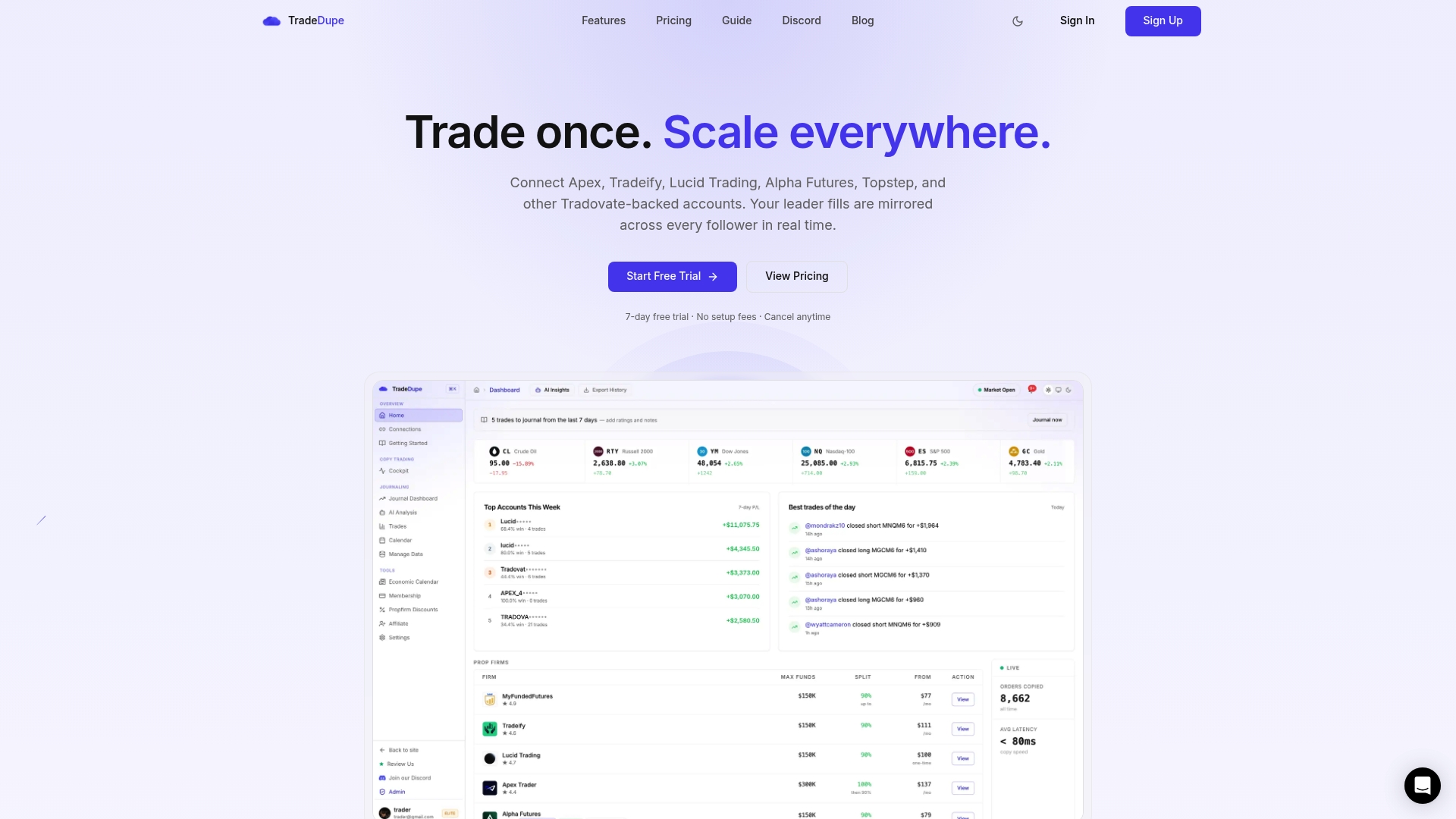
The trial is designed to let you test the features that matter most for prop desks: run a staging copy session, trigger a simulated API disconnect, and verify auto-recovery behavior before you go live. Onboarding support is included. Setup takes minutes, not days.
Start your Tradedupe trial and run your first staging copy test today.
*
Sources and further reading
The claims in this article draw from vendor documentation, independent review sites, and broker API references. Use these during your trial to validate latency numbers, pricing, and supported broker lists.
Review and comparison sources:
- Best Futures Trade Copiers 2026: Prop Tools & Reviews — Use this to cross-check cloud vs. local/VPS category breakdowns and editorial latency guidance.
- Best Futures Trade Copiers 2026: Top Picks & Low Latency Reviews — Contains latency and price band data for representative copiers; useful for benchmarking vendor claims during a trial.
- 7 Best Trade Copiers for Futures Prop Firm Trading in 2026 — Covers prop-firm preset features and cross-broker support; good for verifying which platforms include compliance-oriented onboarding.
- SyncFutures Alternatives — SaaSHub — Aggregated directory of alternatives with community tags; useful for confirming market availability of cloud and self-hosted options.
- 7 Best Copy Trading Platforms for 2026 — ForexBrokers.com — Authoritative guidance on trial policies, track record verification, and demo copying standards.
- Best SyncFutures Alternatives in 2026 — Signal Trade App Blog — Vendor-perspective comparison; read alongside neutral sources to separate marketing claims from documented features.
Tradedupe product and integration pages:
- Futures Trade Copier for Prop Firms — Primary product page with technical specs, latency figures, and supported prop-firm integrations.
- Best Trade Copier for Prop Firms in 2026 — Editorial overview of copier categories and buyer guidance.
- Apex Copy Trading — Use-case page for Apex Trader Funding integration details.
How to use these during a trial:
- Cross-reference the vendor's stated latency against the independent review bands (50–150ms cloud, sub-5ms local/VPS) to assess whether the claim is plausible.
- Check the broker API documentation for Tradovate or your specific broker to understand what API events the copier needs to handle, and ask the vendor how they respond to each.
- Use the SaaSHub aggregator to find community-sourced feedback on reliability and support response times, which vendor pages will not surface.
Recommended
- Best Futures Prop Firms 2026 — Updated Rankings | TradeDupe Blog
- TradeSyncer vs TradeCopia: Honest 2026 Comparison for Futures Traders
- Best Trade Copier for Prop Firms in 2026 | TradeDupe
- The Futures Day Trading Landscape in 2026: ICT, Order Flow, Prop Firms, and What Actually Works | TradeDupe Blog