
Best Prop Desk Trade Management Platforms in 2026
TradeDupe
20 min read
Discover the best trade management platforms for prop desks in 2026. Optimize your trading with low-latency solutions and powerful features.
For U.S. prop desks running Tradovate accounts, Tradedupe is the strongest operational fit: real-time multi-account mirroring at a median 34ms latency, rogue-trade detection, and per-account toggle controls purpose-built for funded account workflows. For larger institutional desks that need full EMS or front-to-back OEMS capability, FlexTRADER and LSEG TORA are the next tier. The right choice among the top prop desk trade management platforms comes down to four axes: latency profile, OMS/EMS scope, multi-account and copy-trading scale, and integration effort with your existing stack.
Quick shortlist:
- Tradedupe — Best for Tradovate-based prop desks needing low-latency copy trading and scalable multi-account mirroring across funded accounts like Apex, Tradeify, and Lucid Trading
- FlexTRADER (FlexTrade) — Best for institutional desks requiring broker-neutral multi-asset execution, advanced algos, and integrated TCA
- LSEG TORA — Best for large multi-asset teams that need 600+ broker/venue connectivity and integrated LSEG market data
- Enfusion — Best for funds that want a single live database spanning portfolio management, trading, and back-office operations
- Trading Technologies (TT) — Best for futures-focused desks that prioritize low-latency direct market access and algo deployment
- NinjaTrader / Sierra Chart / Rithmic — Best for cost-conscious desks running discretionary or systematic futures strategies on U.S. exchanges
*
Key Takeaways
The most important decision rule for U.S. prop desks is this: match your platform to your actual workflow, not to the most feature-rich option on the market.
| Point | Details |
|---|---|
| Match platform to workflow | Tradovate-based prop desks need copy-trading SaaS; multi-asset institutional desks need EMS/OEMS. |
| Latency vs. integration tradeoff | Lower-latency platforms (Rithmic, CQG, TT) require more integration work; SaaS tools deploy faster. |
| Per-account controls are non-negotiable | Server-side risk enforcement and per-account toggles are required for funded account operations at scale. |
| Audit trail and reconciliation | Every platform must log all order events with account attribution; manual reconciliation at scale is an operational liability. |
| Tradedupe for Tradovate desks | Tradedupe delivers 34ms server-side mirroring, rogue-trade detection, and per-account controls for Tradovate-based prop operations. |
*
Table of Contents
- How do the top prop desk trade management platforms compare?
- Platform profiles: what each system actually offers
- How do you choose the right platform for your prop desk?
- How were these platforms selected and evaluated?
- Where does Tradedupe fit your prop desk's stack?
- An operator's perspective on platform selection
- Tradedupe is built for the Tradovate prop desk workflow
- Primary sources and further reading
- Sources
How do the top prop desk trade management platforms compare?
The table below covers the platforms most relevant to U.S. prop trading operations. Tradedupe leads as the featured option; remaining entries follow by operational scope and fit.
| Platform | Best for | Asset classes | Core function | APIs & FIX | Latency / low-touch | Broker / venue connectivity | Multi-account / copy trading | Risk & compliance | Analytics / TCA | Deployment | Pricing model |
|---|---|---|---|---|---|---|---|---|---|---|---|
| Tradedupe | Tradovate prop desks: multi-account mirroring, funded accounts | Futures (Tradovate) | Copy-trading / mirroring SaaS | REST, WebSocket | Median 34ms server-side | Tradovate ecosystem (Apex, Tradeify, Lucid, Alpha Futures) | Core feature: unlimited broker connections, per-account toggles | Rogue-trade detection, auto-recovery, per-account controls | Real-time dashboard, AI-powered analytics, audit trail | Cloud SaaS; setup in minutes | Tiered subscription; free trial |
| FlexTRADER | Institutional multi-asset EMS, portfolio trading | Equities, FI, FX, derivatives | EMS | FIX, REST, WebSocket, proprietary API | Low-latency; algo-driven | 300+ brokers | Portfolio-level; limited native copy trading | Pre-trade risk, compliance rules | FlexTCA integrated | Cloud / on-prem | Enterprise license |
| LSEG TORA | Large multi-asset institutional teams | Equities, FI, FX, derivatives, spread | OEMS | FIX, WebSocket | Institutional-grade | 600+ brokers/venues | Multi-account OMS workflows | Pre-trade compliance, audit logs | Integrated TCA, LSEG data | Cloud / hybrid | Enterprise license |
| Enfusion | Funds needing front-to-back on one live database | Equities, FI, FX, derivatives | Front-to-back (PM + OEMS) | FIX, REST | Institutional | 300+ liquidity sources | Multi-portfolio; not a copy-trading tool | Inline pre-trade compliance, live IBOR/ABOR | Integrated reporting | Cloud-native | Subscription |
| Bloomberg Terminal | Market data, analytics, trade decisioning | All major asset classes | Market data + analytics terminal | Bloomberg API (BLPAPI) | Data-layer; not an EMS | Bloomberg network | Not applicable | Compliance data feeds | Best-in-class analytics | Desktop / cloud | High-cost subscription |
| Refinitiv Eikon (Reuters Eikon) | Market data, news, analytics | All major asset classes | Market data terminal | Eikon API, REST | Data-layer | Refinitiv network | Not applicable | Compliance data | Analytics, charting | Desktop / cloud | Subscription |
| CQG / CQG Integrated Client | Futures and options execution, DMA | Futures, options, FX | EMS / DMA | FIX, CQG API | Ultra-low latency DMA | 40+ FCMs, major exchanges | Limited; per-account setup | Pre-trade risk limits | CQG Analytics | Desktop / cloud | Per-user or enterprise |
| Trading Technologies (TT) | Futures desks: algo deployment, DMA | Futures, options, FX | EMS + algo platform | FIX, TT REST API | Low-latency DMA | 200+ venues | Multi-account; limited copy trading | Pre-trade risk, kill switch | TT Score analytics | Cloud | Subscription |
| TradeStation | Active retail / semi-pro prop traders | Equities, futures, options | Broker + platform | TradeStation API | Moderate | TradeStation network | Limited | Basic risk controls | Built-in analytics | Desktop / cloud | Commission-based |
| NinjaTrader | Discretionary / systematic futures traders | Futures, FX | EMS / charting platform | NinjaTrader API, FIX | Low-latency capable | Rithmic, CQG, Interactive Brokers | Add-on trade copier | Basic risk controls | Performance analytics | Desktop | License + commissions |
| Sierra Chart | Quant / systematic futures traders | Futures, equities, FX | Charting + EMS | FIX, Sierra Chart API | Very low latency | Rithmic, CQG, DTNIQ | Limited; manual setup | Basic controls | Advanced charting analytics | Desktop | Low flat fee |
| Rithmic | Futures execution infrastructure / data feed | Futures | Execution infrastructure / data feed | Rithmic API, FIX | Ultra-low latency | CME, CBOT, NYMEX, ICE | Infrastructure layer; not a UI | Server-side risk | Market data analytics | Cloud infrastructure | Per-connection fee |
| cTrader | FX / CFD prop desks | FX, CFDs, equities | EMS + charting | FIX, cTrader API | Low latency | Broker-dependent | Copy trading (cTrader Copy) | Risk controls, compliance | Analytics, reporting | Cloud / desktop | Broker-licensed |
| Match-Trader | FX prop firm operators | FX, CFDs | Broker platform + OMS | REST, FIX | Low latency | Broker-dependent | Multi-account | Risk engine | Reporting | Cloud | Operator license |
| DXtrade | FX / CFD prop firm operators | FX, CFDs, crypto | Broker platform + OMS | REST API | Low latency | Broker-dependent | Multi-account | Risk controls | Reporting | Cloud | Operator license |
| UpTrader | FX prop firm operators and brokers | FX, CFDs | CRM + OMS | REST API | Standard | Broker-dependent | Multi-account | Risk controls | CRM analytics | Cloud | Subscription |
| Trading Platform 5 (MT5) | Broad prop firm deployments | FX, CFDs, futures, equities | Broker platform + EMS | MQL5 API, FIX | Low latency | Broker-dependent | Multi-account; copy trading via signals | Risk controls | Analytics | Desktop / cloud | Broker-licensed |
| Jane Street | Proprietary quantitative trading (internal) | All asset classes | Proprietary internal system | Internal / proprietary | Ultra-low latency | Direct market access | Internal multi-strategy | Institutional risk | Proprietary analytics | Internal | Not commercially available |
| GooeyPro | Prop firm challenge management | FX, CFDs | Challenge management platform | API integrations | Standard | Broker-dependent | Multi-account management | Challenge rules engine | Reporting | Cloud | Subscription |
*
Platform profiles: what each system actually offers
Tradedupe
Tradedupe is purpose-built for prop desks running on Tradovate. Its server-side mirroring engine replicates trades from a single leader account to an unlimited number of follower accounts at a median 34ms latency, with no client-side software required on follower machines. The platform's rogue-trade detection flags anomalous orders before they propagate, and auto-recovery restores sync after connectivity interruptions without manual intervention. Supported prop firm integrations include Apex, Tradeify, Lucid Trading, and Alpha Futures.
- Core capabilities: Real-time trade mirroring, per-account toggle controls, AI-powered analytics, real-time monitoring dashboard, audit trail for compliance reporting
- Asset classes: Futures (Tradovate ecosystem)
- Best for: Prop desks managing multiple funded accounts on Tradovate that need scalable, automated copy trading with per-account risk controls
FlexTRADER (FlexTrade)
FlexTRADER is a broker-neutral, multi-asset EMS built on an API-first open architecture. It connects to 300+ brokers, supports advanced execution algos, portfolio trading, and pairs/basket strategies, and includes FlexTCA for post-trade transaction cost analysis. Its open architecture lets desks keep proprietary execution logic in-house while routing through vendor infrastructure.
- Core capabilities: Multi-asset execution, advanced algos, portfolio trading, FlexTCA analytics
- Asset classes: Equities, fixed income, FX, derivatives
- Best for: Institutional desks that need deep broker connectivity, algo customization, and integrated TCA without being locked into a single broker
LSEG TORA
LSEG TORA combines order management, execution management, TCA, and spread trading in a single OEMS, backed by connectivity to 600+ brokers and venues. FIX and WebSocket APIs support systematic execution and automation workflows. LSEG market data integrates natively, reducing the need for a separate data vendor.
- Core capabilities: Multi-asset OEMS, 600+ broker/venue connectivity, integrated LSEG market data, TCA
- Asset classes: Equities, fixed income, FX, derivatives, spread products
- Best for: Large institutional trading teams that need global multi-asset connectivity and want market data and execution on one platform
Enfusion
Enfusion runs portfolio management and OEMS on a single live database, so P&L, positions, and compliance checks update in real time across PM, trading, and back-office teams. Pre-trade compliance is inline with order creation, not a separate step. Connectivity spans 300+ liquidity sources via FIX.
- Core capabilities: Live IBOR/ABOR sync, inline pre-trade compliance, front-to-back PM and OEMS
- Asset classes: Equities, fixed income, FX, derivatives
- Best for: Funds scaling quickly that want to eliminate reconciliation overhead between portfolio management and execution
Bloomberg Terminal
The Bloomberg Terminal remains the institutional standard for market data, analytics, and trade decisioning. It is not an EMS in the traditional sense, but execution desks rely on it for pre-trade analytics, pricing, and order routing via BLOOMBERG AIM. The cost is high; it is most justified when a desk already depends on Bloomberg data for research and risk.
- Core capabilities: Market data, analytics, news, order routing via AIM
- Asset classes: All major asset classes
- Best for: Desks where Bloomberg data is already central to the research and risk workflow
Refinitiv Eikon (Reuters Eikon)
Refinitiv Eikon provides market data, news, charting, and analytics comparable to Bloomberg at a generally lower price point. It is a data and analytics terminal rather than a full EMS, but its API layer (Eikon Data API, Refinitiv Data Platform) allows integration into execution workflows.
- Core capabilities: Market data, charting, analytics, API access
- Asset classes: All major asset classes
- Best for: Desks that need institutional-grade market data without Bloomberg's price tag
CQG and CQG Integrated Client
CQG is the execution infrastructure of choice for many U.S. futures desks. Its direct market access to CME, CBOT, NYMEX, and ICE, combined with ultra-low latency order routing via 40+ FCMs, makes it a natural fit for high-frequency and systematic futures strategies. CQG Integrated Client adds charting, analytics, and order management on top of the core execution layer.
- Core capabilities: DMA futures execution, ultra-low latency, CQG Analytics
- Asset classes: Futures, options, FX
- Best for: Futures desks that need ultra-low latency DMA and broad FCM connectivity
Trading Technologies (TT)
TT is a cloud-native EMS and algo platform with direct connectivity to 200+ venues. Its ADL (Algo Design Lab) lets quant teams build and deploy algos without writing code, and TT Score provides post-trade analytics. The kill-switch and pre-trade risk controls are well-documented and widely used by U.S. futures prop desks. For systematic trading frameworks, TT's REST API and FIX connectivity give quant teams clean integration points.
- Core capabilities: Algo deployment (ADL), DMA, TT Score analytics, pre-trade risk
- Asset classes: Futures, options, FX
- Best for: Futures prop desks that deploy systematic strategies and need a documented algo environment
TradeStation
TradeStation is a broker-platform hybrid that suits active retail and semi-professional prop traders. Its EasyLanguage scripting environment supports automated strategies, and the platform covers equities, futures, and options. It is not designed for multi-account mirroring at scale, but it is accessible and cost-effective for smaller operations.
- Core capabilities: EasyLanguage automation, charting, broker integration
- Asset classes: Equities, futures, options
- Best for: Smaller prop operations or individual traders who want an integrated broker-platform without enterprise complexity
NinjaTrader
NinjaTrader is a desktop EMS and charting platform widely used by discretionary and systematic futures traders. Its NinjaScript environment supports custom indicators and automated strategies, and it connects to Rithmic, CQG, and Interactive Brokers for execution. A third-party trade copier ecosystem exists, though native multi-account mirroring is limited.
- Core capabilities: NinjaScript automation, advanced charting, multi-broker connectivity
- Asset classes: Futures, FX
- Best for: Discretionary and systematic futures traders who need a flexible desktop platform with strong charting
Sierra Chart
Sierra Chart is the platform of choice for latency-sensitive systematic traders who want maximum control at minimal cost. Its flat monthly fee, FIX connectivity, and support for Rithmic and CQG make it a serious execution environment. The UI is dated, but the performance is not.
- Core capabilities: Advanced charting, FIX execution, Rithmic/CQG connectivity, ACSIL programming
- Asset classes: Futures, equities, FX
- Best for: Quant and systematic traders who prioritize raw performance and low cost over UI polish
Rithmic
Rithmic is execution infrastructure, not a trading interface. It provides ultra-low latency order routing and market data for U.S. futures exchanges (CME, CBOT, NYMEX, ICE) and is the connectivity layer behind NinjaTrader, Sierra Chart, and many prop firm platforms. Desks that need the lowest possible latency on U.S. futures often build directly on Rithmic's API.
- Core capabilities: Ultra-low latency execution, market data, FIX/Rithmic API
- Asset classes: Futures
- Best for: Desks building custom execution infrastructure on U.S. futures exchanges
cTrader
cTrader is a broker-licensed EMS and charting platform widely used in FX and CFD prop operations. Its cTrader Copy module provides native copy trading, and the FIX and cTrader API support algorithmic strategies. It is the most capable of the FX-focused platforms for prop desks that need copy trading built in.
- Core capabilities: FX/CFD execution, cTrader Copy, FIX API, algo support
- Asset classes: FX, CFDs, equities
- Best for: FX and CFD prop desks that need native copy trading and a polished trader-facing interface
Match-Trader, DXtrade, UpTrader, and Trading Platform 5 (MT5)
These four platforms serve FX and CFD prop firm operators rather than futures desks. Match-Trader and DXtrade are cloud-native operator platforms with multi-account management and risk engines. UpTrader adds CRM and back-office functionality on top of a trading platform layer. MT5 (Trading Platform 5) is the most widely deployed broker platform globally, with MQL5 scripting, FIX connectivity, and a signals-based copy trading module. All four are broker-licensed rather than sold directly to end traders.
Jane Street
Jane Street's trading infrastructure is proprietary and not commercially available. It is included here for completeness: Jane Street operates one of the most sophisticated quantitative trading systems in the world, built internally in OCaml, with direct market access across asset classes. It is not a platform a prop desk can buy or license.
GooeyPro
GooeyPro focuses on prop firm challenge management rather than execution. It handles challenge rules, account provisioning, and reporting for prop firm operators who run evaluation programs. It is a back-office and operator tool, not an EMS or copy-trading platform.
*
How do you choose the right platform for your prop desk?
The single most important criterion is matching your deployment and latency profile to your strategy type. A discretionary futures desk running 20 funded accounts on Tradovate has no use for an enterprise OEMS that takes six months to implement. Conversely, a multi-asset institutional desk trading equities, fixed income, and FX simultaneously cannot run on a copy-trading SaaS built for a single brokerage.
Evaluation checklist for your demo or proof-of-concept:
- Connectivity: Confirm the platform connects to your specific brokers, FCMs, and venues. Ask for a live FIX session test, not a slide deck.
- Per-account risk enforcement: Test whether risk limits (drawdown thresholds, position limits) are enforced server-side or only client-side. Client-side enforcement can be bypassed.
- Copy/mirror accuracy: Run a multi-account mirror test with simultaneous orders. Measure fill latency across accounts and check for order sequencing errors.
- Reconciliation: Confirm positions reconcile automatically after a connectivity drop. Manual reconciliation at scale is an operational liability.
- Audit trail: Verify that every order, modification, and cancellation is logged with timestamps and account attribution. This is non-negotiable for prop trading compliance.
- TCA and reporting: Ask for a sample TCA report. If the vendor cannot produce one for your asset class, the analytics are likely superficial.
- Disaster recovery: Run a failover test. Kill the primary connection and measure how long it takes for the system to recover and resume mirroring.
Red flags to watch:
- Server-side workarounds that require a client machine to stay online for mirroring to function
- Per-account fees that scale linearly with no volume discount, making growth expensive
- APIs described as "available on request" with no public documentation
- Audit logs that only capture fills, not order submissions and modifications
Pro Tip: Before signing any enterprise contract, ask the vendor for a reference from a prop desk of similar size and strategy type. A vendor that cannot provide one is telling you something.
The difference between retail and institutional trading workflows matters here: institutional-grade platforms carry implementation timelines measured in weeks to months, while SaaS-native tools like Tradedupe can be operational in minutes. Match the implementation timeline to your operational urgency.
*
How were these platforms selected and evaluated?
Platforms were included based on five criteria: documented product scope (EMS, OMS, or front-to-back), multi-account or copy-trading capability, API and FIX support, known deployments at U.S. prop firms, and published analytics or TCA features. Sources used include vendor product pages, official API documentation, and industry press. No platform was included based solely on marketing claims without corroborating product documentation.
A note on benchmarks: Latency figures cited here come from vendor-published claims, not independent lab measurements. Vendor-reported latency is a starting point for evaluation, not a guarantee. Always run your own latency test in a PoC environment using your actual order types and account configuration.
> Selection note: This comparison focuses on the U.S. market. Platforms like Match-Trader, DXtrade, and MT5 are included because they serve U.S.-facing prop firm operators, but their primary connectivity is to FX and CFD liquidity rather than U.S. futures exchanges. Readers outside the U.S. should confirm regional broker and venue connectivity independently before shortlisting.
The TradeSmart EMS from TS Imagine is a cloud-first multi-asset EMS/OEMS worth noting for desks with significant fixed-income volume; the vendor reports 44% year-over-year growth in fixed-income EMS volumes (vendor claim, 2025). Platforms like Tickblaze and YourPropFirm serve the prop firm operator layer (challenge management, account provisioning, payouts) rather than execution, and Propriotec bundles a trading terminal, CRM, and risk management starting at $3,000/month for up to 500 active accounts (vendor claim). TraderEvolution offers a Market Emulator for evaluation phases and server-side per-account risk enforcement, which is relevant for prop firms running challenge programs. Moxy from Advent covers order creation through settlement with maker/checker workflows, suited to investment managers rather than prop desks. PropForge provides white-label prop firm infrastructure with per-active-account pricing and built-in KYC and fraud reduction.
*
Where does Tradedupe fit your prop desk's stack?
Tradedupe is the correct primary platform for one specific and common operational profile: a U.S. prop desk running multiple funded accounts on Tradovate that needs real-time, automated trade mirroring with per-account controls and minimal setup overhead. It is not a general-purpose EMS or OEMS, and it does not try to be.
Core capabilities documented for Tradovate-based prop desks:
- Server-side trade mirroring at a median 34ms latency, with no client machine required for follower accounts
- Rogue-trade detection that flags anomalous orders before they propagate across accounts
- Auto-recovery that restores sync after connectivity interruptions without manual intervention
- Per-account toggle controls for granular risk management across funded accounts
- Real-time monitoring dashboard covering sync status, leader and follower activity, and position exposure
- AI-powered trade analysis and comprehensive performance metrics reporting
- Tiered subscription plans with unlimited broker connections at the enterprise tier
Concrete use cases:
- A small prop desk launching 10–30 funded Apex or Tradeify accounts needs copy trading operational within a day, not a quarter. Tradedupe's quick-start setup covers this without an implementation team.
- A mid-size desk scaling to 100+ funded accounts needs per-account risk controls that enforce drawdown limits independently, not a single account-level kill switch. Tradedupe's per-account toggles address this directly.
- A compliance-driven operation needs a full audit trail of every mirrored trade with account attribution and timestamps. Tradedupe's analytics and reporting layer provides this without a separate reporting tool.
When to look beyond Tradedupe: If your desk trades equities, fixed income, or FX alongside futures, or if you need multi-broker connectivity beyond Tradovate, FlexTRADER or LSEG TORA are the appropriate next step. Tradedupe's scope is deliberately narrow: Tradovate, futures, copy trading. That focus is its operational advantage for the desks it serves.
For a direct comparison of copy trading infrastructure options, the tradeoff between a specialized tool and a general-purpose EMS is primarily one of implementation speed and operational complexity.
*
An operator's perspective on platform selection
The most common mistake prop desk operators make is evaluating platforms on feature lists rather than on operational fit. A platform with 600+ broker connections is irrelevant if your desk trades one asset class on one exchange. The question is not "which platform has the most features?" It is "which platform gets my specific workflow operational fastest, with the fewest failure points?"
Latency and integration complexity pull in opposite directions. The lowest-latency platforms (Rithmic, CQG, TT) require the most integration work. SaaS-native tools like Tradedupe trade some raw latency headroom for dramatically faster deployment and lower operational overhead. For a desk running funded accounts on Tradovate, 34ms server-side mirroring is not a constraint. For a high-frequency desk trading CME futures in microseconds, it is.
The first 90 days after deployment matter more than the vendor demo. Measure three things: fill accuracy across mirrored accounts, recovery time after a connectivity event, and the time your team spends on manual reconciliation. If reconciliation is consuming more than 30 minutes per day, the platform is not doing its job. Set those benchmarks before go-live and hold the vendor to them.
*
Tradedupe is built for the Tradovate prop desk workflow
Prop desks evaluating enterprise EMS platforms often spend months in procurement before realizing their actual workflow is copy trading across funded Tradovate accounts, not multi-asset portfolio management. Tradedupe is built specifically for that workflow.
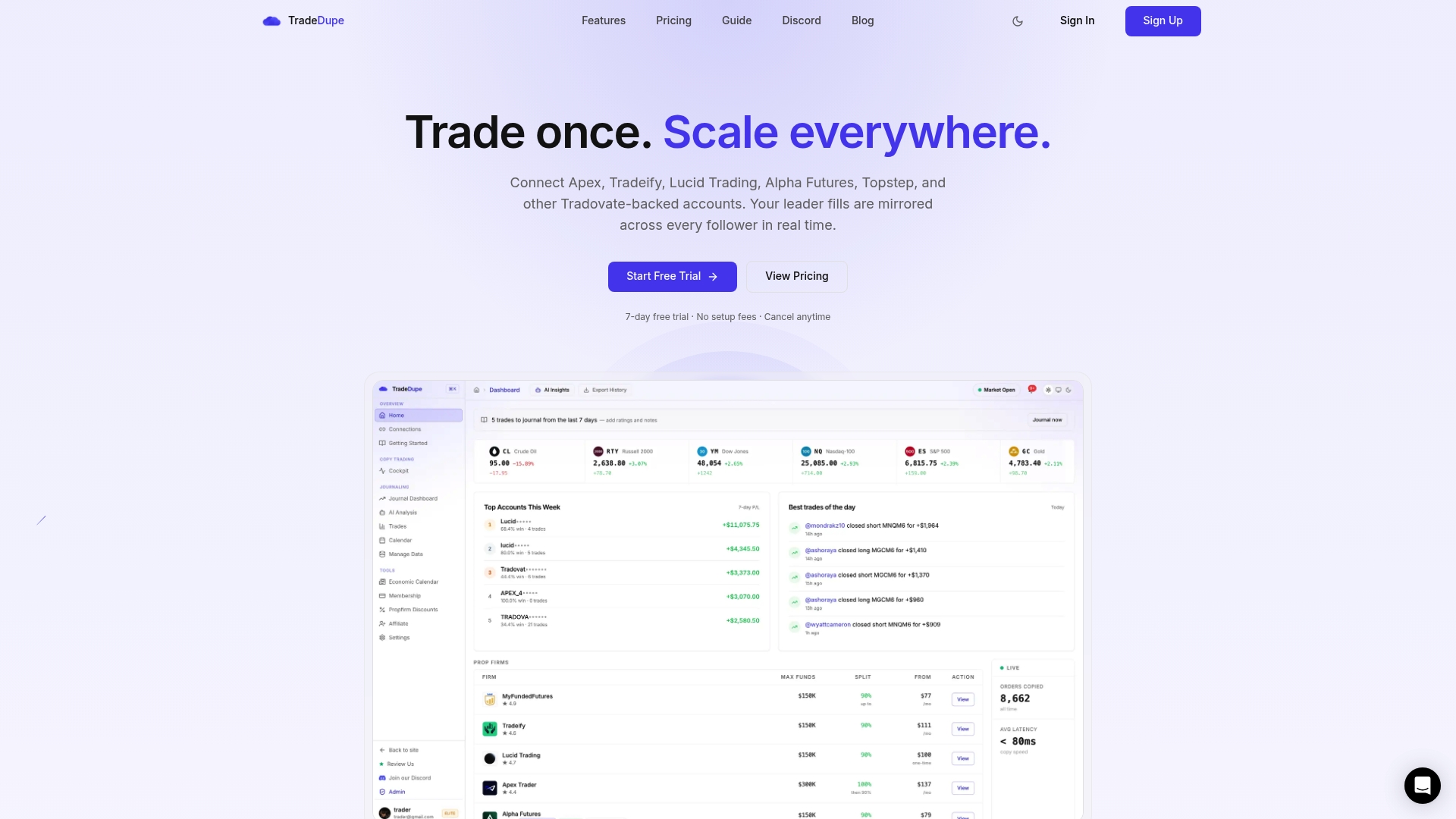
The platform mirrors trades server-side at a median 34ms latency, enforces per-account risk controls, and recovers automatically from connectivity interruptions. Setup takes minutes, not months. Supported prop firm integrations include Apex, Tradeify, Lucid Trading, and Alpha Futures, covering the accounts most U.S. prop desks actually operate.
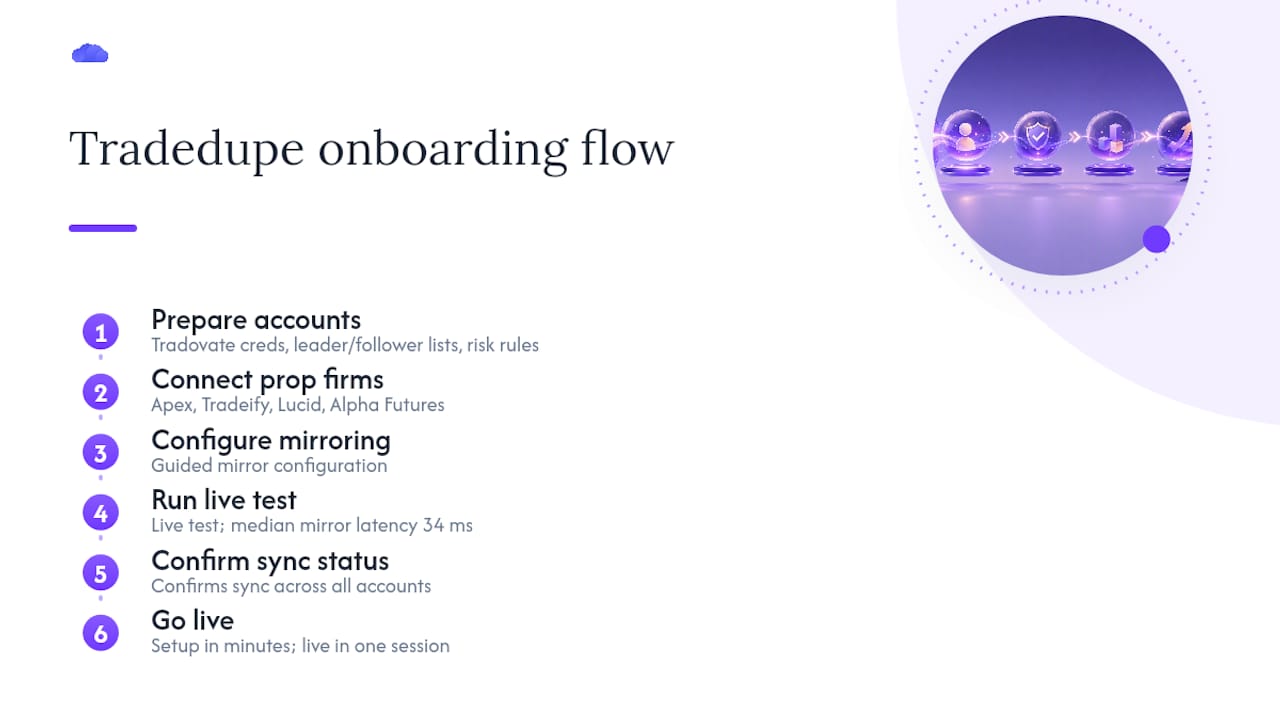
To get started, prepare your Tradovate credentials, a list of your leader and follower accounts, and your desired risk rules per account. Tradedupe's onboarding flow walks you through the mirror configuration, runs a live test with sample orders, and confirms sync status across all accounts before you go live. Most desks are fully operational within a single session.
Start your free trial at Tradedupe and see how quickly your Tradovate accounts can be mirrored and monitored in one dashboard.
*
Primary sources and further reading
The following vendor pages and authoritative resources were used in preparing this comparison. Verify all vendor claims directly before procurement.
- FlexTRADER Execution Management System (FlexTrade) — EMS product documentation, API specs, and FlexTCA details
- LSEG TORA Multi-Asset Trading (LSEG) — OEMS product page, broker connectivity claims, and FIX/WebSocket API documentation
- Enfusion by Clearwater (Enfusion) — Front-to-back platform documentation, compliance features, and connectivity specs
- Bloomberg Terminal (Bloomberg Professional) — Terminal product overview and analytics capabilities
- TradeSmart EMS (TS Imagine) — Cloud-first EMS/OEMS product page, fixed-income volume growth claim (vendor-reported)
- TraderEvolution Prop Trading Platform — Market Emulator, server-side risk enforcement, and BackOffice REST API documentation
- YourPropFirm (Quant Technology) — Prop firm operating system, challenge management, and risk engine documentation
- Moxy Trade Order Management System (Advent) — OMS product documentation, maker/checker workflows, and settlement integration
- Tradedupe Tradovate Copy Trading — Product documentation, mirroring architecture, and analytics dashboard
- Tradedupe Futures Trade Copier — Implementation guide and supported prop firm integrations
- Best Trade Copier for Prop Firms (TradeDupe Blog) — Buyer's guide and platform comparison for copy-trading infrastructure
- Best Charting Platform for Active Traders (BigMoveAlgo) — Independent perspective on charting tools and front-end UX considerations
This article is general information, not a substitute for advice from a qualified financial advisor. Consult a qualified financial professional about your own circumstances before acting on anything here.
Sources
- LSEG TORA multi-asset trading (LSEG)
- Enfusion by Clearwater (Enfusion product page mirror)
- Prop Trading Platform — TraderEvolution
- Moxy | Seamless Trade Order Management System (Advent)
- YourPropFirm — Prop Firm Operating System (Quant Technology)