
Trade Rule Enforcement for Prop Firms: 2026 Guide
TradeDupe
10 min read
Discover what is trade rule enforcement for prop firms and how understanding it can protect your capital and improve your trading success.
Trade rule enforcement for prop firms is defined as the automated, continuous application of firm-specific trading regulations covering drawdown limits, consistency requirements, trade timing restrictions, and position rules to protect capital and maintain compliance. The industry term for this practice is prop firm risk management enforcement, and it operates as the operational backbone of every funded account program. Industry data shows that 80–90% of prop firm accounts fail during evaluation primarily due to rule misunderstandings rather than poor trading strategy. That figure reveals a critical gap: traders often lose funded accounts not because they cannot trade, but because they do not fully understand how enforcement works. Knowing what is trade rule enforcement for prop firms gives you a direct operational advantage.
What types of trade rules do prop firms enforce and why?
Prop firm trading rules fall into two broad categories: capital protection rules and behavioral consistency rules. Capital protection rules set hard limits on how much a trader can lose. Behavioral rules govern how profits are generated to prevent firms from funding erratic or unsustainable trading patterns.
The most common rules enforced across futures prop firms include:
- Daily loss limit: The maximum drawdown allowed within a single trading session. Breaching this triggers immediate account action.
- Trailing drawdown: A moving floor that rises with your account equity high-water mark. 70% of futures prop firms use end-of-day trailing drawdown as their primary capital protection mechanism.
- Consistency rule: Prevents traders from passing an evaluation by generating all profits in a single session. 80% of futures prop firms enforce this rule, requiring profit distribution across multiple trading days. You can review how specific firms apply this in the prop firm consistency rule guide.
- News event trading ban: Prohibits opening or holding positions during major scheduled economic releases such as Non-Farm Payrolls or FOMC announcements.
- Inactivity clause: Terminates funded accounts after a defined period of no trading activity.
- Maximum position size: Caps the number of contracts or lots a trader can hold simultaneously.
The distinction between breach types matters enormously for operational outcomes. Hard breaches such as exceeding the maximum daily loss result in immediate account termination. Soft breaches such as consistency violations typically trigger alerts or a probationary period before termination. Understanding this escalation structure helps traders and risk managers prioritize which rules require the tightest monitoring.
Pro Tip: Read your firm's rule documentation specifically for whether trailing drawdown is calculated on end-of-day equity or intraday unrealized equity. The difference can cost you a funded account on a day your P&L never went negative at close.
How do prop firms enforce trade rules using technology and automation?
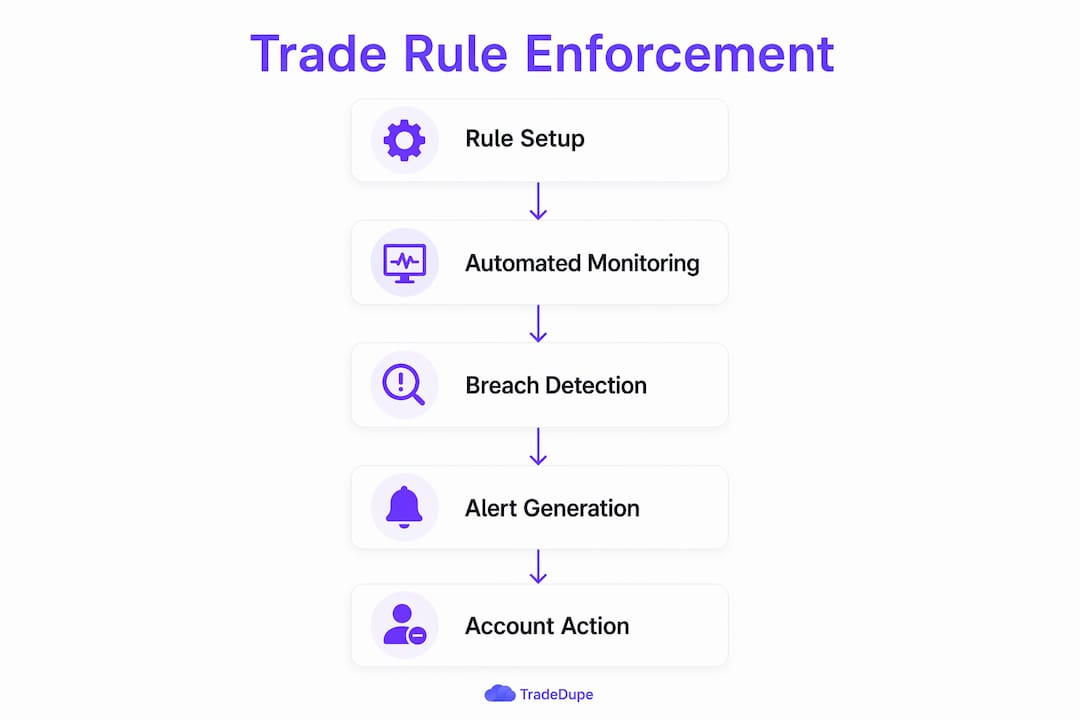
The real-time risk engine is the nervous system of any prop firm's enforcement infrastructure. It runs continuous evaluation loops at sub-millisecond latency, checking every price tick against each account's rule parameters. Risk engines evaluate every price tick to prevent slippage in enforcement, ensuring real-time risk control at scale. That level of speed is not a luxury. It is a technical requirement for firms managing thousands of accounts simultaneously.
> "Automation of the risk engine is essential. Human enforcement at scale leads to fatal delays and inconsistent application." This principle, now standard across institutional prop desks, explains why manual oversight alone cannot sustain a funded account program beyond a small number of traders.
Manual enforcement creates three specific failure points. First, it produces inconsistent rule application across accounts because human reviewers interpret edge cases differently. Second, it misses fraud patterns that automated systems detect through statistical anomaly detection. Third, it reacts to breaches after the fact rather than preventing them in real time. Automation ensures uniform, instant enforcement where manual processes consistently fall short.
Modern prop firm infrastructure integrates the risk engine with CRM systems, account management dashboards, and trade routing logic. CRM and risk system integration into a live, real-time infrastructure is becoming an industry standard for consistent rule enforcement at scale. This integration allows firms to trigger automated account actions, send trader notifications, and log enforcement events in a single workflow. Risk managers gain a complete audit trail without manual data entry.

Trade routing also plays a role in enforcement architecture. Firms use tiered booking models, running accounts through B-book simulation during evaluation and routing to A-book hedged execution after promotion. This structure manages firm risk exposure while maintaining consistent rule application across both phases. For risk managers, understanding this architecture clarifies why enforcement behavior can differ between evaluation and funded account stages.
What are the practical implications of enforcement for traders and risk managers?
Trailing drawdown mechanics cause more avoidable account closures than any other single rule. Trailing drawdown is often calculated on intraday unrealized profit, meaning a position that peaks at a gain and then reverses can trigger a breach even if it closes flat or positive. The high-water mark moves up with unrealized equity, not just closed P&L. Traders who do not account for this dynamic routinely lose accounts on days they believe they traded within limits.
The table below summarizes the most common enforcement pitfalls and their operational impact:
| Rule | Common Misunderstanding | Operational Impact |
|---|---|---|
| Trailing drawdown | Calculated on closed P&L only | Account terminated on intraday reversal |
| Consistency rule | One big day can pass evaluation | Evaluation reset or disqualification |
| Inactivity clause | Account stays active indefinitely | Silent termination without breach notice |
| News trading ban | Only applies to major U.S. releases | Breach on international data events |
| Daily loss limit | Resets at midnight local time | Breach due to timezone miscalculation |
Inactivity rules terminate funded accounts after no trading activity for a defined period, often without any notification that resembles a classic rule breach. This is the silent account killer in funded programs. Traders who take extended breaks without checking their firm's inactivity policy lose accounts they believe are still active.
For risk managers, the practical priority is monitoring account heartbeat metrics alongside standard P&L and drawdown data. Tracking inactivity metrics prevents silent account terminations that affect funded account retention rates without appearing in standard breach reports. Integrating this data into a centralized dashboard gives risk managers a complete picture of account health. You can see how copy trade systems improve this monitoring workflow in practice.
Pro Tip: If you manage multiple funded accounts, map each firm's inactivity threshold to a calendar reminder. A single missed trading week can terminate an account that took months to pass evaluation.
How do prop firms integrate enforcement with compliance and regulatory requirements?
Regulatory compliance and trade rule enforcement are not separate functions. They are the same infrastructure viewed from different angles. CFTC and FCA regulators require documented, automated enforcement practices to prove objectivity and compliance, preventing conflicts of interest. A firm that enforces rules inconsistently or manually cannot demonstrate to regulators that its policies are applied fairly across all accounts.
Automated enforcement satisfies regulatory requirements in three specific ways:
- Documented audit trails: Every enforcement action is timestamped and logged, creating a defensible record of policy application.
- Objective rule application: Automated systems apply the same parameters to every account without human discretion, eliminating the appearance of selective enforcement.
- Fraud pattern detection: Risk engines identify statistical anomalies such as coordinated trading across accounts, which manual review routinely misses.
Compliance is about clear, defensible operational policies documented and implemented through automation, not just P&L monitoring. This distinction matters for risk managers building enforcement infrastructure. A firm that monitors profits but cannot produce an enforcement log for a specific account on a specific date has a compliance gap, regardless of how well its traders perform.
Institutional trust also depends on enforcement consistency. Prime brokers, liquidity providers, and institutional partners evaluate prop firms partly on the quality of their risk controls. A firm with a documented, automated enforcement system signals operational maturity. That signal affects the firm's ability to access better execution terms and capital partnerships. For risk managers, this means enforcement infrastructure is a business development asset, not just a compliance cost. Understanding how trade reporting works is the natural complement to building this infrastructure.
Key Takeaways
Effective trade rule enforcement for prop firms requires automated risk engines, documented audit trails, and trader-level understanding of rule mechanics to protect capital and maintain regulatory compliance.
| Point | Details |
|---|---|
| Enforcement is automated | Real-time risk engines apply rules at sub-millisecond speed across all accounts simultaneously. |
| Breach types determine consequences | Hard breaches trigger immediate termination; soft breaches trigger alerts or probation periods. |
| Trailing drawdown is intraday | Unrealized equity moves the high-water mark, causing breaches even when closed P&L is flat. |
| Inactivity terminates accounts silently | Funded accounts close without a classic breach if traders exceed the firm's inactivity threshold. |
| Regulatory compliance requires automation | CFTC and FCA require documented, objective enforcement records that only automated systems reliably produce. |
Why enforcement consistency is the real competitive edge in 2026
The firms that survive long-term in the prop space are not the ones with the most generous drawdown limits. They are the ones with the most consistent enforcement. I have watched firms with attractive rule sets collapse operationally because their enforcement was manual, inconsistent, and impossible to audit. Traders lost accounts on rules that were applied differently across support agents. Regulators flagged inconsistencies. Institutional partners walked away.
What I find most underappreciated in 2026 is that enforcement consistency is a trust signal to traders, not just a risk control for firms. When a trader knows exactly how a rule will be applied, they can build a strategy around it. When enforcement is unpredictable, even skilled traders cannot manage their accounts effectively. The firms that publish clear rule documentation and back it with automated, auditable enforcement attract better traders and retain them longer.
For risk managers, the priority right now is not finding more rules to enforce. It is making existing enforcement infrastructure auditable and integrated. If your risk engine cannot produce a timestamped log of every enforcement action for a specific account, you have a gap that will surface in a regulatory review or a trader dispute. Fix that before adding new rule categories.
For traders, the single most valuable skill in 2026 is rule literacy. Read the full terms of your funded account program, including the inactivity clause and the exact trailing drawdown calculation method. Most evaluation failures are preventable. The practical playbook for passing funded accounts starts with understanding enforcement mechanics, not refining entry signals.
> — Andres
How Tradedupe supports real-time enforcement across prop accounts
Prop firms and traders managing multiple funded accounts need enforcement visibility at the account level, not just the portfolio level. Tradedupe is built for exactly that operational context.
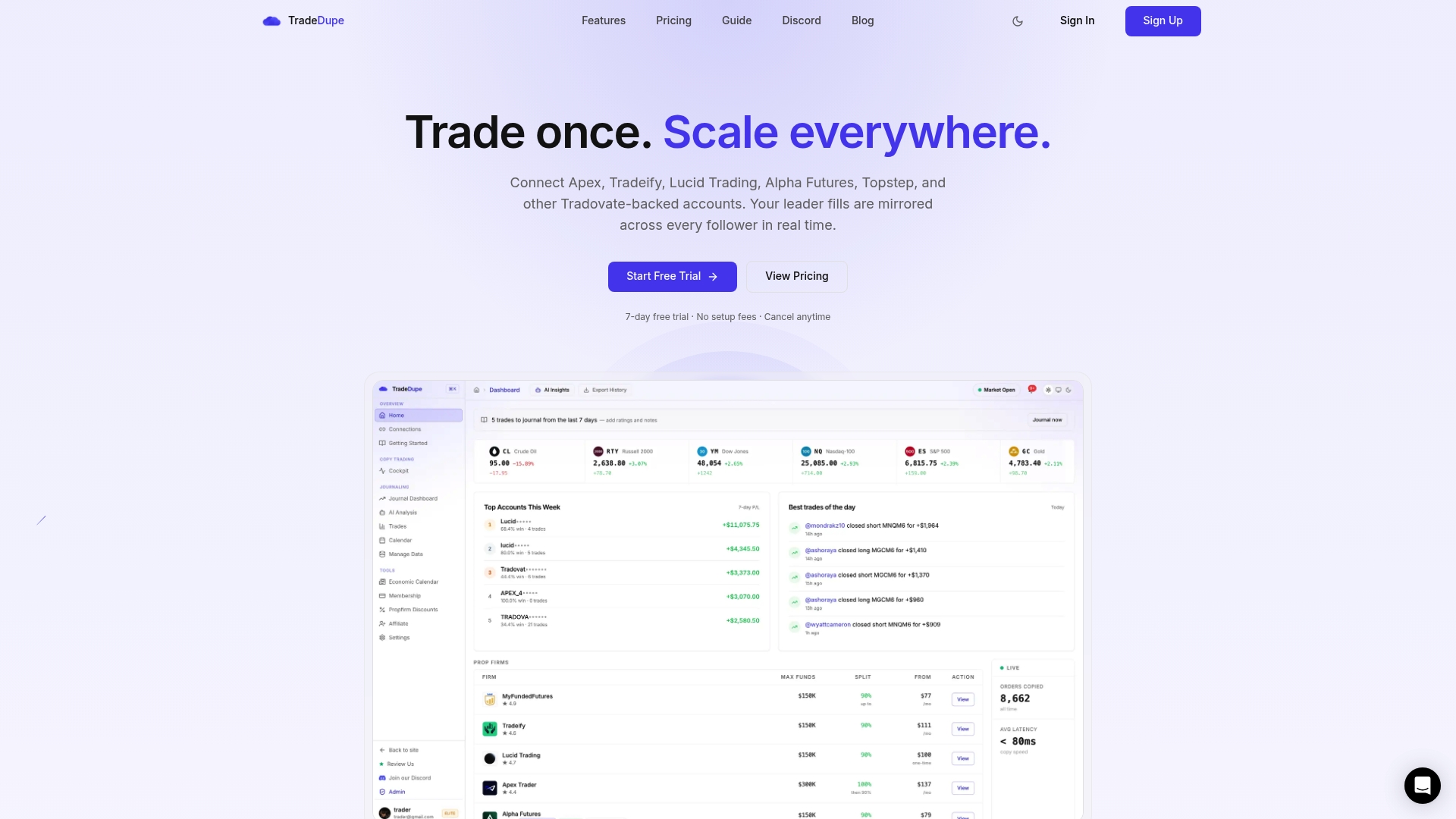
Tradedupe mirrors trades from a single lead account to multiple follower accounts on Tradovate with a median latency of 34ms. The platform includes rogue-trade detection, auto-recovery, and per-account toggle controls that give risk managers direct enforcement oversight across accounts on Apex, Tradeify, Lucid Trading, and Alpha Futures. Every sync event is logged, giving you the audit trail that compliance requires. Risk managers can monitor leader and follower activity in real time through a centralized dashboard. Start your account sync to see how Tradedupe fits your enforcement workflow, or visit tradedupe.com to review plan options for your desk size.
FAQ
What is trade rule enforcement for prop firms?
Trade rule enforcement for prop firms is the automated application of firm-specific trading regulations, including drawdown limits, consistency rules, and position restrictions, to protect capital and maintain compliance across all funded accounts.
Why do most traders fail prop firm evaluations?
80–90% of prop firm evaluation failures result from rule misunderstandings rather than poor trading strategy, with trailing drawdown mechanics and consistency rules being the most commonly misunderstood.
What is the difference between a hard breach and a soft breach?
A hard breach such as exceeding the maximum daily loss triggers immediate account termination, while a soft breach such as a consistency violation typically results in an alert or probationary period.
How does trailing drawdown enforcement work in practice?
Trailing drawdown is calculated on intraday unrealized equity, meaning the high-water mark rises with open position gains. A position that peaks and reverses can trigger a breach even if it closes at breakeven.
What do regulators require from prop firm enforcement systems?
The CFTC and FCA require documented, automated enforcement practices that produce objective, auditable records of rule application, preventing conflicts of interest and demonstrating consistent policy implementation across all accounts.