

Tradeify Consistency Rule: Prop Trader's 2026 Guide
TradeDupe
9 min read
Discover the Tradeify consistency rule in 2026 and learn how it impacts your payouts. Ensure smooth withdrawals with expert insights.
The Tradeify consistency rule is defined as a cap that limits how much of your total account profit can come from a single trading day at payout time. No single day's profit can exceed a set percentage of your total accumulated profit when you submit a payout request. This rule applies across most Tradeify account types, with thresholds ranging from 20% to 35% depending on your account tier. For prop traders managing multiple funded accounts, understanding this rule is the difference between a clean payout and a blocked withdrawal.
How does the Tradeify consistency rule work across account types?
The rule formula is straightforward: Best Day Profit divided by Total Account Profit must be less than or equal to the applicable percentage threshold. If your best single day was $1,000 and your rule threshold is 20%, your total account profit must be at least $5,000 before you can request a payout. That math forces you to build a base of steady gains rather than riding one outsized trade to a withdrawal.
Thresholds vary significantly by account type:
- Lightning accounts start at a 20% cap. After your first payout, the threshold relaxes to 25%. After your second payout, it moves to 30%.
- Growth Sim accounts carry a fixed 35% threshold throughout.
- Select Flex and Daily funded accounts have no consistency rule at all.
The progressive structure for Lightning accounts is deliberate. Tradeify rewards traders who demonstrate reliability over time by loosening the constraint after each successful payout cycle. This design treats the rule as a probationary measure, not a permanent restriction.
Breaching the rule does not terminate your account. A soft breach means your funds remain intact, but payout requests are blocked until you restore compliance by accumulating more total profit. You can keep trading. You simply cannot withdraw until the ratio falls back within the allowed threshold.

Pro Tip: Track your best day profit and total profit in a spreadsheet after every session. Knowing your current ratio in real time prevents surprises when you go to request a payout.
How does Tradeify's consistency rule compare to other futures prop firms?
Tradeify's 20–35% range is stricter than most competitors in the futures prop firm space. Most futures prop firms set consistency caps between 25% and 50%, and many of the largest names sit at the higher end of that band.
| Firm | Consistency Rule Cap |
|---|---|
| Tradeify (Lightning) | 20% → 25% → 30% (progressive) |
| Tradeify (Growth Sim) | 35% |
| Apex Trader Funding | ~50% |
| MyFundedFutures | ~50% |
| Topstep | ~50% |
| TradeDay | ~30% |
| Earn2Trade | ~30% |
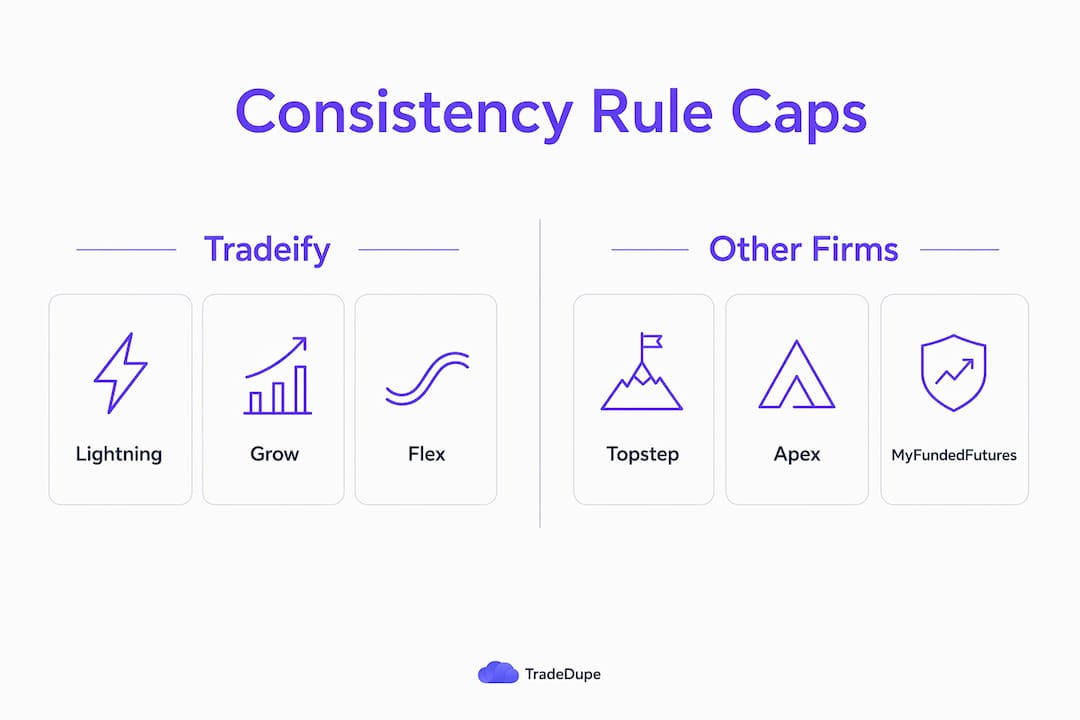
The practical implication is significant. A 50% cap at Apex or Topstep means a single day can represent half your total profit at payout. Tradeify's 20% starting cap on Lightning accounts requires five times as much total profit relative to your best day. That is a materially higher bar.
Tradeify aligns more closely with TradeDay and Earn2Trade, both of which enforce 30% caps. Traders who prefer less restrictive environments often gravitate toward firms with 50% thresholds or accounts with no rule at all. Tradeify's own Select funded accounts fall into that no-rule category, giving experienced traders a path to fewer constraints within the same firm.
- Stricter caps force more total trading days to build a compliant profit base.
- More lenient caps allow faster payout cycles but may encourage riskier single-day behavior.
- No-rule accounts shift the discipline burden entirely to the trader.
For a full industry comparison of consistency caps across Topstep, Apex, Tradeify, and MyFundedFutures, the differences in threshold design reveal how each firm thinks about risk at the payout stage.
Why does Tradeify implement the consistency rule?
The consistency rule exists to enforce repeatable trading behavior, not to punish profitable days. A trader who earns $4,000 in one session and $200 across the next ten days is not demonstrating a reliable edge. Tradeify's rule promotes steady growth by making outlier days structurally less valuable at payout time.
The risk management logic is sound from the firm's perspective:
- Outlier trades inflate perceived performance. A single lucky session in a volatile market does not prove a trader can manage risk consistently.
- Funded account longevity improves with steady returns. Traders who build profit incrementally are less likely to blow accounts in drawdown.
- The rule filters for process, not luck. Consistent incremental profit is harder to fake than one large win.
> "The consistency rule pushes traders to focus on incremental profit instead of relying on outlier trades." — Tradeify
The rule also functions as a probationary signal. Newer Lightning accounts face the tightest 20% cap. As those traders prove themselves through successful payouts, the threshold relaxes. Experienced traders on Select funded accounts face no rule at all. That progression reflects a firm building trust with traders over time, not applying a one-size-fits-all restriction indefinitely.
Understanding this design intent changes how you approach the rule. It is not an obstacle to route around. It is a framework that rewards the kind of consistent trading habits that sustain funded accounts long term.
How can traders plan around the Tradeify consistency rule?
The consistency rule applies at payout time, which means the ratio is dynamic and manageable. You do not need to avoid big days. You need to build enough total profit to keep any big day within the threshold. That distinction changes your planning entirely.
A practical compliance workflow looks like this:
- Record your best single day profit after every session. This is your binding constraint for the next payout request.
- Calculate the required total profit. Divide your best day profit by the applicable threshold percentage. A $2,000 best day on a 25% rule requires $8,000 total profit.
- Set a payout target, not a payout date. Request withdrawal only when your total profit clears the required threshold, not on a fixed calendar schedule.
- After a large day, shift to smaller position sizes. Building steady gains dilutes the ratio faster than taking on more risk to chase a bigger total.
- Monitor rule progression. If you are on a Lightning account, your threshold improves after each successful payout. Factor that into your planning horizon.
Pro Tip: Tradeify's own consistency rule calculator lets you input your best day and total profit to see exactly how far you are from compliance. Use it before every payout request, not after.
The soft breach design actually works in your favor here. Because a breach does not cost you the account, you have room to trade through a compliance gap. The goal is to accumulate enough additional profit to bring the ratio back within range. Smaller, consistent gains after a large day accomplish this faster than sitting idle or taking on oversized risk.
For traders running multiple Tradeify accounts simultaneously, the ratio on each account is independent. A big day on one account does not affect another. Managing prop firm rules across multiple accounts requires tracking each account's best day and total profit separately, which is where synchronized trade copying tools become operationally relevant.
Key Takeaways
The Tradeify consistency rule is a payout-time ratio check, not a real-time trading restriction, and managing it requires deliberate profit scaling rather than avoiding large days entirely.
| Point | Details |
|---|---|
| Rule formula | Best Day Profit divided by Total Profit must stay at or below the threshold percentage. |
| Account thresholds vary | Lightning starts at 20% and relaxes to 30% over payouts; Growth Sim holds at 35%; Select accounts have no rule. |
| Soft breach protection | A breach blocks payouts but does not close the account; keep trading to restore compliance. |
| Stricter than most peers | Tradeify's 20–35% range is tighter than Apex, Topstep, and MyFundedFutures, which commonly cap at 50%. |
| Plan around payouts | Use the consistency calculator before requesting withdrawal and scale down position size after large days. |
The consistency rule is a planning tool, not just a constraint
My view on the Tradeify consistency rule has shifted over time. Early on, I treated it as a penalty for good days. That framing is wrong, and it leads to bad decisions like avoiding high-conviction setups because you are worried about skewing the ratio.
The more useful mental model is to treat the rule as a payout planning variable. Your best day is a fixed number once it happens. Everything after that is about building the denominator. Knowing that, you can trade your normal process and simply adjust your payout timing based on where the ratio sits.
What I find most underappreciated is the account progression structure on Lightning accounts. Moving from 20% to 25% to 30% after each payout is a meaningful improvement in flexibility. Traders who rush their first payout before they have built a strong profit base often find themselves stuck at 20% longer than necessary. Patience in the early phase pays off structurally.
For traders running synchronized strategies across multiple Tradeify accounts, the per-account independence of the ratio is actually an advantage. A strong day on one account does not contaminate the others. That makes copy trading setups particularly well-suited to this rule structure, since each mirrored account builds its own compliant profit base independently.
The traders I have seen struggle most with this rule are those who treat every trading day as isolated. The consistency rule rewards a portfolio view of your performance across time. Build the base, manage the ratio, and the payouts follow.
> — Andres
Tradedupe and the Tradeify consistency rule: a natural fit
Managing the Tradeify consistency rule across multiple funded accounts is an operational challenge. Each account carries its own ratio, its own best day, and its own payout timeline.
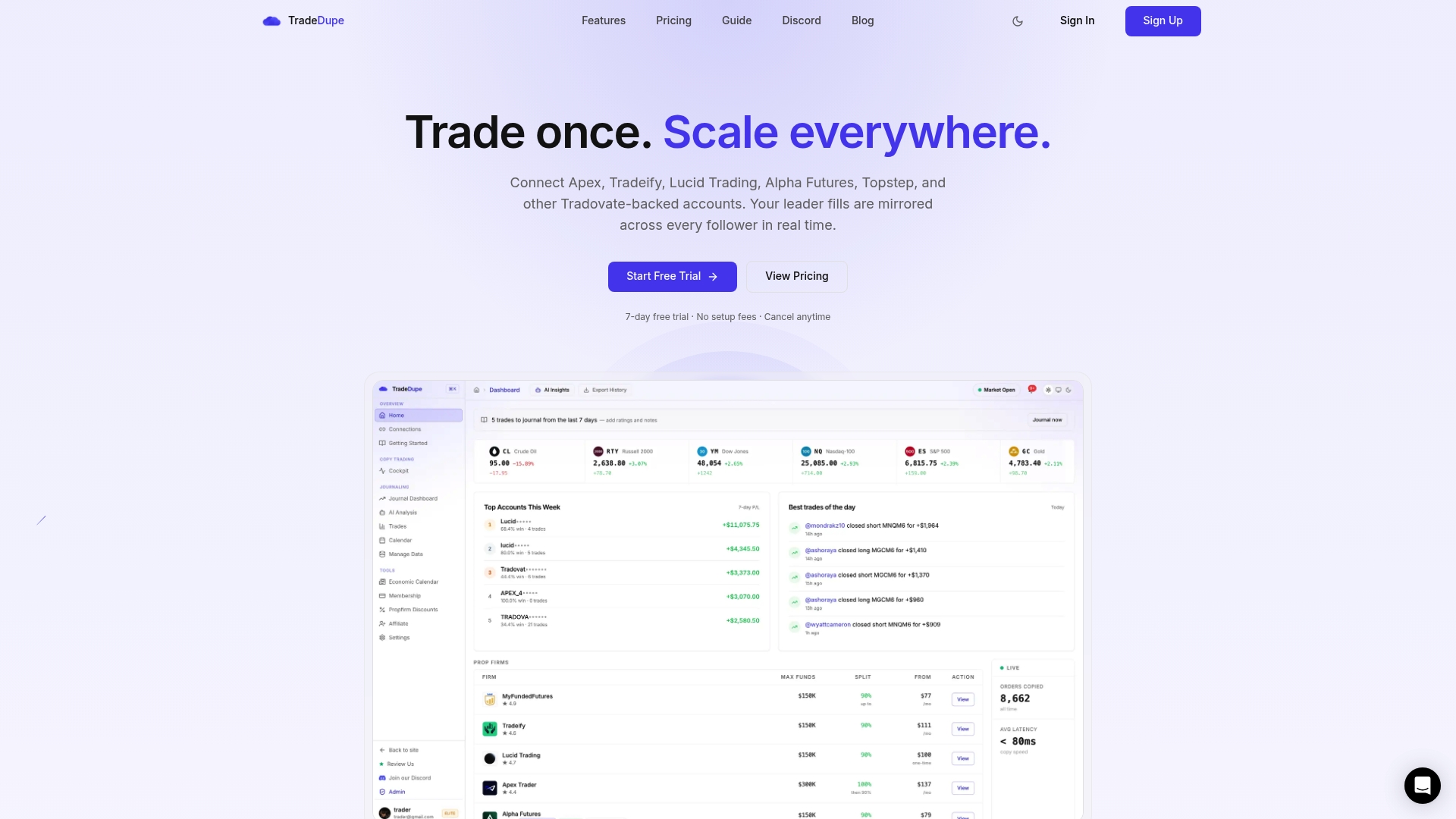
Tradedupe is built for exactly this environment. The platform mirrors trades from a single lead account across multiple Tradeify accounts on Tradovate with a median latency of 34ms. Every follower account builds its own profit history independently, which means each account's consistency ratio develops on its own track. Tradedupe's real-time dashboard lets you monitor sync status, account-level performance, and payout readiness across your entire prop desk from one screen. For traders who want to get started with synchronized copy trading across Tradeify accounts, the setup takes under ten minutes.
FAQ
What is the Tradeify consistency rule?
The Tradeify consistency rule caps how much of your total account profit can come from a single trading day at payout time. The threshold ranges from 20% to 35% depending on your account type.
Does breaching the consistency rule close my Tradeify account?
No. A breach is a soft restriction that blocks payout requests but leaves your account active. You restore compliance by accumulating additional profit to bring the ratio back within the threshold.
Which Tradeify accounts have no consistency rule?
Select Flex and Daily funded accounts carry no consistency rule. These accounts are designed for experienced traders and remove the payout ratio requirement entirely.
How do I calculate whether I meet the consistency rule?
Divide your best single day profit by your total account profit. If that number is less than or equal to your applicable threshold (20%, 25%, 30%, or 35%), you are eligible to request a payout.
How does Tradeify's consistency rule compare to Apex or Topstep?
Tradeify's 20–35% range is stricter than Apex Trader Funding and Topstep, which commonly set their caps at 50%. Tradeify aligns more closely with TradeDay and Earn2Trade, both of which enforce approximately 30% caps.
Recommended
- Prop Firm Consistency Rule Guide (2026): Topstep, Apex, Tradeify, MFFU Rules Explained | TradeDupe Blog
- Prop Firms With No Consistency Rule (2026): The Honest List
- How to Trade Prop Firms (2026): A Practical Playbook to Pass and Keep a Funded Account | TradeDupe Blog
- How Trade Reporting Works for Prop Traders in 2026 | TradeDupe Blog