Multi-Account Trade Management: A 2026 Guide for U.S. Traders
TradeDupe
8 min read
Discover what multi-account trade management is and how it empowers U.S. traders to execute trades efficiently across multiple accounts seamlessly.
Multi-account trade management is the practice of executing and allocating trades across multiple brokerage accounts simultaneously from a single master interface, using specialized software to distribute orders automatically and fairly. A trader places one master order, and the system instantly splits it across every linked sub-account according to pre-defined allocation rules, so every account receives the same execution price at the same moment. This eliminates the manual, account-by-account workflow that creates price slippage, operational errors, and unequal fills.
The core use cases span three distinct trader profiles:
- Registered Investment Advisors (RIAs) managing dozens or hundreds of client portfolios who need uniform execution across all accounts
- Individual traders running separate accounts for different strategies, such as a day-trading account alongside a long-term IRA
- Prop firm traders scaling buying power across multiple funded accounts with firms like Apex Trader Funding, where consistent execution across accounts is operationally critical
Platforms like Tradedupe, operating within the Tradovate ecosystem, and prop firm programs like Apex Trader Funding represent the modern infrastructure that makes this workflow practical at scale.
What is multi-account trade management: MAM vs. PAMM architectures
The two dominant software architectures powering multi-account management are MAM and PAMM, each with meaningfully different allocation logic.
MAM (Multi-Account Manager) allocates trades with flexibility. A manager can assign different leverage ratios or lot sizes to individual sub-accounts, accommodate varying risk tolerances, and even separate personal capital from the master pool. If one client carries higher risk appetite, their account can receive proportionally larger exposure without affecting others.
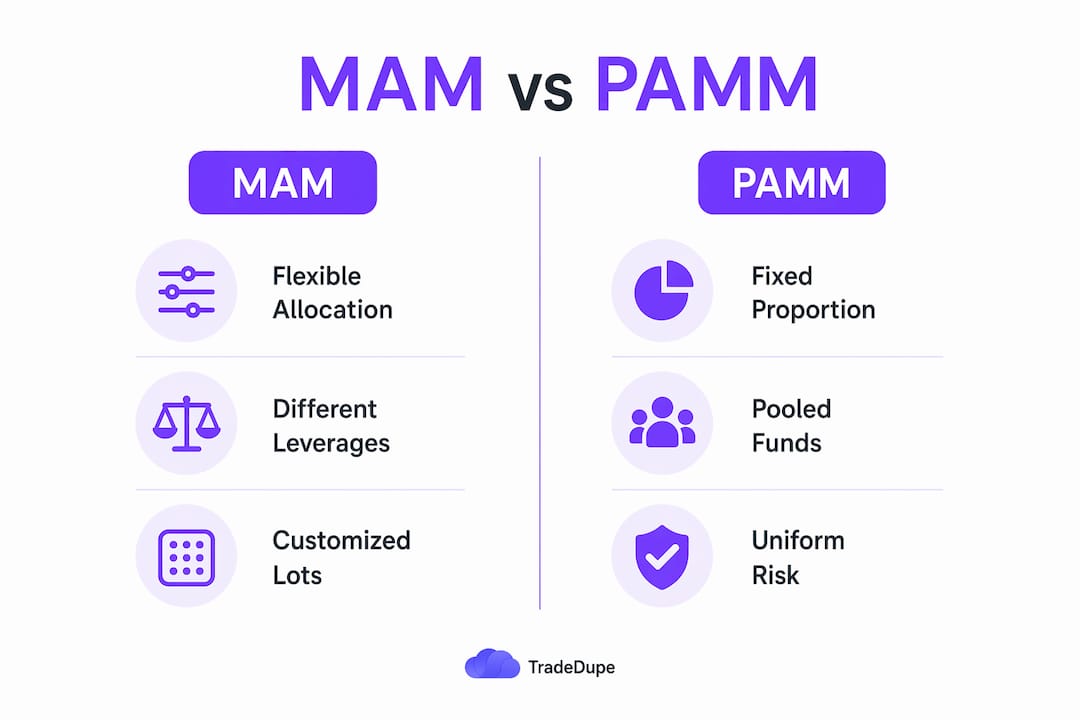
PAMM (Percentage Allocation Management Module) works strictly by proportion. Each sub-account holds a fixed ratio relative to the master account, calculated from its deposit size. You cannot assign different leverages per account, and you cannot separate your own funds from the master. PAMM suits managers who want pure proportional fairness with no discretionary overrides.
The practical difference: MAM fits professional managers with clients at different risk levels; PAMM fits pooled-fund structures where every participant shares identical exposure ratios.
Operational discipline and risk management in multi-account trading
Multi-account management shifts focus from logistics to operational discipline. The efficiency gain is real, but so is the amplified downside: a single error in a master account replicates instantly across every sub-account, multiplying losses before you can intervene.
Effective risk controls include:
- Aggregated exposure sizing: treat all accounts as one combined position. If you are trading two contracts on the same instrument across three accounts, your real exposure is six contracts.
- Per-account drawdown logs: prop firms like Apex Trader Funding use trailing drawdown structures with daily loss limits that differ by firm. Misreading one firm's rules while managing multiple accounts simultaneously is how traders blow funded accounts they spent weeks building.
- Pre-trade error checks: validate order size, direction, and account eligibility before execution, not after.
- Session isolation: run each account in a separate browser profile or virtual environment to prevent credential cross-contamination and broker detection.
Pro Tip: Maintain a written one-page document per account that lists the exact drawdown rules, daily loss limit, trailing stop structure, and any consistency requirements. Review it before the trading session opens, not after a loss.
U.S. regulatory environment for managing multiple accounts
The legal line in U.S. multi-account management runs between trading your own sub-accounts and managing money for others. Crossing it without proper licensing carries real penalties. Managing accounts for others for a fee typically requires professional registration, most commonly the Series 65 license, which qualifies you as an Investment Adviser Representative under state law.
Key compliance considerations:
- Personal sub-accounts: no special license required to trade multiple accounts containing only your own capital
- Client funds: managing third-party money for compensation triggers SEC or state registration requirements depending on assets under management
- Broker policies: many brokers prohibit multiple accounts per user and actively detect violations via device fingerprinting and IP tracking
- Audit obligations: professional managers face reporting requirements and must demonstrate that trade allocation is fair and non-preferential, with no cherry-picking of fills
Running isolated browser profiles per account is the standard practice among professional prop traders to maintain IP separation and pass broker compliance checks.
How Tradedupe handles real-time multi-account execution
Tradedupe is built specifically for prop traders operating within the Tradovate ecosystem. Its core function is real-time trade mirroring with a median latency of 34ms, meaning follower accounts receive fills within fractions of a second of the leader account's execution.
| Feature | Details |
|---|---|
| Trade mirroring latency | Median 34ms |
| Rogue-trade detection | Automatic flagging of anomalous orders before propagation |
| Auto-recovery | Reconnects and resynchronizes follower accounts after disconnection |
| Per-account toggle controls | Enable or disable individual follower accounts without stopping the leader |
| Supported prop firm integrations | Apex Trader Funding, Tradeify, Lucid Trading, Alpha Futures |
| Dashboard monitoring | Real-time sync status, leader/follower activity, and risk metrics |
| AI-powered trade analysis | Pattern recognition and performance analytics across all accounts |
| Subscription tiers | Individual, small team, and enterprise prop desk plans |
The platform's Apex Trader Funding integration is particularly relevant for traders scaling across multiple evaluation and funded accounts simultaneously. Rogue-trade detection prevents a miskeyed order from propagating to every follower before the trader can react.

How portfolio management and CRM systems connect to multi-account workflows
Multi-account trading generates data across multiple accounts that must flow into a unified view to be useful. Portfolio management tools aggregate positions, P&L, and drawdown status across all accounts so traders can assess total exposure without manually reconciling separate dashboards.
CRM integration matters most for professional managers. When a manager handles client accounts, the CRM tracks client-specific allocation profiles, fee structures, and communication history. Connecting the CRM to the trading platform means that when a client's risk mandate changes, the allocation profile updates automatically rather than requiring a manual override mid-session. For prop traders without client relationships, a centralized journal or tracker that pulls data from all accounts serves the same consolidation function.
The order execution and allocation workflow, step by step
Understanding the mechanics clarifies why multi-account management produces fairer fills than manual account-by-account entry.
- Allocation profiles are set before trading begins. Each sub-account receives a defined rule: pro-rata by equity, fixed lot size, or custom percentage.
- The manager places a single master order. The broker treats this as a block trade, executing it as one unified transaction to minimize market impact.
- The software calculates distribution the moment the order fills. A sub-account representing 10% of total equity receives 10% of the filled quantity, calculated in real time.
- Every sub-account receives the same average execution price. No account gets a better fill because it was processed first in a queue.
- P&L tracking updates continuously. Performance fees and management fees calculate automatically per account, reducing administrative overhead.
This workflow eliminates sequence risk, where the first account in a manual entry queue gets a meaningfully different price than the last.
Performance tracking and reporting across multiple accounts
Consolidated reporting is where most multi-account setups break down. Without it, traders are manually reconciling P&L from separate dashboards, which delays risk decisions and obscures cross-account patterns. Tracking multiple accounts in one place requires a system that aggregates balance, drawdown status, and net exposure in real time.
Effective performance tracking covers:
- Aggregate metrics: total day P&L, net exposure across correlated positions, and win rate by account
- Drawdown proximity alerts: accounts within a defined threshold of their daily or trailing limit need attention before the next session
- Cross-account pattern analysis: if Tuesday morning trades are negative across every account, that is a strategy signal, not an account-specific anomaly
- Audit trail maintenance: a complete log of every order, allocation, and account state change supports regulatory compliance and internal review
Tradedupe's dashboard surfaces sync status, leader and follower activity, and risk metrics in one interface, reducing the time traders spend on administration.
Benefits and challenges of multi-account trade management
Benefits:
- Execution fairness: every account receives the same fill, eliminating preferential treatment
- Operational scale: one master order replaces dozens of manual entries
- Risk compartmentalization: a drawdown in one account does not directly contaminate capital in another
- Strategy separation: running a trend-following approach in one account and a mean-reversion scalp in another produces clean performance data per strategy
Challenges:
- Error amplification: a miskeyed master order propagates to every sub-account instantly, requiring strict pre-trade controls
- Cognitive load: monitoring multiple live positions across accounts degrades decision quality without proper automation and alerts
- Regulatory complexity: the line between personal sub-accounts and managed client funds is legally significant and easy to misread
- Correlated exposure: trading the same instrument across multiple accounts in the same direction multiplies real market exposure, not just account count
The traders who manage multiple accounts well are not doing more. They are running the same process more times with better systems and tighter controls.
*
Try Tradedupe for real-time multi-account execution
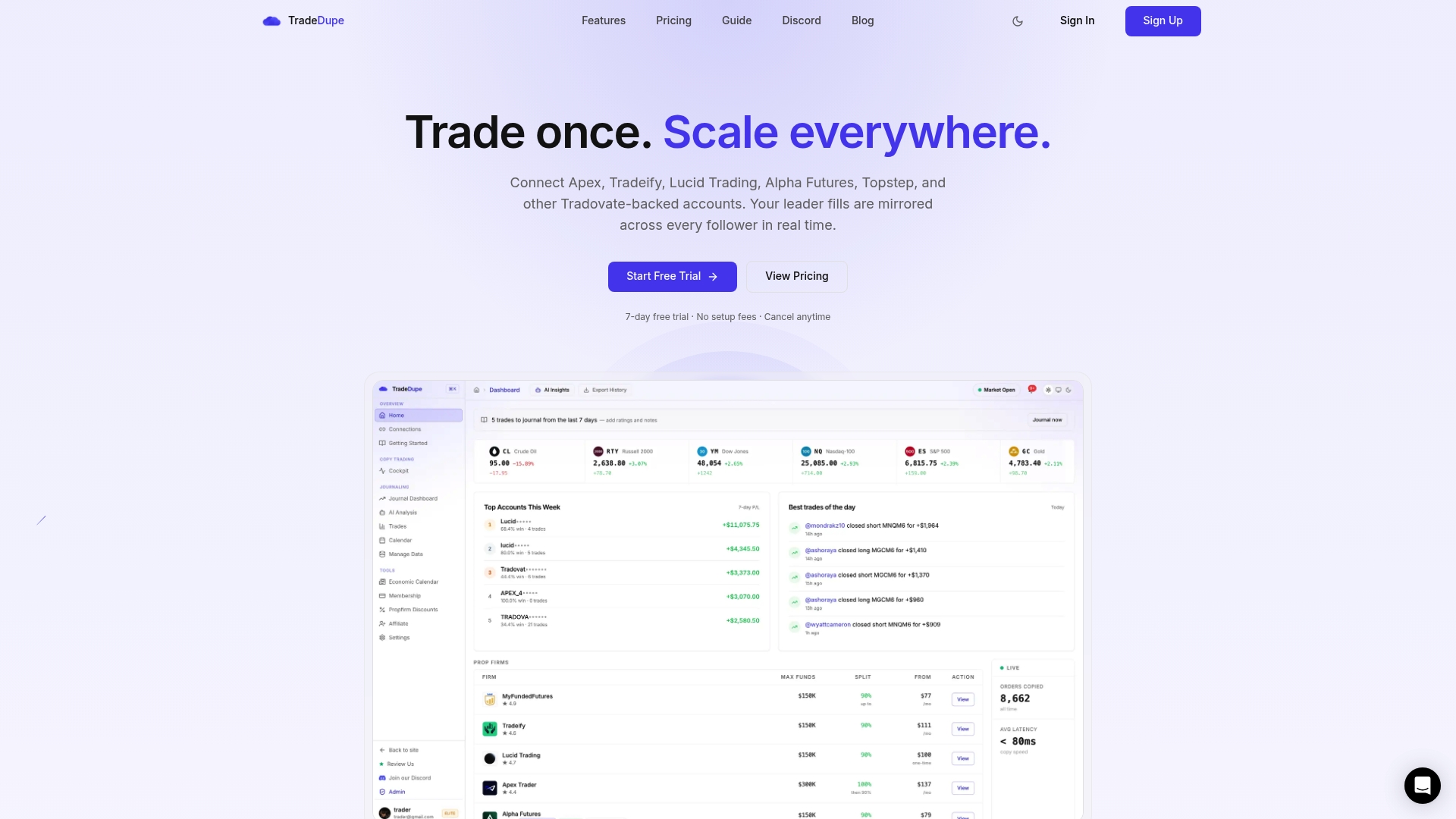
Tradedupe is purpose-built for prop traders who need reliable, low-latency trade mirroring across multiple Tradovate accounts. With 34ms median execution, rogue-trade detection, and native support for Apex Trader Funding, Tradeify, Lucid Trading, and Alpha Futures, it handles the operational complexity so you can focus on the trade. Start mirroring your accounts with Tradedupe's futures trade copier, or get set up in minutes on the main platform.
*
Key Takeaways
Multi-account trade management requires specialized software, strict pre-trade controls, and a clear understanding of U.S. licensing rules to execute fairly and scale without amplifying risk.
| Point | Details |
|---|---|
| MAM vs. PAMM architecture | MAM allows custom leverage per sub-account; PAMM allocates strictly by deposit percentage. |
| Error amplification risk | A single master account mistake replicates instantly across all sub-accounts, requiring pre-trade validation. |
| U.S. licensing threshold | Managing others' money for a fee typically requires Series 65 registration under state law. |
| Broker detection | Device fingerprinting and IP tracking are standard; isolated browser profiles per account are best practice. |
| Tradedupe latency | Tradedupe mirrors trades to follower accounts with a median latency of 34ms within the Tradovate ecosystem. |