

Why Individual Traders Open Multiple Accounts
TradeDupe
9 min read
Discover why individual traders open multiple accounts. Learn about strategy isolation, risk management, and how it can enhance your trading performance.
Multiple trading accounts are defined as two or more separate brokerage accounts operated by a single trader to isolate strategies, reduce counterparty risk, and protect capital. Understanding why individual traders open multiple accounts reveals a practice that goes well beyond simple diversification. Professional traders typically operate between 3 and 5 accounts to balance risk management with operational control. The reasons for multiple trading accounts range from strategy separation and broker redundancy to tax efficiency and prop firm compliance, each serving a distinct operational purpose.
Why individual traders open multiple accounts
The core reason traders split across accounts is strategy isolation. A scalping strategy and a swing trading strategy behave differently under stress. Running them in the same account makes it nearly impossible to track which approach is generating profit and which is creating drag on your P&L.
Separating experimental from conservative trades prevents a single bad position from wiping out capital reserved for income-oriented trading. This is not a theoretical benefit. A trader testing a new order flow setup in a live account alongside a proven futures strategy is exposing both to the same margin pool and the same emotional pressure.

The second major driver is counterparty risk mitigation. Brokers face technical outages, liquidity freezes, and in rare cases, insolvency. Spreading capital across 3–5 brokers eliminates the single point of failure that comes with concentrating everything at one firm. This is an operational risk management decision, not just an investment one.
Benefits of account diversification also extend to prop firm traders. Running evaluation accounts at Apex, Tradeify, or Lucid Trading alongside a personal funded account creates a natural separation between capital at risk during evaluation and capital already earned. That separation protects your funded status and keeps your risk parameters clean across each account type.
- Strategy separation: Scalping, swing trading, and experimental setups each get their own account and margin pool.
- Broker redundancy: If one platform goes down during a high-volatility session, your other accounts remain active.
- Prop firm compliance: Each evaluation or funded account carries its own drawdown rules, requiring strict isolation.
- P&L clarity: Clean per-account reporting makes it far easier to evaluate which strategies are worth scaling.
- Capital protection: Losses in one account cannot bleed into capital held elsewhere.
Pro Tip: Open a dedicated account for any new strategy you are testing. Fund it with a fixed amount you are willing to lose entirely. Never let test trades share margin with your primary income-generating account.
What challenges come with managing multiple accounts?
The benefits of account diversification come with real operational costs. Managing beyond five accounts manually creates execution errors, missed entries, and inconsistent position sizing. The cognitive load alone becomes a liability during fast-moving sessions.
Financial costs compound quickly. Scattering assets across too many firms means losing lower-fee breakpoints that come with consolidated account sizes. Commission structures at most brokers reward larger account balances with reduced per-contract fees. Fragmentation works against that.
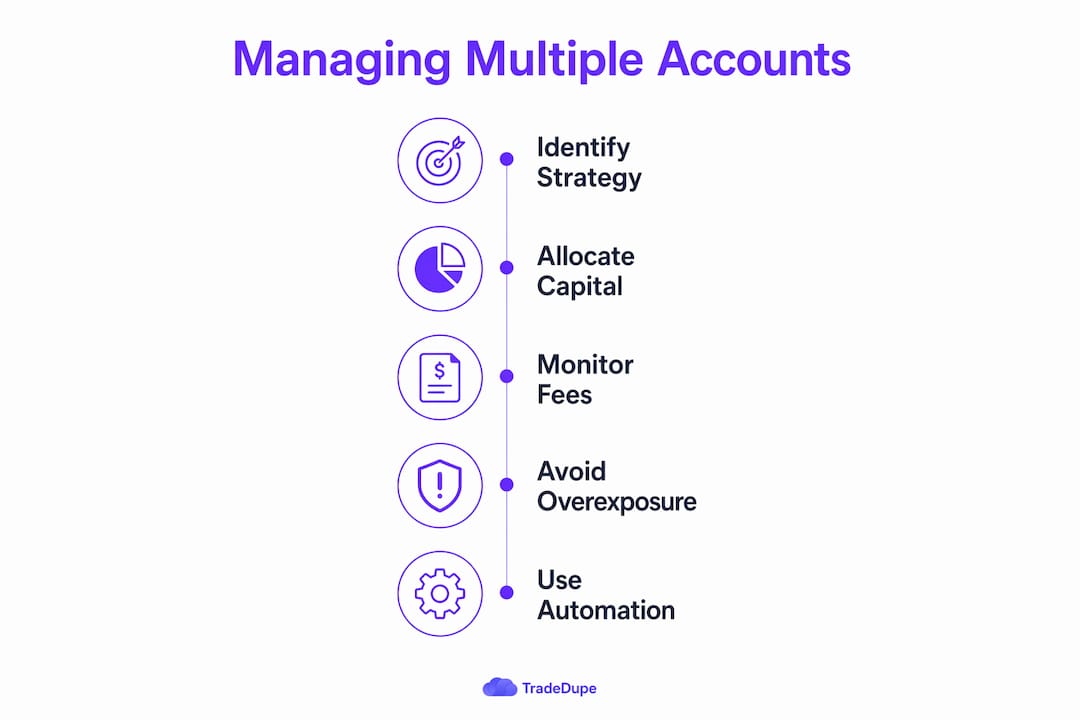
Tax coordination is the challenge most traders underestimate. Each broker issues separate tax documents. If you are trading futures across multiple accounts at different firms, reconciling wash sale rules, Section 1256 contract treatment, and mark-to-market elections across fragmented records becomes a serious compliance burden. A tax professional familiar with active trading is not optional at this level.
Margin risk is the final trap. Traders who do not track aggregate exposure across all accounts can find themselves overexposed to correlated positions. A long bias in ES futures across three separate accounts is still a long bias. The accounts are separate. The market risk is not.
- Execution errors increase sharply beyond five accounts without automation.
- Fee fragmentation erodes the commission advantages that come with consolidated capital.
- Tax complexity multiplies with each additional broker relationship.
- Aggregate margin risk is invisible unless you actively track total exposure across all accounts.
- Platform fatigue from managing multiple web logins and dashboards slows decision-making.
Advisors consistently note that complexity and fees from too many accounts can outweigh the benefits. For most retail traders, two to three accounts represents the practical ceiling before management costs start eating into returns.
How to set up and manage multiple accounts effectively
The right number of accounts depends on your experience level and capital base. Starting with two to three accounts and scaling as both grow is the recommended approach. A typical starting structure looks like this:
- Primary account: Your main income-generating strategy. Fully funded, tightly risk-managed, and never used for experimentation.
- Secondary account: A second broker for redundancy and a distinct strategy type, such as swing trading while your primary runs intraday.
- Testing account: A small, fixed-capital account for evaluating new setups before committing real size.
Capital discipline between accounts requires a structural solution. Scheduled, fixed-amount transfers from a capital account to your trading account are the only fresh capital source for active trading. Profits stay inside the trading account. This prevents the psychological trap of treating unrealized gains as available margin.
Setting up separate bank sub-accounts dedicated to each trading account adds another layer of protection. Most retail banks allow online sub-account creation in under 15 minutes. This structure means a margin call or broker issue in one account cannot drain capital held for another.
For traders managing multiple web-based broker platforms simultaneously, isolated browser sessions prevent cross-contamination between logins. Cloud browsers or multi-login browser tools create separate environments for each platform, reducing the risk of session errors or accidental order placement in the wrong account.
Beyond five accounts, automated trade copier systems become necessary for execution consistency. Manual management at that scale is not reliable. Platforms like Tradedupe replicate trades from a single lead account to multiple follower accounts in real time, with a median latency of 34ms. That kind of automation is what makes multi-account prop trading operationally viable.
Pro Tip: Treat your testing account like a prop firm evaluation. Set a maximum drawdown limit before you start. When you hit it, stop trading that strategy. The discipline you build in a small account transfers directly to how you manage larger capital.
Legal considerations and broker policies for multiple accounts
No law in the United States prohibits individual traders from opening accounts at multiple brokers. Using multiple brokers with multiple accounts is industry standard and legal. The restrictions that do exist come from individual broker terms of service, not from regulatory bodies like the CFTC or FINRA.
The key legal and policy considerations every trader should verify before opening additional accounts:
- Same-broker limits: Some brokers restrict clients to one account per individual. Opening a second account at the same firm under a different name or entity to circumvent this rule violates their terms and can result in account termination.
- Prop firm rules: Evaluation and funded accounts at prop firms carry specific restrictions on strategy replication and simultaneous trading. Read each firm's terms before running a trade copier across their accounts.
- Regulatory separation: Institutional traders face stricter rules requiring separation of client and proprietary trading. Individual retail traders are not subject to the same requirements, but the principle of clean account separation still applies.
- Tax reporting obligations: The IRS requires accurate reporting of all trading activity regardless of how many accounts or brokers are involved. Fragmented records do not reduce your reporting obligation. They increase your audit risk.
- Estate and compliance planning: Multiple accounts across multiple brokers complicate beneficiary designations and account access in the event of incapacity. Maintaining an audit trail for multiple accounts is both a compliance best practice and a practical necessity.
The practical rule is straightforward. Verify each broker's terms before opening a second account there. Use different brokers for different accounts when possible. Keep records clean and current across all accounts.
Key Takeaways
Multiple trading accounts work best when each account has a defined purpose, a fixed capital allocation, and a clear set of rules that never overlap with the others.
| Point | Details |
|---|---|
| Strategy isolation | Keep scalping, swing trading, and experimental setups in separate accounts to track P&L accurately. |
| Broker redundancy | Spreading capital across 3–5 brokers eliminates single points of failure from outages or insolvency. |
| Start small and scale | Begin with 2–3 accounts and add more only as capital and experience justify the added complexity. |
| Automate beyond five accounts | Manual management past five accounts creates execution errors; use trade copier software for consistency. |
| Verify broker terms | No law prohibits multiple accounts, but individual broker policies may restrict same-firm duplicates. |
The uncomfortable truth about multiple accounts
I have watched traders open five, six, even eight accounts thinking that more separation equals more safety. What it usually equals is more confusion. The accounts multiply. The discipline does not.
The traders who actually benefit from multiple accounts share one trait: they treat each account like a separate business with its own rules, its own capital, and its own performance review. They are not running eight accounts because they read that professionals do it. They are running three accounts because each one serves a function they can clearly articulate.
The technology side has gotten easier. Tools like Tradedupe handle the real-time trade mirroring that used to require a dedicated desk. Prop firm traders running Apex evaluations alongside funded accounts can now replicate from a single leader without manually entering the same trade four times. That removes a real operational burden.
What technology cannot fix is the trader who opens a second account to escape the discipline problems in the first one. A new account does not reset your edge. It just gives you a fresh place to repeat the same mistakes. Start with a clear purpose for each account. Fund it appropriately. Review it on a fixed schedule. That is the structure that makes managing multiple brokers worth the effort.
> — Andres
Tradedupe for traders running multiple prop firm accounts
Prop traders managing multiple evaluation and funded accounts face a specific problem: executing the same trade manually across four or five accounts during a fast-moving session is slow, error-prone, and exhausting.
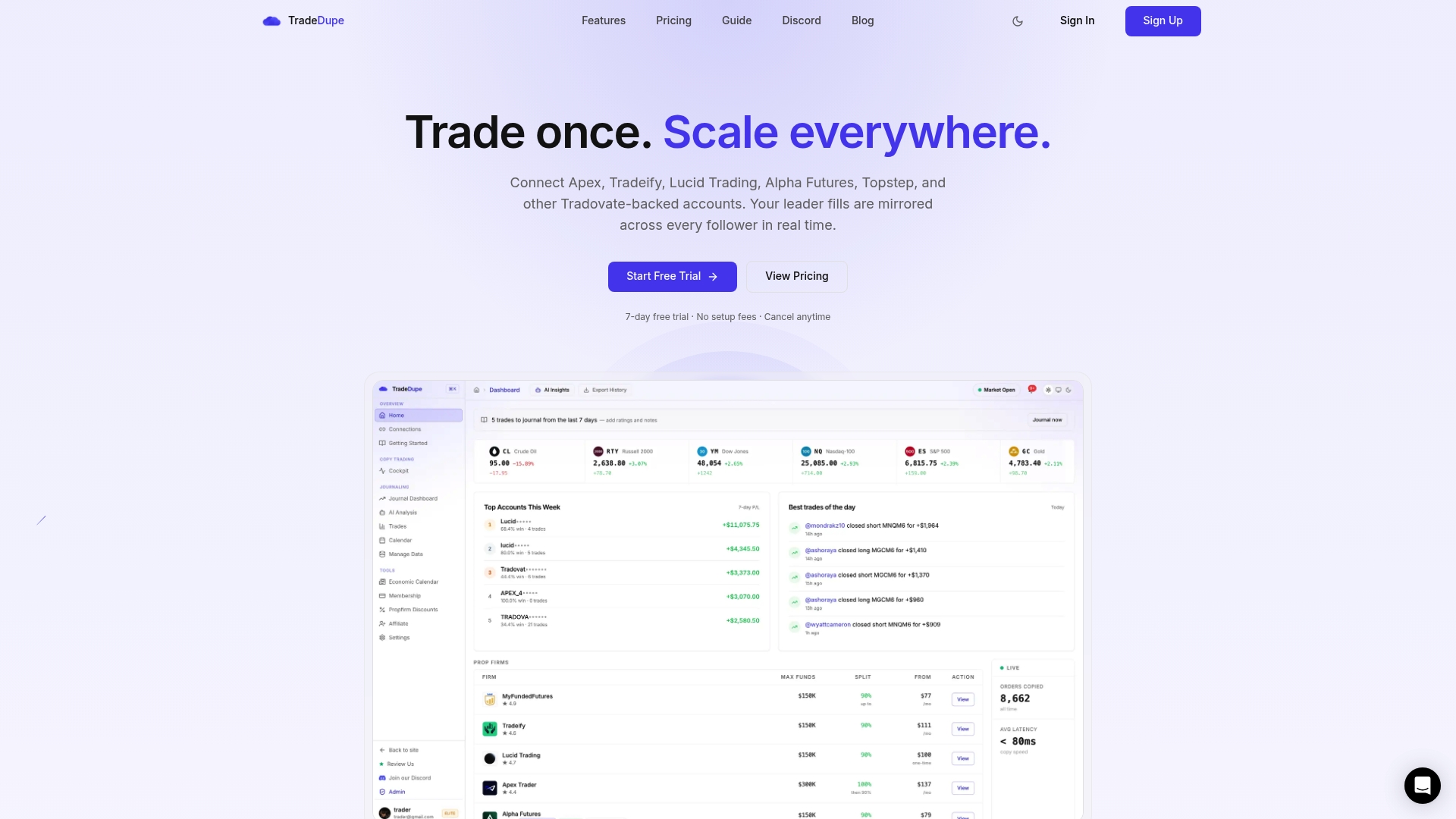
Tradedupe solves this with real-time trade mirroring built specifically for Tradovate users. A single lead account sends trades to all follower accounts with a median latency of 34ms. Supported integrations include Apex, Tradeify, Lucid Trading, and Alpha Futures. The platform includes rogue-trade detection, auto-recovery, and per-account toggle controls so you stay in control of every account without watching each one individually. Traders who want to see how it works can get started with Tradedupe in under 10 minutes, or explore the full copy trading platform to see which plan fits their account structure.
FAQ
Why do individual traders open multiple trading accounts?
Traders open multiple accounts to isolate strategies, reduce counterparty risk, and protect capital across different brokers. Each account serves a distinct purpose, from income-generating strategies to experimental setups.
How many accounts should a trader have?
Most retail traders operate 2–4 accounts; professionals typically aim for 3–5 to reduce counterparty risk while keeping management complexity under control.
Is it smart to have multiple accounts at the same broker?
Some brokers restrict clients to one account per individual, so check their terms first. Using multiple brokers is the standard approach and avoids same-firm policy violations.
What are the biggest risks of managing multiple trading accounts?
The main risks are aggregate margin overexposure, fee fragmentation from losing volume-based commission discounts, and tax complexity from reconciling records across multiple brokers.
How do trade copiers help with multiple account management?
Automated trade copier systems replicate trades from a single lead account to multiple follower accounts in real time, eliminating manual entry errors and maintaining execution consistency across all accounts.