

Alpha Futures Copy Trading: 5 Accounts, Plan Caps, Setup Rules
TradeDupe
13 min read
See how Alpha Futures’ single trader rule, account caps, Daily Loss Guard, and Consistency Rule shape compliant copying, with TradeDupe setup safeguards.
Alpha Futures permits copy trading as long as a single user or username executes the trades, which rules out group trading, reverse trading, and fully automated bot-driven replication across accounts. Beyond that core requirement, you still need to respect maximum allocation caps, the Daily Loss Guard, the Consistency Rule, and the firm's prohibited practices list. We unpack each one below so you can set up a compliant workflow.
*
> TL;DR: > > - Zero, Direct, and Standard accounts allow five qualified accounts, while Advanced allows three; each cap includes the leader, leaving four or two followers. > - Zero accounts have a 2% Daily Loss Guard based on starting balance; it counts open and realized losses, fees, and commissions, then locks breached accounts. > - Your largest day’s share of net profit must meet payout thresholds: Direct, 20%; Zero or Standard Qualified, 40%; Standard Evaluation, 50%; Advanced Evaluation, 40%. > - Alpha recommends using your lowest buying power account as leader, since a follower with less capacity may miss fills and become unsynchronized. > - Avoid trading within 2% of a CME price limit and check news restrictions, since a follower may be barred even when the leader trades.
*
Table of Contents
- 1. Alpha Futures' official stance on copy trading
- 2. Maximum allocation: how many qualified accounts you can run
- 3. Daily Loss Guard mechanics and what they do to copied trades
- 4. Consistency Rule math and its effect on payouts
- 5. Prohibited practices that most affect copy trading setups
- 6. A setup checklist for copying trades without breaking Alpha's rules
- 7. Common execution problems when mirroring across Alpha accounts
- 8. Why discipline matters more than the tool you use
- How TradeDupe maps to Alpha's copy trading rules
- FAQ
- Sources
1. Alpha Futures' official stance on copy trading
Alpha Futures addresses copy trading directly in its help center, and the language is worth reading closely before you connect anything. According to the Copy Trading help-center article, copy trading in general is permitted as long as it is a single user executing the trades across their own accounts. Automated, group, and reverse trading are strictly prohibited under that same guidance.
That distinction matters because it separates a trader mirroring their own decisions across their own funded and evaluation accounts from a setup where multiple people trade off one signal, or where a bot places trades without a human initiating them. Alpha's language targets the latter, not a single trader managing several of their own Alpha accounts.
The help center also offers practical advice on leader selection: designate the account with the smallest leverage or lowest buying power as your leader. Here's why that matters for execution:
- A follower account with less buying power than the leader may simply fail to copy a trade, leaving you with a mismatched position and an audit trail that looks inconsistent.
- Using your most restrictive account as the leader means every other account can technically accommodate the same size, reducing synchronization failures.
- Alpha's guidance is published at the help-center level and can change, so confirm the current wording before you automate anything with real capital behind it.
Policies get revised, and a rule you read last quarter may not match what's live today. Before connecting any copy trading setup to your Alpha accounts, pull up the current help-center article yourself and read it in full.
2. Maximum allocation: how many qualified accounts you can run
Alpha caps how many qualified accounts you can hold at once, and that cap directly limits how many followers you can realistically copy into. Per the Maximum Allocation help-center article, the current structure breaks down by account type:
- Zero, Direct, and Standard accounts: up to 5 qualified accounts.
- Advanced accounts: up to 3 qualified accounts.
- One username per individual, and one individual per household, with no stacking of multiple identities to bypass the cap.
These caps exist partly to make allocation easy to audit and partly to prevent the kind of account stacking that makes rolling or group trading hard to detect. For your copy trading setup, the practical effect is straightforward: your maximum allocation tier sets the ceiling on how many follower accounts you can run under one leader at the same time. If you hold five Zero accounts, you have room for a leader plus four followers; an Advanced trader working with three accounts has a leader plus two followers at most.
Confirm your current tier and count before adding a new account to your copy trading stack, since enrollment rules and caps are published separately from the evaluation terms you originally signed up under.
3. Daily Loss Guard mechanics and what they do to copied trades
The Daily Loss Guard, or DLL, is Alpha's soft-breach mechanism: when your account's loss for the day hits the threshold, the account locks until the next trading day rather than terminating outright. According to the Daily Loss Guard help-center article, Zero accounts carry a 2% DLL threshold calculated against the account's starting balance, with the dollar figure scaling by account size.
A few mechanics matter for anyone running copy trading across multiple accounts:
- DLL calculations include both unrealized and realized profit and loss, plus simulated commissions and fees, so an open losing position counts toward the threshold even before you close it.
- When DLL triggers, the platform sends liquidation market orders to flatten positions and cancels pending orders on that account, and fills on those liquidation orders can vary with volatility.
- DLL is a risk guard, not a substitute for your own stop-loss discipline, since it reacts only after the threshold is already breached.
The operational risk for copy trading is simple: if a follower account hits its DLL mid-session, it locks and stops accepting new fills, while your leader and other followers may keep trading normally. That mismatch means the locked account's position no longer tracks the rest of your book, and you need to notice it quickly rather than assume everything is still mirrored correctly.
Pro Tip: Check each account's DLL status on your dashboard before you walk away from the screen, since a locked follower account can sit silently out of sync for the rest of the session.
4. Consistency Rule math and its effect on payouts
The Consistency Rule measures whether your profits are concentrated in one outsized day or spread across your trading history, and it directly affects withdrawal eligibility, so you can use an AI Formula Generator to quickly build calculators that help you track your consistency and payouts. Per the Consistency Rule help-center article, the published thresholds vary by account type and stage:
- Direct Qualified accounts: 20% consistency threshold.
- Zero and Standard Qualified accounts: 40% consistency threshold.
- Standard Evaluation: 50% consistency threshold.
- Advanced Evaluation: 40% consistency threshold.
The calculation itself is a simple ratio: your biggest single trading day divided by your total net profit gives you the consistency percentage. If that percentage exceeds the threshold for your account type, you typically need to bring your profit distribution back in line before a withdrawal request will clear.
For traders running copy trading across several Alpha accounts, this is worth watching closely, because a single strong day copied simultaneously across multiple accounts can push more than one of them past their threshold at the same time. Alpha's dashboard shows your running consistency percentage, and the firm publishes a consistency calculator you can use to check your numbers before you submit for a payout rather than finding out after the fact.

5. Prohibited practices that most affect copy trading setups
Alpha's Prohibited Trading Practices help-center article enumerates behaviors that can void profits or terminate your agreement, and several of them sit close to normal copy trading activity if you're not careful about how you configure it.
- Account rolling and group trading. Copying identical positions across multiple accounts you control can resemble rolling into a lucky trade if the pattern looks engineered rather than incidental, and Alpha's risk team reviews behavioral patterns for exactly this kind of signal. Vary timing and sizing where practical and keep your own records of why each account traded when it did.
- Automated and reverse trading. High-frequency bot behavior, certain AI-driven automations, and reverse trading, where one account is deliberately positioned opposite another, fall outside what the single-user copy trading allowance covers.
- Order-book spamming and tick scalping. Rapid order placement and cancellation patterns designed to manipulate the appearance of liquidity are prohibited regardless of whether copy trading is involved.
- Price-limit violations. Per the price-limit trading guidance, Alpha asks traders not to trade within 2% of a CME price limit, and monitoring the percent net change on your quote board helps you spot that zone before you're in it. A leader order placed near a limit can also fail to fill cleanly across followers.
- News trading windows. Certain accounts restrict order placement within a window around high-impact news events, and a copy trading setup that doesn't account for that window risks a payout denial if a follower account picks up a trade during a restricted period.
Alpha's enforcement posture treats these as behavioral red flags rather than one-off technicalities, so the safest approach is building your copy trading configuration around avoiding them entirely rather than hoping a single instance goes unnoticed.
6. A setup checklist for copying trades without breaking Alpha's rules
Before you connect any copy trading tool to your Alpha accounts, work through a short checklist that maps directly to the rules above.
- Pick your most restrictive account (smallest leverage, lowest buying power) as the leader, as Alpha's own guidance recommends.
- Confirm your current maximum allocation tier and leave room under the cap before adding another follower.
- Set DLL-aware position sizes on every account so one follower hitting its loss guard doesn't surprise you mid-session.
- Build in a news filter or manual pause around high-impact events rather than letting a leader trade straight through them.
- Run a test cycle on evaluation or smaller accounts before committing size to a full live stack.
This is the exact operational gap TradeDupe is built to close for traders juggling several Tradovate-based accounts at once. We connect through Tradovate's own OAuth flow, so your password is never stored and nothing runs locally on your machine. Once connected, every fill on your leader account mirrors to your enabled follower accounts over a live WebSocket stream, typically under 100ms, with rogue-trade detection flagging a follower trade that didn't originate from the copier itself. Per-account toggles let you pull a single follower out of the mirror instantly, and execution mode controls let you size each follower independently instead of forcing identical contract counts across accounts with different buying power.
Pro Tip: Keep a simple log of which accounts were active, at what size, and why, for every session you run copy trading. If Alpha's risk team ever asks about a pattern, a clear record of deliberate, varied decisions is your best answer.
For a deeper walkthrough of connecting accounts and testing a mirror before going live, see our playbook for mirroring trades across prop accounts.
7. Common execution problems when mirroring across Alpha accounts
Even with a compliant setup, copy trading across accounts with different balances and leverage runs into predictable friction points.
- Buying-power mismatches. If a follower account has less available margin than the leader, its copied trade can fail outright or fill at a reduced size, leaving your accounts out of sync. Run a margin pre-check on every follower before each session, not just once at setup.
- DLL or price-limit flattening mid-copy. A follower that hits its Daily Loss Guard or trades near a CME price limit can flatten independently of the leader. Staggering position sizes and using limit orders instead of market orders on followers gives you more control over where each fill actually lands.
- Latency and illiquid conditions. Even fast mirroring can't fix a thin order book. In lower-liquidity contracts or during the open and close, expect wider slippage between leader and follower fills, and monitor your dashboard rather than assuming every copy executed at the price you saw on the leader.
A quick pre-session habit, checking margin, confirming no news event sits inside your trading window, and glancing at each account's DLL status, catches most of these problems before they turn into a compliance question.
8. Why discipline matters more than the tool you use
Having traded multiple funded accounts myself, the rules Alpha publishes aren't obstacles to work around, they're the framework that keeps both you and the firm solvent over time. The habit that separates traders who keep their accounts from those who don't is simple: reread the current help-center language before you automate anything, every time you change your setup, not just once.
Keep conservative sizing when you first turn on a copy trading configuration, and keep your own records of what each account did and why. Rules exist because unmonitored automation across multiple accounts is exactly the pattern risk teams are trained to catch.
> — Andres
How TradeDupe maps to Alpha's copy trading rules
Everything we've covered, the single-user requirement, allocation caps, DLL thresholds, and prohibited automation, points to the same operational need: visibility and control over every account in your stack. We built TradeDupe around that need for traders running several Tradovate-based prop accounts, including Alpha Futures.
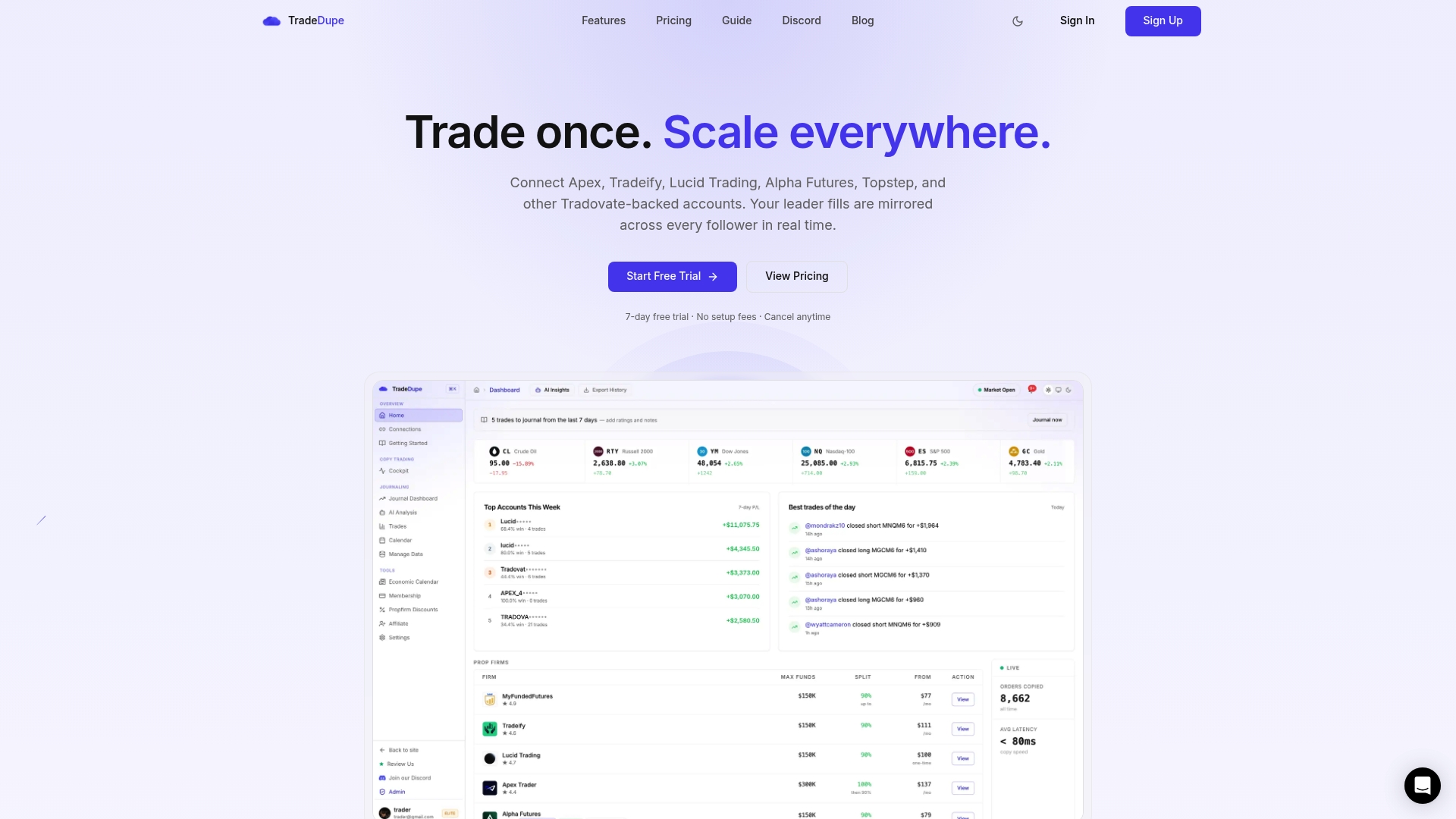
- OAuth connection to Tradovate means your credentials stay with Tradovate, not stored externally.
- Live WebSocket mirroring, typically under 100ms, keeps follower fills close to your leader's execution.
- Rogue-trade detection can flag a follower position that didn't originate from the mirror.
- Per-account toggles may let you pull any single account out of a copy session instantly.
Mirroring at typically under 100ms means a follower order lands close enough to your leader's fill that leverage-aware sizing stays meaningful rather than stale by the time it executes.
| Plan | Price | Connections |
|---|---|---|
| Standard, billed yearly | $20/month | 2 connections |
| Pro, billed yearly | $40/month | 4 connections, 20 accounts each |
| Elite, billed yearly | $80/month | Unlimited connections |
Every plan starts with a 7-day free trial and one-click cancellation. See current pricing and plan details to find the tier that matches your account count.
FAQ
How do you copy trade successfully across multiple accounts?
Successful copy trading starts with picking your most restrictive account as the leader, confirming your allocation cap before adding followers, and sizing each account according to its own buying power rather than mirroring identical contract counts everywhere.
What is the inactivity rule for Alpha Futures accounts?
Alpha Futures publishes inactivity terms separately from its copy trading and allocation rules, and specific day counts and consequences can change. Confirm the current inactivity policy directly in Alpha's help center before relying on it for your account planning.
Can you sell a futures contract before expiry?
Yes, most futures contracts trade freely before expiration and traders routinely close positions ahead of the delivery or settlement date rather than holding to expiry. Your prop firm's own rules, including any restrictions near contract rollover, still apply on top of normal exchange mechanics.
What is the 3-5-7 rule in trading and how does it work?
The 3-5-7 rule is a general risk management guideline, not an Alpha Futures policy: it suggests capping risk at 3% on any single trade, 5% across all open trades, and 7% in total monthly drawdown. Definitions vary across trading educators, so treat it as one risk framework among several rather than a rule Alpha enforces.
How many accounts can you run copy trading on with Alpha Futures?
Your maximum allocation tier sets the limit: up to 5 qualified accounts for Zero, Direct, and Standard, or up to 3 for Advanced, as published in Alpha's maximum allocation guidance. That cap includes your leader account, so plan your follower count accordingly.
Recommended
- Apex Trader Funding Copy Trading Rules (2026): Multiple Accounts, Limits & Compliance
- Best Trade Copier for Prop Firms (2026): Rules + Setup
- MyFundedFutures (MFFU) Copy Trading (2026): Mirror Every Account
- Funded Futures Family Copy Trading (2026): Mirror Every Account
For educational purposes only. Not financial advice. Futures trading involves substantial risk of loss and is not suitable for every investor.