

Avoid CTA Registration: CFTC Copy Trading Rules for U.S. Futures Firms
TradeDupe
17 min read
Enforcement‑informed playbook for U.S. futures firms: what triggers CTA registration, recordkeeping and allocation risks, and concrete technical controls...
Copy trading itself is not illegal in the United States, but the structure behind it often is what triggers regulation. The moment a signal provider or platform exercises discretion over a follower's account, mirrors trades automatically without the follower's active control, or bunches orders and allocates them after the fact. That provider typically crosses into Commodity Trading Advisor territory under the Commodity Exchange Act. Check Section 1a(12) and Section 4m for the registration triggers, and scrutinize your setup for custody, automated execution, and allocation practices before you assume you're exempt.
*
> TL;DR: > > - Most copy trading platforms unintentionally trigger CFTC registration requirements if they exercise discretion over follower accounts or control trade execution and allocation processes. > - Exemptions under Regulation 4.14 are often misapplied because they require advice to be standardized, non-personalized, and not directing account actions, which is difficult for mirror trading models. > - Clear, verifiable evidence of follower control, such as timestamps and independent account execution logs, is crucial to defend a non-discretionary claim during regulatory scrutiny. > - Automatic trade mirroring and allocation practices that are not mechanical or documented can lead to enforcement actions, exemplified by cases against IML and allocation rule violations. > - Platform architecture and operational controls, including broker-enforced risk limits and genuine follower toggles, are essential for building a compliant and defensible copy trading setup.
*
Table of Contents
- What Are CFTC Copy Trading Rules Under the CEA?
- Which Exemptions Apply to Copy Trading Signal Providers?
- Discretionary vs Non-Discretionary Copy Trading: What Triggers Registration?
- What Recordkeeping and Advertising Rules Apply to Copy Trading Platforms?
- How Do You Build a Defensible Copy Trading Compliance Program?
- What Enforcement Cases Show About CFTC Copy Trading Compliance?
- How TradeDupe's Safeguards Support a Non-Discretionary Setup
- A Compliance Priority List for Copy Trading Operators
- Get a Compliance-Minded Copy Trading Setup With TradeDupe
- Sources
- FAQ
What Are CFTC Copy Trading Rules Under the CEA?
The CFTC doesn't have a single rulebook titled "copy trading." Instead, copy trading gets pulled into the same regulatory bucket as traditional trading advice, through the Commodity Trading Advisor definition. A CTA under 7 U.S.C. §1a(12) is anyone who, for compensation, directly or indirectly advises others on the value of trading futures, options on futures, retail forex, or swaps. That definition is broad on purpose. It doesn't require a formal contract or a fee structure that looks like a traditional advisory business. If you're telling someone what to trade, or your system is doing it for them without their say, you likely fit.
Section 4m(1) of the CEA is where the registration obligation actually lives. It states that a person acting as a CTA must register with the CFTC unless an exemption applies. Registration isn't just paperwork. It brings NFA membership, which layers on additional obligations around recordkeeping, promotional material review, and ongoing supervision. The application fee for CTA registration runs a small, fixed amount, plus NFA membership dues on top of that.
A few Commission rules shape how this plays out in practice for copy trading specifically:
- Regulation 4.14 exempts advisors who give standardized advice without directing accounts or tailoring recommendations to individual clients.
- Rule 4.10(f) defines what "directing" a customer account actually means, which matters enormously for platforms that auto-execute trades.
- Regulation 4.7 offers relief for CTAs who deal exclusively with Qualified Eligible Persons, but it comes with its own filing and disclosure mechanics.
- Rule 4.5 and Regulation 4.13/4.12 cover operators of certain pools and smaller commodity pools, which sometimes intersect with copy trading structures built around pooled accounts.
CFTC staff have also weighed in on where the line sits. A Division of Swap Dealer and Intermediary Oversight interpretation notes that advice considered "solely incidental" to a futures commission merchant's, swap dealer's, or introducing broker's main business may avoid CTA registration in narrow situations. Critically, the letter makes clear that separate compensation alone doesn't decide the outcome. Regulators look at the whole fact pattern, not one variable in isolation.
Statistic Callout: CTA registration costs $200 upfront, but the real cost is operational. NFA membership requires ongoing compliance infrastructure, recordkeeping systems, and supervisory review of any marketing material, which is a far bigger lift than the filing fee suggests.
NFA membership isn't a separate optional layer you can skip if you register with the CFTC. The two are linked. Once you're required to register as a CTA, NFA membership generally follows automatically, and NFA's own rulebook governs how you advertise, supervise employees, and retain records going forward. The CFTC's registration resource page walks through the mechanics if you're mapping out what registration actually requires day to day.
Which Exemptions Apply to Copy Trading Signal Providers?
Most signal providers who think they're exempt are relying on Regulation 4.14, and most of them are applying it incorrectly. The exemption exists for people who give standardized, one-size-fits-all advice, and it was never built for services that mirror trades into individual accounts in real time.
To actually qualify for the 4.14(a) exemption, a provider generally needs to satisfy three conditions simultaneously:
- No account direction. The provider cannot place trades in a client's account or control execution. Advice has to stop at the recommendation stage.
- No tailoring. The advice must go out to everyone the same way. Customizing signals based on account size, risk tolerance, or individual requests defeats the exemption.
- No holding out for individualized service. Marketing that promises personalized attention or account-specific strategy undermines the exemption even if the actual advice is standardized.
Copy trading, by its nature, pushes hard against all three. A signal that mirrors into a follower's account is directing that account, even if a human never touches the trade. That's the core tension platforms have to design around.
Regulation 4.7 works differently. It's built for CTAs serving Qualified Eligible Persons, a category that generally covers sophisticated, high-net-worth clients or institutional accounts. The exemption doesn't remove registration entirely. It reduces disclosure and reporting burdens for providers who file the appropriate notice with the NFA and confirm every client actually meets the QEP threshold. Skipping the verification step is one of the more common ways providers lose the exemption after the fact, usually discovered during an audit rather than upfront.
Regulation 4.13 and 4.12 cover smaller pools and family-office style arrangements, and they come with their own participant caps and trading limits. These rarely apply cleanly to a typical retail copy trading service, but they matter for platforms structured around pooled or fund-like arrangements.
The pitfall that catches the most providers isn't a missing form. It's the Letter of Direction problem. A signed letter authorizing a provider to trade a follower's account feels like a clean legal fix, but regulators don't treat it as automatic protection. Even with a signed LOD on file, examiners look at who actually controls order entry and whether the client had a meaningful, ongoing ability to override or stop trades. A letter that grants broad, standing authority without a genuine off switch reads a lot like discretionary control, no matter what the document is titled. Separate compensation structures and account-by-account customization compound the problem, turning what looked like a standardized service into something that behaves like individualized management. The NFA's exemptions reference lays out the filing mechanics for 4.7 and related relief if you're evaluating which category actually fits your structure.
Discretionary vs Non-Discretionary Copy Trading: What Triggers Registration?
This is the single most consequential distinction in the entire regulatory picture, and it's almost entirely a function of how your system is built, not what you call your service.
Discretionary activity happens when the provider, or the platform acting on the provider's behalf, controls whether and how a trade lands in a follower's account. A few specific patterns push a setup firmly into discretionary territory:
- Automatic execution with no follower action required. If a trade fires the instant the leader trades, with zero input from the follower at the moment of execution, that's discretion in practice even if the follower opted in once at signup.
- Provider-controlled allocation. Any setup where the provider decides after the fact how a bunched or omnibus order gets split among follower accounts creates direct exposure, especially if allocation isn't mechanical and rule-based.
- Persistent authority without a genuine override. A follower who technically can turn off copying, but only through a slow, buried, or non-functional process, doesn't have real control. Regulators evaluate the practical reality, not the theoretical option.
Non-discretionary structures look different. Execution happens inside the follower's own account, under the follower's own brokerage relationship, with the follower retaining a persistent and functional ability to disable copying at any time. Per-trade approval steps, real-time toggles, and explicit account-level opt-in mechanics all support a non-discretionary classification, but only if they're genuinely accessible and not cosmetic.
Pro Tip: Test your own "off switch." If disabling copy trading takes more than a couple of clicks, or requires contacting support, a regulator reviewing your system may conclude the follower never had meaningful control to begin with.
Broker-side custody arrangements matter too. When a follower's funds sit in their own account at a broker like Tradovate, and that broker enforces account-level controls such as loss limits directly, it reinforces the argument that the follower, not the provider, retains ultimate control over capital and risk. Client acknowledgments help build the record, but they only carry weight if the operational reality backs them up. A checkbox that says "I control my account" means very little if the system architecture doesn't actually give the follower that control.
What Recordkeeping and Advertising Rules Apply to Copy Trading Platforms?
Platforms and any affiliated CTAs sit under a set of operational obligations that go well beyond registration paperwork, and this is where a lot of otherwise well-intentioned providers get tripped up during an audit.
Recordkeeping expectations are specific and unforgiving. Regulators expect a documented trail covering trade fills, timestamps down to the second where possible, execution logs showing which account initiated what action, and retention periods that hold up if a complaint surfaces months or years later. The insight that matters most here: regulators focus heavily on whether contemporaneous evidence exists showing followers retained execution control. A platform that can't produce timestamped logs proving the follower's system, not the provider's, triggered each fill is in a much weaker position, regardless of what its terms of service claim.

Allocation fairness is a separate, equally serious obligation. When trades get bunched across multiple accounts and split after execution, Regulation 1.35(b)(5) requires that allocation be fair and equitable, with no systematic favoring of proprietary or higher-fee accounts over others. Enforcement history shows this isn't a theoretical risk. Complaints involving unfair post-trade allocation have led to real penalties, and the pattern regulators flag most often is allocation logic that isn't mechanical, meaning a human decision after the fact determines who gets the better fill.
Statistic Callout: The CFTC's Regulation AT rulemaking process laid out expectations for pre-trade risk controls in algorithmic trading environments, including system safeguards and monitoring requirements that inform how regulators think about automated execution risk even outside formal Reg AT applicability.
On the marketing side, NFA Compliance Rule 2-29 requires that promotional material never be deceptive, and it places supervisory responsibility squarely on the Member firm. Practical obligations include:
- Reviewing performance claims before they go public, including win rates or return figures.
- Supervising audio and video advertising, which carries additional review requirements under NFA guidance.
- Retaining copies of all promotional material and the internal approval record tied to each piece.
- Avoiding cherry-picked performance windows that misrepresent typical results.
How Do You Build a Defensible Copy Trading Compliance Program?
A defensible program isn't built during an examination. It's built into the platform's architecture from day one, and the sequence matters.
- Verify custody first. Confirm every follower's funds sit in their own brokerage account, not a pooled or provider-controlled account. This single fact shapes almost every downstream analysis.
- Map the execution model precisely. Document exactly where each trade originates, what triggers execution in the follower's account, and whether any human or algorithmic decision point sits between the leader's fill and the follower's fill.
- Confirm order flow control. Establish, in writing and in system logs, that the follower's account executes independently rather than as a sub-allocation of a bunched order.
- Generate per-account execution evidence. Every follower fill needs its own timestamped record showing it happened in that follower's account, under that follower's standing authorization.
- Draft or review Letters of Direction carefully. If any LOD exists, make sure it includes clear, functional revocation rights, not just a signature authorizing broad ongoing control.
- Build qualification questionnaires for any service leaning on the 4.7 QEP exemption, and keep the verification records, not just a checkbox confirmation.
- Write internal compliance policies covering allocation methodology, promotional review, and escalation procedures if a follower disputes an execution.
- Instrument the technology stack with audit logs, per-account toggles that are genuinely accessible, rogue-trade detection that flags fills the follower didn't authorize, and regular reviews of execution latency and accuracy.
- Run compliance testing on a schedule, not just once at launch. Regulatory expectations shift, and staff interpretations get updated.
- Register when the facts call for it, file exemption notices with the NFA promptly when an exemption genuinely applies, and get written counsel the moment any of these steps produces an ambiguous answer.
Pro Tip: Keep an immutable, correlated log that ties leader fills, follower acceptance timestamps, and broker-side execution together in one continuous chain. That single piece of documentation does more to defend a non-discretionary claim than any policy document you write.
None of this happens overnight, and smaller platforms in particular tend to underinvest in step eight because logging and toggle infrastructure feels like a technical afterthought rather than a compliance requirement. It isn't. It's often the deciding factor in how an examiner reads the rest of the file.
What Enforcement Cases Show About CFTC Copy Trading Compliance?
Enforcement history gives a clearer picture of regulator thinking than any interpretive letter, because it shows exactly which fact patterns actually get punished.
The CFTC's order against International Markets Live, Inc. (IML) is the clearest copy trading precedent on the books. The Commission found that IML allowed automatic mirroring of trades into customer accounts, and because customers had no meaningful discretion over individual trades once they opted in, the Commission concluded IML was acting as an unregistered CTA. The order resulted in civil penalties and stands as the reference case any platform offering automated mirroring should study closely. The lesson isn't subtle: automation plus lack of follower control equals CTA treatment, almost regardless of how the service is marketed.
Separately, the CFTC's complaint against Systematic Alpha Management centers on allocation practices, alleging that trades were bunched and allocated in ways that didn't treat accounts fairly, tying directly back to Regulation 1.35(b)(5)'s fair allocation requirement. Cases like this reinforce that allocation methodology isn't a back-office detail. It's a front-line compliance obligation with real enforcement teeth.
A few consistent takeaways emerge across these cases:
- Automatic execution without a functional follower override is treated as discretion, full stop.
- Allocation logic needs to be mechanical and documented, never subject to after-the-fact discretion.
- A provider under scrutiny needs to produce records, not just policies, proving followers controlled their own accounts.
- Marketing claims that promise personalized results while the underlying service is standardized create separate exposure on top of any registration issue.
If you're building or operating a platform, the defensible position starts with evidence you can hand over immediately: execution logs, timestamps, and account-level control records that match what your marketing actually claims.
How TradeDupe's Safeguards Support a Non-Discretionary Setup
TradeDupe was built around the exact operational questions this article has walked through, and its feature set maps directly onto the controls regulators look for when evaluating whether a follower retained genuine control.
Account connections run through Tradovate's official OAuth flow, so credentials are never stored by the platform and execution happens inside each follower's own brokerage relationship, not a pooled or provider-controlled account. That structural choice supports the custody analysis at the heart of the discretionary versus non-discretionary distinction.
A few specific mechanics worth noting:
- Per-account copy toggles give every follower a persistent, accessible control to enable or disable mirroring at any time, addressing the "genuine override" question head-on.
- Rogue-trade detection flags fills that don't match the leader's activity, creating a monitoring layer that supports the audit trail regulators expect.
- Daily loss limits and profit targets are enforced by Tradovate itself at the broker level, not by TradeDupe, reinforcing that the broker, not the platform, controls account-level risk parameters.
- Execution logs and reporting in the dashboard build the timestamped record that a non-discretionary claim depends on.
None of this substitutes for legal advice or guarantees any particular regulatory outcome. It's infrastructure, not a legal opinion. But it's the kind of documented, checkable architecture that gives a signal provider or platform operator something concrete to point to if a compliance question ever comes up. Readers building out a similar setup can review the mechanics in more depth on TradeDupe's copy trading explainer or the breakdown of security safeguards for futures copy trading.
A Compliance Priority List for Copy Trading Operators
If you take one thing away from all of this, make it the custody and execution model audit. Everything else, exemption filings, promotional review, recordkeeping systems, gets easier once you know definitively whether your setup is discretionary or not. Too many providers spend months on paperwork before answering the one question that actually determines what paperwork they need.
My honest read: platform redesign usually beats registration for smaller operators. Registering as a CTA brings ongoing NFA obligations that most early-stage signal providers aren't resourced to handle well. If a few architecture changes, a real opt-out toggle, follower-controlled execution, mechanical allocation, can keep you outside CTA territory, that's almost always the better investment than becoming a registered advisor with all the supervisory infrastructure that requires.
Marketing deserves more caution than most providers give it. Overstated performance claims create exposure independent of your registration status, and that risk is easy to underestimate when you're focused on the technical side of the build.
When the facts sit anywhere near the line, especially around Letters of Direction or allocation logic, get written counsel before you scale. This isn't a place where a confident guess holds up well.
> — Andres
Get a Compliance-Minded Copy Trading Setup With TradeDupe
TradeDupe is built specifically for Tradovate prop firm traders who need real, checkable control over how their accounts mirror trades, not a generic bridge that treats every broker the same. Every connection runs through Tradovate's official OAuth, so your credentials stay with Tradovate, and execution happens inside your own account with a working, accessible toggle to enable or disable copying at any time.
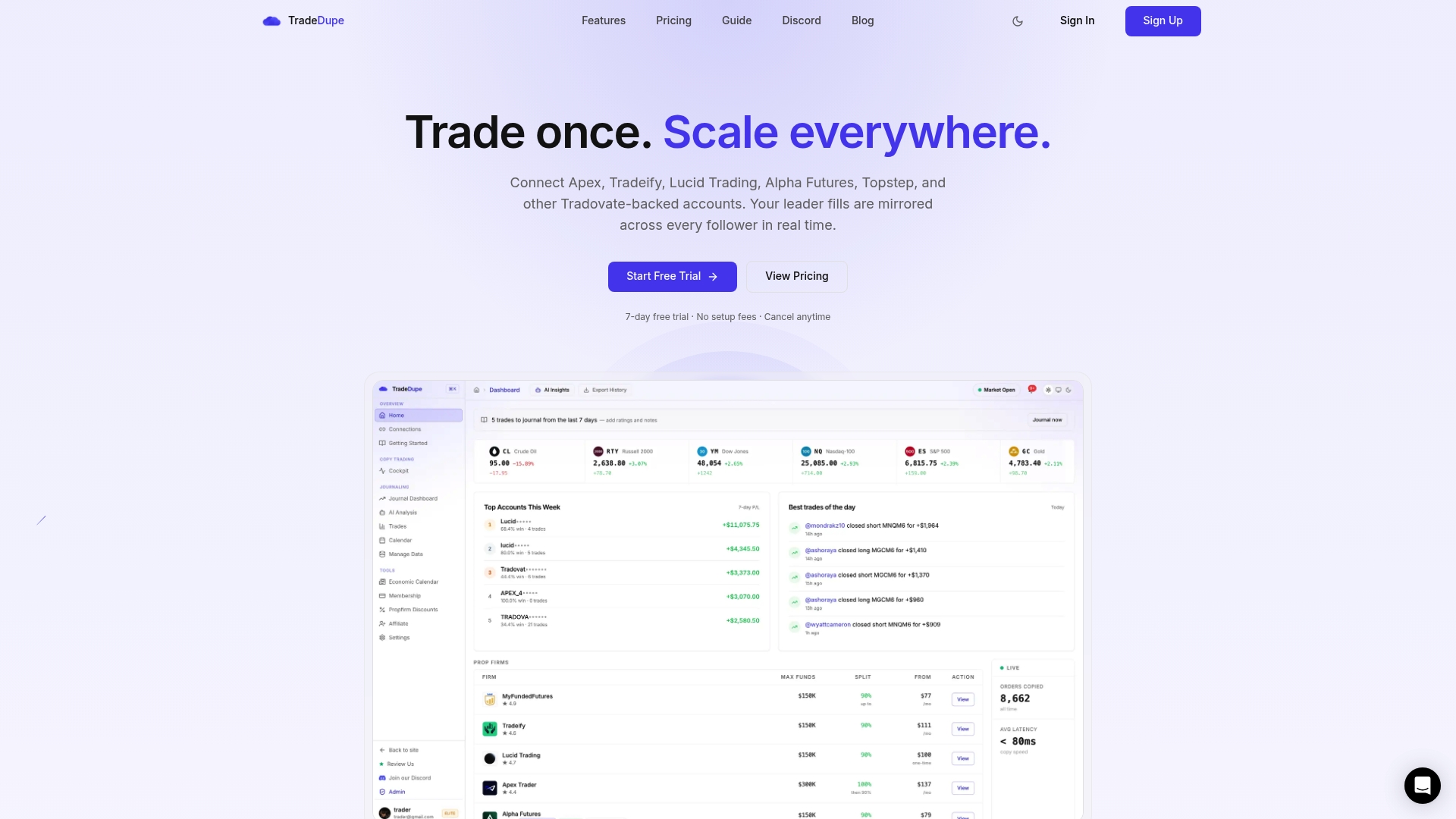
Rogue-trade detection catches follower activity that doesn't match the leader, and daily loss limits get enforced by Tradovate itself, so risk control sits with the broker, not with TradeDupe. Plans start at an affordable monthly rate billed yearly, and every plan includes a free trial period with easy cancellation. None of this is a substitute for legal advice on your specific setup, but it gives you documented infrastructure to work from. Visit the TradeDupe copy trading page to see how the connections and controls work, or head to getting started to set up your first account in about ten minutes.
This article is general information, not a substitute for advice from a qualified lawyer. Consult a qualified legal professional about your own circumstances before acting on anything here.
Sources
- U.S. Code, Title 7, Section 1a (definitions)
- CFTC staff interpretation regarding CTA registration requirements
FAQ
Is Copy Trading Legal in the US?
Yes, copy trading is legal in the United States, but the structure matters more than the label. A provider who exercises discretion over follower accounts, through automatic execution without follower control or discretionary allocation, generally must register as a Commodity Trading Advisor unless a specific exemption applies.
What Is CFTC Rule 4.13(a)(3)?
Regulation 4.13 provides exemptions for operators of certain commodity pools that meet specific size, participant, and trading limit criteria, reducing registration burdens for smaller pool structures. It rarely applies cleanly to typical retail copy trading services, since most copy trading doesn't operate as a pooled fund structure covered by this exemption.
What Is the Eddie Murphy Rule?
The "Eddie Murphy Rule" is an informal nickname for a CFTC rule restricting the use of nonpublic government information for commodity trading, unrelated to copy trading structures directly. It doesn't govern signal providers or platform operators and shouldn't be confused with CTA registration requirements.
What Are Common CFTC Violations in Copy Trading?
The most common violations involve operating as an unregistered CTA through automatic trade mirroring without follower control, as seen in the IML enforcement order, and unfair allocation of bunched orders among accounts. Deceptive promotional material lacking required NFA supervisory review is another frequent finding in enforcement actions.
Do Platforms Like TradeDupe Need CFTC Registration?
TradeDupe operates as infrastructure connecting followers to their own Tradovate accounts through per-account toggles and broker-enforced controls, designed to preserve follower execution control rather than direct it. Whether any individual signal provider using a platform needs to register depends on that provider's own conduct, and providers exercising discretion should evaluate their specific setup against CFTC registration requirements with qualified counsel.
For educational purposes only. Not financial advice. Futures trading involves substantial risk of loss and is not suitable for every investor.