
3 Safeguards Prop Firm Traders Need for Futures Copy Trading Security
TradeDupe
17 min read
Risk first checklist to secure futures copy trading for prop firm managers: OAuth connections, broker enforced loss limits, and per account caps.
Futures copy trading can be secure and compliant, but only when three things align: the platform uses secure, password-free account connections like OAuth, the broker enforces loss limits and profit targets natively, and your risk team applies per-account allocation caps before the first trade is mirrored. Skip any one of those, and you're not managing risk. You're hoping.
*
> TL;DR: > > - Using OAuth connections and encrypted channels is essential to prevent credential theft and ensure secure data flow during copy trading. > - Prop firms mainly detect external copying through identical trade timing, shared IPs, and metadata patterns, so slight variance and dedicated IPs reduce detection risk. > - Latency, slippage, partial fills, and connection outages pose significant risks, making real-time monitoring and robust reconnection strategies crucial for managing exposures. > - Set follower account risk controls based on proportionate leverage, including allocation caps, stop-losses, and symbol filters, with broker-enforced limits to prevent unmanageable drawdowns. > - Confirm ownership and copying permissions with each prop firm beforehand, as misaligned operational practices undermine security and compliance efforts.
*
Table of Contents
- Understanding Futures Copy Trading Security: Authentication, Data Flows, and Custody
- Prop-Firm Compliance: Where Internal Copying Ends and Violations Begin
- What Execution Risks Threaten Copied Futures Trades?
- What Risk Controls Should Follower Accounts Set Before Going Live?
- How Do You Vet a Lead Trader for Copy Trading?
- Why Audit Trails Matter for Prop-Firm Reviews
- How TradeDupe Applies These Security Controls in Practice
- Where Does User Data Go in a Copy Trading Platform?
- Do Copy Trading Platforms Cover Losses From Copied Trades?
- How Secure Are the API Connections Powering Trade Mirroring?
- What Stops a Fake or Manipulated Signal From Triggering a Trade?
- The Real Gap in Copy Trading Security Advice
- Get Started With Prop-Firm-Safe Copy Trading
- Sources
- FAQ
Understanding Futures Copy Trading Security: Authentication, Data Flows, and Custody
The biggest security gap in trade copying isn't exotic. It's password reuse. Older copier tools ask you to hand over your brokerage login directly, which means your credentials sit on a third-party server, often unencrypted at rest, waiting for a breach. Platforms built on OAuth connections never see or store your password. Tradovate's own OAuth flow issues a token the copier uses to act on your behalf. If the copier gets compromised, the attacker gets a revocable token instead of your login.
Data flow architecture matters just as much. Server-side execution means the mirroring logic runs on the platform's infrastructure and pushes orders over an encrypted WebSocket stream, typically completing the round trip in well under a second. Local or native execution, by contrast, depends on your own machine staying online, which introduces a different failure mode: a dropped connection doesn't just delay a trade, it can silently desynchronize your follower account from the leader.
Custody is the other half of this. A copier never holds your funds. Your broker does. That means the real custody risk isn't theft, it's unauthorized order placement if the connection layer is weak.
Before connecting any account, confirm:
- The platform uses OAuth or an equivalent token-based login, never a stored password
- Trade data moves over encrypted channels (TLS/WSS), not plain HTTP
- The vendor documents an incident-response process, not just a privacy policy
- Server-side execution doesn't require your device to stay running
Pro Tip: Ask any copier vendor directly whether they can see your Tradovate password. If the answer is anything but a flat no, walk away.
Prop-Firm Compliance: Where Internal Copying Ends and Violations Begin
Prop firms draw a hard line between internal and external copying, and that line is the single most common way traders get flagged. Internal copying, mirroring trades across multiple accounts you personally own and fund, is generally permitted by Tradovate-based firms including Apex Trader Funding and MyFundedFutures. External copying, where your trades feed someone else's funded account or you receive signals from a paid third party, is widely prohibited because it breaks the ownership assumption the evaluation was built on.
Firms detect violations through a handful of consistent signals: identical trade timestamps across accounts, shared IP addresses on cloud-hosted copiers, and metadata patterns that betray automated origin rather than individual decision-making. A copier that fires every follower fill within milliseconds of the leader, from the same server, is exactly the pattern compliance teams train their systems to catch.
Practical mitigations that reduce your detection footprint:
- Confirm account ownership in writing with each firm before connecting a copier.
- Introduce slight, deliberate variance in position sizing across accounts rather than identical lot counts everywhere.
- Use dedicated IPs or a VPS per account where the firm's rules allow it, instead of one shared cloud instance.
- Stagger execution timing by a few hundred milliseconds if the firm's terms flag simultaneous fills.
- Keep documented rule confirmations from support on file in case a review ever questions your setup.
None of this is about hiding trades. It's about matching your operational footprint to what the firm's contract actually permits.
What Execution Risks Threaten Copied Futures Trades?
Latency and slippage don't disappear because a copier is fast. They just shift. A leader account might fill at one price while a follower, milliseconds later, fills at a worse one, especially during high-volatility windows around economic releases. That gap compounds across dozens of trades a week, and it's the reason industry analysis treats automation as a risk multiplier, not just a convenience: it scales good decisions and bad fills at the same speed.
Partial fills create a subtler problem. If a leader's order fills across three price levels and the follower's copier doesn't proportionally size the mirrored order, the follower ends up over or under-exposed relative to the strategy being copied. Depth-aware copiers cap order size against available liquidity and scale proportionally instead of forcing a fixed lot count into a thin book.
Availability risk is the one traders underestimate most. A copier outage during an open position isn't neutral, it's a follower account frozen at whatever exposure it held the moment the connection dropped. Retry logic with exponential backoff, paired with a manual kill switch, is the difference between a five-second blip and an unmanaged loss.
Track these in production:
- Round-trip mirroring latency (milliseconds, leader fill to follower fill)
- Slippage delta between leader and follower entry prices
- Connection uptime and reconnection frequency
- Kill-switch response time under simulated disconnection
Pro Tip: Test your copier's reconnection behavior deliberately by killing your internet mid-trade in a demo account. If it doesn't recover cleanly, don't trust it with funded capital.
What Risk Controls Should Follower Accounts Set Before Going Live?
Every allocation decision starts with one question: how does the leader's leverage translate into follower exposure? A leader running three contracts on a $50,000 account carries a different risk profile than a follower mirroring three contracts on a $25,000 evaluation account. Allocation rules should scale contract size to account equity, not copy the raw lot count.
Risk-management frameworks built for copy trading converge on the same core levers: allocation percentage, a copy-specific stop-loss independent of the leader's own stop, hard contract caps, and symbol filters that block instruments the follower account isn't cleared to trade.
| Control | What it does | Practical setting |
|---|---|---|
| Allocation cap | Limits follower exposure as a percentage of leader size | Scale to account equity, not fixed lots |
| Copy stop-loss | Halts copying independent of leader's own stop | Set tighter than the firm's daily loss limit |
| Contract/lot cap | Caps maximum position size per symbol | Match to evaluation account contract limits |
| Symbol filter | Blocks copying into unapproved instruments | Restrict to firm-approved products only |
| Daily loss limit | Broker-enforced ceiling on account drawdown | Set at or below firm's stated threshold |
The daily loss cap deserves particular attention because it should be enforced by the broker, not just the copier software. A broker-native limit on Tradovate stops trading the instant a threshold hits, regardless of whether the copier is even running. Software-only limits fail if the platform crashes at the wrong moment.
Monitoring cadence matters too. Checking allocation drift once a week is too slow for leveraged futures. Automated alerts on margin utilization, open contract count, and daily P&L should fire in real time, not on a schedule a person has to remember to check. Understanding how leverage and margin actually compound across copied accounts is worth revisiting before setting any of these thresholds.
How Do You Vet a Lead Trader for Copy Trading?
A lead trader's win rate tells you almost nothing on its own. Maximum drawdown, trade count stability over rolling 30-day windows, and margin utilization patterns tell you far more about whether a strategy is sustainable or quietly drifting toward blowup risk. A leader whose average daily contract count triples without a documented strategy change is a red flag, not a hot streak.
Watch specifically for:
- Sudden increases in position size relative to historical average
- Margin utilization creeping toward account limits over consecutive sessions
- Trade frequency spikes with no corresponding change in stated strategy
- Drawdown recovery attempts that increase size rather than reduce it
- Gaps or inconsistencies in exportable trade history
Sharpe or Sortino ratios, where a platform makes them available, add a risk-adjusted view that raw P&L hides entirely. A leader posting strong returns on wildly inconsistent risk-taking will show a weak Sortino even with a green equity curve.
The operational proof that separates a real vetting process from a gut feeling is documentation: exportable audit logs, an immutable trade history that can't be edited after the fact, and written strategy rules the leader actually follows. If a lead trader can't produce that, the strategy isn't auditable, and an unauditable strategy is not one worth risking funded capital on.
Why Audit Trails Matter for Prop-Firm Reviews
If a prop firm ever questions your account activity, your defense is only as good as your logs. A usable audit trail needs order IDs matched to timestamps down to the millisecond, complete fill records including partial fills, and API call traces showing exactly when the copier issued each instruction relative to the leader's action.
Retention matters as much as content. Logs need to be exportable in a format a compliance reviewer can actually read, typically CSV or JSON, and held for at least as long as the firm's own review window, often 90 days or more depending on the evaluation terms.
These records aren't just defensive paperwork. A detailed trade journal turns a dispute over a flagged trade into a five-minute resolution instead of a drawn-out appeal, because the timestamp and fill data either confirm your explanation or they don't. Journaling outputs that pair execution data with your own notes on strategy intent give you a paper trail that stands up to scrutiny.
How TradeDupe Applies These Security Controls in Practice
TradeDupe connects to Tradovate through the broker's own OAuth flow, meaning passwords are never stored on TradeDupe's servers at any point in the connection process. Every fill on a leader account mirrors to enabled followers over a live WebSocket stream, with rapid execution typically completing in milliseconds.
Daily loss limits and profit targets get set directly on Tradovate, so the broker enforces them regardless of whether the copier app is even open at the time. Built-in rogue-trade detection flags mirrored orders that deviate from expected behavior, per-account toggles let you pause a single follower without disrupting others, and execution mode controls give you granular say over how aggressively each account copies. The trade journal and reporting dashboard capture the audit trail a prop-firm review would ask for, and Pro and Elite plans layer in AI trade analysis for spotting drift before it becomes a drawdown. It's a feature set built around the same checklist this article just walked through, not a coincidence given the firms it was designed to serve, including Apex Trader Funding, Tradeify, and Alpha Futures.
Where Does User Data Go in a Copy Trading Platform?
Every trade a copier mirrors generates data: order details, account identifiers, timing metadata, and sometimes strategy notes if you're journaling activity. Where that data lives and who can see it is a question worth asking before you connect a single account.
A platform built around OAuth connections already limits one major exposure, your login credentials never transit through or sit on the vendor's servers. But trade data itself still needs handling. Encrypted transmission (TLS for API calls, WSS for streaming data) protects information in transit. Encryption at rest protects your trade history and account metadata if a database is ever compromised.
The practical question to ask any vendor is narrower than "do you have a privacy policy." Ask specifically:
- Is my trade history shared with, or visible to, other users on the platform?
- Is account-level data sold to or shared with third parties for any purpose?
- What happens to my data if I cancel my subscription?
- Does the platform anonymize or aggregate data before using it for product analytics?
Multi-account operators running several funded accounts across different firms have more at stake here than a single-account trader. A breach exposing account identifiers across five prop firms is a bigger liability than one exposing a single account. Vendors serving prop-firm fleets should be explicit about data segregation between accounts, not just between users.
Do Copy Trading Platforms Cover Losses From Copied Trades?
No trade copier insures you against trading losses, and any platform implying otherwise is misrepresenting how this works. Copy trading tools mirror execution. They don't underwrite outcomes. If a leader's strategy loses money, the follower's mirrored position loses money too, and that risk sits with the trader, not the software vendor.
What varies meaningfully between platforms is indemnity language around platform-caused losses, meaning losses that stem from execution failure rather than strategy failure. If a copier's outage causes a follower position to sit unmanaged during a market move, or a bug causes an order to fire at the wrong size, that's a different category of harm than a losing trade the strategy itself generated. Most vendor terms of service draw this distinction explicitly, and it's worth reading closely before you connect a funded account, not after an incident.
Regulators increasingly treat this gap as a supervisory priority. IOSCO's 2023 report flags conflicts of interest and operational risk as areas where platforms need clearer accountability, precisely because the line between "the strategy lost" and "the platform failed" isn't always obvious to the end user in the moment. Practically, that means your due diligence should include reading the vendor's terms on service outages and execution errors with the same seriousness you'd apply to a brokerage agreement, not treating it as boilerplate to skip.
How Secure Are the API Connections Powering Trade Mirroring?
The connection between your broker and your copier is the single point where an entire multi-account setup can be compromised at once, which makes API security the technical foundation everything else in this article depends on.
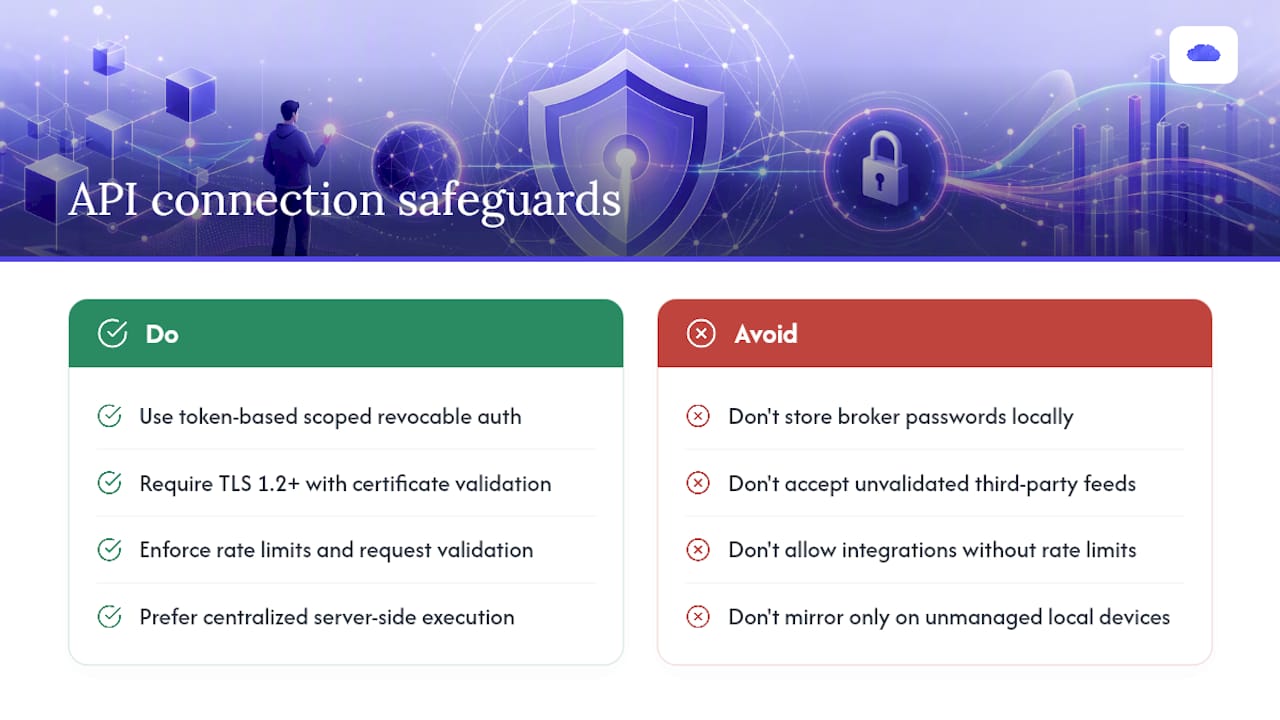
Token-based authentication, the mechanism behind OAuth, means the copier holds a scoped, revocable credential rather than a master password. If that token is compromised, you revoke it at the broker level and the exposure ends immediately. A stored password compromise, by contrast, can require a full credential reset across every connected service.
Beyond authentication, the data feed itself needs protection. Third-party market data and execution feeds should run over encrypted channels with certificate validation, preventing a man-in-the-middle attack from injecting false price data or intercepting order instructions. Rate limiting and request validation on the platform side stop a compromised or malicious integration from flooding an account with erroneous orders.
Server-side execution architecture adds another layer here worth understanding, since algorithmic execution depends entirely on the integrity of the data feed it acts on. If the copier's infrastructure runs the mirroring logic centrally rather than on your local machine, the attack surface narrows to one hardened endpoint instead of every trader's individual device, each running different security patches on different schedules.
Ask any platform directly which encryption standard protects API traffic (TLS 1.2 or higher is the baseline) and whether third-party data feeds are validated against known-good sources before being acted on.
What Stops a Fake or Manipulated Signal From Triggering a Trade?
A copier that mirrors trades faithfully is only as trustworthy as the signal it's mirroring, and that creates an opening for manipulation that pure execution speed doesn't solve. If a leader account's feed gets spoofed or a bad actor injects a false fill into the data stream, a fast copier just mirrors the fraud faster.
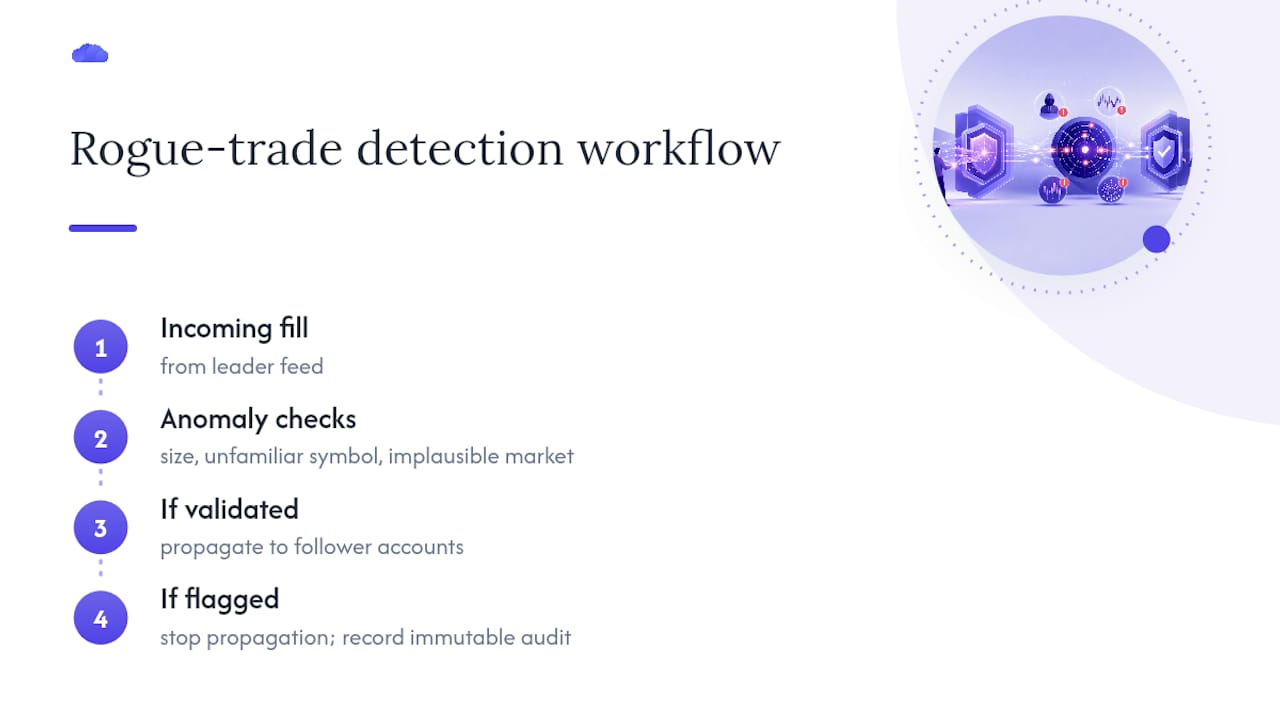
Rogue-trade detection is the primary technical defense here. It works by flagging orders that deviate sharply from a leader's established pattern, an unusually large position size, a symbol never traded before, or a fill that doesn't match plausible market conditions at that timestamp, before that order propagates to every connected follower account. Catching an anomaly at the source stops one bad signal from becoming a dozen bad fills.
Execution mode controls add a second layer by letting you require confirmation or apply size limits on trades that fall outside a leader's normal range, rather than blindly mirroring everything. Immutable audit logs matter here too: a tamper-evident trade history makes it possible to prove after the fact exactly what signal triggered what order, which matters both for internal review and for any dispute with a prop firm about how a flagged trade actually originated.
None of this replaces vetting the leader in the first place. Technical safeguards catch anomalies; they don't validate whether a strategy was ever sound.
The Real Gap in Copy Trading Security Advice
Most guidance on this topic treats security and compliance as two separate conversations: one about encryption and passwords, another about prop-firm rule violations. That split misses the point. A trader who nails OAuth authentication but ignores the internal-versus-external copying boundary hasn't solved their risk problem. They've just solved the easy half of it.
The conventional advice also overweights the platform and underweights the operator. Vendors can build broker-enforced loss limits, rogue-trade detection, and clean audit trails, and none of it matters if the person running five funded accounts through a shared VPS never varies position sizing or reads the firm's actual copying policy. Security here is a shared responsibility between the software and the trader configuring it, and most articles on this topic only talk about one side of that.
If there's one thing to prioritize first, it's this: confirm account ownership and copying permissions with each prop firm in writing before connecting anything. Every other control, allocation caps, stop-losses, latency monitoring, is protecting capital you're still allowed to trade with. Get the compliance boundary wrong, and none of the rest matters.
> — Andres
Get Started With Prop-Firm-Safe Copy Trading
TradeDupe is built for exactly the checklist this article just walked through, not bolted on after the fact. OAuth-based Tradovate connections mean no stored passwords. Broker-enforced daily loss limits and profit targets mean your risk cap holds even if an app crashes. Per-account toggles, rogue-trade detection, and a full trade journal give you the audit trail a prop-firm review actually asks for.
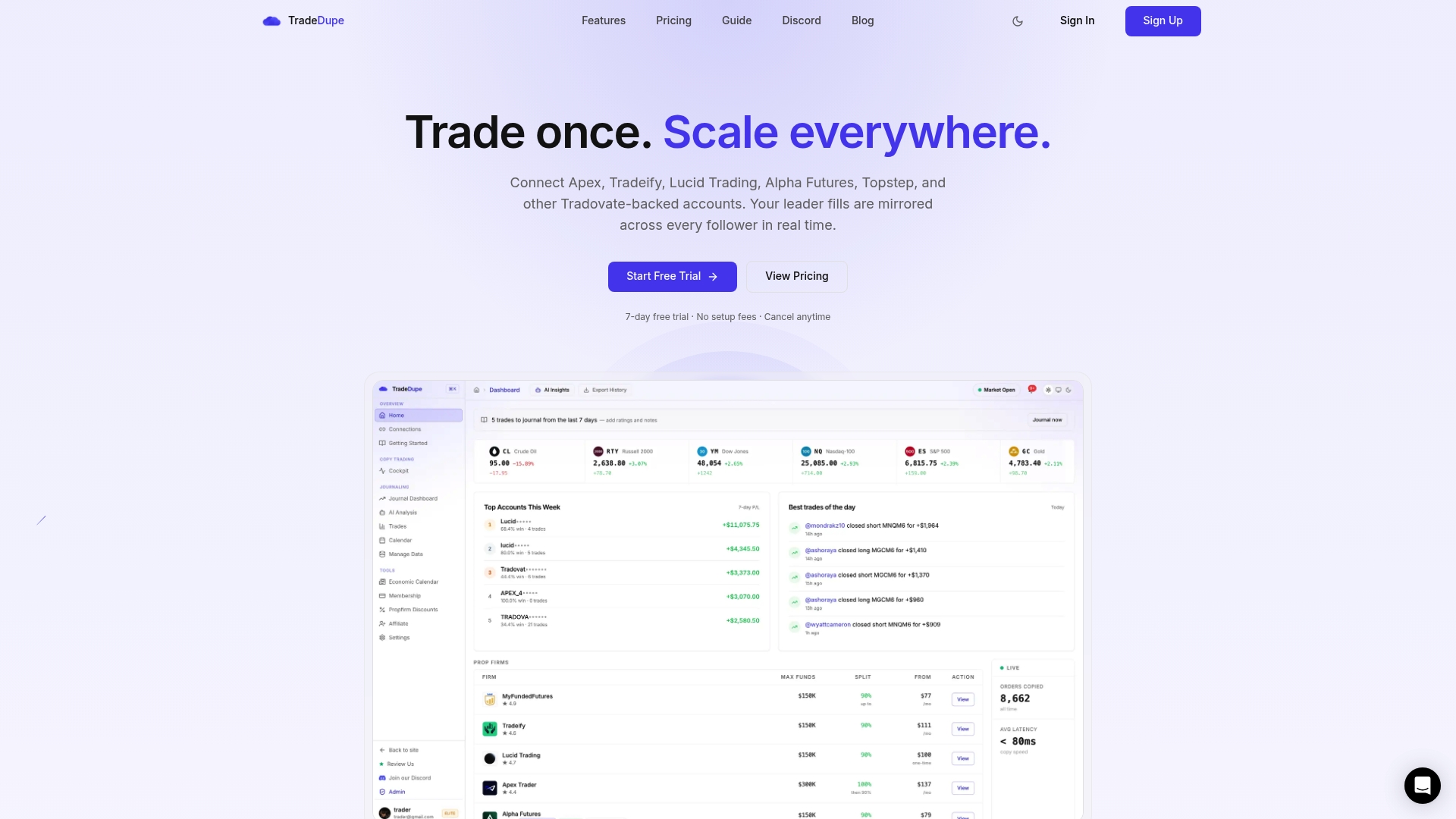
If you're running multiple funded accounts across firms like Apex Trader Funding, Lucid Trading, or TakeProfit Trader, start by reading how copy trading works for futures, then follow the 10-minute setup guide to connect your first leader and follower pair. Plans include a free trial period and allow one-click cancellation, so testing the controls on a demo account before committing real allocation costs you nothing but the time it takes to click connect.
Sources
For deeper regulatory context beyond this article, consult IOSCO's final report on copy trading and ESMA's supervisory briefing for the primary regulatory framing referenced above. For operational compliance detail specific to prop firms, the trade copier compliance guide covers detection vectors and mitigations in more depth than space allowed here.
This article is general information, not a substitute for advice from a qualified financial advisor. Consult a qualified financial professional about your own circumstances before acting on anything here.
- IOSCO final report on copy trading (Dec 2023)
- Common mistakes to avoid in copy trading | Coin Bureau
FAQ
Is There Any Risk in Copy Trading?
Yes. Copy trading carries operational risk (latency, slippage, outages), compliance risk (prop-firm rule violations for external copying), and the same market risk as any leveraged futures position, since a losing strategy loses money whether you traded it yourself or copied it.
Which Copy Trader Is Best for Futures Trading?
For traders running multiple accounts on Tradovate, TradeDupe is built specifically around that use case, with OAuth connections, broker-enforced limits, and per-account risk controls designed for prop-firm compliance rather than general retail copy trading.
Is Copy Trading Illegal in the US?
Copy trading itself isn't illegal, but external copying, mirroring trades into a funded account you don't own, typically violates individual prop-firm agreements rather than any federal law, so the restriction comes from your firm's contract, not government regulation.
Can I Copy Trade Futures?
Yes, and copying trades across multiple futures accounts you personally own is standard practice among prop-firm traders managing several funded evaluations, as long as the platform uses broker-native risk enforcement and you confirm each firm's specific ownership rules first.
Recommended
- Best Trade Copier for Prop Firms (2026): Rules + Setup
- How Prop Firm Rules Affect Trade Copying in 2026
- TradeSyncer vs TradeCopia: Honest 2026 Comparison for Futures Traders
- Five Year Retention: Audit Trails for Copy Trading on Prop Desks
For educational purposes only. Not financial advice. Futures trading involves substantial risk of loss and is not suitable for every investor.