Protect Prop Desk Capital With 34ms Tradovate Selective Copy Trading
TradeDupe
14 min read
Practitioner playbook for Tradovate prop desks: deploy selective copy trading with 34ms median replication, per account toggles, rogue trade detection,...
Selective copy trading, in a professional Tradovate context, means server-side trade mirroring from one leader account to multiple follower accounts with per-account controls governing exactly what replicates and where. The recommended setup pairs deterministic, low-latency execution with granular toggles and portfolio-level exposure limits rather than a blanket "copy everything" mirror. Platforms like TradeDupe are built around this exact model, reporting a low median replication latency across leader-to-follower legs.
*
> TL;DR: > > - Latency must stay below 50 milliseconds for scalping strategies, with median times averaging around 34ms on platforms like TradeDupe. > - Implementing per-account controls, automated rogue-trade detection, and strict reconciliation routines significantly reduces risk and system failures. > - Starting with a small number of accounts, running staged tests, and progressively scaling helps avoid compounded errors and account suspensions. > - Using consolidated portfolio exposure caps, not just per-account limits, prevents correlated trades from exceeding overall risk thresholds. > - Combining automated filters with manual oversight ensures flexibility during volatile sessions and adherence to prop firm policies.
*
Table of Contents
- What Selective Copy Trading Means for Prop Firms
- Core Requirements for Secure, Low-Latency Copying
- How to Roll Out Selective Copy Trading Safely
- Managing Portfolio Risk Across Multiple Accounts
- Monitoring, Alerts, and Recovery Runbooks
- Manual vs. Automated Filtering: Choosing a Strategy Type
- How to Choose Which Traders to Copy
- Setting Allocation Percentages Per Copied Trader
- Why Market Conditions Change the Math
- Common Pitfalls in Selective Copy Trading
- Overview: Why Selective Control Beats Blanket Mirroring
- Lessons From Running a Tradovate-Focused Copier
- Getting Selective Copy Trading Running on Tradovate
- Sources
What Selective Copy Trading Means for Prop Firms
Selective copy trading in the prop world has almost nothing in common with the retail social-copy services most search results describe. Those platforms let an individual follow a public trader's signals with a personal brokerage account and no real control over execution mechanics. Prop desks run a different animal entirely: a leader/follower architecture where a single Tradovate account generates the trade, and a copier engine replicates that order server-side into multiple follower accounts, often across several prop firm evaluations and funded accounts simultaneously.
The word "selective" carries real weight here. A desk operator needs to choose which followers mirror which leader, which symbols get copied, and how position size scales per account. That requires per-account toggle controls and symbol mapping, not a one-size-fits-all broadcast.
Deterministic execution matters more than most traders realize until something breaks. A scalping strategy built on order flow and quick reversals can be destroyed by a 200ms lag between leader fill and follower fill. A swing setup built around fair value gaps or multi-hour holds tolerates more slack. Selective copy trading has to be engineered for the fastest strategy on the desk, because latency budgets don't average out. They get exposed by the worst case.
Core Requirements for Secure, Low-Latency Copying
Running selective copy trading reliably on Tradovate comes down to four technical pillars: speed, control, security, and infrastructure hygiene.
Latency is the first filter. Anything above roughly 100ms between leader execution and follower fill starts to matter for fast intraday strategies, and desks running scalps off liquidity sweeps should be pushing for sub-50ms medians. Some platforms report median latencies comfortably inside that window, which can be a useful benchmark when evaluating any copier's execution logs.
Beyond speed, a workable setup needs:
- Per-account controls: individual on/off toggles, position-size multipliers, and symbol-level inclusion or exclusion per follower.
- API-native connectivity: direct Tradovate API integration rather than screen-scraping or UI automation, which breaks on platform updates.
- Rogue-trade detection: automated flags when a follower account opens a position that doesn't match its leader, or when an order gets stuck mid-fill.
- Auto-recovery: the ability to reconcile or flatten a desynced account without manual intervention.
- Account isolation: authentication and execution paths that don't co-mingle credentials across accounts.
Pro Tip: Run your copier from infrastructure tied to your own identity rather than a shared cloud instance. Isolated execution keeps your setup out of the pattern-matching that some prop firm compliance teams use to flag identical trade signatures across shared IP ranges.
How to Roll Out Selective Copy Trading Safely
Deploying a copier across a multi-account desk is not a flip-the-switch decision. It's a sequence, and skipping steps is where most desks get burned.
- Verify firm policy first. Some prop firms permit automated copying only under strict proof-of-ownership documentation, and a few restrict cloud-based copiers outright. Get this in writing before connecting a single follower account.
- Run a sandbox test. Set up one leader and two followers in demo or minimal-size live conditions for at least a week to check fill parity, slippage drift, and how the system handles a stuck order.
- Activate in small groups. Start with three to five accounts rather than connecting your entire roster on day one. A full week of staged testing at low size before scaling catches replication issues while the downside is still small.
- Configure Tradovate and Rithmic settings deliberately. Confirm order routing, symbol mapping, and account permissions match across every follower before going live.
- Automate portfolio ceilings. Set a combined exposure cap and an auto-stop trigger that flattens the group if drawdown or desync exceeds a defined threshold.
- Reconcile daily. Compare leader and follower logs every session, not just when something looks wrong.
Desks that follow this staged approach consistently report fewer live incidents than those that connect everything at once. The Managing Multiple Funded Accounts framework recommends requiring at least two successful payout cycles at a small account count before adding more, and that discipline is worth building into a written internal policy, not just a mental note.
Managing Portfolio Risk Across Multiple Accounts
Per-account stop losses feel like enough protection until every account is running the same strategy at the same time. Multiple accounts running the same strategy at the same time mean total portfolio risk is higher than individual per-account risk limits, due to correlated trades.
The fix is a consolidated portfolio exposure ceiling calculated across all accounts combined, not per account in isolation. One workable framework suggests capping aggregate risk at around 1% of combined funded capital per trade rather than layering individual limits and hoping they don't stack.
Building that ceiling into daily practice means:
- Running a pre-session check that totals open exposure across every connected account before the first trade of the day.
- Running scenario analysis (what happens if this setup fails on all five accounts simultaneously) before adding a new follower to the group.
- Documenting the copier's toggle configuration, symbol mapping, and exposure limits in a format compliance teams at each firm can review quickly.
- Setting a hard rule for when to pause the entire group: three consecutive stopped-out trades across the portfolio, for example, not just one account.
- Reducing position size across the board, not just on the losing account, when drawdown crosses a predefined threshold.
None of this replaces legal or compliance review specific to each firm's rulebook. It does replace the common mistake of treating five funded accounts like five unrelated risk buckets.
Monitoring, Alerts, and Recovery Runbooks
A copier without a dashboard is a liability wearing a convenience label. Desk operators need visibility into four numbers at minimum: replication success rate, per-account latency, open position drift between leader and followers, and reconciliation deltas at end of session.
Reasonable alert thresholds look like this:
- Auto-flatten the follower group if replication success drops below 95% within a session.
- Flag and pause new order routing if median latency spikes past your baseline by more than 3 to 4 times (for a 34ms baseline, that's a red flag north of 120ms).
- Trigger a manual review if position drift between leader and any follower exceeds one contract on a size-matched account.
A reconciliation playbook should generate timestamped logs of every leader order and its corresponding follower fills, kept in a format that survives an audit or a post-incident review. Pro Tip: Don't rely solely on the copier's own fill logs. Cross-check against an independent execution feed like Rithmic or CQG periodically. Platform replication logs sometimes miss partial fills that the raw execution feed catches immediately.
Manual vs. Automated Filtering: Choosing a Strategy Type
Selective copy trading strategies split into two broad camps, and most desks end up using both depending on the leader's strategy profile.
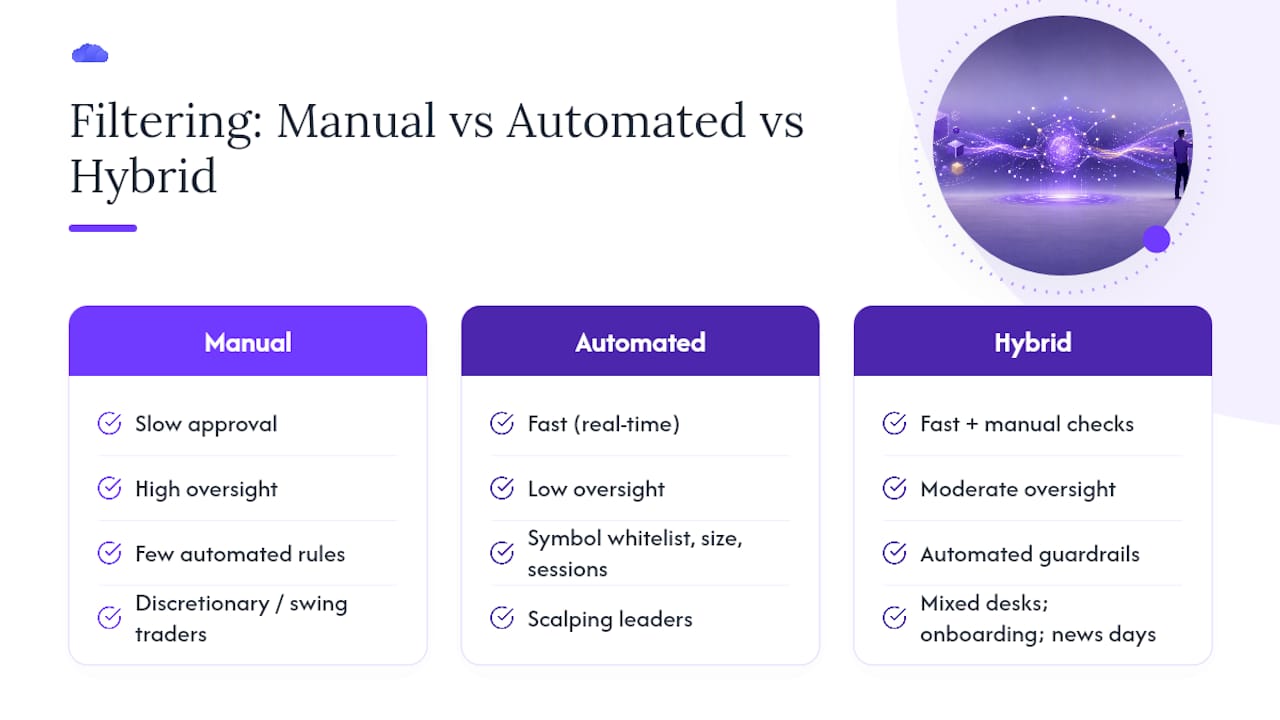
Manual filtering means a human reviews and approves which trades or which leaders get mirrored before capital moves. This suits discretionary strategies where context matters, such as a leader trading around liquidity sweeps or news events where a follower account might need a different symbol allocation entirely. It's slower but gives an operator a final checkpoint before risk hits multiple accounts.
Automated filtering applies rules at the system level: symbol whitelists, maximum position size per follower, time-of-day restrictions, or automatic exclusion of any trade above a volatility threshold. This is the only practical approach for scalping strategies, where a human review step would erase the latency advantage the entire setup depends on.
Most professional desks land on a hybrid. Automated filters handle the mechanical guardrails (symbol mapping, size limits, session windows), while a manual review layer sits on top for strategy changes, new leader onboarding, or unusual market conditions like a Federal Reserve announcement day. The mistake to avoid is treating filtering as binary. A desk running a single scalping leader across ten followers needs almost entirely automated rules. A desk copying a discretionary swing trader into two or three accounts can afford a slower, more manual approval process without losing much edge.
How to Choose Which Traders to Copy
Picking a leader account is where most of the long-term performance gets decided, and it deserves more rigor than "this account has a good week."
Look past raw profit and loss first. A leader with a strong win rate built on oversized risk per trade is a liability once it's scaled across five or ten follower accounts. The metrics that matter more:
Drawdown consistency over at least several weeks, not a single hot streak. Risk-adjusted return, meaning profit relative to how much capital was actually put at risk on losing trades. Trade frequency and holding time, because a high-frequency scalper needs a fundamentally different latency setup than a swing trader holding overnight. Correlation to existing leaders, since copying two traders who both go long on the same order flow signal doesn't diversify anything. It doubles the same bet.
A leader's risk profile should be documented before onboarding: typical stop distance, average position size relative to account balance, and maximum historical drawdown. That documentation becomes the basis for setting the allocation percentage in the next step, and it's the same paperwork a prop firm compliance reviewer will likely ask to see.
Setting Allocation Percentages Per Copied Trader
Allocation percentage determines how much of a follower account's buying power mirrors each leader's position size, and getting this wrong is one of the fastest ways to blow a funded account.
A common starting approach: allocate based on the follower account's balance relative to the leader's typical position sizing, scaled down conservatively. If a leader trades 3 contracts on a $150,000 evaluation account, a follower with a $50,000 account shouldn't mirror at full size. A proportional multiplier, often starting well under 1:1, keeps the follower's risk in line with its own capital base rather than blindly copying contract counts.
Allocation isn't a single number set once. It should flex with:
- The leader's current drawdown state (reduce allocation percentage during a losing stretch rather than after it).
- The follower account's proximity to a daily loss limit imposed by its prop firm.
- Correlation with other leaders already being copied into that same follower.
Desks that treat allocation as fixed tend to discover the problem the hard way, usually during a volatile session when every copied leader moves at once. Reviewing allocation weekly, not quarterly, keeps the number honest.
Why Market Conditions Change the Math
Selective copy trading performs differently depending on volatility regime, and assuming static behavior across all conditions is a quiet way to erode an edge.
In low-volatility, range-bound sessions, latency tolerance widens. A few extra milliseconds of slippage barely registers when price isn't moving much between leader entry and follower fill. High-volatility sessions, especially around economic releases, are a different story. Spreads widen, fills slip further from intended price, and the gap between a 34ms replication and a 150ms one becomes the difference between a matched fill and a follower account entering at a meaningfully worse price than its leader.
Liquidity deserts, the thin, gappy conditions that show up overnight or during low-volume holiday sessions, create another failure mode. A leader's order might fill cleanly on one instrument while a follower's mirrored order on the same instrument gets partial fills or rejects outright due to thinner depth on that specific account's routing.
The practical response isn't to avoid volatile sessions entirely. It's to build volatility-aware rules into the copier configuration: wider slippage tolerance bands during high-impact news windows, automatic pause triggers if fill price deviates beyond a set threshold, and closer manual monitoring during known high-volatility periods rather than assuming the automated system will handle every scenario identically.
Common Pitfalls in Selective Copy Trading
The failures that sink multi-account desks are rarely dramatic. They're usually small process gaps that compound.
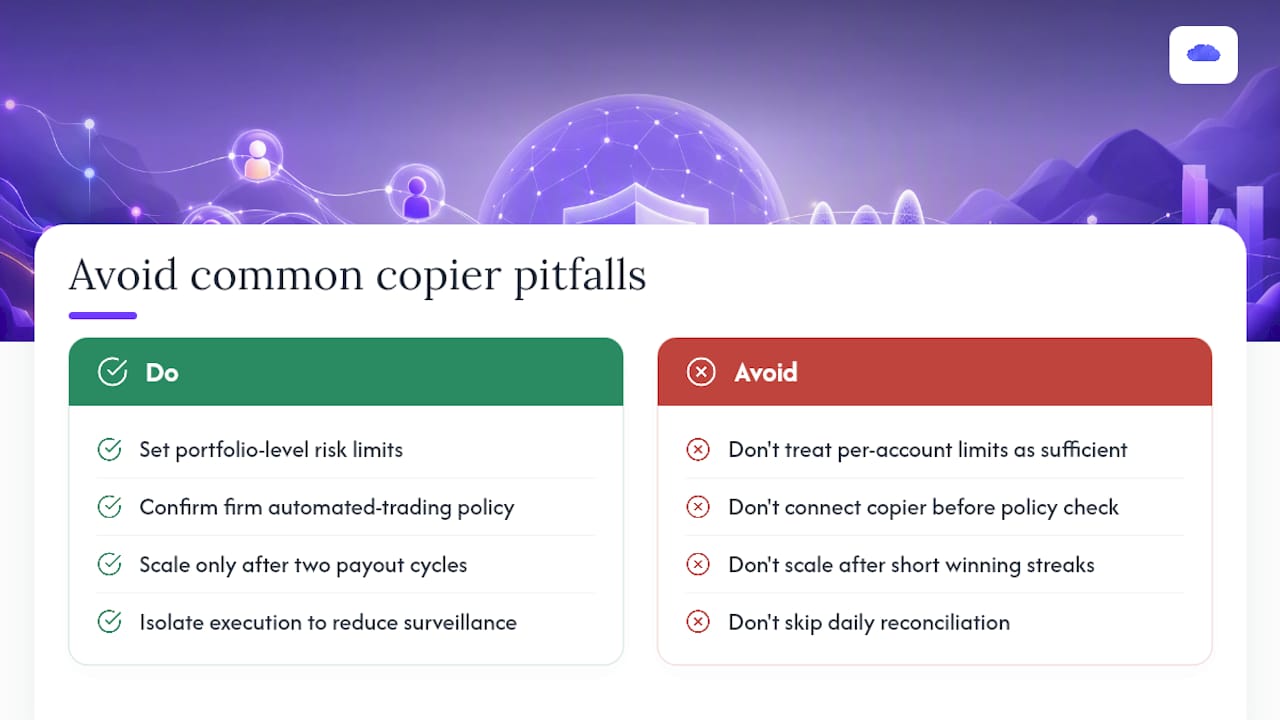
Treating per-account limits as portfolio protection. As covered earlier, five accounts running correlated trades can stack risk far beyond what any single account's stop loss suggests.
Skipping the firm-policy check. Connecting a copier before confirming a prop firm's specific rules on automated trading risks an account suspension that has nothing to do with trading performance.
Scaling too fast after a good week. A leader that performs well across three accounts for five days isn't proven. Waiting for at least two full payout cycles before adding meaningfully more accounts filters out short-term variance from genuine edge.
Running on shared cloud infrastructure without checking surveillance exposure. Identical trade timestamps and sizes across accounts are exactly the pattern some firm surveillance systems are built to catch, and isolated execution reduces that footprint.
Ignoring reconciliation until something breaks. Daily log comparison between leader and follower fills catches drift while it's still a minor fix, not a compliance incident.
Assuming the copier's dashboard is the only source of truth. Cross-checking against an independent execution feed occasionally catches issues the platform's own logs miss entirely.
None of these require exotic solutions. They require a written checklist and the discipline to follow it every session, especially on the days trading feels routine.
Overview: Why Selective Control Beats Blanket Mirroring
The core benefit of selective copy trading over blanket mirroring is simple: it lets a desk scale one proven strategy across many accounts without scaling the mistakes along with it. A leader account generates signal. Selective controls decide which followers receive that signal, at what size, and under what conditions it gets paused.
That selectivity shows up in three concrete advantages. First, capital efficiency: a desk can run one strategy across a dozen funded accounts instead of splitting attention across a dozen separate manual executions. Second, risk containment: per-account toggles mean a single problematic follower account can be paused without touching the rest of the group. Third, compliance clarity: documented, controllable copying is far easier to explain to a prop firm's compliance team than an opaque automation nobody on the desk fully understands.
The tradeoff is operational overhead, especially regarding a compliant trade execution setup that minimizes compliance risk and enforces isolated account execution. Selective copy trading demands monitoring, reconciliation, and a genuine understanding of latency and exposure math that manual single-account trading never requires. Desks that treat the setup phase as a formality rather than an engineering task are the ones that end up with an unplanned account suspension or a correlated drawdown they never modeled.
Lessons From Running a Tradovate-Focused Copier
Every session on a multi-account desk starts the same way: check overnight news for anything that could widen spreads, confirm every follower account shows a healthy connection status, and verify the previous session's reconciliation closed clean. That three-minute routine catches more problems than any single dashboard alert.
The failure modes worth remembering are rarely the exotic ones. A stuck order on one follower during a fast market move, left unresolved for even a few minutes, can snowball into a position mismatch that takes the rest of the session to untangle. The fix wasn't a smarter algorithm. It was a hard rule: any desync gets flattened and manually reviewed before the next signal fires, no exceptions for "it'll probably resolve itself."
Scaling from three accounts to ten should follow the same logic every time: add one or two accounts, run them for a full week without touching allocation, confirm reconciliation stays clean, then add the next group. Desks that skip that patience usually find out why it existed the hard way, and usually during the one week they least expected volatility to spike.
> — Andres
Getting Selective Copy Trading Running on Tradovate
Everything covered above, latency targets, per-account toggles, rogue-trade detection, staged rollout, points toward the same operational shape: a copier built specifically for Tradovate's execution environment rather than a generic bolt-on. TradeDupe was built around exactly that shape.
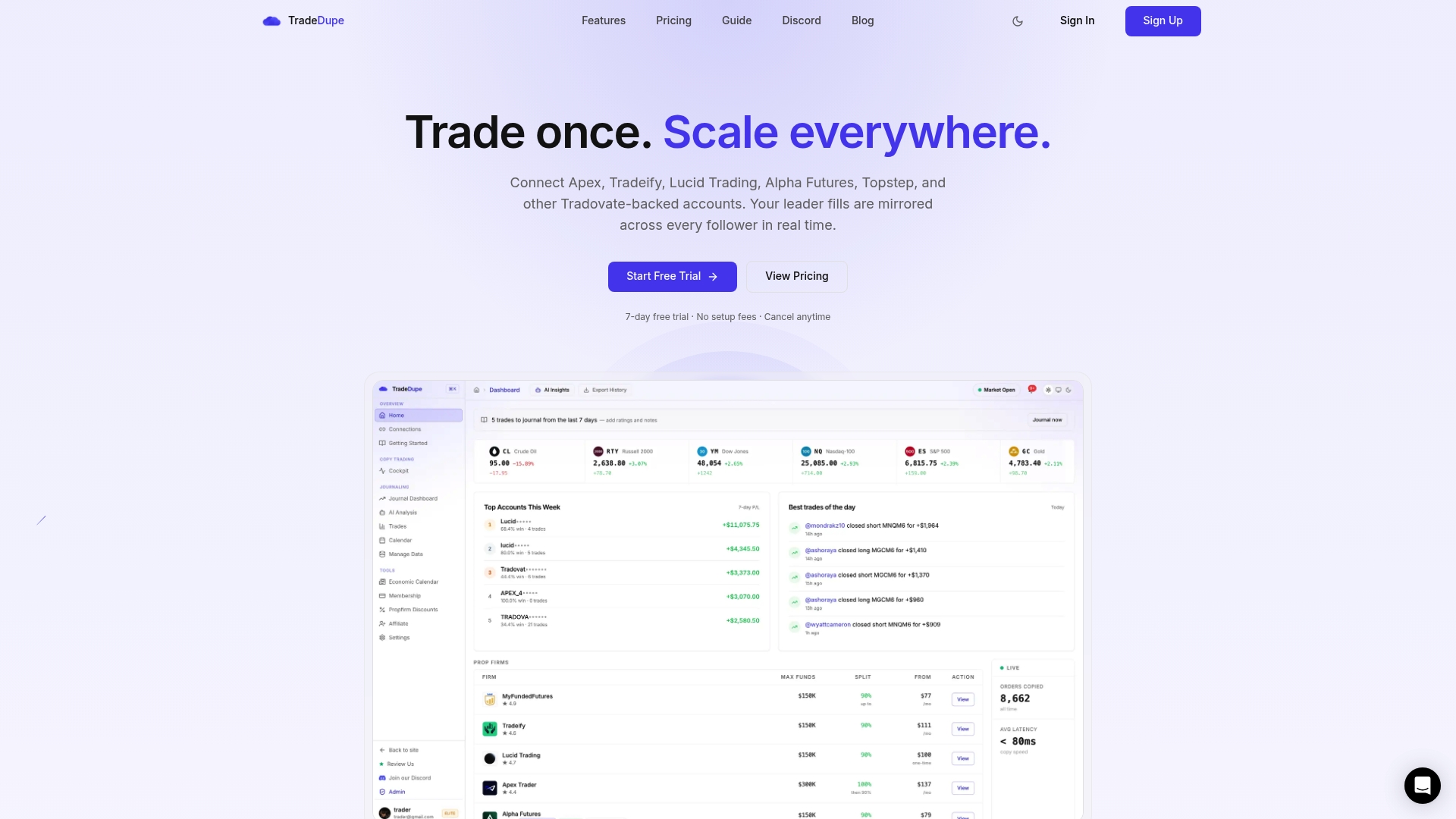
The platform runs leader-to-follower replication at a median of 34ms with per-account toggle controls that let you pause or resize any single follower without touching the rest of the group. Rogue-trade detection and auto-recovery handle the desync scenarios covered in the runbook section above, and native integrations with Apex, Tradeify, Lucid Trading, and Alpha Futures mean the setup maps directly onto accounts most Tradovate-based desks are already running. The admin verification process walks through the same proof-of-ownership documentation your prop firm will likely want to see before approving automated copying.
If you're managing three accounts or thirty, the right next step is a staged trial rather than a full connection on day one. Get started with TradeDupe and configure your first leader-follower pair on a small group before scaling the rest of your desk.
Sources
- Prop Firm Trade Copier Rules: What's Allowed in 2026
- Risk Management for Multi-Account Prop Firm Traders
- Managing Multiple Funded Accounts: The Portfolio Approach to Prop Firm Trading
- Trade Copying Rules for Futures Prop Firms