
Trade Reconciliation Automation for Tradovate Prop Desks: 6 Essentials
TradeDupe
8 min read
Real-time trade reconciliation automation for Tradovate prop desks: the six essential components, latency targets, compliance controls, and how TradeDupe...
Trade reconciliation automation, in the sense that matters for prop desks, means real-time Tradovate trade mirroring with per-account risk controls, latency monitoring, and audit logging, not back-office ledger matching. The right approach for a Tradovate-based operation is a low-latency native copier or a purpose-built platform, tested in a sandbox before it ever touches live capital.
*
> TL;DR: > > - Real-time trade mirroring requires instant leader signal capture, symbol mapping, and order translation to prevent mismatches and account blowups. > - Latency thresholds of 150ms for scalping and 300ms for swing trading are critical; exceeding them triggers auto-pause and increases risk of misexecution. > - Prop firms detect group trade copying through timestamp correlation, shared IPs, reused identifiers, and performance pattern analysis, requiring deliberate countermeasures. > - Proper deployment involves sandbox testing, symbol mapping, setting risk thresholds, and small pilots to catch errors before risking large capital. > - TradeDupe offers a built-in, low-latency, compliant trade copying solution with extensive monitoring, auto-recovery, and multi-platform support, saving weeks of development time.
*
Table of Contents
- What Does Trade Reconciliation Automation Actually Require?
- How Does Tradovate API Integration Work for Trade Copying?
- How Do You Avoid Detection Issues With Prop Firm Copy Trading?
- What Is the Implementation Checklist Before Going Live?
- How TradeDupe Meets These Requirements for Prop Desks
- Build Versus Buy: What Actually Determines the Right Call
- Get Your Tradovate Accounts Mirroring in Minutes, Not Weeks
- Sources
What Does Trade Reconciliation Automation Actually Require?
A copying system that survives contact with a funded desk needs six working parts, and skipping any one of them is how firms end up with blown accounts or compliance letters. Each piece solves a distinct failure mode.
- Leader signal capture: the master account's fills and cancellations need to be caught the instant they happen, not polled every few seconds.
- Symbol mapping: futures tickers carry roll-dependent suffixes (think ESZ6 vs. ESH7), and a mismatch here sends orders into the wrong contract entirely.
- Order translation: converting a master order into a follower order with the correct multiplier, side, and order type before it ever reaches an execution endpoint.
- Per-account scaling: a $50,000 evaluation account and a $150,000 funded account should never receive identical contract sizes off the same signal.
- Execution channel: how the translated order actually reaches each broker, whether through direct API calls or a broker-side gateway.
- Monitoring and logging: a running record of what the master did, what each follower did, and how long it took.
Latency and audit logs aren't optional extras bolted onto a copier. They're critical to catching drawdown breaches promptly, rather than after the fact. TradeDupe builds each of these components around the Tradovate ecosystem specifically, which matters more than it sounds, since generic multi-broker copiers tend to treat Tradovate as just another REST endpoint rather than a first-class integration.
How Does Tradovate API Integration Work for Trade Copying?
Tradovate's partner API exposes both REST and WebSocket endpoints across live, demo, and market-data environments (`live.tradovateapi.com`, `demo.tradovateapi.com`, and `md.tradovateapi.com`). Access requires Org Admin credentials, an API key, and a CID, so the first real engineering decision is how your organization structures those credentials across leader and follower accounts.
The order lifecycle in a functioning mirror setup runs through five discrete steps:
- Master event detection — the WebSocket subscription fires the instant the leader account fills, cancels, or modifies an order.
- Symbol mapping and validation — the system checks the contract against each follower's mapped symbol table, catching suffix mismatches before they become bad fills.
- Multiplier calculation — each follower's position size is computed from its own risk profile, not a flat copy of the leader's size.
- Destination API call — the translated order fires to each follower account, ideally within tens of milliseconds of the master event.
- Execution confirmation and logging — every fill, partial fill, or rejection writes to an audit log tied to a timestamp and account ID.
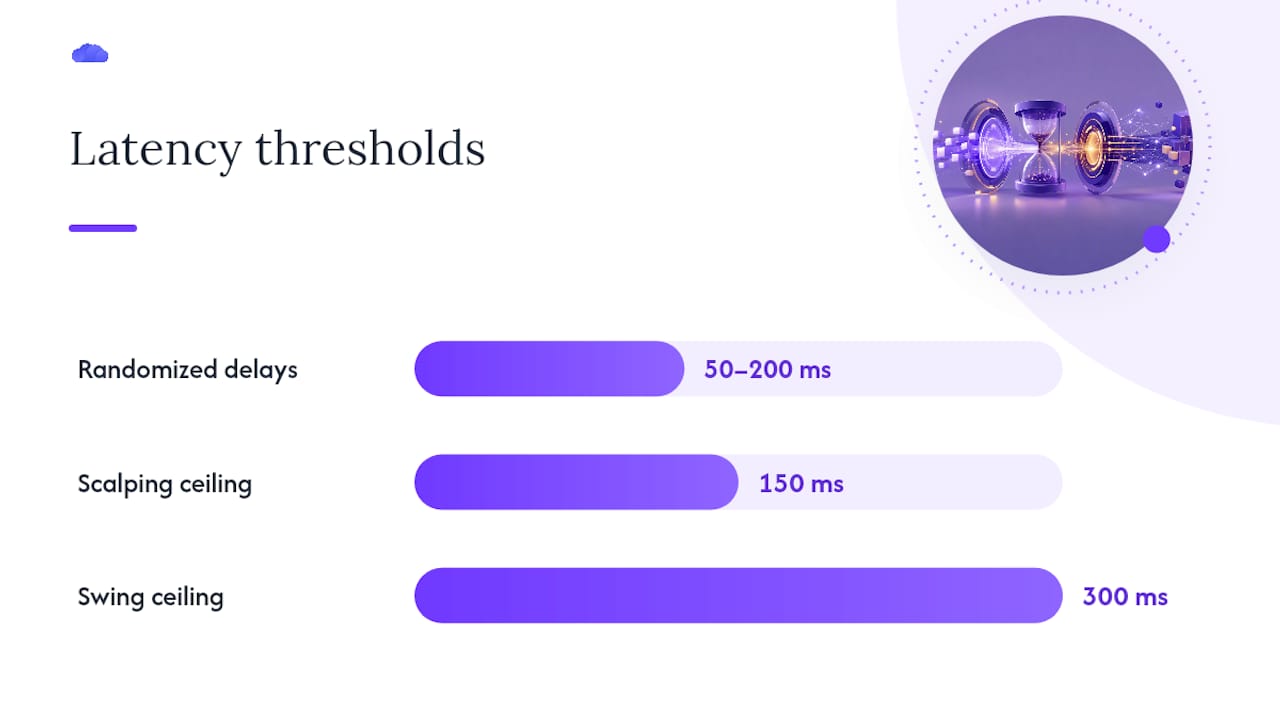
Round-trip latency needs active monitoring, not a one-time check at setup. Guidance from copier operators generally points to thresholds around 150ms for scalping strategies and 300ms for swing trades, with automated pause logic suspending new orders to any account whose round-trip time spikes past its threshold. That prevents a slow follower connection from executing into a price that's already moved.
Partial fills and symbol suffix mismatches are the two most common operational headaches. A follower that only gets filled on 60% of a contract needs a re-sync routine that reconciles the discrepancy against the master rather than silently drifting out of alignment.
Pro Tip: Build your auto-recovery logic to compare follower positions against the master's net position on every heartbeat, not just after a trade event. Drift that starts from a single missed WebSocket message compounds fast across a trading session.
How Do You Avoid Detection Issues With Prop Firm Copy Trading?
Most funded-account agreements prohibit "group trading" while still permitting a trader to copy their own signals across their own accounts. The distinction lives in how the copying happens, not whether it happens at all, and prop firms have gotten reasonably sophisticated about spotting the difference.
Detection commonly relies on a handful of signals: identical execution timestamps across accounts, shared IP addresses from a common cloud copier server, reused EA identifiers, and statistical correlation between account performance curves that's too tight to be coincidental.
The countermeasures map directly to those detection vectors:
- Run per-account multipliers so position sizes never match exactly across accounts.
- Use unique API credentials, and local or native execution rather than a shared cloud IP, wherever the firm's rules make IP correlation a real risk.
- Set circuit breakers tied to max-drawdown limits that halt copying automatically before a group-level breach occurs.
- Keep per-account toggle controls so any single follower can be paused without disrupting the rest.
- Introduce small, randomized delays, typically in the 50–200ms range, between replicated orders to break the identical-timestamp fingerprint.
A useful number to anchor your setup around: treat 150ms as your scalping latency ceiling and 300ms for swing trades, per the thresholds copier operators commonly cite, and log every breach automatically rather than relying on someone noticing.
Documentation matters as much as the controls themselves. Keep support correspondence with each prop firm, full execution logs, and sandbox test records on file. If a firm ever flags an account, a clean audit trail is what separates a quick clarification from a lost account.
What Is the Implementation Checklist Before Going Live?
Deployment order matters here. Skipping the sandbox phase to get live faster is the single most common way desks end up debugging a broken copier with real capital exposed.
- Secure API credentials for each account, keeping Org Admin access, API keys, and CIDs organized per firm and per account.
- Map every symbol the leader trades, including contract roll dates and suffix conventions for each destination account.
- Record each prop firm's specific rules, including drawdown limits, permitted position sizes, and any explicit language on copy trading.
- Define multipliers and latency thresholds per account before any live connection is made.
- Run full sandbox tests end to end, capturing slippage, establishing a latency baseline, and confirming circuit breakers actually trigger.
- Launch a small-capital pilot across one or two follower accounts before scaling to the full roster.
- Set monitoring thresholds on the live dashboard and confirm the rollback and auto-recovery playbook works under simulated stress.
- Establish ongoing operations: daily health checks, scheduled rule reviews with each prop firm, and a standing incident log.
Following this order isn't bureaucratic caution. It's how you catch the mapping error or the latency spike before it happens to a $200,000 funded account instead of a demo one.
How TradeDupe Meets These Requirements for Prop Desks
TradeDupe was built around this exact checklist rather than adapted to it after the fact. The platform runs real-time trade mirroring at a median latency of 34ms, with rogue-trade detection and auto-recovery handling the drift and disconnect scenarios covered above. Per-account toggle controls let you pause a single follower without touching the rest of the group.
Integration support covers Apex, Tradeify, Lucid Trading, and Alpha Futures, which matters if your desk runs evaluation and funded accounts across more than one firm simultaneously. The dashboard tracks sync status, leader/follower activity, and execution deltas in one place, backed by audit trail workflows built for exactly the documentation prop firms expect.
Solo traders running two or three accounts fit the entry tier; desks managing a dozen funded accounts across multiple firms generally need the enterprise plan for unlimited broker connections and priority support.
Build Versus Buy: What Actually Determines the Right Call
The honest answer is that building your own copier only makes sense once you have the staffing to maintain it: someone doing SRE-style uptime work, a compliance lead tracking each firm's evolving rules, and an engineer who treats Tradovate API integration as an ongoing job, not a weekend project.
Most desks don't have that staffing, and that's not a knock on their trading skill. It's a different discipline entirely.
The scaling signals worth watching are account count, capital under management, and trade frequency. A trader running two accounts on a swing strategy can often get away with a simple setup. A desk running fifteen accounts across four prop firms on an intraday strategy is running real operational risk with anything less than dedicated tooling, regardless of how good the underlying strategy is.
> — Andres
Get Your Tradovate Accounts Mirroring in Minutes, Not Weeks
Building the checklist above from scratch means weeks of engineering time before your first live trade even syncs. TradeDupe gets a Tradovate-based desk from signup to a working sandbox test in one session, with the latency dashboards, per-account controls, and audit logs already built rather than something your team has to code.
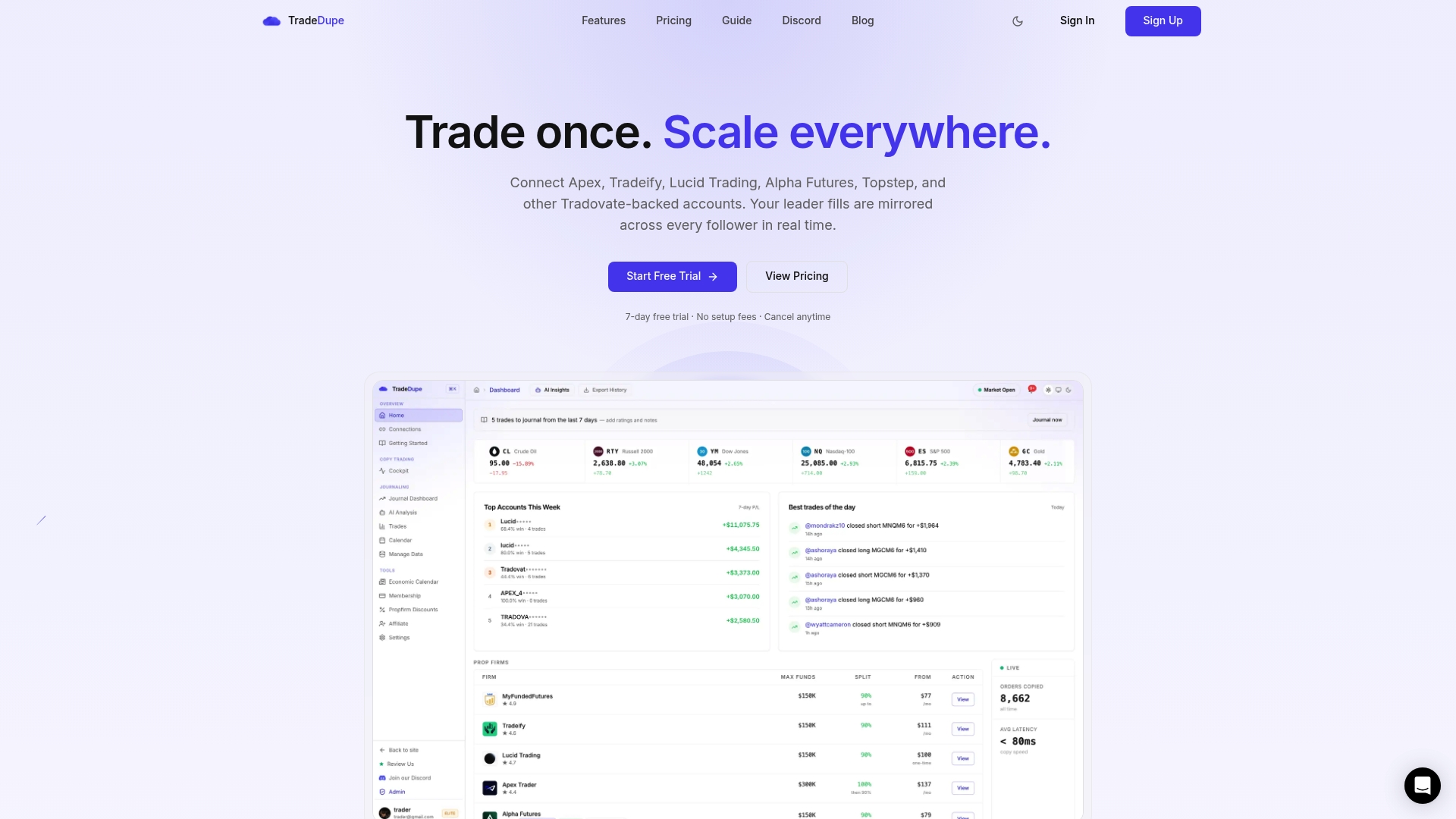
The demo walks through real sync-status dashboards, per-account toggle controls, rogue-trade detection alerts, and the sandbox testing flow that lets you validate everything before a single follower account goes live. If your desk runs multiple accounts across Apex, Tradeify, Lucid Trading, or Alpha Futures, the Apex copy trading page shows exactly how account scaling works in practice. Start by connecting your organization through the admin verification flow, then run your first sandbox test the same day.
Sources
- Trade Copier for Multiple Prop Firm Accounts: Setup Guide
- Trade Copying Across Multiple Prop Firm Accounts Safely - TradingIM
- Prop Firm Trade Copier Rules: 5 Key Facts for 2026