

Audit Trade History Across Accounts: A Prop Firm Workflow
TradeDupe
11 min read
Discover a streamlined workflow to effectively audit trade history across accounts, ensuring compliance and accuracy in your trading operations.
A compliant audit of trade history across accounts must produce one artifact: a time-ordered, attributed, tamper-evident record linking order requests, executions, and account identity, end to end. NIST defines this as the audit trail's core job, and SEC guidance treats account identifiers and execution timestamps as non-negotiable fields. Your first move today: export a canonical trade CSV from every connected account and confirm each row carries an execution ID. Tools like TradeDupe, PropForge, and Interactive Brokers' TWS trade log all produce a starting export, but none of them substitute for the linking work described below.
Key Takeaways
A defensible multi-account trade audit requires deterministic linking keys, a signed evidence manifest, and documented limitations, not just raw exports.
| Point | Details |
|---|---|
| Lead with linking, not collection | Build deterministic matching rules (execution_id, tolerance windows) before building dashboards or reports. |
| Standardize the schema early | Require account_id, execution_id, ISO timestamps, and fill flags on every row before any analysis. |
| Sign your evidence bundle | Package canonical CSVs, traces, and a manifest with file hashes for chain of custody. |
| Document what you cannot prove | Log clock skew, missing IDs, and shared-credential gaps with a compensating control for each. |
| Consider a mirroring platform | Tradedupe provides real-time trade mirroring and logging across Tradovate accounts, giving prop desks an audit trail as trades happen rather than after the fact. |
This article is general information, not a substitute for advice from a qualified financial advisor. Consult a qualified financial professional about your own circumstances before acting on anything here.
Table of Contents
- How Do You Audit Trade History Across Multiple Accounts?
- What Fields Belong in a Minimal Trade-Log Schema? For best-practice checklist on trade journaling fields and analytics, see [what a crypto trading journal app should track.](#what-fields-belong-in-a-minimal-trade-log-schema-for-best-practice-checklist-on-trade-journaling-fields-and-analytics-see-what-a-crypto-trading-journal-app-should-trackhttpsdisciplineaiappcompostwhat-a-crypto-trading-journal-app-should-track)
- How Do You Link and Reconcile Trades Across Accounts?
- What Multi-Account Abuse Patterns Should You Watch For?
- Should You Use CSV Exports, an ETL Pipeline, or a SaaS Investigation Desk?
- What Should Go Into the Compliance Evidence Bundle?
- How Do You Turn Audit Rules Into a Repeatable Policy?
- What Governance Controls Do Auditors Expect?
- What Are the Limits of a Multi-Account Trade Audit?
- The Honest Take on Multi-Account Audit Tooling
- A Practical Next Step for Prop Desks Auditing Across Accounts
- Sources
- FAQ
How Do You Audit Trade History Across Multiple Accounts?
Cross-account trading audit work follows five stages, and skipping any of them leaves gaps an examiner will find.
- Collect. Pull raw exports from every source: broker trade logs (Interactive Brokers TWS or Flex XML exports work well here), prop firm dashboards, and any internal mirroring tool logs. Minimal input: account credentials or API scope. Minimal output: raw CSV or JSON per account.
- Normalize. Convert every export into one schema (see below), fixing timezone offsets, symbol formats, and partial-fill notation.
- Link. Match executions across accounts using execution IDs, order IDs, and timestamp windows, covered in detail further down.
- Enrich. Attach KYC records, device fingerprints, and IP logs to each account_id so a matched pair can be traced to a person, not just a login.
- Report. Package normalized data, matched pairs, and flagged anomalies into a signed evidence bundle.
Pro Tip: If your mirroring tool issues temporary credential pairs for follower accounts, log the pairing event itself. It is often faster to trace a copy-trading relationship through a credential-issuance timestamp than to reconstruct it purely from execution timing.
What Fields Belong in a Minimal Trade-Log Schema? For best-practice checklist on trade journaling fields and analytics, see what a crypto trading journal app should track.
A workable schema for trade history analysis needs fewer fields than most teams assume, but every one of them is load-bearing. Drop one and reconciliation breaks downstream.
- `account_id`, `order_id`, `parent_order_id` (for child fills)
- `execution_id` or a unique nonce per fill
- `timestamp` in ISO 8601 with explicit timezone, plus a separate `server_timestamp` where available
- `instrument`, `side`, `quantity`, `price`, `fees`
- `fill_flag` (full, partial, canceled) and raw order metadata (order type, TIF)
Normalize symbol formats to one convention (root plus expiry for futures, no exchange suffixes) before matching anything. Partial fills should carry the same `order_id` with incrementing `execution_id` values rather than being collapsed into a single row.
| Field | Example Value |
|---|---|
| account_id | account_id |
| order_id | ORD-88213 |
| execution_id | EXEC-88213-1 |
| timestamp | 2026-03-04T14:32:01.203Z |
| instrument | instrument |
| side / qty / price | side / quantity / price |
How Do You Link and Reconcile Trades Across Accounts?
Deterministic linking beats fuzzy matching every time an auditor is going to read the output. Use hard keys first, tolerance windows second.
- Primary keys: execution_id, order_id pairs, and where a mirroring tool assumes short-lived credentials to place trades on a follower account, the credential-pairing ID works the same way AWS's cross-account role pattern links an AssumeRole event to the API calls made under it.
- Secondary keys: client_order_id heuristics, useful when a broker doesn't expose a stable execution ID across API versions.
- Timestamp tolerance: set a window (commonly 50 to 250 milliseconds for mirrored fills, wider for manually copied trades) based on your platform's observed latency, not a guess.
A matched pair looks like: leader account fills EXEC-88213-1 at 14:32:01.203Z, follower account fills EXEC-99042-1 at 14:32:01.238Z, same instrument, same side, quantity scaled by account size ratio. The reconciliation logic sketch: group by instrument and side within the tolerance window, score matches by quantity ratio consistency, then flag anything left unmatched as an orphan fill requiring manual review.
Pro Tip: Widening your timestamp tolerance to "fix" unmatched fills usually hides a clock-skew problem instead of solving it. Fix the clock, not the window.
What Multi-Account Abuse Patterns Should You Watch For?
Multi-account trade review exists mainly to catch behavior a single-account view can't see. The patterns worth building rules around:
- Matched opposing positions across two accounts under common control, effectively a risk-free hedge against firm capital
- Near-simultaneous entries across accounts that consistently precede a favorable move, suggesting information or execution advantage sharing
- Repeated correlated fills between accounts that share a device fingerprint or IP but not a stated ownership link
- Duplicate KYC details, or KYC fields that match a previously banned account under superficial edits
Detection signals worth computing: cross-correlation of fill timing between account pairs, identical order hashes across accounts, and millisecond-level clustering of entries that shouldn't be coincidental. Start threshold tuning conservatively (flag only correlations above 0.85 with three or more repeated instances) and loosen only after reviewing false positives manually. A rule that fires on every high-volume trader's normal behavior will bury your investigators in noise.
Should You Use CSV Exports, an ETL Pipeline, or a SaaS Investigation Desk?
The right architecture depends on volume and how fast you need evidence ready, not on which option sounds most sophisticated.
- Manual CSV inspection works for small desks auditing a handful of incidents a month. It's the slowest option and doesn't scale past a few accounts before spreadsheet errors creep in.
- Automated ETL into a canonical store fits firms with in-house engineering who need to audit trade history across accounts regularly and want full control over the schema and retention. Expect real setup time before the first audit runs.
- Integrated SaaS investigation desks built around real-time mirroring, like Tradedupe, combine trade replication with immutable logging so the evidence trail exists before an investigation ever starts, rather than being reconstructed after the fact.
Decide based on: data volume, how fast you must produce evidence for a firm's risk desk, audit frequency, available engineering hours, and whether you need signed, tamper-evident exports or a simple internal review file.
What Should Go Into the Compliance Evidence Bundle?
An investigation package needs to stand on its own when an auditor or regulator opens it months later, without anyone available to explain gaps.
- Canonical trade CSVs and their normalized JSON equivalents
- Execution traces showing order-to-fill lineage per account
- System audit logs and alert history covering the incident window
- Investigator notes and a decision log showing why each flagged event was resolved as it was
- A signed manifest binding every file together
| Manifest Field | Purpose |
|---|---|
| manifest_id | Unique bundle identifier |
| snapshot_timestamp | When the export was generated |
| exporter_identity | Who or what system produced it |
| file_hashes | Verifies files haven't been altered |
| chain_of_custody | Records handoffs between reviewers |
Export in append-only or signed formats wherever your storage layer supports it. Auditors consistently prefer one verifiable, signed snapshot over five partial logs stitched together after the fact, a pattern documented in Teleport's audit-readiness research.

How Do You Turn Audit Rules Into a Repeatable Policy?
A policy expressed as code, not a memo, is what makes an audit trading records process repeatable across reviewers. A minimal declarative example:
``` max_daily_loss: 2000 forbidden_assets: ["MEME-PERP"] hedging_across_accounts: deny ```
Running this against normalized data should produce four things: `violations.json`, `normalized_trades.json`, `attribution_summary.json`, and a human-readable `report.md`. A local-first policy runner that rejects incomplete rows instead of guessing at missing data forces your team to document gaps rather than paper over them.
Pro Tip: Record the policy's own limitations inside its metadata, including which thresholds are provisional. An auditor trusts a policy more when it admits what it doesn't check.
What Governance Controls Do Auditors Expect?
Retention, immutability, and access control are the three governance pillars regulators come back to.
- Set a documented retention minimum per FINRA recordkeeping expectations, and state it explicitly rather than leaving retention undefined.
- Use append-only stores or content-addressed manifests so a record can't be edited after the fact without detection.
- Enforce least-privilege access, encrypt data at rest and in transit, and log every access to the audit store itself.
Data point: NIST's definition of an audit trail explicitly requires the record to support attribution and integrity, meaning an unsigned, editable log fails the standard regardless of how complete it looks.
What Are the Limits of a Multi-Account Trade Audit?
No audit trail proves everything. Shared credentials, missing execution IDs from a legacy broker feed, third-party account logs you can't access, clock skew between servers, and partial fills with ambiguous attribution are the recurring gaps.
Document each one with a limitation ID, its impact on the finding, a compensating control, and a mitigation plan. Auditors accept an evidence package faster when its gaps are named upfront rather than discovered during review.
The Honest Take on Multi-Account Audit Tooling
Most guidance on this topic treats data collection as the hard part. It isn't. The hard part is deterministic linking, the step where a firm decides how tight a timestamp tolerance should be and what counts as a matched pair versus a coincidence. Get that wrong and you'll either miss real copy-trading abuse or flag legitimate correlated trades as violations, and both mistakes cost you credibility with regulators.

The conventional advice to "just export everything and review it" also undersells how much manual CSV review breaks down past a handful of accounts. Spreadsheet-based review works until an examiner asks why two accounts moved identically at 14:32:01 and your evidence file has no execution-level lineage to answer with.
What should come first: build the linking logic before the dashboard. A firm auditing multi-account trading operations needs matched pairs and tolerance windows nailed down before anything else matters, because every downstream report inherits the quality of that first match.
A Practical Next Step for Prop Desks Auditing Across Accounts
Building an ETL pipeline from scratch to reconcile leader and follower fills takes engineering time most prop desks don't have to spare. Tradedupe mirrors trades across Tradovate accounts in real time, with a median latency of 34 milliseconds, and logs every leader-to-follower fill as it happens, so the evidence trail exists before you ever need it.
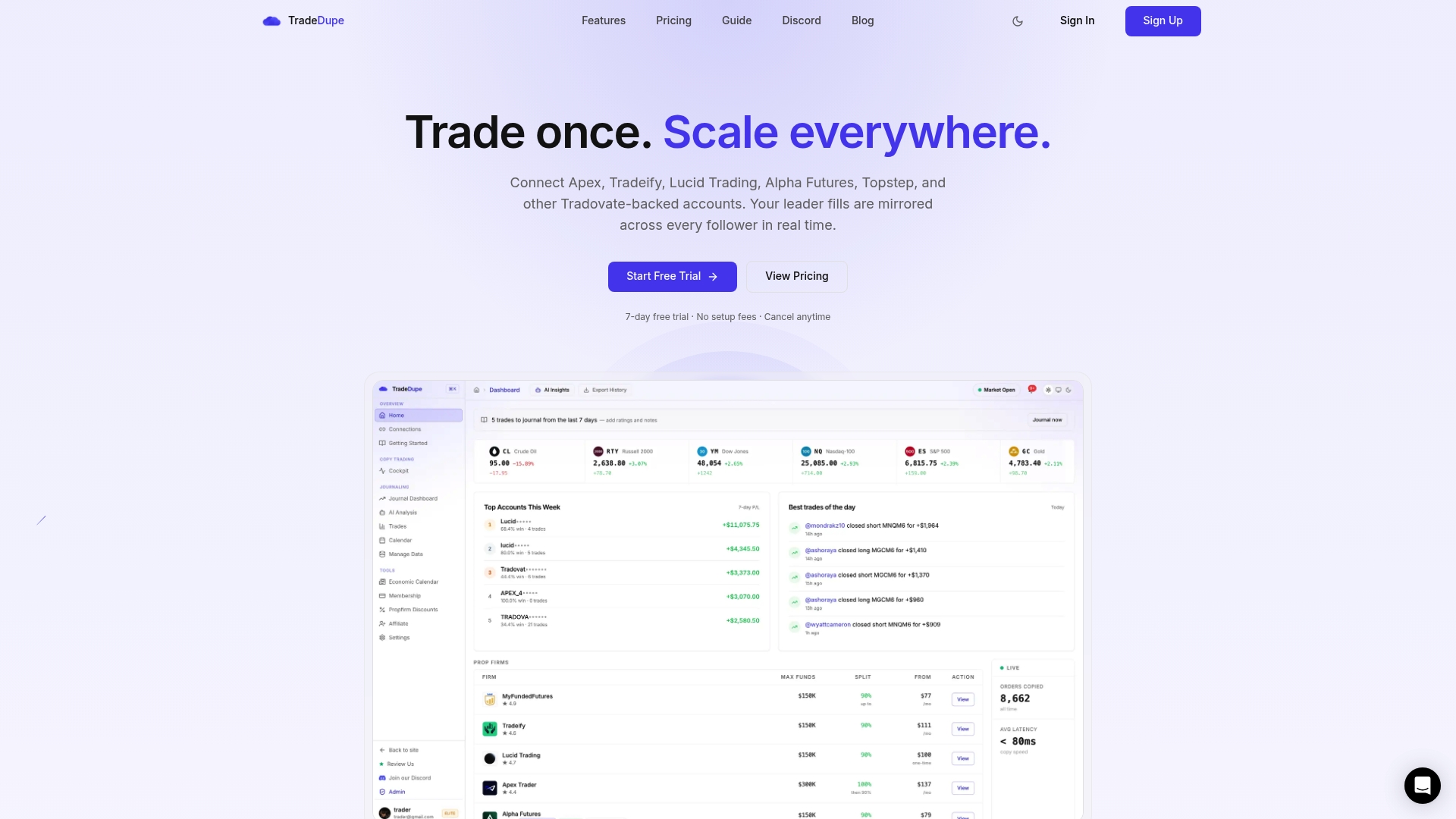
A desk running evaluations across Apex, Tradeify, Lucid Trading, or Alpha Futures accounts can enable per-account toggles, watch sync status live on the dashboard, and pull a matched-pair export the moment a risk manager flags an anomaly, instead of reconstructing it from five separate broker logs after the fact. Rogue-trade detection and auto-recovery catch desync events automatically, which is the kind of gap a manual audit typically only finds weeks later.
If you're setting up multi-account mirroring for the first time, get started with Tradedupe and have your first synchronized audit trail running within minutes.
Sources
- How to Audit Cross-Account Roles Using AWS CloudTrail and Amazon CloudWatch Events
- NIST glossary — audit trail
- SEC — Form ATS & filings information (alternative trading systems)
- How to make trading infrastructure audit-ready (Teleport blog)
- FINRA
FAQ
What does it mean to audit trade history across accounts? It means producing one consolidated, time-ordered record that links order requests, executions, and account identity across every trading account involved, so an investigator can trace a single trade from placement to attribution without gaps.
What's the minimum data needed for a cross-account trading audit? Account ID, order ID, execution ID, ISO-format timestamps, instrument, side, quantity, price, fees, and fill status. Anything less makes reliable linking across accounts nearly impossible.
How do you detect copy-trading abuse across multiple accounts? Compute timestamp correlation between account pairs, check for shared device or IP fingerprints, and flag identical order hashes appearing across accounts that claim no ownership relationship.
Is a spreadsheet enough to audit trading records for a small prop desk? It can work for a handful of accounts and infrequent reviews, but it breaks down fast once volume grows or regulators expect signed, tamper-evident exports rather than an editable file.
Does Interactive Brokers' TWS trade log work for cross-account audits? It's a solid raw export source for a single account, but you still need to normalize its output into a canonical schema and build linking logic to reconcile it against other accounts.