
Duplicate Order Prevention for Tradovate Prop Desks
TradeDupe
14 min read
Ensure smooth trading with effective duplicate order prevention. Discover four essential components that protect your Tradovate prop desk today.
Duplicate order prevention in a Tradovate copy-trading system requires a multi-layer architecture: one authoritative signal source, per-account idempotency keys, an in-memory deduplication window, and a reconciliation loop with auto-recovery. Miss any layer and a single network hiccup can double-fill a follower account during a live prop-firm evaluation.
The four components you need right now:
- Authoritative signal source: one versioned webhook endpoint per strategy, no legacy duplicates running in parallel
- Per-account idempotency keys: a composite key (signal ID + accountId + symbol + side + volume bucket) persisted before any order is placed
- In-memory dedup window: a time-bucketed cache that rejects re-arrivals within the same signal window before they reach the broker
- Reconciliation + auto-recovery loop: query `order/item` and `fill/deps` after every submission to confirm state before retrying
Tradedupe provides a turnkey integration that implements all four layers for Tradovate prop desks, with low execution latency.
Pro Tip: Enforce one authoritative signal source per strategy and tag every payload with a `strategy_version` field. Any consumer that receives a version mismatch should reject the signal immediately, before it reaches the idempotency layer.
*
Key Takeaways
Duplicate order prevention in Tradovate copy trading requires idempotency keys, in-memory dedup, reconciliation, and strict Tradovate API compliance to guarantee exactly-once execution per follower account.
| Point | Details |
|---|---|
| Set `isAutomated=true` | Every automated submission must include this flag to satisfy exchange policy and enable accurate event tracking. |
| Composite idempotency keys | Build keys from signal ID, accountId, symbol, side, volume bucket, and strategy version before placing any order. |
| One syncrequest per socket | Tradovate conformance tests require a single `user/syncrequest` per websocket lifecycle; reconnections must re-gate this call. |
| Reconcile before retrying | Query `order/item` or `fill/deps` after any ambiguous response; never retry placement without confirming broker state first. |
| Tradedupe for turnkey coverage | Tradedupe implements all four prevention layers server-side with low execution latency and per-account toggle controls. |
*
Table of Contents
- What does a solid duplicate order prevention architecture look like?
- What Tradovate API requirements directly affect duplicate prevention?
- How should you design idempotency keys for per-account order commands?
- How does in-memory deduplication work alongside durable persistence?
- How do you keep one authoritative signal and prevent duplicate webhooks?
- What does the reconciliation and auto-recovery loop look like?
- How do you scale dedup across hundreds of follower accounts?
- What should you monitor and test before going live?
- Why does exchange compliance directly affect your dedup design?
- Pre-deployment checklist for your operations team
- An operations perspective on where duplicate risk actually bites
- Tradedupe eliminates duplicate-order risk for Tradovate prop desks
- Sources
What does a solid duplicate order prevention architecture look like?
Academic research on distributed trading systems confirms that duplicate trade events originate from network retransmissions and upstream retries. The defense is layered: no single guard catches every failure mode.
The sequence flows like this: an upstream signal arrives at your dispatch layer, which stamps it with a composite idempotency key and checks the in-memory dedup cache. If the key is new, the command is written to a durable event ledger and forwarded to the Tradovate `placeOrder` endpoint for each follower account. The broker response (or timeout) triggers the reconciliation loop, which queries `order/item` and `fill/deps` to confirm the actual fill state. Only after confirmation does the system mark the key as settled.
Each layer has a distinct job. The idempotency key prevents the same logical signal from generating two commands. The in-memory cache blocks re-arrivals that arrive before the durable write completes. The reconciliation loop catches the cases where a response was lost in transit but the order actually landed.
| Prevention method | Latency impact | Recovery capability | Implementation complexity | Scalability to N followers | Auditability | Exchange-compliance risk |
|---|---|---|---|---|---|---|
| Idempotency keys | Negligible | High — survives restarts | Medium | High with consistent hashing | Full key log | Low |
| In-memory dedup | Sub-millisecond | Low — lost on restart | Low | Medium — requires shard ownership | Partial | Low |
| Reconciliation loop | 50–200ms per cycle | High — catches silent fills | High | High with per-account workers | Full audit trail | Low |
| Blind retry (no dedup) | Minimal | None | None | Poor | None | High |
*
What Tradovate API requirements directly affect duplicate prevention?
The Tradovate API documentation is explicit: automated order submissions must include `isAutomated=true`. The example API README confirms that this field defaults to `false`, so any bot that omits it is silently mislabeling its traffic. Exchange policy enforcement and event tracking both depend on this flag being set correctly.
Beyond `isAutomated`, four other requirements directly affect your order duplication solutions:
- `accountId` / `accountSpec` are mandatory on every `placeOrder` call. Missing either field causes the request to fail or route incorrectly, which can trigger a retry loop that generates duplicates.
- One `user/syncrequest` per socket lifecycle. Tradovate partner conformance tests require a single syncrequest per connection. Reconnecting without tracking this produces duplicate subscription events and can replay buffered order events.
- Subscribe to the right entity types: `order`, `fill`, `position`, and `account` at minimum. Missing a subscription means your reconciliation loop is working with stale data.
- `placeOrder` response is not a fill confirmation. The response confirms the order was received, not executed. Use the returned `orderId` to query `fill/deps` or `order/item` for actual fill status.
- `p-ticket` / `p-time` rate-limit handling: when Tradovate returns a time-penalty response, wait the full `p-time` duration and include the `p-ticket` token on the retry. Immediate retries without the ticket compound the penalty and can generate duplicate submissions.
*
How should you design idempotency keys for per-account order commands?
A strong idempotency key contains: `source_signal_id` + `normalized_symbol` + `side` + `volume_bucket` + `strategy_version` + `timestamp_bucket`. The timestamp bucket rounds the arrival time to a fixed window (e.g., 500ms or 1s) so that near-simultaneous re-deliveries of the same signal collapse to the same key.
The persistence chain matters as much as the key design. Before placing any order, write the mapping `signal_id → perAccountCommandId → pending` to a durable store (Redis with AOF, PostgreSQL, or equivalent). After the broker responds, update the record to `settled` with the broker `orderId`. On any retry, look up the key first. If the record exists and is `settled`, return the cached broker response. If it is `pending`, query broker state before retrying.
- Recommended TTL for intraday signals: 2–10 minutes, tuned to your strategy's re-entry frequency
- Swing strategies: extend to 30 minutes or longer to cover session gaps
- `clOrdId` / `masterId` correlation: map your internal `perAccountCommandId` to the broker's `orderId` immediately on response; use this mapping in the reconciliation loop to call `order/item` with the correct identifier
Pseudocode for key generation:
``` signal_id = sha256(source_id + symbol + side + str(volume_bucket) + strategy_version) timestamp_bucket = floor(event_ts / BUCKET_MS) * BUCKET_MS idempotency_key = f"{signal_id}:{account_id}:{timestamp_bucket}" ```
*
How does in-memory deduplication work alongside durable persistence?
The in-memory layer is a first-pass filter, not a replacement for durable idempotency keys. Its job is to reject re-arrivals that appear before the durable write has propagated, keeping latency near zero for the common case.
A practical pattern: maintain a write-through event ledger backed by an LRU or time-bucketed cache. When a signal arrives, check the cache first. On a miss, write to the durable store and then populate the cache. On a hit, drop the signal immediately without touching the broker.
Suggested starting window ranges: 500ms–5s for high-frequency intraday signals, 30s–5m for feeds that are prone to reposting the same alert. Tune these to your signal provider's actual retry behavior, not a theoretical ideal.
Bloom filters are an option for very high-throughput environments where memory is constrained. Their false-positive rate means a small number of legitimate signals get dropped, so they are only appropriate when the cost of an occasional missed entry is lower than the cost of a duplicate. For most prop-desk operations, a time-bucketed LRU cache with a well-chosen TTL is the right tradeoff.
Pro Tip: Always reconcile in-memory dedup decisions with durable state before retrying a failed order placement. A cache miss after a restart does not mean the order was never placed.
*
How do you keep one authoritative signal and prevent duplicate webhooks?
Duplicate webhooks are an upstream problem that no amount of downstream deduplication can fully compensate for. The fix is governance: one named, versioned alert per strategy condition, with hard enforcement rules.
- Naming convention: `{strategy}_{symbol}_{condition}_v{N}` — every alert name encodes its version
- Enforcement rule: only one active alert per `(strategy, symbol, condition)` tuple at any time; a deployment gate checks this before activating a new version
- Migration playbook: activate the new version first, verify it is receiving events, then disable the old version. Never run both simultaneously, even briefly.
- Checklist for alert hygiene:
- Disable retired alerts immediately on deployment, not after a grace period
- Document all active alert versions in a shared registry
- Require a pull-request review for any alert change that touches a live strategy
Pro Tip: Log the upstream message reference ID alongside your normalized `signal_id` on every event. This gives you end-to-end traceability from the webhook provider's delivery log to the broker fill record, which is the foundation of any postmortem.
*
What does the reconciliation and auto-recovery loop look like?
State-aware verification means querying broker state when a response is ambiguous, not retrying blindly. After any `placeOrder` call, the system should wait a short confirmation window (typically 200–500ms), then check the `orderId` against `fill/deps` or `order/item` before deciding next steps.
| Response type | Next action |
|---|---|
| Fill confirmed | Mark key as `settled`; log fill details |
| Order pending / unknown | Query `order/item`; wait and re-query up to N times before escalating |
| Reject (hard) | Mark key as `rejected`; do not retry; alert ops |
| Partial fill | Log partial quantity; decide per strategy whether to send a balance order |
| Time-penalty (`p-ticket` / `p-time`) | Wait full `p-time`; retry with `p-ticket` token; do not place a new order |
The order/item endpoint exposes `orderId`, `orderQty`, `orderType`, `timeInForce`, and `expireTime` — enough to reconstruct the broker's view of the order and compare it against your internal state record.
For automated escalation: if reconciliation fails after three query cycles, pause routing to the affected account, extract the audit trail for that `signal_id`, and flag for manual review. Do not attempt corrective orders without human sign-off.
*
How do you scale dedup across hundreds of follower accounts?
Scaling from a handful of follower accounts to hundreds multiplies duplicate risk at every layer. The solution is shard ownership: assign each `(account_id, strategy_id)` pair to exactly one worker instance, so no two workers can race to place the same order.
- Sharding approach: `shard = accountId % N` (modAccountId sharding, consistent with Tradovate websocket examples) or consistent-hash routing for dynamic worker pools
- Ownership rule: a worker that does not own a given account drops the signal immediately; it never forwards it
- Cache sizing: budget roughly 1KB per active idempotency key; a desk running 100 accounts with 50 active signals each needs ~5MB of cache per shard, well within typical Redis limits
- Latency budget: target under 10ms for the in-memory dedup check and key lookup combined, leaving the bulk of your latency budget for the broker round-trip
Pro Tip: Build graceful shard handover into your worker restart sequence. A worker coming online should read its shard's pending keys from the durable store before accepting new signals. This prevents a restarted worker from treating in-flight orders as new and placing duplicates during the handover window.
*
What should you monitor and test before going live?
A go-live without synthetic duplicate testing is an untested assumption. Run these checks in a staging environment against a Tradovate paper-trading account before touching live prop-firm capital.
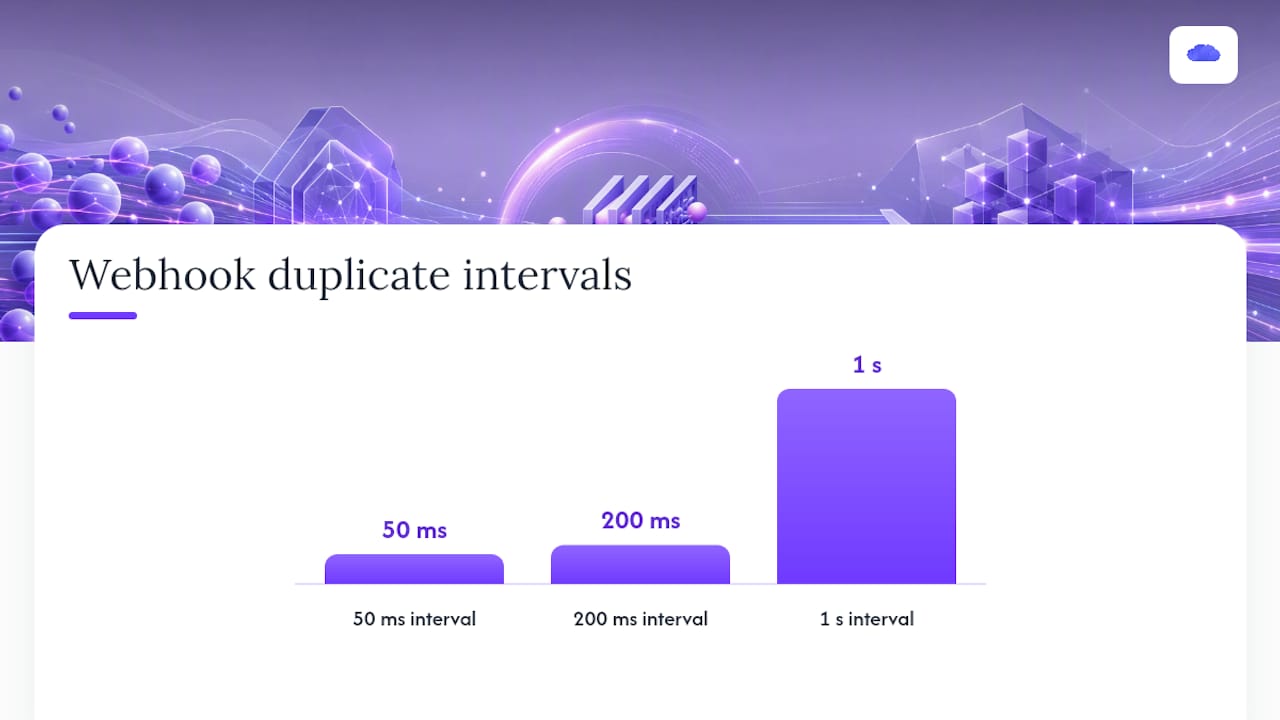
- Inject duplicate webhooks at 50ms, 200ms, and 1s intervals for the same signal. Verify zero duplicate orders reach the broker.
- Simulate websocket disconnect mid-order-lifecycle. Confirm the reconnection triggers a syncrequest, resubscribes to entity types, and reconciles pending keys correctly.
- Introduce a slow broker response (mock 2s delay). Verify the system queries `order/item` rather than retrying placement.
- Inject a partial fill scenario. Confirm the system logs the partial quantity and does not automatically place a balance order without strategy authorization.
- Trigger a `p-ticket` penalty response. Verify the system waits `p-time` and retries with the token, not with a fresh order.
Acceptance criteria for go-live:
- Zero duplicate order acceptances across all synthetic test runs
- Reconciliation success rate above 99% in staging
- Audit log completeness: every `signal_id` traceable to a broker `orderId` or a documented rejection
- Alert on duplicate-rate per account exceeding zero in production; treat any non-zero value as a P1 incident
Essential metrics to monitor in production: duplicate rate per account, order-lifecycle latency, timeout count, retry count, `p-ticket` frequency, and reconciliation mismatches per hour.
*
Why does exchange compliance directly affect your dedup design?
Setting `isAutomated=true` is not optional. The Tradovate API documentation ties this flag to exchange reporting and event classification. A system that omits it is not just non-compliant; it is also harder to audit because order events are miscategorized in the broker's own records, which undermines your reconciliation loop's ability to match internal state to broker state.
- Rate-limit compliance: use the p-ticket / p-time pattern exactly as documented. Bypassing it with immediate retries risks account-level penalties that can affect all follower accounts on the same API credential.
- Token handling: rotate API tokens on a schedule, store them in a secrets manager (AWS Secrets Manager, HashiCorp Vault, or equivalent), and never embed them in application code.
- Least-privilege account specs: each follower account should use an `accountSpec` scoped to that account only. A credential that spans multiple accounts creates a blast radius if compromised.
- Audit logging: log every order event with timestamp, `signal_id`, `accountId`, `orderId`, and outcome. Prop-firm compliance reviews often require this trail on short notice. Tradedupe's security and reliability features are built around these requirements.
*
Pre-deployment checklist for your operations team
Run this list in order. Do not skip steps for a "quick" pilot launch.
- Canonicalize symbol mappings across all follower accounts. A mismatch between `ESM6` and `ES` in different account specs is a common source of reconciliation failures.
- Enable stable websocket handling with a single `user/syncrequest` per socket lifecycle and subscriptions to `order`, `fill`, `position`, and `account` entity types.
- Seed the idempotency store with any in-flight keys from the previous session before accepting new signals.
- Configure retry policy per the response-type table above: hard rejects do not retry; unknown responses query broker state first.
- Run all five synthetic test scenarios listed in the monitoring section. Document pass/fail for each.
- Pilot with a sample of two to three follower accounts before full fleet activation. Require manual audit signoff after 50 synthetic signals with zero duplicates.
- Define rollback triggers: if any duplicate reaches a live broker account, pause routing to the affected shard immediately, extract the audit trail for the offending `signal_id`, and initiate manual reconciliation before resuming.
- Postmortem requirements: capture `signal_id`, `perAccountCommandId`, broker `orderId`, timestamps for each state transition, and the full retry log. Any incident that produces a live duplicate requires a written RCA before the shard is reactivated.
*
An operations perspective on where duplicate risk actually bites
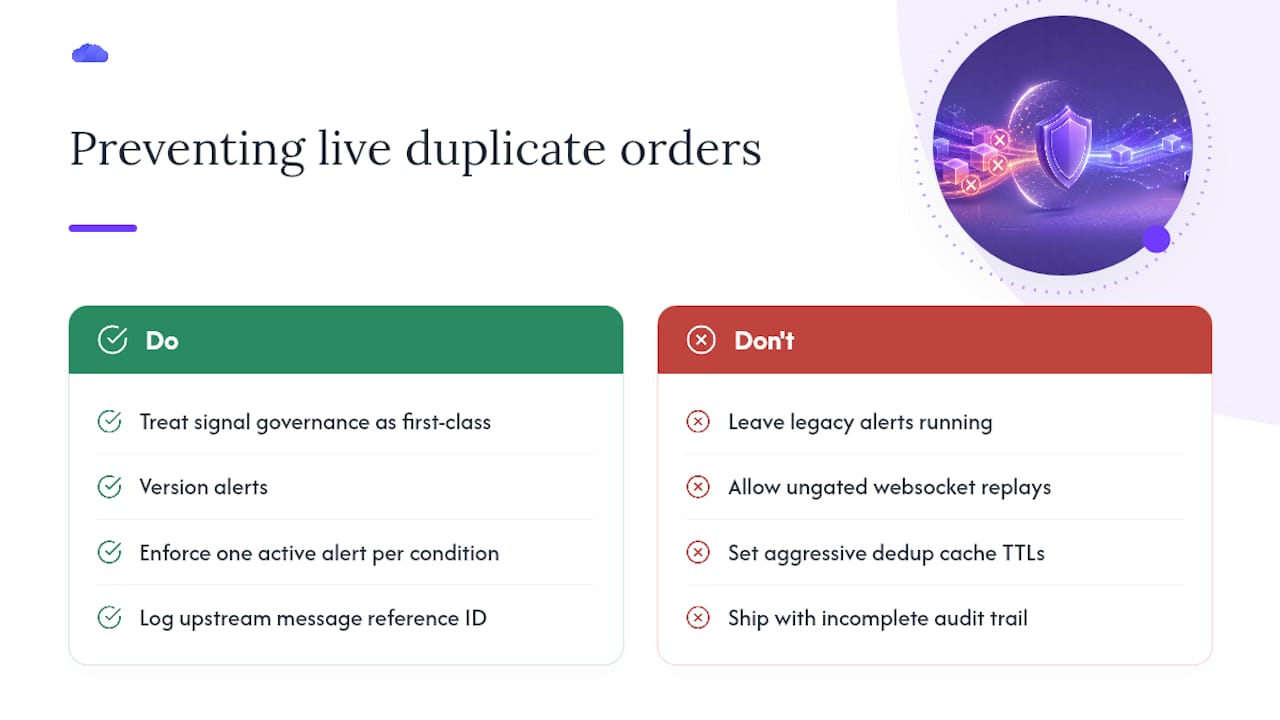
The architecture described here is sound, but the failure mode that catches most prop desks off guard is not a code bug. It is an operational one: a legacy alert left running after a strategy migration, or a websocket reconnection that replays buffered events because the syncrequest was not properly gated.
Scaling to many follower accounts multiplies this risk. A single stale alert that fires twice in a 200ms window will pass through a poorly configured dedup cache if the TTL bucket was set too aggressively. The teams that avoid live duplicates are the ones that treat signal governance as a first-class engineering concern, not an afterthought. Versioning alerts, enforcing one active alert per condition, and logging the upstream message reference ID are the three practices that prevent the most incidents before they reach the broker layer.
For desks that have gone through a reconciliation incident, the postmortem almost always reveals the same gap: the audit trail was incomplete, making it impossible to determine whether a duplicate fill was the system's fault or the broker's. End-to-end traceability from `signal_id` to broker `orderId` is not a nice operational detail. It is the only way to run a credible RCA.
Tradedupe's futures trade copier implements these layers server-side, with per-account toggles and a real-time dashboard that surfaces reconciliation mismatches as they occur. For desks that prefer to build their own stack, the blueprint above gives you the architecture. For those who want it running in days rather than weeks, Tradedupe is the faster path.
*
Tradedupe eliminates duplicate-order risk for Tradovate prop desks
For prop desks that need this architecture running now, Tradedupe delivers every layer described in this guide as a prebuilt, exchange-compliant service. Signal authority enforcement, per-account idempotency keys, in-memory dedup, reconciliation, auto-recovery, and a real-time monitoring dashboard are all included. Per-account toggle controls let you pause a single follower without affecting the rest of the fleet, and rogue-trade detection adds a second line of defense against unexpected order behavior.
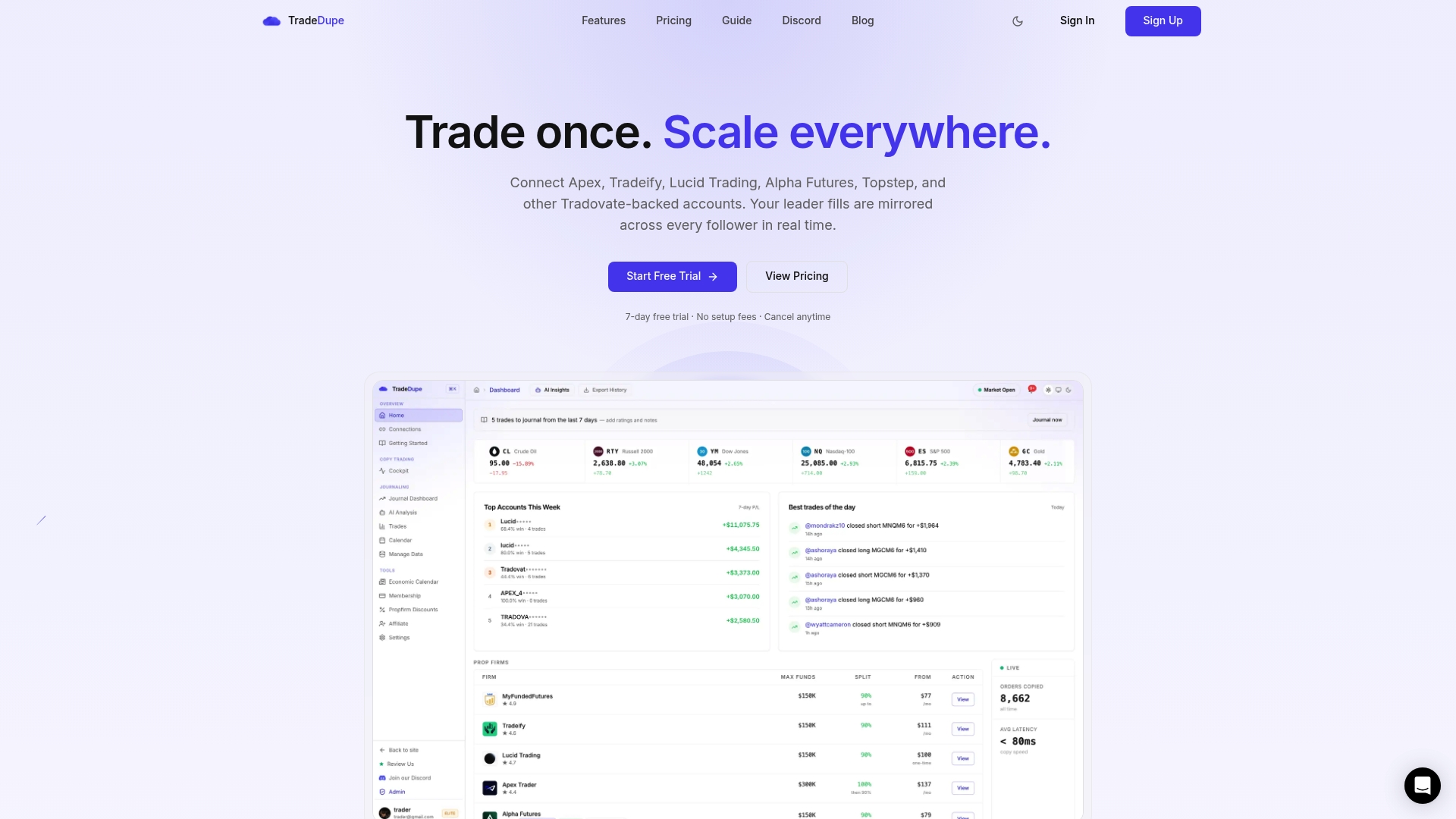
Supported prop-firm integrations include Apex Trader Funding, Tradeify, Lucid Trading, and Alpha Futures. Onboarding typically takes under 10 minutes for a standard Tradovate configuration. Start a trial and connect your first follower account at TradeDupe's getting-started page, or review the full feature set on the futures trade copier product page.
*
Sources
The sources below back the technical claims in this guide and are the primary references for implementation decisions.
- stage-2-websocket-management
- Graph-Based Duplicate Trade Detection and Idempotency Framework Implementation in Distributed Electronic Trading Systems
- HowToHandleRequestLimits.md
- Order filled or rejected feature (community thread)