
Order Fill Mismatch: A Playbook for Tradovate Prop Desks
TradeDupe
17 min read
Learn how to effectively manage an order fill mismatch in copy trading with essential strategies to protect your trading desk's positions.
An order fill mismatch in copy trading occurs when a follower account records a different executed fill than the leader account, whether in price, size, or timing, during real-time replication. The moment you detect one, three actions protect your desk:
- Pause copying on all affected follower accounts before any new signals propagate.
- Snapshot state immediately: capture open positions, P&L, pending orders, and order book depth for both leader and every follower.
- Preserve logs and sequence IDs: outgoing API requests, broker acknowledgements, error codes, and market data timestamps are your forensic record. Losing them makes reconciliation guesswork.
These steps matter because small timing differences and partial fills compound into meaningful position drift under scale, and cascade divergence grows with every new signal you allow through before the root cause is isolated.
*
Key Takeaways
Deterministic replication in Tradovate-based copy trading requires immediate triage controls, architectural discipline, and continuous monitoring, not just a fast connection.
| Point | Details |
|---|---|
| Pause and preserve first | Stop copying immediately on mismatch detection; snapshot positions and preserve sequence ID logs before any retry. |
| Monitor fill-price and time deltas | Alert at 1-tick price delta and fill-time delta; treat any sequence gap as an immediate incident. |
| Fix symbol mapping and normalization | Explicitly map every instrument and exclude anything that does not resolve cleanly; stale or approximate mappings compound into persistent divergence. |
| Prefer server-side aggregation | Block-order aggregation with VWAP distribution eliminates follower-against-follower race conditions that sequential submission cannot avoid at scale. |
| Use Tradedupe for Tradovate prop desks | Tradedupe's 34ms median latency, rogue-trade detection, auto-recovery, and per-account toggles directly address the root causes covered in this playbook. |
*
Table of Contents
- What to check in the first 15 minutes after a fill discrepancy
- Root causes that produce fill discrepancies in real-time mirroring
- How your copy-trading architecture shapes mismatch risk
- Metrics and alerts that catch fill divergence before it grows
- Controls and engineering fixes that prevent fill mismatches
- How to validate copy logic before scaling to a full follower pool
- Incident response and auto-recovery runbook
- Tradovate integration checklist for prop-firm accounts
- How network infrastructure and geography affect fill consistency
- Clock synchronization practices that prevent sequence and timing mismatches
- How market data feed inconsistencies cause fill matching errors
- Aligning order lifecycle events across leader and follower accounts
- Long-term architectural strategies for deterministic replication on Tradovate
- Why deterministic replication is the only standard worth building to
- Tradedupe reduces fill mismatch risk for Tradovate prop desks
- Sources
What to check in the first 15 minutes after a fill discrepancy
Run this checklist in order. Its goal is to classify severity: transient execution difference or systemic copy failure.
- Connection and sync status: confirm the leader and all followers show active, authenticated sessions with no dropped WebSocket connections or API timeouts.
- Sequence ID and timestamp audit: compare the last confirmed sequence ID on the leader against each follower. A gap of more than one event signals missed messages.
- Fill comparison: record fill price delta, fill time delta, executed quantity, and any partial-fill flags for every affected order.
- Symbol and contract-spec validation: verify tick size, contract month, and multiplier match exactly between leader and follower instruments. A single mismatched contract month produces persistent price divergence.
- Log capture: save outgoing API requests, broker acknowledgements, order IDs, error codes, and market data snapshots before any automated retry overwrites them.
- Alert and watch: notify on-call staff and hold a one-hour watch window. Do not re-enable automated restarts until reconciliation is complete.
Pro Tip: Set your log retention to at least 72 hours at the structured-field level. Broker acknowledgement timestamps and sequence IDs stored as flat text are nearly impossible to query under incident pressure.
*
Root causes that produce fill discrepancies in real-time mirroring
Most fill discrepancies trace back to a short list of engineering, broker, or market causes. Mapping the symptom to the cause cuts resolution time significantly.
- Network latency: a follower routed through an additional network hop receives the signal after the leader's fill, landing in a different price environment.
- Market data feed divergence: leader and follower subscribe to different data sources or snapshot intervals, so the price reference at order submission differs.
- Order-type incompatibility: the leader submits a limit order; the follower broker does not support that type for the instrument and silently converts it to a market order.
- Symbol and contract-mapping errors: symbol mapping and contract-spec mismatches are a frequent cause of divergence; excluding instruments that do not map cleanly is safer than copying an approximate equivalent.
- Minimum distance rules: a follower broker enforces a minimum stop distance that the leader's order does not trigger, causing a reject or a modified fill.
- Rounding and lot-size constraints: fractional size scaling rounds differently per broker, producing a one-contract difference that compounds across dozens of followers.
- Partial fills and matching algorithm differences: the leader fills in full at a liquid venue; the follower's venue fills partially, leaving a residual position.
- Sequence and order-ID mismatches: out-of-order delivery of copy events causes a cancel to arrive before the original open, leaving a ghost position.
- Broker rejects and retries: a rejected order that retries without idempotency protection can double-fill or miss entirely.
- Aggregation and batching effects: in large follower graphs, sequential per-follower submissions exhaust available liquidity, so later followers fill at worse prices.
Scenario example: repeated partial fills on follower accounts during a fast market usually indicate liquidity exhaustion from sequential submission. The immediate check is whether your architecture submits one order per follower or aggregates into a block. Reliable trade execution depends on getting that architectural choice right before scaling.
*
How your copy-trading architecture shapes mismatch risk
The design choice between server-side aggregation and client-side sequential forwarding determines most of your failure surface.
Client-side sequential forwarding sends one order per follower in sequence. Under normal conditions it works. Under fast markets or large follower counts, it creates race conditions: follower A's order moves the market before follower B's order arrives, and block-order aggregation with proportional VWAP distribution eliminates these follower-against-follower execution races while preserving a fair aggregate execution price.
Server-side aggregation batches all follower orders into a single block, executes once, and distributes fills proportionally. The failure surface shifts from race conditions to allocation logic errors, which are far easier to audit.
Every order in a copy system travels through these execution path stages:
- Event ingestion: leader order event received and timestamped.
- Normalization: symbol mapping, size scaling, order-type translation, and SL/TP logic applied per follower broker. Centralizing normalization and risk rules keeps fills consistent across heterogeneous brokers.
- Order validation: pre-submission checks against each follower broker's constraints (minimum lot, stop distance, allowed order types).
- Broker API submission: order dispatched with idempotency key.
- Acknowledgement and state verification: broker response logged; state compared against expected position.
Normalization errors at stage 2 and constraint violations at stage 3 account for the majority of preventable mismatches.
*
Metrics and alerts that catch fill divergence before it grows
Detection speed determines how much drift accumulates. These are the metrics worth instrumenting:
| Metric | What it measures | Example alert threshold |
|---|---|---|
| Fill price delta | Difference between leader fill price and follower fill price | Warn at 1 tick; incident at 3 ticks |
| Fill time delta | Milliseconds between leader fill and follower fill | Warn at 100ms; incident at 500ms |
| Missed-fill rate | Percentage of leader fills with no matching follower fill | Warn at 1%; incident at 3% |
| Sequence gap count | Missing sequence IDs in the event stream | Incident at any gap |
| Partial fill frequency | Rate of partially filled follower orders | Warn at 5%; incident at 10% |
For every order event, capture: UTC timestamp (microsecond resolution), sequence ID, leader order ID, follower order ID, broker response code, and market price at submission. Relying only on event-based synchronization causes silent drift; a professional system periodically compares full account state and applies corrective actions.
Pro Tip: Tradedupe operates at a median latency of 34ms. Use that as your baseline when calibrating fill-time-delta alert thresholds. An alert firing at 50ms on a system with 34ms median latency is a genuine signal, not noise.
*
Controls and engineering fixes that prevent fill mismatches
Prevention divides into short-term operational controls and longer-term engineering fixes.
Operational controls (implement immediately):
- Per-account risk limits and order caps enforced before submission.
- Order-type alignment rules: define which order types each follower broker accepts and reject mismatches at normalization.
- Per-account sizing rules: fixed-lot or proportional-multiplier tables, not ad hoc scaling.
- Symbol mapping tables with explicit exclusions for instruments that do not map cleanly.
- Mandatory pre-submission validation against each follower broker's constraints.
Engineering fixes (implement over the next sprint cycle):
- Replace sequential per-follower submission with server-side block aggregation.
- Add micro-batching with VWAP allocation logic for large follower graphs.
- Implement idempotent order submission with deduplication keys.
- Add durable queues with retry logic and dead-letter handling.
- Build a state-based reconciliation loop that runs a full position compare on a schedule, not just on events.
Structured setups with explicit mapping, per-account limits, and defined copy rules prevent most multi-account issues. The risk-management rationale for per-account caps is straightforward: a single misconfigured follower should never be able to breach firm-wide risk limits.
Pro Tip: Use a staged rollout when adding new followers or strategies. Start with one canary follower at minimum size, run it for at least one full session, and verify fill parity before ramping to the full follower set.
*
How to validate copy logic before scaling to a full follower pool
Testing before production scale is the single highest-leverage activity for preventing systemic mismatches.
- Sandbox end-to-end test: connect leader and one follower in a paper-trading environment. Submit orders across all supported order types and verify fills match.
- Synthetic stress conditions: simulate low-liquidity and price-spike scenarios. Confirm partial-fill handling, reject-and-retry cycles, and reconnection replay all produce expected state.
- Mapping and resolution validation: run every instrument in your symbol table through the normalization layer and assert that tick size, multiplier, and contract month resolve correctly.
- Parallel paper trades: run paper leader and paper follower simultaneously for a full session. Compare every fill, sequence ID, and order lifecycle event.
- Canary deployment: promote one real follower account at minimum size. Set automatic rollback if fill price delta exceeds your threshold or missed-fill rate exceeds 1%.
- Progressive ramp: add followers in batches of two to three, pausing after each batch to verify metrics remain within baseline.
Test cases that must pass before any production ramp:
- Partial-fill behavior under thin markets.
- Stop and limit distance enforcement per follower broker.
- Reject-and-retry cycles without double-fills.
- Reconnection and event replay without ghost positions.
- Simultaneous large-volume events across all followers.
Pro Tip: Define objective pass/fail criteria before testing begins. Maximum acceptable median price delta and maximum missed-fill rate should be written into your test harness as hard assertions, not post-hoc judgments.
*
Incident response and auto-recovery runbook
A repeatable incident flow prevents ad hoc decisions under pressure.
- Classify severity: transient (single follower, single fill) or systemic (multiple followers, ongoing divergence).
- Pause copies: halt all automated signal forwarding immediately.
- Snapshot states: capture full position and order state for leader and all followers.
- Reconcile sequences: compare leader and follower sequence IDs to identify the first divergence point.
- Determine corrective action: backfill (idempotent replay of missed events), cancel-and-replace for stale orders, or manual close for positions that cannot be safely automated.
- Resume with canary: re-enable copying on one follower, verify fill parity for at least five trades, then ramp.
Auto-recovery options worth building:
- Safe backfill: idempotent replay of missed events with size adjustments to stay within per-account caps.
- Queued re-submission: durable queue that retries rejected orders with exponential backoff.
- Automated reconciliation: periodic full-state compare that surfaces corrective suggestions for human approval before execution on high-risk adjustments.
Pro Tip: Never automate corrective trades above a defined size threshold without human-in-the-loop approval. The reconciliation engine should propose; a human should confirm for anything that materially changes net exposure.
Audit requirements for compliance reporting: log who approved the resume decision, the full timeline from first detection to resolution, and every affected account with its pre- and post-reconciliation state.
*
Tradovate integration checklist for prop-firm accounts
Tradovate-specific constraints cause a disproportionate share of preventable mismatches. Verify each item before going live.
- API rate limits: Tradovate enforces per-connection request limits. Confirm your submission rate stays within those limits under peak follower counts.
- Symbol and contract-month mapping: Tradovate uses its own symbol format. Map every instrument explicitly; do not rely on string matching.
- Tick sizes and multipliers: verify tick size and point value for every contract in your table. A one-tick error in multiplier produces systematic P&L divergence.
- Minimum order quantities: some Tradovate instruments enforce a minimum lot size that differs from the leader broker.
- Stop distance rules: confirm minimum stop distance for each instrument and build that constraint into your pre-submission validation.
- Allowed order types: not all order types are available on every Tradovate instrument. Validate at normalization, not at submission.
Per-prop-firm items to verify for Apex, Tradeify, Lucid Trading, and Alpha Futures accounts:
- Funding account type and whether simulated fills are available for canary testing.
- Per-account order caps and leverage settings.
- Whether the prop firm's risk engine can conflict with your copier's order submission timing.
Professional systems validate target-broker compatibility before transmission and adjust order attributes when necessary to avoid repeated rejects. Symbol mapping and contract-spec mismatches are among the most frequent causes of divergence, and excluding instruments that do not map cleanly is the conservative and correct policy.
Pro Tip: Log Tradovate-specific order acknowledgement fields and broker error codes as structured fields, not free text. Structured fields let you query "all rejects with error code X in the last hour" in seconds during an incident.
*
How network infrastructure and geography affect fill consistency
Physical distance between your copy server and the Tradovate matching engine adds latency that compounds across follower counts. A server co-located in a Chicago-area data center, close to the CME Group matching engine, will consistently outperform one hosted on a West Coast or European cloud node for NQ and ES contracts. Even a 20ms round-trip difference becomes significant when you are comparing fills across dozens of followers in a fast market.

Beyond raw distance, network path stability matters as much as average latency. A connection with low average latency but high jitter produces unpredictable fill-time deltas that are harder to diagnose than a consistently slower connection. Use a dedicated, low-jitter network path for your copy server rather than shared cloud egress. Automation and cloud-first infrastructure move teams from manual checks to exception management, but only when the underlying network path is stable enough to make latency predictable.
*
Clock synchronization practices that prevent sequence and timing mismatches
Timestamp mismatches between leader and follower systems are a silent source of sequence errors. When two systems disagree on the current time by even a few hundred milliseconds, event ordering becomes ambiguous and reconciliation logic produces false positives.
Use NTP (Network Time Protocol) synchronized to a stratum-1 or stratum-2 source for all systems in your copy stack. For microsecond-level precision, PTP (Precision Time Protocol, IEEE 1588) is the standard in professional trading infrastructure. Record all order event timestamps in UTC at microsecond resolution and store the originating system's clock offset at the time of recording. That offset field is what lets you reconstruct true event order during a post-incident review, even when clocks drifted during the incident window.
*
How market data feed inconsistencies cause fill matching errors
When leader and follower systems consume market data from different sources or at different snapshot intervals, the price reference at order submission diverges. The leader sees a bid of 5,210.25; the follower's feed is 150ms stale and shows 5,210.00. The follower submits a limit order at the stale price, misses the fill, and the position diverges.
The fix is to use a single normalized market data feed as the reference for all order submission decisions, rather than letting each follower consume its own feed independently. Where that is not architecturally feasible, enforce a maximum staleness threshold: if a follower's data feed is more than a defined number of milliseconds behind the leader's reference, suppress order submission for that follower until the feed catches up. This is a form of circuit breaker that prevents stale-data fills from accumulating silently.
*
Aligning order lifecycle events across leader and follower accounts
Cancels and modifications are the most dangerous lifecycle events in a copy system because they are time-sensitive and asymmetric. A cancel that arrives at the follower after the order has already filled creates a position that the leader does not hold. A modification that changes size or price mid-flight can produce a fill that matches neither the original nor the modified intent.
The safest policy is to treat cancels and modifications as atomic: apply them to the leader first, confirm the leader's new state, and only then propagate the event to followers. Never propagate a modification event speculatively. For cancels specifically, implement a check-before-cancel pattern: query the follower's current order state before submitting the cancel, and handle the case where the order has already filled. Sequence IDs are the enforcement mechanism here. Every lifecycle event should carry the sequence ID of the order it references, and the follower's order management system should reject any lifecycle event whose referenced sequence ID does not match an open order.
*
Long-term architectural strategies for deterministic replication on Tradovate
Deterministic replication means that given the same leader signal, every follower produces the same fill outcome every time. Achieving it at scale requires architectural commitments beyond operational controls.
The foundational investment is a single-source-of-truth event log: an append-only, durable log of every leader order event, with sequence IDs, that serves as the authoritative record for all follower state. Followers derive their state from this log, not from independent API subscriptions. This architecture makes replay, reconciliation, and audit trivial because the log is the ground truth.
On top of that log, build a state machine per follower account that tracks the expected position and order state at every sequence ID. The reconciliation loop compares actual broker state against expected state on a schedule and flags any divergence. State-based reconciliation is more robust than pure event-based copying for long-term consistency.
For Tradovate-based prop desks running Apex, Tradeify, Lucid Trading, or Alpha Futures accounts, the practical path to determinism runs through server-side aggregation, normalized symbol tables, and per-account state machines, all instrumented with the monitoring metrics described earlier. The futures trading landscape in 2026 rewards desks that invest in this infrastructure early, before scale exposes the gaps.
*
Why deterministic replication is the only standard worth building to
The prop trading community has a tendency to treat fill mismatches as an acceptable cost of doing business. A tick here, a partial fill there, a follower that occasionally lags. The reasoning is that if the strategy is profitable enough, small execution differences wash out over time.
That reasoning breaks down at scale, and it breaks down in the specific scenarios that matter most: fast markets, news events, and high-volatility opens. Those are exactly the moments when your strategy generates its largest signals, and they are also the moments when sequential per-follower submission, stale data feeds, and unvalidated symbol mappings produce their worst divergence. The mismatches do not wash out. They concentrate at the worst possible times.
The deeper issue is compliance and auditability. A prop desk that cannot produce a clean audit trail showing that every follower fill was the intended result of a leader signal is exposed to regulatory and firm-level risk that has nothing to do with P&L. Per-account toggles, rogue-trade detection, and auto-recovery are not convenience features. They are the controls that let you demonstrate, after the fact, that your system behaved as designed.
Build to deterministic replication from the start. The operational cost of retrofitting these controls after a significant mismatch incident is always higher than building them in.
*
Tradedupe reduces fill mismatch risk for Tradovate prop desks
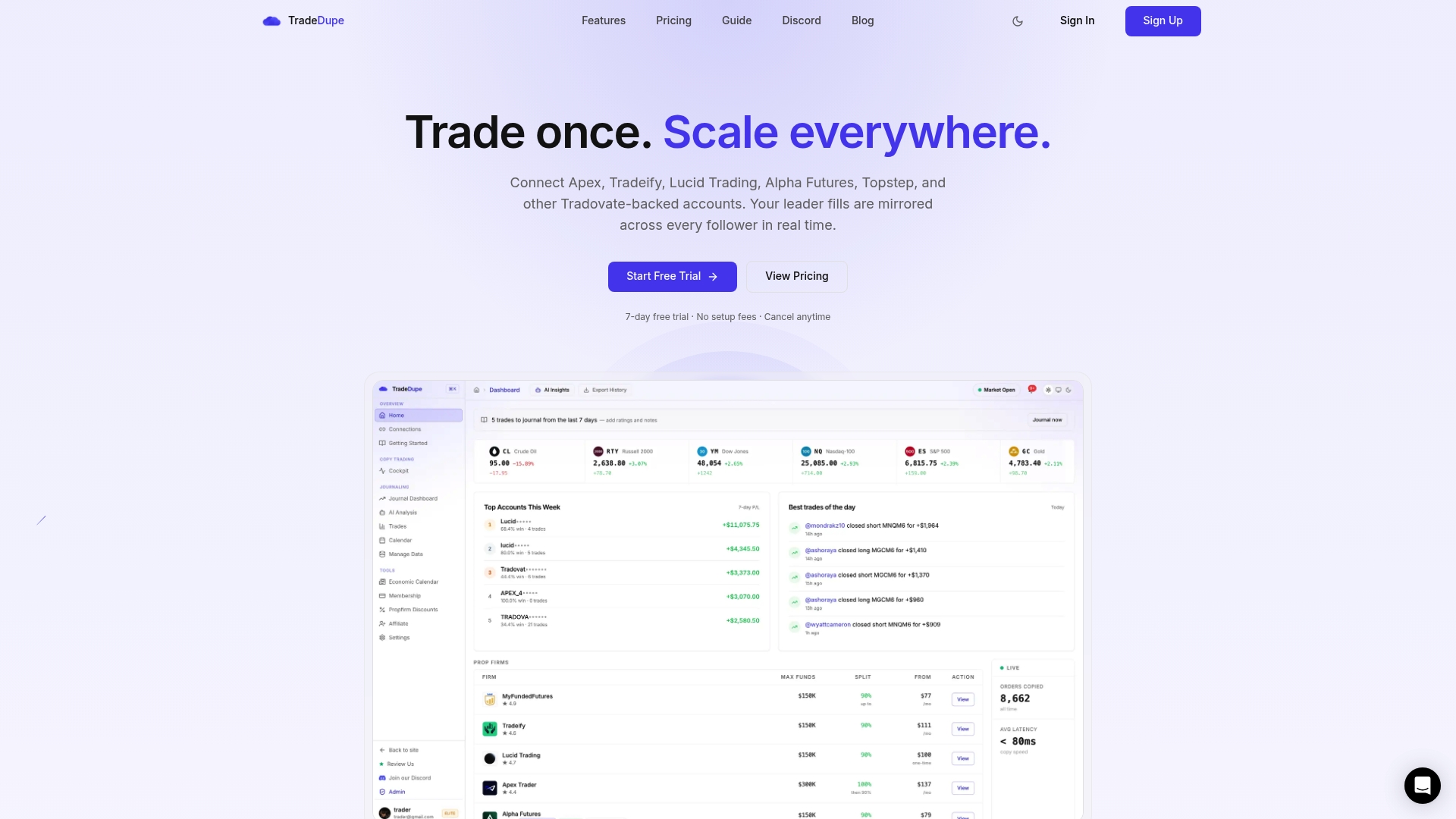
Consistent fills across dozens of follower accounts require more than good intentions. Tradedupe is built specifically for Tradovate prop desks that need deterministic replication at scale, with the controls already in place rather than bolted on later.
Key capabilities that directly address mismatch risk:
- Median 34ms latency baseline, giving you a calibrated reference for fill-time-delta alerts.
- Rogue-trade detection that flags fills deviating from expected leader behavior before they propagate.
- Auto-recovery and backfill for missed events, with idempotent replay that respects per-account caps.
- Per-account toggle controls so you can isolate a single follower without halting the entire desk.
- Real-time monitoring dashboard with analytics and structured alerts across all Apex, Tradeify, Lucid Trading, and Alpha Futures accounts.
Getting started takes minutes: complete admin verification, connect your Tradovate API credentials, build your symbol mapping table, run a one-account canary session, and enable auto-pause thresholds. Tradedupe and run your first canary session today.
*
Sources
Keep these references in your runbooks and incident-response playbooks for fast access during triage.
- Realtime trade copier issues in multi account setups explained
- Mirroring Real-Time Trading Strategies Across Brokers Fast
- Infobeat
- The Hidden Complexities of Multi‑Broker Trade Replication - Other - 7 July 2026 - Traders' Blogs
This article is general information, not a substitute for advice from a qualified financial advisor. Consult a qualified financial professional about your own circumstances before acting on anything here.