From $490–$1,700 Monthly: Copy Trading Costs for Tradovate Prop Desks
TradeDupe
13 min read
Precise cost guide for Tradovate prop desks: monthly ranges, worked 20/100-account examples, security-first features, and TradeDupe setup tips to test...
Professional copy-trading software for Tradovate prop desks typically runs from around $50 to $200 per month for a single-leader setup on the entry end, scaling to $500 to $2,000+ monthly for multi-account enterprise deployments, billed flat, per-account, or in tiers. Latency SLAs, server-side execution, auto-recovery, and broker-connection limits are what push a plan from the low end to the high end. TradeDupe operates in this professional tier, built specifically for Tradovate-based prop desks that need verified low-latency mirroring rather than a hobbyist trade copier.
*
> TL;DR: > > - Copy trading software for prop desks typically costs between $50 and $2,000+ monthly, depending on features like latency guarantees and account support. > - Higher costs are driven by engineering complexity, low-latency requirements, system resilience, and broker integration challenges, not just follower count. > - Support quality and support SLA compliance significantly impact reliability, with enterprise support often costing 15% to 30% more than basic plans. > - Hidden costs such as market data, overage fees, activation charges, and licensing structure can markedly raise the actual yearly expense beyond the advertised subscription.
*
Table of Contents
- What Does Copy Trading Software Cost for Prop Desks?
- What Actually Drives the Price Up or Down?
- How Much Does It Cost to Scale to 20 or 100 Accounts?
- What Security and Reliability Features Are Worth Paying For?
- How Does Licensing Length Affect What You Pay?
- What Do Support and Training Add to the Bill?
- What's the Real Total Cost of Ownership?
- Should You Ever Use Free Copy Trading Software?
- What Hidden Fees Should You Watch For in the Contract?
- How Should You Actually Budget for This?
- Getting Started With TradeDupe's Tradovate Copy Trading
- Sources
What Does Copy Trading Software Cost for Prop Desks?
The phrase "copy trading" gets used loosely across the industry, so it's worth being precise about what you're actually pricing. Retail copy trading, the kind built around following a public trader's feed on a social platform, has almost nothing to do with what a prop desk needs. What you're pricing here is trade mirroring or multi-account replication: a leader account's fills get pushed to follower accounts in near real time, across Tradovate, with account-level risk controls attached. That's the standard industry term, and it's the one procurement teams should use when comparing vendor quotes.
Three billing models dominate this space:
- Flat unlimited plans charge a fixed monthly fee regardless of follower count, often in the $50 to $150 range for smaller setups, but they frequently cap latency guarantees or omit enterprise support.
- Per-account pricing scales linearly, commonly $5 to $25 per follower account per month, which is transparent but can get expensive fast past 20 accounts.
- Tiered enterprise pricing bundles a base platform fee with account bands, typically $300 to $1,500+ per month, and unlocks features like unlimited broker connections and dedicated support.
Cheaper cloud-based copiers exist at introductory prices as low as $10 a month, and they can be genuinely useful for a single trader running two or three personal accounts. But those entry-level plans generally lack the stateful risk management, rogue-trade detection, and signed execution SLAs that funded-account operations need. Features usually gated behind higher tiers include sub-50ms latency commitments, AI-powered trade analytics, multi-broker support beyond a single connection, and dedicated onboarding. If a quote looks unusually low, check whether it includes any latency guarantee at all. Most don't.
What Actually Drives the Price Up or Down?
Price in this category isn't arbitrary. It tracks directly to engineering complexity and operational risk, and understanding the levers lets you ask sharper procurement questions instead of just comparing sticker prices.
- Latency path. Server-side API integration, terminal plugins, and broker bridges each produce different p95/p99 timing profiles, and no single architecture is universally fastest. What matters is whether the vendor can show you timestamped T0 through T3 execution data rather than a marketing claim of "instant" copying.
- Concurrency and order-rate costs. As follower count grows, the system has to fan out orders under load without queueing delay, which is a real infrastructure cost that scales with account count, not a flat overhead.
- Resilience and recovery. Idempotent event ledgers and durable sequence tracking, the mechanisms that let a system auto-replay missed fills after a connection drop, add engineering cost but prevent the kind of desync that gets a funded account flagged.
- Integration complexity. Tradovate-specific rule sets and prop-firm compliance requirements (drawdown limits, consistency rules) often require professional services work beyond a standard installation.
Pro Tip: Ask any vendor for their p95 and p99 latency figures measured across a signed execution ledger, not their advertised median. A median of 34ms means little if the 99th percentile spikes to 400ms during a fast market open.
How Much Does It Cost to Scale to 20 or 100 Accounts?
A usable cost model looks like this: Total monthly cost = base platform fee + (per-account fee × number of accounts) + infrastructure/hosting + market data + one-time activation fees. Ancillary items matter more than most operators expect. Scaling to multiple funded accounts routinely brings activation fees, licensing costs, and market-data charges that push first-year totals well above the advertised monthly subscription.
Worked example A: 20-account mid-sized desk
- Base platform fee (mid tier): $200/month
- Per-account fee: $10 × 20 accounts = $200/month
- Hosting/VPS or co-location: $40/month
- Market data feed: $50/month
- One-time activation across 20 accounts: roughly $300 to $600 in year one
Monthly recurring total: around $490. Annual total including activation: roughly $6,180 to $6,480.
Worked example B: 100-account enterprise desk
- Enterprise base fee: $800/month
- Per-account fee (volume-discounted): $6 × 100 = $600/month
- Dedicated infrastructure: $150/month
- Market data (multi-feed): $150/month
- One-time activation and onboarding: $1,500 to $3,000 in year one
Monthly recurring total: around $1,700. Annual total including activation: roughly $22,900 to $24,400.
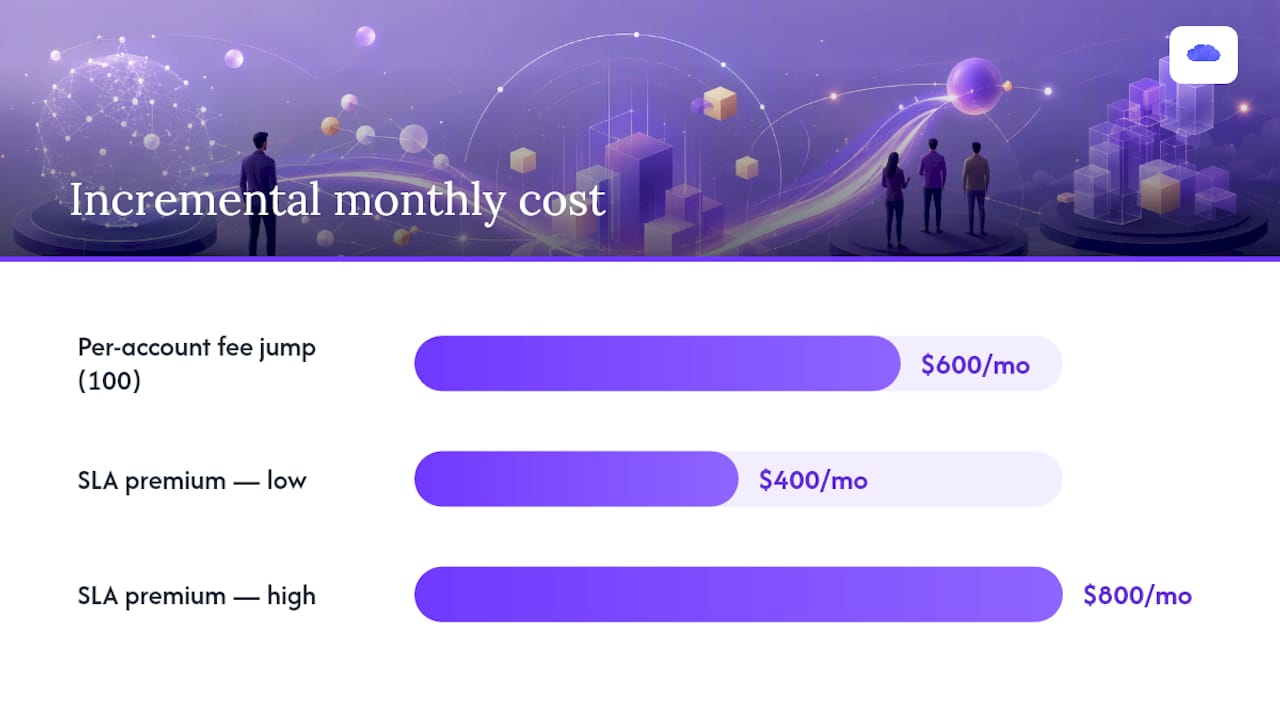
The sensitivity that catches people off guard: doubling per-account fees on a 100-account desk adds $600/month, but adding a strict latency SLA with dedicated support can add $400 to $800/month on top of that, meaning SLA quality often moves the bill more than raw account count once you're past 50 followers.
What Security and Reliability Features Are Worth Paying For?
Rogue-trade detection, per-account toggles, and auto-recovery aren't luxury add-ons for a prop desk running dozens of Tradovate accounts. A single desynced follower account replicating a bad fill across 40 others is the kind of incident that ends a funded-account relationship, and it's exactly the failure mode these features exist to prevent.
> Durable, idempotent event ledgers with sequence tracking let a mirroring system detect a dropped connection and auto-replay missed fills accurately, rather than silently desyncing a follower account until someone notices the P&L doesn't match.
That design principle, drawn from technical execution analysis of mirror-trading architectures, is why reliability engineering costs more than it looks like it should on a feature checklist. TradeDupe builds around this exact logic: rogue-trade detection, auto-recovery, and per-account toggle controls sit alongside a median 34ms mirroring latency and support for Apex, Tradeify, Lucid Trading, and Alpha Futures accounts.
When evaluating a vendor contract, require:
- A written latency SLA with p95/p99 figures, not just a median
- Documented auto-recovery behavior after a dropped connection
- Per-account kill switches you control directly
- A runbook for what happens during a broker outage
How Does Licensing Length Affect What You Pay?
Subscription duration changes your effective rate more than most buyers realize going in. Monthly plans give you flexibility to disconnect quickly if a vendor underperforms, but they typically carry the highest per-month rate. Annual commitments commonly discount 15% to 25% against the monthly rate, which matters at scale: on a 100-account enterprise plan running $1,700 a month, a 20% annual discount is worth over $4,000 a year.
The trade-off is exit flexibility. A prop desk locked into an annual contract with a vendor that can't hold latency SLAs during volatile sessions has limited recourse until renewal. That's a real cost, just not one that shows up on an invoice.
Per-seat or per-broker-connection licensing adds another variable. Some platforms license by individual follower account, others by broker connection regardless of how many accounts sit behind it. If your desk runs multiple accounts through a single Apex or Tradeify master connection, a broker-connection license structure can be meaningfully cheaper than a strict per-account model, and it's worth asking vendors to quote both ways before signing.
The safest approach for a desk that hasn't run a vendor at scale before is a short paid trial or month-to-month term first, then negotiate the annual discount once you've confirmed the SLA holds under real trading conditions, not just in a demo account.
What Do Support and Training Add to the Bill?
Support tier is one of the least transparent line items in copy-trading pricing, and it's where a lot of desks get surprised after the first incident. Entry-level plans usually bundle email or ticket-based support with a 24 to 48-hour response window, which is fine for account setup questions but inadequate when a follower account desyncs during market hours.
Enterprise tiers add dedicated support channels, often with guaranteed response times measured in minutes rather than hours, and that responsiveness typically carries a real premium, sometimes 15% to 30% on top of the base subscription. Onboarding and training also vary by vendor: some include a guided setup call and documentation at no extra charge, while others charge separately for white-glove onboarding across a large multi-account desk, particularly when prop-firm-specific compliance rules need to be configured correctly from day one.
For a desk running more than a handful of accounts, the math usually favors paying for faster support. The cost of an unresolved sync issue during a live trading session, in missed fills or an account that breaches a drawdown rule because of a mirroring delay, tends to dwarf the monthly premium for priority support. Ask vendors directly what their guaranteed response time is in writing, not just what their sales page implies, and confirm whether onboarding for prop-firm-specific rule sets is included or billed as a separate professional services engagement.
What's the Real Total Cost of Ownership?
The subscription line is rarely the full story. Total cost of ownership for a prop desk running server-side copy trading includes the software fee, hosting or infrastructure, market data, and the labor cost of managing it all, and skipping any of those in your budgeting leads to unpleasant surprises by month three.
Cloud-hosted platforms remove the need for a dedicated VPS, since execution happens on co-located infrastructure the vendor manages rather than a server you rent and maintain yourself. That's a real savings versus older plugin-based copiers that required an always-on VPS running $20 to $60 a month per instance. But co-location and higher SLA tiers on the vendor side aren't free. They show up as a recurring infrastructure premium baked into the subscription price rather than a separate line item you pay directly.
Market data feeds add another recurring cost, typically $10 to $80 per month depending on the exchange and depth of data required, and this is billed independently of the copy-trading software itself in most setups. Add the labor cost of a team member monitoring dashboards and handling exceptions, even a few hours a week, and total cost of ownership for a 20 to 30 account desk often lands 20% to 40% above the advertised subscription price once every component is counted.
Should You Ever Use Free Copy Trading Software?
Free and near-free options exist, mostly as loss leaders from cloud-based copier vendors offering flat unlimited-account plans for around $50 a month or trial tiers with no cost for a single connection. For a solo trader testing a strategy across two personal accounts, that's a reasonable starting point.
For a funded-account operation, free or ultra-cheap tools carry risk that isn't obvious until something breaks. Most lack rogue-trade detection, meaning a bad fill on the leader account replicates unchecked across every follower. Most don't publish latency data beyond a marketing claim, so you have no way to verify performance under load. And most offer no meaningful support tier, which means a 2 a.m. desync during overnight futures sessions goes unresolved until someone checks in manually.
The break-even point tends to arrive faster than people expect: once a desk is running more than 5 to 10 funded accounts, the cost of one uncaught rogue trade, in a blown evaluation account or a breached drawdown rule, generally exceeds a year of paid software fees. Free tools aren't wrong for the right use case. They're wrong for the scale this article is written for.
What Hidden Fees Should You Watch For in the Contract?
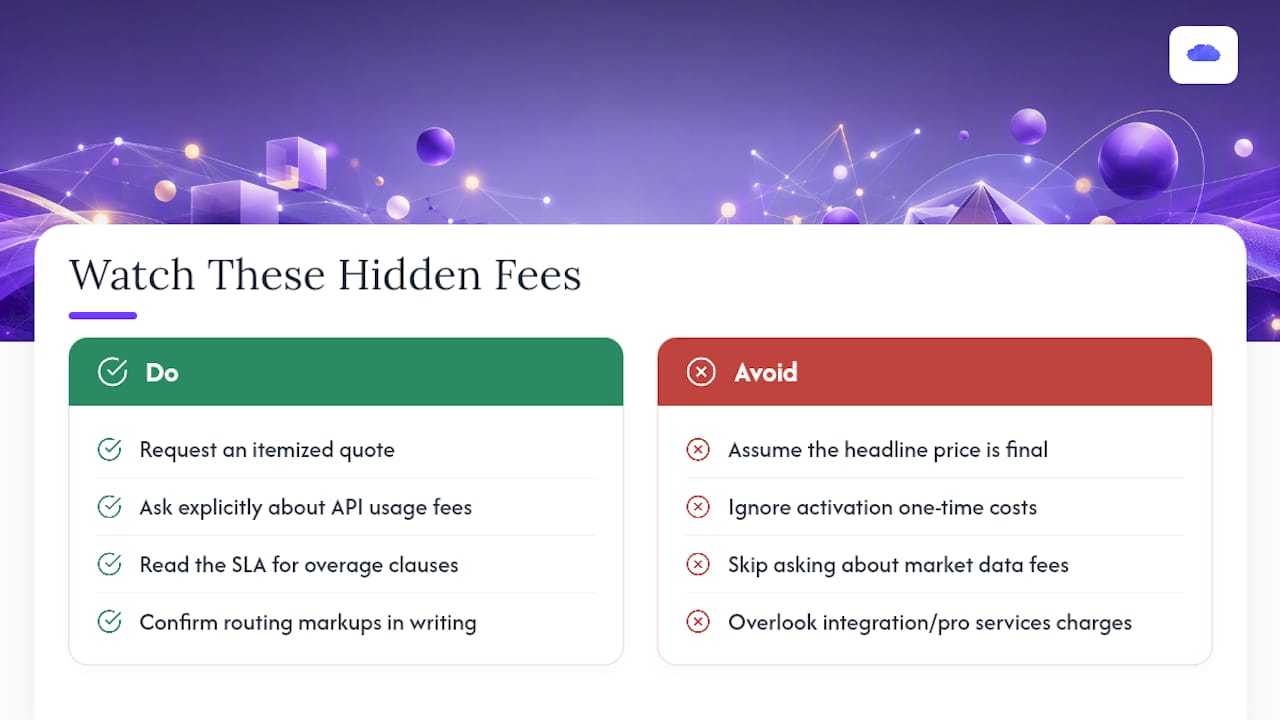
The quoted subscription price is rarely the number you end up paying. Market data fees, often $10 to $80 per month depending on the exchange, are frequently billed separately from the core software subscription and left out of the headline price entirely.
API usage fees can appear on platforms that meter broker connection calls, particularly at high order-rate volumes across many followers, and this is worth asking about explicitly if your desk trades an active strategy with frequent order modifications. Platform commissions, meaning any markup the copy-trading vendor takes on order routing itself, are less common among reputable pro-grade platforms but worth ruling out in writing, since a routing markup compounds badly across dozens of accounts.
Activation fees deserve particular attention because they're structurally different from recurring costs: they hit hardest in year one, when you're connecting a new batch of funded accounts, and community cost breakdowns for scaling prop operations consistently show these one-time charges as the biggest gap between advertised monthly pricing and actual first-year spend. Integration support for less common prop-firm rule sets can also carry a professional services fee outside the base subscription. Before signing, request an itemized quote that separates the recurring subscription from every one-time and usage-based charge, and read the SLA section for any mention of overage fees tied to order volume or account count.
How Should You Actually Budget for This?
Spend on resilience first, not features that look good on a sales page. A desk running real capital across multiple funded accounts should trial any vendor at small scale, two or three accounts, and measure p95/p99 latency under real market conditions before committing to a broader rollout. Marketing latency claims mean little without a signed execution ledger behind them.
On contracts, negotiate a trial period long enough to include at least one high-volatility session, not just a quiet week. Require a written support SLA with a defined response time, and build in exit conditions tied to measurable performance, not just a standard cancellation clause. Reviewing broader downside protection strategies used elsewhere in trading is a useful exercise here too. The same discipline that governs position sizing should govern how you vet the infrastructure your positions depend on.
> — Andres
Getting Started With TradeDupe's Tradovate Copy Trading
TradeDupe operates with low-latency mirroring between leader and follower Tradovate accounts, incorporating rogue-trade detection, auto-recovery, and per-account controls as core features rather than separate add-ons. It supports Apex, Tradeify, Lucid Trading, and Alpha Futures accounts natively, with unlimited broker connections and AI-powered trade analysis available on higher tiers, plus a real-time dashboard for monitoring sync status and follower activity across your whole desk.
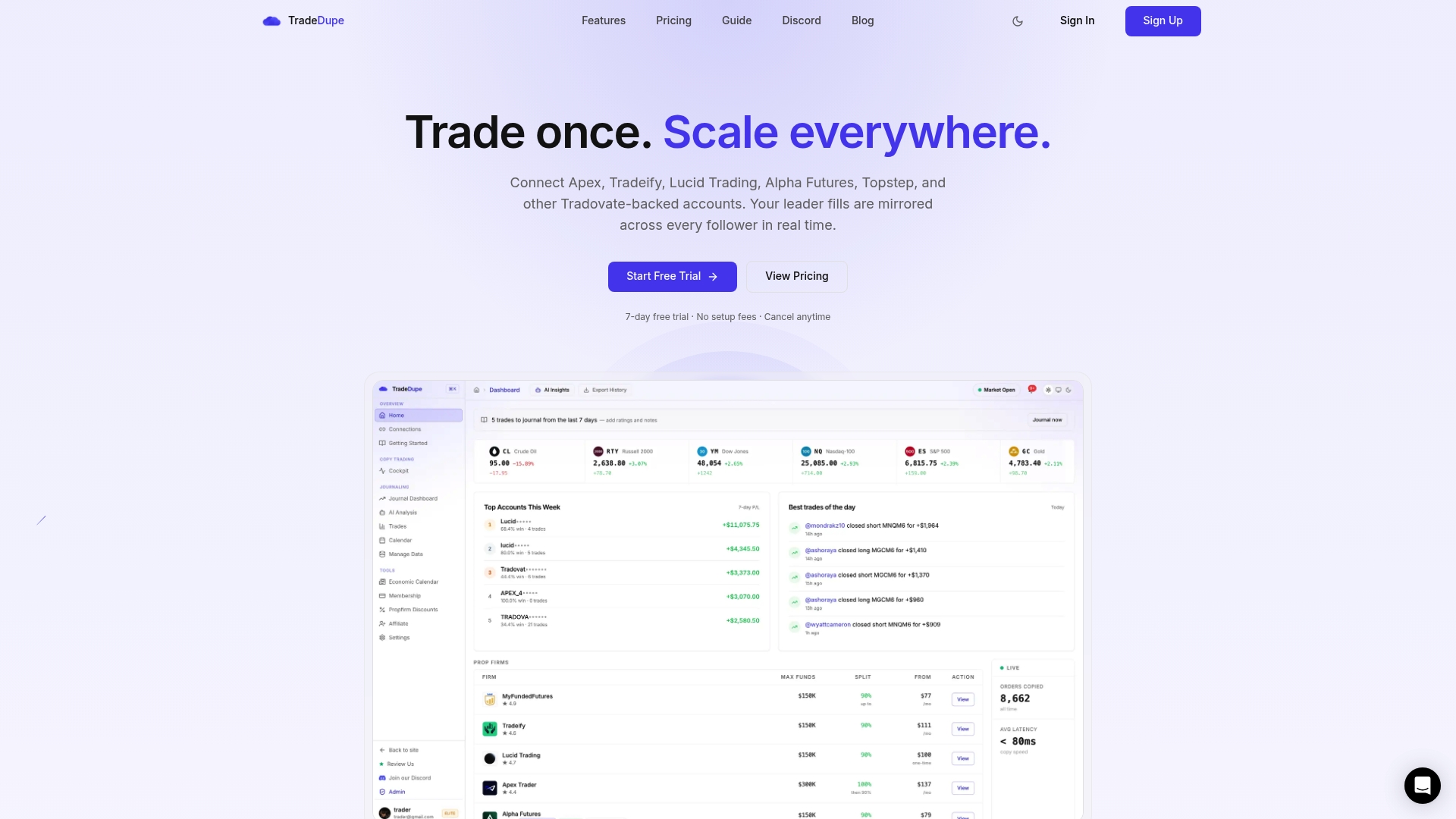
If you're running the math from the worked examples above and trying to figure out where your desk lands, the fastest way to get a real answer is to see it running against your own accounts rather than a demo. The getting-started guide walks through setting up Tradovate copy trading in about 10 minutes, and the Tradovate trade copier page covers the real-time sync mechanics in more depth if you want the technical details before connecting a live account. Start a trial, connect two or three accounts first, and measure the latency yourself before scaling to the rest of your desk.
Sources
For readers who want to go deeper on the technical and operational details behind the pricing figures in this guide, the following sources are worth a direct read:
- Mirror Trading Execution: Technical Performance Analysis
- Managing Multiple Funded Accounts: The Portfolio Approach to Prop Firm Trading - NexusFi Academy
- Cloud Trade Copier | No VPS Required