
Copy Trading in 2026: How It Works and Who It's For
TradeDupe
12 min read
Discover how trading copy works in 2026. Automatically replicate expert strategies, save time, and diversify your portfolio with ease!
Copy trading lets you automatically replicate another trader's live positions in your own account in real time. According to the Investor.gov glossary, a follower's funds are proportionally linked to a selected leader, so every trade the leader opens, adjusts, or closes is mirrored in the follower's account without manual input.
Quick verdict:
- Accessibility: You can access experienced traders' strategies without building one yourself.
- Time savings: Execution is automated, so you are not watching charts all day.
- Diversification: Copy multiple leaders across different asset classes and styles simultaneously.
- Market risk remains: Every loss the leader takes, you take proportionally.
- Past performance is not a guarantee: A leader's six-month track record says nothing definitive about next month.
If you are an individual beginner, start with a demo account on a regulated platform, copy one leader with a small allocation, and treat the first 60 days as a learning period. If you operate a prop desk with multiple Tradovate accounts, the right tool is a server-side SaaS copier like Tradedupe, not a retail copy feature.
*
Table of Contents
- What Is Copy Trading and How Does It Actually Work?
- Risks and Limitations You Need to Understand First
- U.S. Regulatory and Legal Considerations for Copy Traders
- What Types of Copy Trading Platforms Are Available?
- How to Choose a Copy Trading Platform That Fits Your Needs
- Key Takeaways
- The Part Most Copy Trading Articles Skip
- Tradedupe: Built for Prop Desks That Have Outgrown Retail Copy Tools
- Useful Sources and Further Reading
What Is Copy Trading and How Does It Actually Work?
The Wikipedia entry on copy trading traces the practice to the mid-2000s, when algorithmic and mirror trading first allowed systematic replication of another account's positions. Modern copy trading refined that into a follower/leader model where a portion of the follower's capital is proportionally linked to the leader's account.
The core mechanics
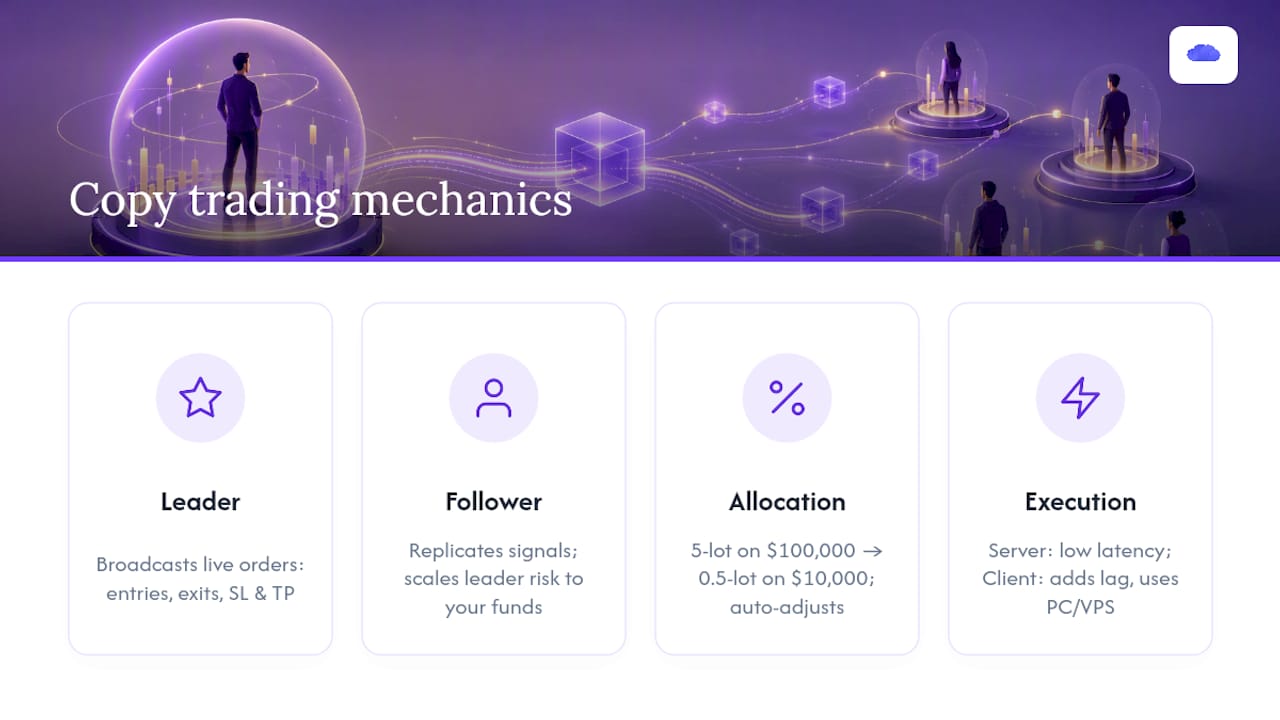
Leader (signal provider): The trader whose positions are broadcast. Leaders may be verified by the platform, self-nominated, or both. Their live order flow, including entries, exits, stop-loss adjustments, and take-profit levels, is the signal stream.
Follower: The account that receives and replicates those signals. If a leader risks 2% of their account on a trade, the platform scales that to 2% of the follower's allocated copy capital.
Proportional allocation: This is the mechanism that makes sizing automatic. A leader opening a 5-lot position on a $100,000 account, while a follower allocates $10,000 to that leader, would receive a 0.5-lot equivalent. The math adjusts continuously as the leader adds to or trims positions.
What typically gets copied: opening and closing positions, stop-loss and take-profit modifications, and partial closes. What often does not get copied: manual account transfers, some platform-specific meta-operations, and trades placed outside the leader's designated copy account.
> Execution model matters more than most beginners realize. Server-side copying processes the mirror instruction on the platform's infrastructure before it reaches your broker, which keeps latency low and removes the dependency on your device being online. Client-side copying, by contrast, routes the signal through software running on your machine or a local VPS — introducing latency and a single point of failure if your connection drops.
For a deeper look at copy trading mechanics and strategy, Tradedupe's primer covers the full lifecycle from signal generation to execution.
Followers retain meaningful control throughout. You can pause copying at any time, close all copied positions independently, set a per-copy stop-loss that triggers before the leader's own stop, or apply a global maximum drawdown limit on the entire copy relationship. That override capability is what separates copy trading from handing your account to a third party.
*
Risks and Limitations You Need to Understand First
Copy trading does not insulate you from the market. It transfers execution, not judgment, and that distinction carries real consequences.
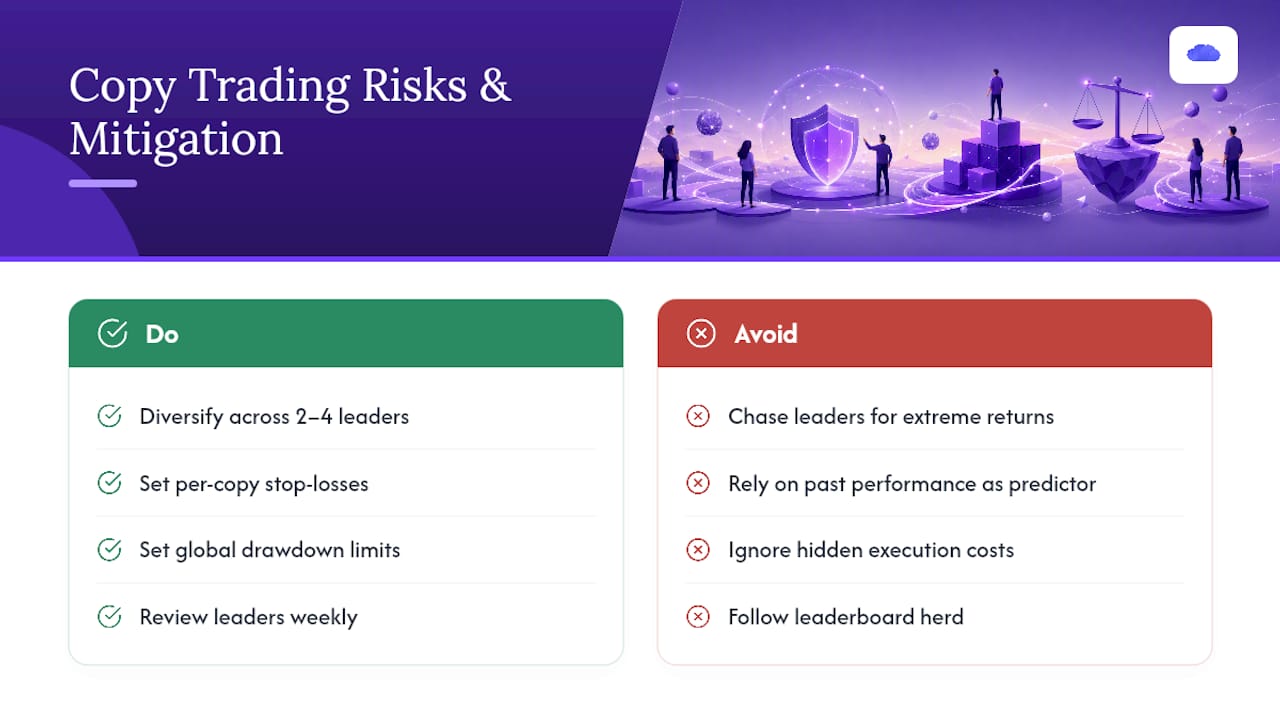
Market risk is fully inherited. When a leader's position moves against them, your proportional copy moves against you by the same percentage. A 15% drawdown on the leader's account is a 15% drawdown on your allocated copy capital. No platform feature changes that math.
Leader selection risk is the most underestimated hazard. FINRA explicitly warns against chasing leaders with very high annual return claims, such as 300% or more, because those figures almost always reflect unsustainable leverage or survivorship bias. A leader who doubled their account in three months may have done so with position sizes that will eventually blow the account.
> Past performance is not a predictor of future results. This is not a legal disclaimer to scroll past. A leader's 18-month track record can be erased in a single week of adverse volatility. Treat historical returns as one data point, not a forecast.
Hidden costs are another layer most beginners miss. Even on platforms that advertise no subscription fee for followers, you still pay through the leader's trading activity: spreads, commissions, and execution fees accumulate on every copied trade. Followers almost always incur implicit costs through the leader's order flow, and "no additional platform fee" does not mean free.
Behavioral risks are subtler but persistent. Platform social features that display leaderboard rankings can create herd behavior, where thousands of followers pile into the same leader simultaneously. That concentration amplifies slippage on entry and exit, particularly in less liquid instruments.
Pro Tip: Diversify across two to four leaders with different trading styles and instruments. A single leader with a great track record is still a single point of failure.
Mitigation starts with per-copy stop-loss settings, global drawdown limits on each copy relationship, and a commitment to reviewing leader performance at least weekly. Risk managers who rely on copy trade systems build these controls into their workflow from day one, not after the first significant loss.
*
U.S. Regulatory and Legal Considerations for Copy Traders
Copy trading in the United States sits at the intersection of several regulatory frameworks, and the platform you use determines which rules apply.
The SEC oversees platforms and intermediaries dealing in securities. If a copy trading service involves stocks, ETFs, or options, the platform and any signal provider acting as an investment advisor may need to be registered with the SEC. EDGAR, the SEC's public filing database, is the canonical source for verifying a platform's registration status and public disclosures.
For futures and derivatives, the relevant regulator is the Commodity Futures Trading Commission (CFTC), with the National Futures Association (NFA) handling member registration and compliance. The NFA BASIC profile search lets you verify registration details for any futures or derivatives service provider operating in the U.S. If you are copying futures trades through a prop firm or SaaS copier, that lookup is a non-negotiable first step.
> The most common compliance gap for U.S. copy traders is using a platform that is not registered with the appropriate regulator. An unregistered entity offering automated trading signals or copy services may be operating illegally, and you have limited recourse if funds are lost or the service disappears.
Practical steps before funding any copy trading account:
- Verify the broker's registration with FINRA's BrokerCheck, the SEC's EDGAR, or the NFA BASIC database depending on the asset class.
- Request a complete fee disclosure, including spreads, commissions, and any performance fees paid to leaders.
- Confirm the platform offers auditable, third-party-verified leader performance histories, not self-reported screenshots.
- Keep detailed records of all copied trades for tax reporting. The IRS treats gains from copy trading the same as any other investment gain, and short-term versus long-term capital gains treatment depends on how long each copied position was held.
Tax note: Copy trading gains and losses are reportable investment income. Consult a qualified tax professional to confirm your specific reporting obligations, as rules vary by account type, asset class, and holding period.
*
What Types of Copy Trading Platforms Are Available?
The platform type you choose shapes everything from execution quality to the range of leaders available. Three distinct categories serve meaningfully different needs.
| Platform Type | Best For | Execution Model | Leader Pool | Multi-Account Support | Demo Available |
|---|---|---|---|---|---|
| Broker-integrated copy features | Retail beginners, single accounts | Varies (often client-side) | Broker's own verified traders | Limited or none | Usually yes |
| Standalone social/copy platforms | Retail investors, social features | Server-side or client-side | Large open pools, variable vetting | Limited | Often yes |
| SaaS multi-account copiers (prop firms) | Prop desks, multi-account managers | Server-side, low latency | Leader is your own master account | Core feature | Trial available |
Broker-integrated platforms embed copy features directly inside the broker's interface. They are the easiest entry point for retail traders, with pre-vetted leader pools and straightforward allocation controls. The trade-off is limited flexibility: you can usually copy only leaders within that broker's ecosystem, and multi-account management is either unavailable or rudimentary.
Standalone social copy platforms offer wider leader pools and community features like forums, leader interaction, and public performance feeds. eToro's CopyTrader is a well-known example of this model, with documented minimums, demo availability, and the ability to start or stop copying at any time. These platforms typically earn revenue through spreads rather than commissions, so copying is not free even when no subscription fee is charged.
SaaS multi-account copiers are built for a different problem entirely. A prop desk running 20 Tradovate accounts cannot manage those through a retail copy interface. These platforms mirror a single master account to many follower accounts with server-side execution, rogue-trade detection, and per-account toggle controls. The leader pool is your own trading desk, not a public marketplace. For an automation workflow perspective on execution and latency, the architecture of server-side mirroring is what separates professional-grade copiers from consumer tools.
AvaTrade's copy trading education pages and Pepperstone's copy trading guide both provide practical overviews of broker-integrated and standalone platform features, including how to set allocation and use stop-loss controls on copy relationships.
*
How to Choose a Copy Trading Platform That Fits Your Needs
Vetting a platform takes 30 minutes if you know what to check. Work through these criteria in order, because a platform that fails on regulation or execution is disqualified regardless of how attractive the leader returns look.
- Regulation and broker custody — Confirm the broker holding your funds is registered with the SEC, FINRA, CFTC, or NFA depending on the asset class. An unregistered intermediary is a red flag regardless of platform quality.
- Costs and minimums — Identify the minimum deposit, the minimum copy allocation per leader, the spread or commission structure, and any subscription or performance fees. Pepperstone's guide recommends checking whether the platform discloses all fee layers, not just the headline number.
*
Key Takeaways
Copy trading gives you automated access to experienced traders' strategies, but the quality of the platform, the rigor of leader selection, and the discipline of your risk controls determine whether it works in practice.
| Point | Details |
|---|---|
| Copy trading definition | A follower's funds are proportionally linked to a leader, mirroring every open, close, and stop-loss adjustment in real time. |
| Primary risks | Market risk is fully inherited; leader selection risk and hidden trading costs are the two most underestimated hazards. |
| U.S. compliance check | Verify broker and platform registration with the SEC, FINRA, CFTC, or NFA before depositing funds. |
| Starting approach | Begin with a demo account, allocate across two to four leaders, and set per-copy stop-loss limits before going live. |
| Tradedupe for prop desks | Tradedupe provides server-side mirroring at 34ms median latency for Tradovate-based multi-account prop operations, with rogue-trade detection and per-account controls. |
*
The Part Most Copy Trading Articles Skip
There is a gap between what copy trading promises and what most people actually experience, and it usually comes down to one thing: followers treat leader selection as a one-time decision rather than an ongoing evaluation.
The platforms that display leaderboards and social feeds are, by design, optimized for engagement. A leader with a spectacular six-month return sits at the top of the list, attracts thousands of new followers, and then faces a market environment that does not match the conditions that produced those returns. The followers who joined at the peak absorb the drawdown. The platform's incentive structure did not cause the loss, but it created the conditions for it.
The more defensible approach is to treat copy trading the way a fund allocator treats manager selection: with documented criteria, a minimum track record threshold, position-size analysis, and a pre-defined exit condition. That is not how most retail platforms are marketed, but it is how the traders who use copy trading profitably actually operate.
For prop desks, the calculus is different but the discipline is the same. Server-side execution and rogue-trade detection solve the operational problem. The strategic problem, which is ensuring the master account's strategy is sound and the risk parameters are calibrated correctly, still requires human judgment. Tradedupe handles the infrastructure. The trading decisions remain yours.
*
Tradedupe: Built for Prop Desks That Have Outgrown Retail Copy Tools
Running 10, 20, or 50 Tradovate accounts from a single master strategy is a fundamentally different operation than retail copy trading, and retail tools reflect that. Tradedupe is the purpose-built alternative: server-side mirroring at 34ms median latency, rogue-trade detection that protects funded accounts from rule violations, and per-account toggle controls that give you surgical precision over which accounts are live at any moment.
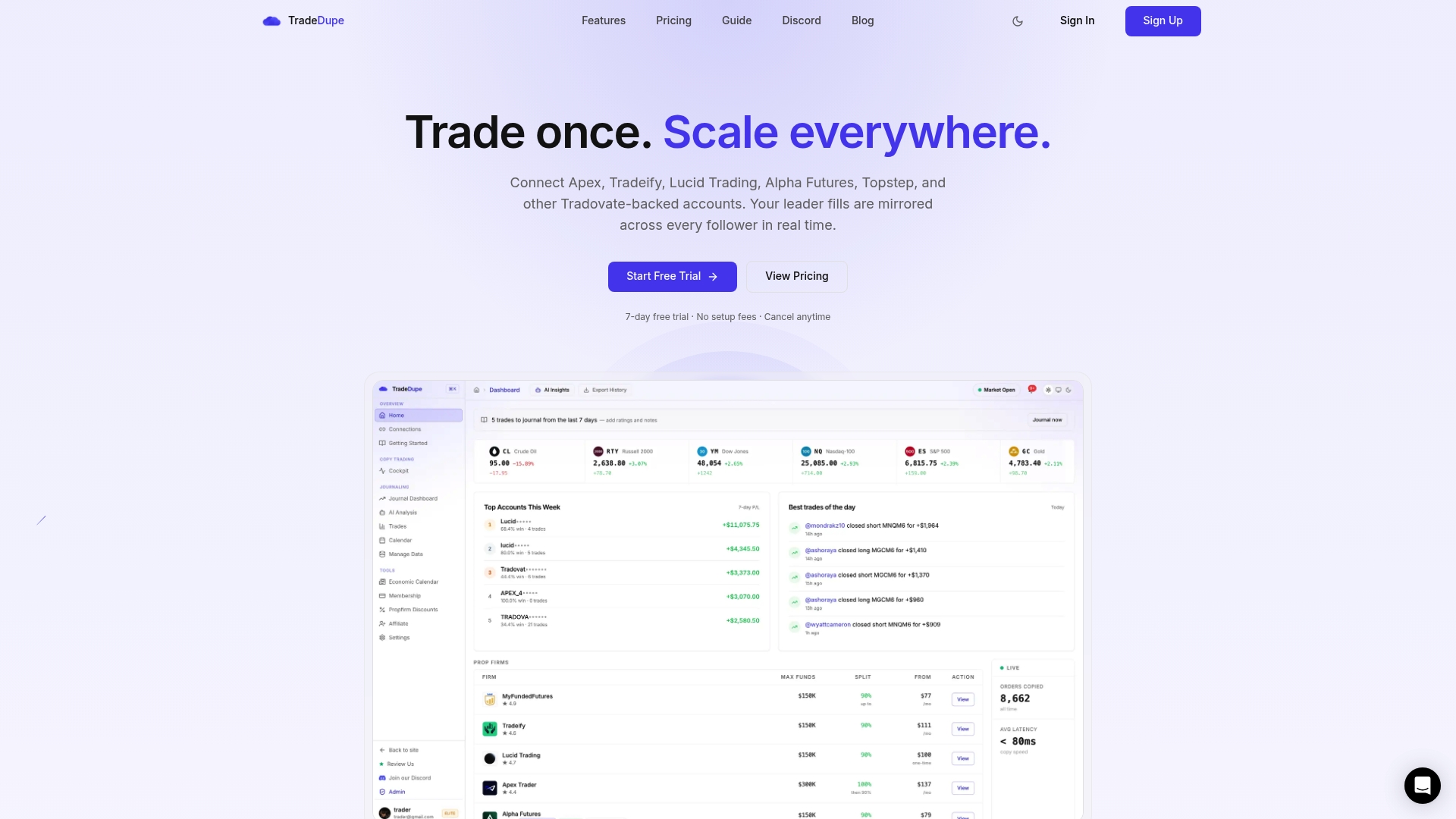
The platform integrates natively with Apex, Tradeify, Lucid Trading, and Alpha Futures, so your prop firm's specific account structures are supported out of the box. Tiered subscription plans scale from individual multi-account traders to enterprise prop desks, with unlimited broker connections and AI-powered trade analysis included at higher tiers.
If your current setup involves manual copying, spreadsheet tracking, or a broker's built-in copy feature that cannot keep pace with your trade frequency, start your Tradedupe trial and run the first session alongside your existing workflow. The getting started guide walks through Tradovate setup in under 10 minutes.
*
Useful Sources and Further Reading
Authoritative references for verifying facts, checking registrations, and deepening your understanding of copy trading:
- Investor.gov glossary — copy trading
- FINRA — Know the risks of auto-trading services
- Wikipedia — Copy trading
- AvaTrade — Copy trading education
- IG — What is copy trading?
- Pepperstone — Copy trading guide
- eToro — CopyTrader overview
- U.S. Securities and Exchange Commission (SEC)
- NFA BASIC Profile search
Recommended
- Best Futures Trading Strategy for Copy Trading (2026): Order Flow vs ICT Concepts | TradeDupe Blog
- Best Trade Copier for Prop Firms in 2026 (Honest Comparison) | TradeDupe Blog
- Getting Started with TradeDupe: Set Up Tradovate Copy Trading in 10 Minutes
- The Futures Day Trading Landscape in 2026: ICT, Order Flow, Prop Firms, and What Actually Works | TradeDupe Blog