Five Year Retention: Audit Trails for Copy Trading on Prop Desks
TradeDupe
20 min read
Checklist to make copy trading audit ready: millisecond timestamps, five year retention, tuned detection, and vendor‑mapped export tests.
A compliant copy-trading system must produce a reproducible, timestamped audit trail linking mandate to allocation to routed order to fill, and it must retain that trail for five years, with the most recent two years readily accessible. Anything less leaves a prop desk exposed the moment a regulator, a funding partner, or an angry follower account asks for proof. Platforms like TradeDupe build toward that standard by design rather than as an afterthought.
*
> TL;DR: > > - Firms must retain an immutable, timestamped audit trail linking each trade from lead signal to follower fill for at least five years, with the most recent two accessible. > - Essential audit log fields include source trade and lead account IDs, order IDs, execution timestamps down to the millisecond, and allocation parameters to ensure provable provenance. > - Classification of copy trading as portfolio management or advice triggers stricter regulations, making controls and disclosures mandatory even if initially framed as passive technology. > - Automated, correlation-based detection of copy-trade abuse should combine multiple signals like timing, size proportionality, and latency to reduce false positives and identify genuine misconduct. > - Building scalable, event-sourced systems with comprehensive export formats, versioned performance metrics, and integration with trading and forensic tools is critical for compliance readiness.
*
Table of Contents
- What Compliance Logging Copy Trading Actually Requires
- Audit Log Fields, Provenance, and Retention Requirements
- Regulatory Expectations and Classification Risk for Copy Trading
- How Prop Firms Spot Copy-Trade Abuse
- Building an Auditable Trail: Technical Patterns and Exports
- Operational Checklist for Compliance Teams Running Copy Trading
- TradeDupe Evidence: Mapping the Checklist to a Real Implementation
- Common Challenges and Pitfalls in Compliance Logging
- Integrating Compliance Logging With Trading Platforms and Third-Party Tools
- Case Studies and Lessons From Compliance Breaches
- Automated Compliance Monitoring and Alerting Techniques
- Three Lessons From Auditing Copy Trading Systems
- Get Your Copy Trading Program Audit-Ready With TradeDupe
- Sources
What Compliance Logging Copy Trading Actually Requires
Compliance logging copy trading is not a single feature you turn on. It's a discipline that spans data architecture, retention policy, and detection logic, and most firms underestimate how many moving parts it touches until an audit request lands on their desk. The industry term for this discipline is trading recordkeeping and audit-trail governance, and it borrows heavily from established futures and securities recordkeeping practice even where copy trading itself sits in a regulatory gray zone.
The core obligation is provenance: every trade a follower account executes must trace back, without gaps, to the lead trader's original signal. That means the system needs to answer, on demand, four questions for any given fill: who initiated it, what allocation logic scaled it, when each leg happened relative to the others, and whether anything about the routing or execution deviated from the documented mandate.
Firms that treat this as a checkbox exercise tend to log the wrong things. They capture P&L summaries and dashboard snapshots but not the underlying order events, which means when a dispute or investigation arrives, they have a narrative but no evidence. The next section breaks down exactly which fields close that gap.
Audit Log Fields, Provenance, and Retention Requirements
A defensible audit log for copy trading captures the full lifecycle of a trade signal, not just its outcome. At minimum, compliance teams should be able to pull the following fields for any trade, on any account, on any date within the retention window:
- Source trade ID and the leader account ID that generated the signal
- Follower account ID and the specific mandate or subscription tier governing that link
- Allocation parameters, including multiplier, position sizing method, and rounding logic applied at the moment of the copy
- Order IDs for both the leader's original order and every routed follower order
- Exchange timestamps for order placement, acknowledgment, and fill, down to the millisecond
- Instrument, price, and quantity for each leg
- Fill IDs, fees charged, slippage realized versus the leader's fill, and observed latency
- Rejection codes for any follower order that failed to execute, with the reason
Each of these fields exists because a specific dispute type demands it. Slippage and latency fields answer "why did my fill differ from the leader's?" Rejection codes answer "why didn't my account get the trade at all?" Allocation parameters answer the most common complaint in copy trading: "why was my position sized differently than promised?"
Provenance matters as much as the fields themselves. Logs need to be append-only and immutable, meaning no one, including administrators, can quietly edit a historical record after the fact. Performance reporting tied to a lead trader's track record should be versioned, so that if a firm restates a metric, both the old and new calculations remain retrievable and the methodology behind each is documented. Industry analysis of copy trading legality across jurisdictions treats versioned performance records as a baseline trust signal, not an optional extra, because a performance number that can't be recalculated from raw ledger data isn't defensible in a dispute.
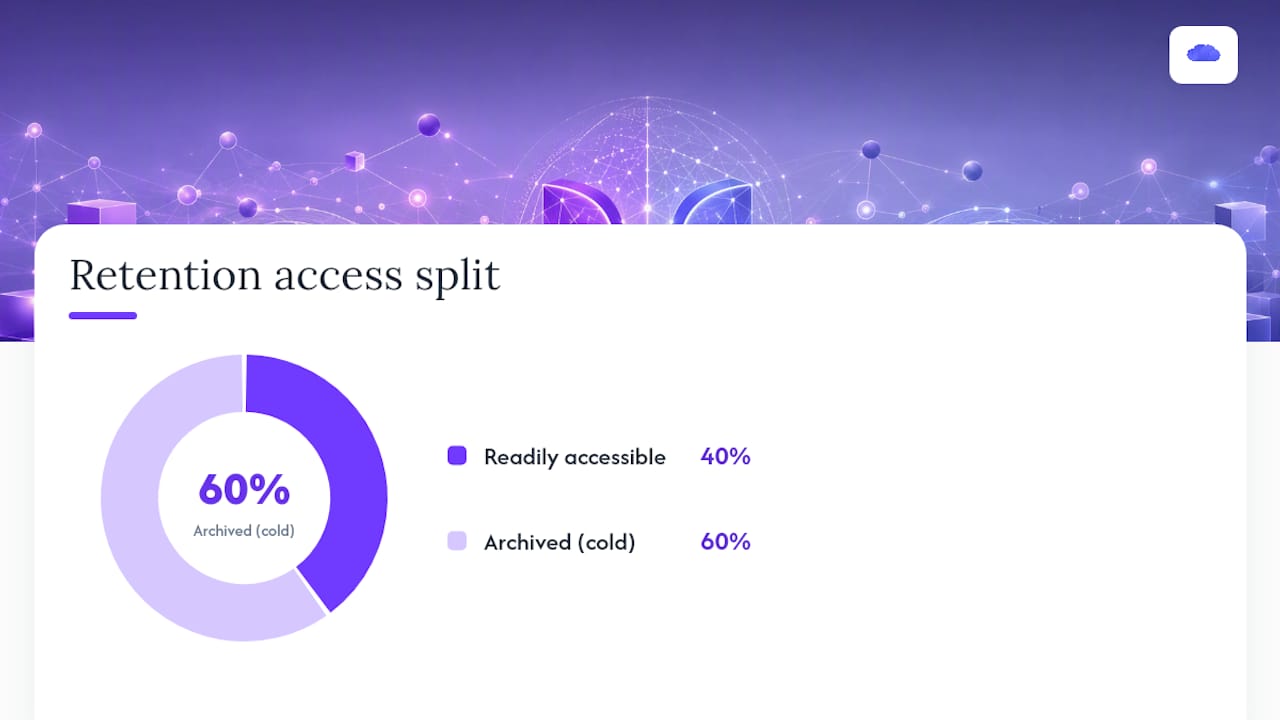
Retention is where many firms get the timeline wrong. NFA guidance requires that required books and records be kept for five years, with the most recent two years readily accessible rather than archived in cold storage. Electronic records satisfy this as long as they remain permanent, indexed, and convertible to hard copy on request.
On format, most compliance teams end up needing three output types: CSV exports for ad hoc regulator or auditor requests, a compliance API for systematic pulls into a case management system, and signed ledger snapshots that prove a record hasn't been altered since the date it was generated. A granular audit trail that connects mandates, risk settings, and copied trades into one exportable record does the heavy lifting here, turning what would otherwise be a multi-day manual reconstruction into a same-day export.
Regulatory Expectations and Classification Risk for Copy Trading
The single biggest compliance risk in copy trading isn't fraud. It's classification. The moment a platform automatically executes trade signals on a follower's behalf without meaningful client discretion, it starts to resemble portfolio management or investment advice, which triggers a different, heavier regulatory regime than simple order routing.
ESMA's supervisory briefing on copy trading is explicit about this trigger point: automatic execution of a lead trader's signals can constitute portfolio management, which brings suitability assessments and disclosure obligations into play even when the platform frames itself as a passive technology layer. U.S. firms operating in futures markets don't fall under ESMA's jurisdiction, but the underlying logic, that automation of discretion equals advice, shows up in analogous form across regulatory regimes and is worth building controls around now rather than after a regulator asks.
IOSCO's cross-market review of copy and social trading practices lays out good practices that apply regardless of jurisdiction. Firms offering these services should assess whether their arrangement amounts to investment advice or portfolio management, and if there's any ambiguity, build controls as though it does. IOSCO's recommendations include:
- Formal lead-trader selection criteria and a documented process for removing underperforming or rule-violating leaders
- Ongoing monitoring of lead trader conduct, not just a one-time vetting at onboarding
- Clear disclosure of fees, compensation arrangements, and any conflicts of interest tied to lead trader promotion
- Regular review of both lead and follower outcomes, not just aggregate platform performance
Regulators are increasingly focused on lead trader marketing and compensation structures, since a platform that pays lead traders based on follower volume has a built-in incentive to promote risk over sustainability, a conflict IOSCO flags directly.
For U.S. prop desks operating through futures brokerages, the practical recordkeeping bar mirrors NFA and CFTC expectations even where a copy trading feature itself isn't separately licensed. That means the five-year retention standard, indexed and retrievable electronic records, and an audit trail sufhttps://tradedupe.com/blog/how-prop-firm-rules-affect-trade-copying-in-2026)efficient to reconstruct any single trade become the operating floor, not a nice-to-have. Compliance teams should treat prop firm rule changes as a moving target and build interpretation pipelines rather than reacting one policy update at a time. A 2025 industry review found that 74% of financial institutions reported a lag of over a year between identifying a regulatory change and fully implementing it, a gap that's far more survivable with automated compliance data pipelines than with manual policy reviews.
When in doubt about whether a copy trading feature crosses into advice or portfolio management, that's the point to bring in counsel and start building registration-ready controls before a regulator forces the issue.
How Prop Firms Spot Copy-Trade Abuse
Detecting abusive or unauthorized copying is fundamentally a correlation problem, and single-flag systems fail because any one signal in isolation has a plausible innocent explanation. Two accounts trading the same instrument at the same time could be coincidence, shared strategy, or unauthorized mirroring, and you can't tell which from timing alone.
Operator guidance on cross-account abuse in prop firms recommends combining multiple weak signals into a composite score rather than relying on any single trigger, since correlation-based detection catches patterns that no individual metric would flag on its own.
The signals worth computing and logging on an ongoing basis include:
- Similarity scores across order timing, instrument selection, and directional bias between account pairs
- Sequence alignment that checks whether one account's trade history is a time-shifted copy of another's, not just a statistical correlation
- Latency covariates, since a follower account consistently trading milliseconds behind a specific leader is a stronger signal than random correlation
- Order-size proportionality, flagging cases where position sizes scale in lockstep with another account rather than independently
- Identical stop and limit patterns, which are harder to fake than entry timing and often the clearest tell
- Follower fill dispersion, since legitimate independent trading shows more variance in execution than coordinated copying
When a detection score crosses threshold, the investigation itself needs its own evidence set, separate from routine audit logs. That means pulling raw order streams with full timestamps, per-order latency traces, IP and API key binding for every session involved, and toggle event history showing exactly when copy links were enabled or disabled relative to the flagged activity. Practical forensic reviews of copy trading disputes treat signed snapshots of the performance ledger for the period under review as essential, since a dispute months later is far easier to resolve with a preserved point-in-time record than a recalculation from current data.
Pro Tip: Tune your correlation thresholds against your own historical false-positive rate before rolling them out platform-wide. A threshold copied from another firm's playbook will either flood your triage queue with legitimate strategy overlap or miss the abuse pattern specific to your account structure.
Retention for investigation files should match or exceed your general audit log policy. A case that gets escalated to a regulator or a funding partner needs the full evidence packet preserved, not just the summary conclusion.
Building an Auditable Trail: Technical Patterns and Exports
Engineering an auditable copy-trading system starts with event sourcing rather than state snapshots. Instead of storing "current position" as a mutable record, the system stores every event, order placed, order filled, allocation applied, toggle flipped, as an immutable entry in an append-only ledger. Current state becomes a derived view, and history becomes permanent by construction rather than by policy.
Unique global identifiers need to thread through the entire leader-to-follower flow. A single source trade ID should be traceable through every allocation decision and every routed follower order it spawned, so that a compliance officer can start from one leader trade and enumerate every account affected, or start from one follower fill and trace it back to its origin, without a manual join across disconnected tables.
For e-discovery purposes, the fields worth indexing (not just storing) include account ID, instrument, timestamp range, source trade ID, and toggle state at time of execution. Indexing matters because a regulator's request rarely comes in the shape your database is optimized for. If your only query path is "by account," a request for "every trade touched by leader X during a specific week" turns into a slow, error-prone scan instead of an indexed lookup.
| Export type | Primary use case | Typical format |
|---|---|---|
| Ad hoc regulator request | One-time audit or investigation pull | Signed CSV export |
| Systematic compliance pull | Scheduled case management ingestion | REST API with pagination |
| Dispute resolution snapshot | Point-in-time performance verification | Signed ledger snapshot with hash |
| Exchange reconciliation | Matching internal fills to exchange records | Exchange-native send/recv log |
On the exchange side, send/recv logs are typically available within about thirty minutes of session end, which gives compliance teams a same-day reconciliation window against internal records rather than waiting on a next-day batch process.
Performance reporting deserves its own versioning discipline, separate from the trade-level ledger. Every published performance metric for a lead trader should carry its calculation methodology, whether fees are included, the exact timestamp range covered, and whether the figure reflects gross or net follower outcomes. When a metric changes, whether from a bug fix or a methodology update, the old version stays retrievable rather than silently overwritten.
Data integrity, finally, comes down to making tampering detectable rather than merely inconvenient. Cryptographic hashing of ledger snapshots, combined with periodic signed checkpoints, means any retroactive edit to historical data breaks the hash chain and becomes immediately visible. Firms building a full audit trail across multiple accounts should treat this hashing layer as part of the initial architecture, not a bolt-on added after the first dispute forces the question. Third-party forensic tools like trade review software can supplement in-house logging by providing an independent performance analysis layer that doesn't rely solely on the platform's own reporting.
Operational Checklist for Compliance Teams Running Copy Trading
A working copy-trading compliance program runs on four repeating cycles: onboarding, control configuration, monitoring, and incident response. Skipping any one of them tends to surface as a gap exactly when you can least afford it, mid-audit or mid-investigation.
- Onboarding. Run every follower through a suitability questionnaire before activating a copy link, map the specific mandate governing the relationship, vet lead traders against a documented selection standard, and issue a disclosure template covering fees, risk, and compensation conflicts before the first trade copies.
- Control configuration. Set per-account toggles that let any single follower link be disabled instantly, cap maximum allocation multipliers, define exposure limits per account and per instrument, and configure auto-disable thresholds that kill a copy link automatically if drawdown or deviation crosses a preset line.
- Monitoring cadence. Run real-time alerts for rejection spikes and latency anomalies, reconcile fills daily against exchange records, sweep for correlation anomalies weekly, and conduct a full audit-log review monthly regardless of whether anything flagged in between.
- Incident response. When something trips, capture the full evidence set immediately (raw orders, toggle history, session metadata), package it into a reviewable file, know your regulator notification triggers in advance, and run a documented remediation playbook rather than an improvised fix.
A 2025 industry review found 74% of firms take more than a year to fully implement a regulatory change after identifying it. Desks that build this checklist into recurring calendar events, rather than a one-time setup task, close that lag by treating compliance as infrastructure rather than a periodic scramble.
TradeDupe Evidence: Mapping the Checklist to a Real Implementation
TradeDupe's feature set maps directly onto the checklist above rather than requiring a compliance team to bolt monitoring on top of a generic copy-trading tool. Per-account toggle controls give operators the instant disable capability the control-configuration step calls for. Rogue-trade detection runs the correlation-style monitoring the detection section describes, flagging deviation from expected allocation patterns in real time. Audit exports and reporting APIs cover the CSV and systematic-pull formats compliance teams need for regulator or internal audit requests.
The platform's dashboard gives compliance and desk managers a live view of sync status and leader/follower activity, which supports the daily reconciliation and real-time alerting cadence the operational checklist requires. TradeDupe's median trade mirroring latency of 34 milliseconds matters here specifically because latency is one of the detection covariates investigators use to distinguish authorized mirroring from unauthorized copying, and a documented, consistent latency profile makes that distinction cleaner. Broker connections across supported prop firms, including Apex, Tradeify, Lucid Trading, and Alpha Futures, mean the audit trail stays consistent across a multi-account operation rather than fragmenting by broker.
Before committing to any vendor, run a short evaluation:
- Request a sample audit log export and check it against the field list in this article
- Run a short reconciliation between the vendor's fills and your own exchange records
- Validate that CSV and API exports actually match, field for field, without manual cleanup
Common Challenges and Pitfalls in Compliance Logging
The most common failure isn't missing data. It's data that exists but can't be assembled fast enough when a request actually lands. Firms log the right fields into three different systems, an order management system, a broker platform, and a separate analytics dashboard, and then discover during an audit that reconciling them by hand takes days rather than minutes.
Retention gaps rank second. A firm hits its five-year requirement on paper but archives the older records in a format nobody can actually query without a specialist, which technically satisfies the letter of NFA guidance while failing its spirit of accessible recordkeeping.
Timestamp precision causes quieter but equally damaging problems. A system logging order events to the second, rather than the millisecond, can't distinguish a legitimate simultaneous fill from a suspicious latency pattern, which blinds the detection layer described earlier without anyone noticing until a dispute forces a closer look.
Version drift in performance reporting is another recurring trap. A platform recalculates a lead trader's historical return using an updated fee methodology, overwrites the old figure, and loses the ability to explain why last quarter's published number doesn't match this quarter's restated one. That's exactly the scenario versioned performance records exist to prevent.
Finally, many firms treat compliance logging as a launch-day task rather than a living system, building it once and never revisiting it as account volume, prop firm partnerships, or regulatory guidance shift. A logging architecture that worked for ten follower accounts often buckles at two hundred, not because the fields changed but because the query and export layer wasn't built to scale with volume.
Integrating Compliance Logging With Trading Platforms and Third-Party Tools
Compliance logging rarely lives in a vacuum. It has to pull data from the trading platform itself, push exports to case management or e-discovery tools, and often reconcile against exchange-native records that arrive on their own schedule.
The cleanest integration pattern treats the trading platform as the source of truth for order and fill events, with the compliance logging layer subscribing to those events rather than polling for them after the fact. That distinction matters at scale: polling introduces latency and gaps, while event subscription captures every state change as it happens, which is closer to the append-only ledger pattern described earlier.
Third-party analytics and forensic review tools add a layer the core platform often can't provide on its own: independent verification. A tool like trade review software can ingest exported fills and recalculate performance metrics from raw data, serving as a check against the platform's own reporting rather than relying on a single source's math.
Exchange reconciliation is the trickiest integration point, mainly because exchange logs arrive on the exchange's timeline, not yours. Building a reconciliation job that runs automatically once send/recv logs post, rather than requiring a manual daily check, closes the gap between internal records and the exchange's own record of what actually happened.
API design matters more than most firms initially budget for. A compliance API that only supports single-record lookups forces manual work for any bulk regulator request. Pagination, date-range filtering, and bulk export by account or by leader ID should be standard, not an afterthought added after the first slow audit response.
Case Studies and Lessons From Compliance Breaches
Copy trading compliance failures tend to follow one of a few recognizable patterns, and the lessons compound across jurisdictions even where the specific regulatory citation differs.
The most instructive pattern involves platforms that marketed lead trader performance without disclosing compensation tied to follower volume. IOSCO's review of imitative trading practices flags this conflict directly: when a lead trader earns more as follower assets under mirroring grow, the incentive to promote aggressive, high-turnover strategies over sustainable ones becomes structural rather than incidental. The lesson isn't just "disclose compensation." It's that compensation structure needs its own audit trail showing exactly what a lead trader earned and when, tied back to specific follower volume, so a regulator reviewing a complaint can verify the disclosure matched reality.
A second recurring pattern involves classification drift, where a feature launched as a simple order-routing tool gradually added automated execution logic until it functionally became portfolio management without anyone updating the compliance framework around it. ESMA's supervisory briefing exists largely because this drift happens gradually enough that no single product update feels like the moment suitability obligations should have kicked in. The lesson: classification review needs to be a recurring compliance task tied to product changes, not a one-time assessment at launch.
A third pattern, more operational than regulatory, involves firms that could prove what happened but couldn't prove when, because timestamp granularity was too coarse to resolve a dispute about simultaneous versus sequential fills. That gap turns an easily resolvable complaint into a prolonged investigation purely due to a logging design choice made months earlier.
Automated Compliance Monitoring and Alerting Techniques
Manual compliance review doesn't scale past a small handful of accounts, which is why automated monitoring has become the default rather than the exception for any prop desk running copy trading at volume.
Real-time alerting should trigger on a defined set of conditions rather than a vague "monitor everything" mandate: rejection rate spikes on a specific follower link, latency drift beyond a set threshold, allocation multiplier changes outside pre-approved bounds, and toggle events happening outside expected business hours. Each of these has a specific investigative next step attached, which is what separates a useful alert from noise that gets ignored after the third false positive.
Correlation sweeps, distinct from real-time alerts, run on a scheduled cadence rather than continuously, since detecting a copying pattern often requires a window of historical data rather than a single event. Weekly sweeps that recompute similarity scores across all active account pairs catch slow-building patterns that a single-transaction alert would miss entirely.
Building this kind of pipeline in-house is possible but demands ongoing maintenance as regulatory guidance shifts and account volume grows. That's the core argument for automated interpretation pipelines: mapping regulatory obligations directly to live trade data, rather than relying on periodic manual policy review, closes the implementation lag that leaves so many firms exposed for over a year after a rule change.
Alerting thresholds also need periodic recalibration. A threshold set when a desk ran twenty accounts will generate a flood of false positives, or worse, miss real signals, once that same desk scales to two hundred. Treating threshold tuning as a quarterly task, rather than a set-once configuration, keeps the automated layer useful rather than becoming background noise everyone learns to ignore.
Three Lessons From Auditing Copy Trading Systems
Working through how copy trading systems actually fail in practice surfaces three lessons that don't get enough attention in most compliance guidance.
First, automation of interpretation beats manual policy review every time volume scales past what a small team can track by hand. Firms that build the pipeline once tend to stop dreading regulatory change; the ones that don't keep re-litigating the same gap every time a rule shifts.
Second, instrument and account provenance matters more than performance data. A compliance team can survive a bad quarter. It can't survive an unexplained gap in the chain linking mandate to allocation to fill.
Third, no single detection signal is trustworthy alone. Defense in depth, correlation scoring, latency covariates, and manual review working together, catches what any one layer misses.
The next 90 days matter more than a perfect system on day one: audit your retention policy against the five-year standard, verify your export formats actually reconcile, and pressure-test your detection thresholds against real historical data before you need them in a real investigation.
> — Andres
Get Your Copy Trading Program Audit-Ready With TradeDupe
Everything in this checklist, timestamped audit exports, per-account toggles, rogue-trade detection, and a reporting API that produces reconciliation-ready output, is what TradeDupe was built around from the start, not features added after a compliance complaint forced the issue. For a prop desk running Tradovate across multiple funded accounts, that means less time reconstructing evidence by hand and more confidence handing a regulator or funding partner exactly the record they're asking for.
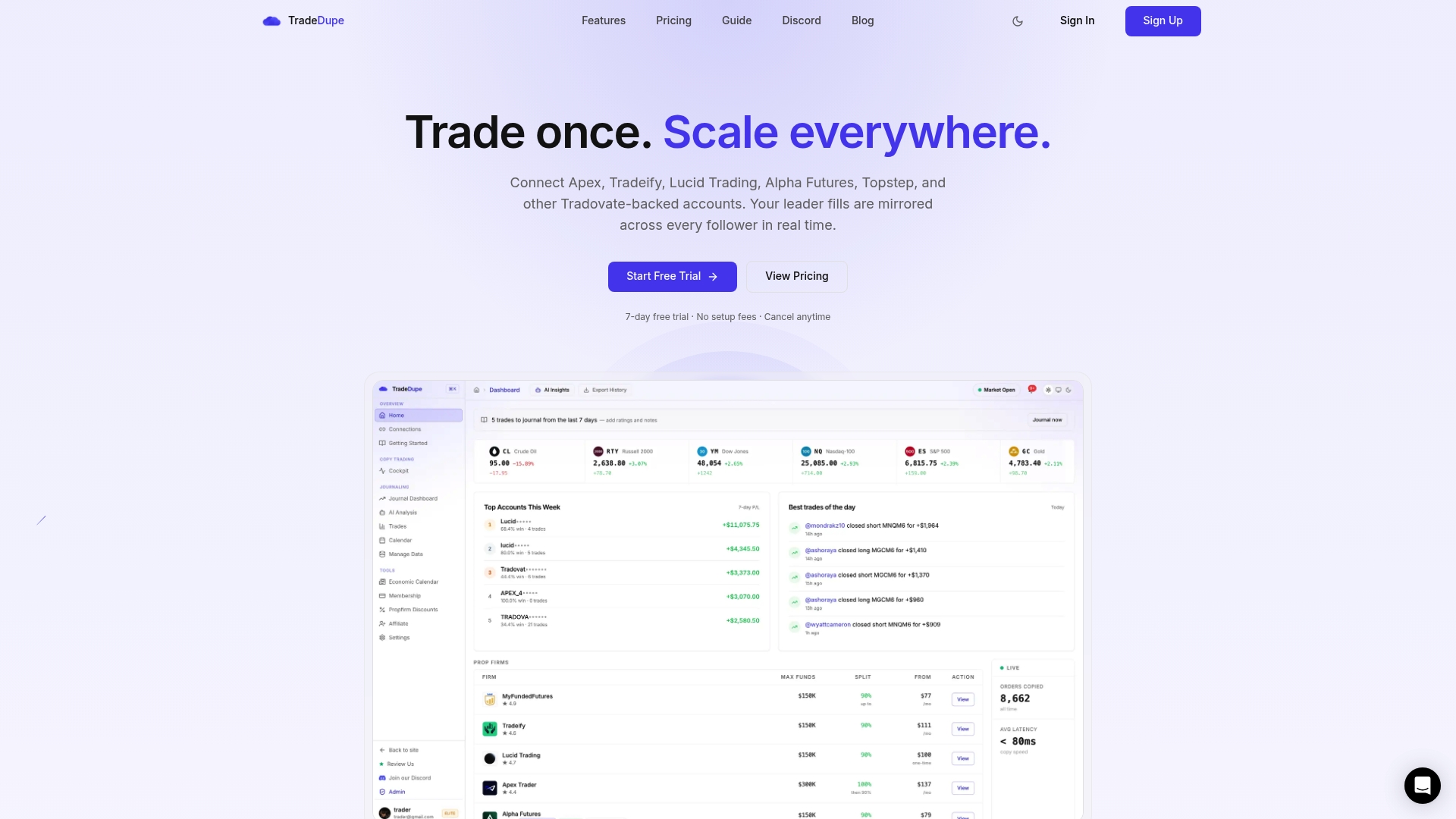
If you're evaluating vendors against the checklist above, start by requesting a sample audit log and running it against your own reconciliation process before committing to anything. TradeDupe's getting-started guide walks through setup in about ten minutes, and the Tradovate trade copier page covers the full feature set, including the 34ms median mirroring latency and supported prop firm integrations, in more depth. Start a trial, pull an export, and see whether it holds up against the standard this article just laid out.
This article is general information, not a substitute for advice from a qualified financial advisor. Consult a qualified financial professional about your own circumstances before acting on anything here.
Sources
- IOSCO Final Report: Online imitative trading practices (copy trading, mirror trading, social trading)
- ESMA supervisory briefing on copy trading
- Regulatory compliance data management and automation — AQMetriks
- NFA regulatory requirements guide