

Apex Copy Trading on Tradovate: Your Own Accounts, No Shared Access
TradeDupe
9 min read
Learn how Apex copy trading works on Tradovate, where Group Trade's limits apply, and how to simulate, monitor API use, and verify flattening.
Yes, you can copy trades across your own Apex accounts using Tradovate's Group Trade, but Apex's compliance rules and platform limits set strict conditions. Apex and Tradovate allow mirroring across accounts you personally control, while account sharing, third-party access, and automation tied to Performance or Live accounts fall under prohibited activity. External copiers are usable in practice, but you need to confirm them against Apex's rules before relying on one.
*
> TL;DR: > > - Tradovate Group Trade does not copy bracket orders, requires contract quantities for each follower account, and counts every place, modify, or cancel separately per account. > - Tradovate caps unique actions at 5,000 per 60 minutes and grouped orders at 100 total contracts; neither limit automatically closes existing positions. > - Apex permits you to trade your own accounts, but third party automation or access on Performance and Live accounts requires explicit written approval. > - Run a full week of simulated trades, including a flatten from the wrong account context, and verify that every follower position closes.
*
Table of Contents
- How native Tradovate Group Trade works for Apex accounts
- Apex compliance and prohibited activities that affect copy trading
- Step-by-step: set up Tradovate Group Trade for your Apex accounts (simulation first)
- Operational limits and practical risks when copying across many accounts
- External copiers and integrations: options, how they differ, and compliance cautions
- Short recommended workflow and final verdict
- Author perspective: practical habits and safeguards from an active multi-account trader
- How TradeDupe helps scale Tradovate multi-account copying
- FAQ
- Sources
- Authoritative Apex and Tradovate documentation to confirm rules and limits
How native Tradovate Group Trade works for Apex accounts
Tradovate includes a built-in copier called Group Trade, and it's automatically enabled once you have more than one active Tradovate account under Apex. It runs entirely inside the Tradovate platform, not through TradingView or a third-party bridge, which keeps the entire copying process inside the same system Apex already monitors.
Before you place a single trade, you select which group is active. That selection determines which accounts receive the copied orders, so the account context you're trading from matters as much as the trade itself. According to Apex's documentation, Group Trade comes with a few real constraints:
- Bracket orders (ATMs) aren't supported, so strategies built around automated stop and target brackets won't copy correctly.
- Contract sizing is tied to how you configure each account inside the group, not a single global multiplier.
- Every order counts as a separate action per account, which affects how close you run to Tradovate's activity limits.
Group Trade suits traders who want simple, self-managed mirroring without added software, but it asks you to understand its limits before you trust it with live size.
Apex compliance and prohibited activities that affect copy trading
Apex's rules are specific about who is allowed to trade an account. According to Apex's prohibited activities page, Performance Accounts and Live Prop Accounts must be traded exclusively by the individual listed on the account, and sharing credentials, computers, IP addresses, or trade access with someone else is forbidden.
A violation of these terms can result in account closure, forfeiture of funds, and additional verification requirements, according to Apex's compliance documentation, so treat this language as binding rather than advisory.
The practical test Apex applies comes down to one question: who is executing the trades on each account? Grouping your own accounts through Tradovate's native feature fits the pattern Apex permits, since you remain the one placing every order. The gray area shows up when a third-party service or another person's login touches your account. If you're considering any external tool, get written confirmation from Apex support for your specific account type before you connect it. Keep in mind:
- Self-managed grouping of accounts you personally own and trade is the normal, permitted pattern.
- Any setup involving shared logins, outside operators, or automated third-party mirroring on Performance or Live accounts needs explicit, written sign-off first.
Step-by-step: set up Tradovate Group Trade for your Apex accounts (simulation first)
Test everything in simulation before you touch a funded or evaluation account. The setup itself is straightforward:
- Sign in to Tradovate and switch to Simulation mode.
- Open the accounts dropdown and select Manage Groups.
- Create a new group and add the accounts you want to mirror.
- Assign contract quantities for each follower account individually.
- Save the group, select it as your active trading context, and place test trades.
- Check entries, stop behavior, and exits across every account in the group before going live.
Flattening deserves its own pass. Flatten the lead account or the group first, then verify each follower account closed out cleanly. If you flatten from the wrong account context, you can leave positions open elsewhere in the group without realizing it, according to Apex's flattening instructions.
Pro Tip: Run a full week of simulated trades through your group before funding it live, including at least one scenario where you deliberately flatten from the wrong account to see what breaks.
Operational limits and practical risks when copying across many accounts
Tradovate counts every place, modify, and cancel action separately for each account, and that adds up fast once you're mirroring across several accounts at once. Tradovate documents a ceiling on unique actions per 60 minutes, according to Apex's API limit page, and placing one order across ten accounts in a group counts as ten separate actions against that limit.

A grouped order also can't exceed 100 total contracts across the group, and hitting either limit doesn't trigger an automatic flatten. You're left holding whatever positions were open when the ceiling stopped further action.
A few habits reduce the risk:
- Leave real headroom below the 5,000 action ceiling, especially during active, high frequency sessions.
- Keep per-account contract size conservative as your account count grows.
- Have a manual recovery plan ready in case you hit a limit mid-trade.
External copiers and integrations: options, how they differ, and compliance cautions
Native Tradovate Groups cover the simplest case: your own accounts, inside Tradovate, with no bracket support. If your strategy depends on ATM-style bracket orders, you'll likely look at a NinjaTrader bridge instead, which supports brackets but requires a paid license and runs through a different execution path than native groups, according to Apex's Tradovate FAQ.
Webhook setups running through TradingView and a VPS can also mirror trades, but they change the execution path again and may be treated as automation under Apex's rules. Apex's compliance pages specifically flag automation and third-party access as areas that need scrutiny, so any setup outside native Group Trade is worth confirming directly with Apex first.
Whichever route you choose, a few operational safeguards matter more than the marketing around them:
- Per-account copy toggles so you can disable mirroring on one account without shutting down the rest.
- Rogue-trade detection that flags a follower trade the copier didn't place.
- Daily loss limits enforced at the broker level, not just inside the copier's own interface.
- Execution confirmation and a simulation test run before any live deployment.
Pro Tip: Ask any copier provider how they handle a dropped connection mid-trade. If the answer is vague, test it yourself in simulation before trusting it with funded accounts.
Short recommended workflow and final verdict
For most traders holding several of their own Apex accounts, native Tradovate Group Trade is the simplest compliant path: test it thoroughly in simulation, then scale up size gradually. If you choose an external copier instead, get explicit written permission for your account type and watch your API usage closely during the first few live sessions. Keep logs of your group settings and test runs so you have a record to show if Apex ever asks.
Author perspective: practical habits and safeguards from an active multi-account trader
We simulate every new workflow before it touches a funded account, start with the smallest contract size the group allows, and manually verify that flattening actually closed every position across every account. We log group changes and retest settings in Simulation whenever something shifts, because a quiet configuration error is the kind of thing that only shows up at the worst moment. Tools like TradeDupe exist for exactly this kind of multi-account Tradovate copying, with safeguards built around that discipline rather than against it.
> — Andres
How TradeDupe helps scale Tradovate multi-account copying
If you're managing several Apex, Tradeify, Lucid, MyFundedFutures, Alpha Futures, or TakeProfit Trader accounts on Tradovate and want mirroring without babysitting every connection, that's the specific problem such tools can solve.
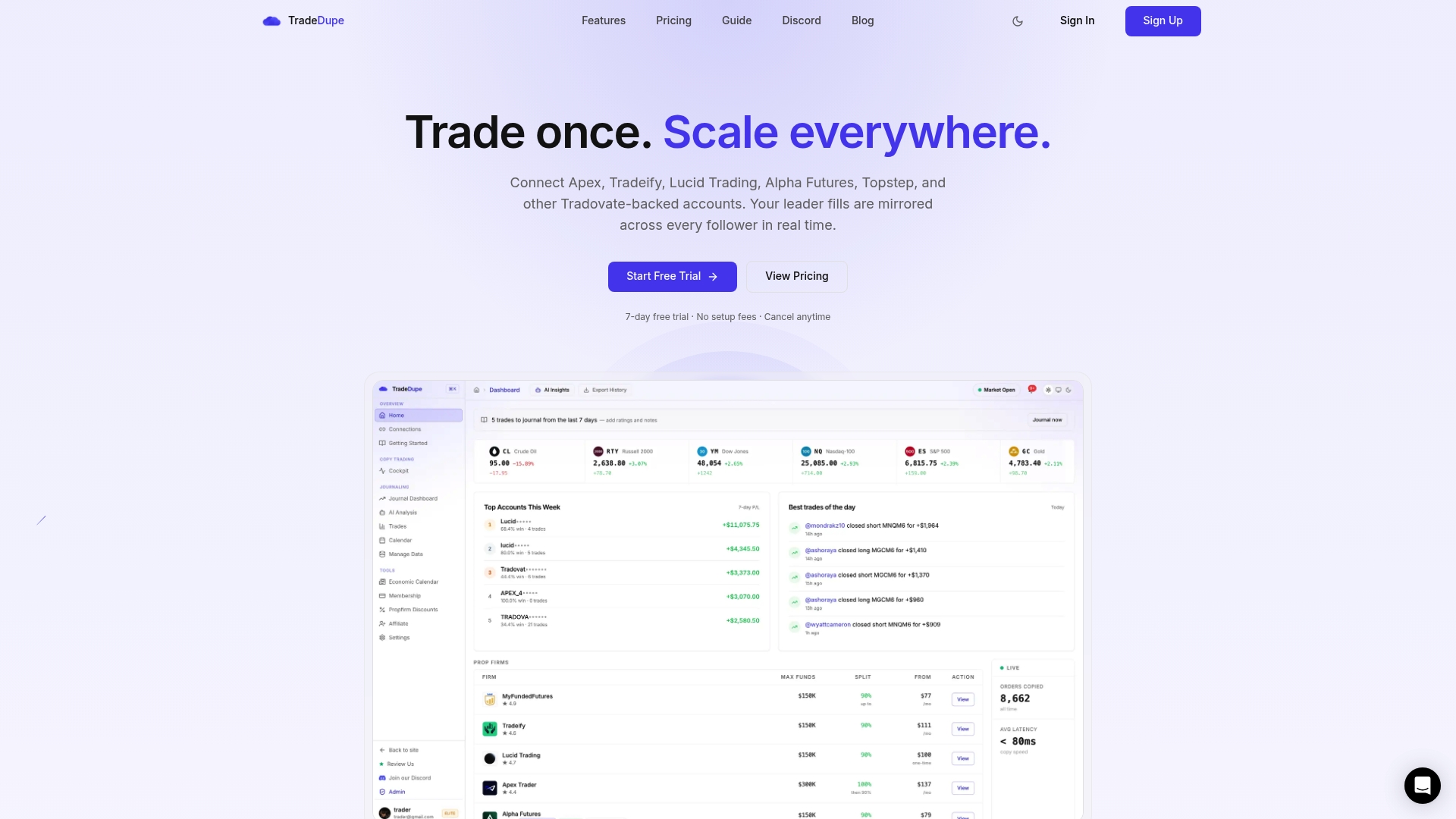
We connect through Tradovate's official OAuth flow, so your password is never stored and nothing runs on your own PC or VPS. Every fill on your leader account mirrors to your enabled follower accounts over a live WebSocket stream, typically under 100ms. Built-in safeguards cover the gaps that matter most when you're running several accounts at once:
- Per-account copy toggles so you can pause mirroring on any single account.
- Rogue-trade detection that flags a follower trade the copier didn't place.
- Daily loss limits and profit targets enforced directly through Tradovate.
Plans start at a monthly rate billed yearly, with a 7-day free trial and one-click cancellation. Before connecting any external copier, confirm with Apex that your account type permits it, then see our Tradovate copy trading overview and check pricing to find the plan that fits your account count.
FAQ
Which funded accounts allow copy trading?
Copy trading across your own accounts is generally allowed when you use a broker-native tool like Tradovate's Group Trade, since you remain the one placing every trade. Rules vary by firm, so confirm directly with each firm, including Apex, Tradeify, Lucid Trading, MyFundedFutures, Alpha Futures, and TakeProfit Trader, before connecting any copier to a funded or evaluation account.
Can I have multiple Apex evaluation accounts active at once?
Apex allows traders to hold multiple evaluation and funded accounts, but exact account limits and pricing tiers can change. Confirm current account limits directly with Apex support before purchasing additional evaluations.
Which trader setup works best for copy trading?
There's no single setup that fits every trader. A Tradovate-based multi-account structure using native Group Trade or a purpose-built tool like TradeDupe tends to work well for traders who want mirroring without manually re-entering each trade on every account.
Which brokers allow copy trading?
Tradovate supports native copy trading through its Group Trade feature, and several Tradovate-based prop firms permit mirroring across your own accounts when you remain the one executing trades. Rules differ by broker and firm, so confirm the specific policy with your broker and prop firm before setting up any copier.
How much does TradeDupe cost?
TradeDupe's Standard plan runs $20 a month billed yearly, Pro runs $45 a month billed yearly, and Elite runs $90 a month billed yearly, each with a 7-day free trial. Full plan details and account limits are listed on the pricing page.
Authoritative Apex and Tradovate documentation to confirm rules and limits
Before you rely on any copying setup with real money, read the primary documentation yourself and keep it bookmarked for reference. Apex and Tradovate update these pages periodically, so if anything in your setup touches an active, funded account, confirm the current rule directly with Tradovate support or Apex support rather than relying solely on secondhand summaries.
Recommended
- Apex Trader Funding Copy Trading Rules (2026): Multiple Accounts, Limits & Compliance
- 5 Steps to Connect Apex to Tradovate and Scale Multi Account Trading
- Apex Trader Funding Copier: Scale Multiple Apex Accounts Safely (2026)
For educational purposes only. Not financial advice. Futures trading involves substantial risk of loss and is not suitable for every investor.