
Multi-account prop trading: tools, strategies, and results
TradeDupe
13 min read
Discover how individual traders manage prop firm accounts effectively. Explore essential tools and strategies to maximize your trading success!
Managing multiple prop firm accounts sounds like a straightforward path to multiplied profits, but the operational reality tells a very different story. Multi-account setups demand automated trade copiers, disciplined risk allocation at the 0.25% to 1% per-trade level, and real-time aggregation tools to track exposure across every live position simultaneously. Without those pillars, scaling from two accounts to five doesn't multiply your edge—it multiplies your exposure to execution errors, rule violations, and compounding drawdown events that can wipe funded accounts faster than a single bad trade ever could.
Table of Contents
- The multi-account prop trading landscape: realities and benchmarks
- Automated trade duplication: copiers, latency, and platform compatibility
- Risk allocation: mastering position sizing and aggregate exposure
- Real-time monitoring and performance tracking: aggregation tools and dashboards
- Expert pitfalls and best practices for scaling multiple accounts
- The hard truths most traders overlook about managing multiple prop firm accounts
- Power your multi-account prop trading with the right tools
- Frequently asked questions
Key Takeaways
| Point | Details |
|---|---|
| Automate for speed and accuracy | Use low-latency trade copiers and VPS setups to reliably duplicate trades across accounts. |
| Treat risk collectively | Monitor aggregate risk and drawdown, not just individual trades, to avoid ruin. |
| Centralize real-time monitoring | Leverage dashboards that aggregate P&L and rule violations for all accounts. |
| Scale only after testing | Build systems and processes that catch errors before adding new accounts to your workflow. |
| Stay adaptable with tools | Evaluate automation and reporting software regularly to keep up with evolving firm rules and automation capabilities. |
The multi-account prop trading landscape: realities and benchmarks
The advantages of prop firm trading are well-documented: access to institutional-grade capital, defined risk parameters, and structured payouts that reward disciplined execution. Those advantages become even more attractive when replicated across multiple accounts, which explains why automated multi-account trading has grown into a serious professional practice.
The numbers reflect this momentum. DayTraders.com recently surpassed $3M in trader payouts, a benchmark the firm described as signaling the maturation of automated futures prop trading. Pass rates across major futures prop firms, however, still hover between 20% and 25%—even as automated trading solutions have proliferated. That gap between interest and success points directly to the operational complexity most traders underestimate.
Prop firms have also started capping account numbers. Topstep, for example, limits traders to 5 accounts. Other firms have their own limits and rule structures that govern drawdown, position sizing, and trading hours. Scaling up means tracking every one of those rules simultaneously.
Key operational benchmarks for multi-account traders:
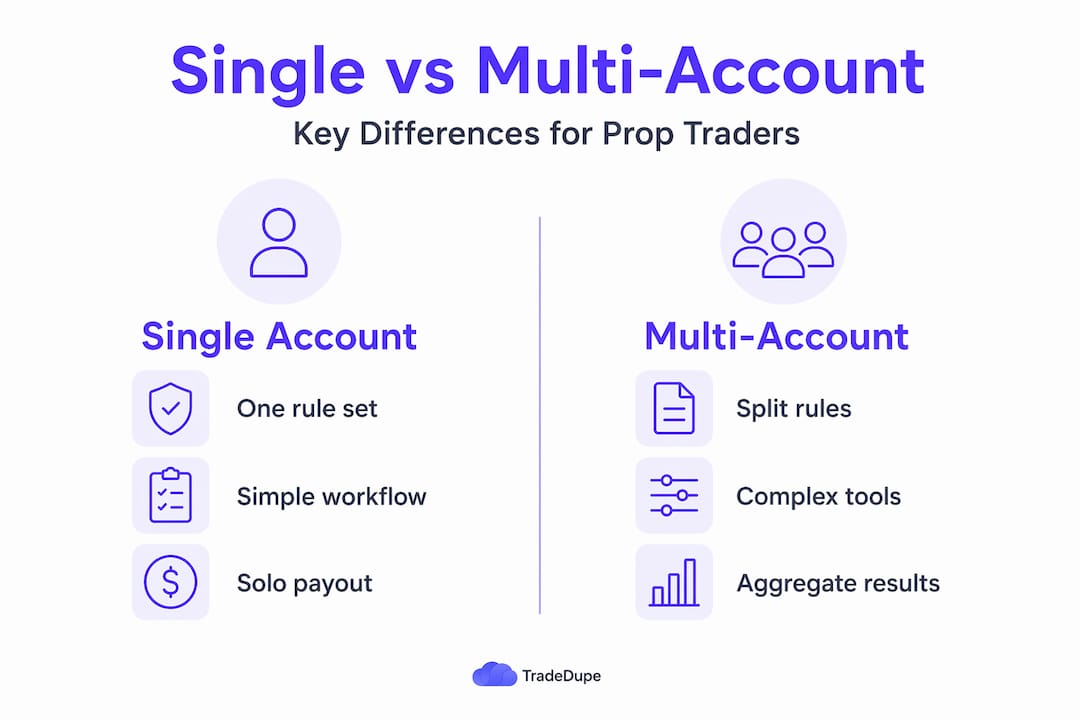
| Factor | Single account | Multi-account setup |
|---|---|---|
| Rule tracking | One set of rules | Per-account rules, each unique |
| Risk monitoring | Simple P&L review | Aggregate exposure tracking |
| Execution method | Manual or automated | Automated copier required |
| Compliance risk | Contained | Cascading if unmanaged |
Optimizing your workflow—from trade execution to monitoring and payout tracking—must evolve in step with your account count. With these realities established, let's explore the core pillars required to run multi-account setups efficiently.
Automated trade duplication: copiers, latency, and platform compatibility
The operational backbone of any multi-account setup is the trade copier, which automates signal duplication from a single leader account to every follower account simultaneously. Without automation, manually entering the same trade across five accounts introduces slippage, timing inconsistencies, and compounding execution errors that erode your edge on every single position.
Latency is the metric that separates professional setups from fragile ones. Execution quality depends directly on how fast a copied trade reaches each follower. Copiers achieve sub-100ms latency in professional configurations, but the infrastructure behind that number varies significantly. Local or VPS-based solutions can achieve latencies under 1ms in some configurations, while cloud-based solutions typically range from 5ms to 100ms depending on server proximity and network routing.
Platform compatibility shapes every tool decision. The major platforms in futures prop trading—NinjaTrader, Tradovate, and MetaTrader—each have distinct API architectures, which means a copier built for one doesn't always extend to another. Community discussions among active prop traders highlight this variance, with some traders reporting sub-1ms latency using NinjaTrader-specific setups while others using cloud-based solutions manage 5ms to 100ms and still find it adequate for their execution style.
Comparison of trade copier deployment types:
| Setup type | Typical latency | Best for | Key consideration |
|---|---|---|---|
| Local machine | Under 1ms | Low-account count, high-frequency | Single point of failure |
| VPS (co-located) | 1ms to 10ms | 5 to 20 accounts | Ongoing VPS cost |
| Cloud platform | 5ms to 100ms | Scalable, remote setups | Latency varies by region |
Criteria for selecting a trade copier:
- Platform compatibility: Does it natively support your broker and prop firm accounts?
- Latency profile: What is the median and worst-case copy delay at your account volume?
- Risk controls: Can you set per-account position sizing and toggle accounts individually?
- Failure recovery: Does the tool auto-recover from disconnections without missed fills?
- Compliance features: Does it flag or block trades that would violate account-specific rules?
Explore the best trade copiers for futures trading or review a detailed prop firm copier comparison to match tool capabilities to your specific setup. For traders using Tradovate, Tradovate account sync solutions are specifically optimized for that ecosystem.
Pro Tip: Don't evaluate a copier on average latency alone. Test it under load with the maximum account count you plan to run. Median performance is misleading if tail latency spikes during high-volatility sessions when execution precision matters most.
If you're comparing specific platforms, a detailed TradeSyncer vs TradeCopia breakdown can help you assess feature and latency differences before committing to a subscription. With a technical foundation in place, effective risk management becomes even more vital.
Risk allocation: mastering position sizing and aggregate exposure
Most traders approaching multi-account setups focus on execution mechanics and overlook the more dangerous variable: aggregate risk exposure. Two correlated trades across two accounts aren't twice as risky as one—they can be functionally identical positions, which means drawdown hits both accounts simultaneously and amplifies the operational damage.
Professional risk allocation follows a structured framework. Risk per trade is capped at 0.25% to 1%, adjusted downward when correlation between active positions is high. That adjustment is critical. If your leader account is long ES futures and all five follower accounts mirror that position, you don't have five independent trades—you have a five-times-leveraged directional bet that violates the core principle of risk-adjusted scaling.
Treating a multi-account operation as a business means tracking aggregate P&L, maximum drawdown, and exposure limits at the portfolio level, not just the account level. Manual trading breaks down beyond two or three accounts due to execution errors alone, which is why professional setups automate risk checks at the infrastructure layer.
A practical risk allocation framework for multi-account traders:
- Set a per-trade risk ceiling: Cap individual trade risk at 0.25% to 0.5% of each account's notional value to stay well inside firm drawdown limits.
- Calculate aggregate exposure before entry: Sum all open positions across accounts to assess total directional exposure before adding new risk.
- Adjust for correlation: Reduce position size on any trade with a correlation above 0.7 to another active position across the portfolio.
- Define a portfolio-level drawdown stop: Set an absolute dollar or percentage threshold at which all copying pauses pending review.
- Automate enforcement: Use dashboard tools or built-in copier controls to enforce these limits without relying on manual checks during live sessions.
> "Treat multi-account as a business with aggregate risk tracking, not multiplied leverage."
That framing isn't just philosophical. It's the difference between a scalable operation and one that collapses at the first correlated drawdown event. Review practical risk management examples and master risk management strategies to build a framework specific to futures prop trading. The TradeDupe prop trading glossary also provides clear definitions for terms like drawdown, correlation risk, and portfolio exposure.
Pro Tip: Use your risk management workflow as a pre-session checklist. Before the market opens, confirm your aggregate exposure ceiling, review any account-specific rule changes from your prop firms, and verify that all copier connections are active and responsive.
Now let's turn to how experts monitor and measure results across dozens—or even hundreds—of live accounts.
Real-time monitoring and performance tracking: aggregation tools and dashboards
Visibility is a non-negotiable requirement at scale. Running five or ten accounts without centralized monitoring means you're reacting to problems after they've already exceeded rule thresholds, not before. Real-time P&L aggregation solves that by centralizing position data, drawdown exposure, and rule compliance status across every account into a single interface.
Aggregation tools like PropTally centralize P&L and drawdown data across accounts, giving traders a live view of total exposure. When combined with automated alerting, these tools can flag approaching drawdown limits, session rule violations, or unusual position sizes before they trigger account restrictions. That early warning layer is what separates compliant, professional operations from those that lose funded accounts to avoidable rule breaches.
Core features to prioritize in a monitoring dashboard:
- Real-time P&L aggregation across all live accounts with per-account breakdowns
- Drawdown tracking against each firm's maximum daily and trailing drawdown thresholds
- Automated rule breach alerts sent via dashboard notification, email, or SMS
- Session-level filtering to separate performance by trading session, instrument, or account
- Latency monitoring to confirm that copier connections are performing within acceptable thresholds
Staggering trading sessions across accounts is another underused tactic. If all accounts trade the same instrument in the same session window, a single news-driven spike can simultaneously push multiple accounts toward their drawdown limits. Spreading session exposure across instruments or time windows reduces the probability of a simultaneous multi-account breach.
Infrastructure quality directly impacts monitoring reliability. A VPS positioned geographically close to your broker's servers reduces both copy latency and the likelihood of connection dropouts during volatile sessions. Monitoring tools running on a local machine are vulnerable to power outages, ISP issues, and hardware failures—none of which care about your open positions.
Review the trade copier software guide for a practical breakdown of infrastructure requirements, and consult a prop firm evaluation checklist when assessing which firms align best with your monitoring and compliance workflow. Seeing the advantages and hurdles, what pitfalls and advanced tactics should even experienced multi-account traders keep in mind?
Expert pitfalls and best practices for scaling multiple accounts
Scaling from three accounts to eight isn't a linear process. Every account added introduces a new set of firm-specific rules, a new failure point in your infrastructure, and a new layer of operational risk that compounds when things go wrong. Most traders who fail at this stage don't fail because of bad trade selection—they fail because their operational infrastructure wasn't built to survive the edge cases.
Manual trading scales poorly beyond 2 to 3 accounts due to execution errors. That's not an opinion—it's a practical ceiling based on human reaction time, attention span under pressure, and the mechanical limits of manually entering identical trades across multiple platforms simultaneously.
Common pitfalls to actively prevent:
- Neglecting account-specific rules: Each prop firm has unique drawdown thresholds, position limits, and prohibited instruments. Failing to track these individually causes rule violations that end funded accounts without warning.
- Assuming VPS reliability: VPS providers can and do experience downtime. Build redundancy into your setup, including failover alerts and manual override procedures.
- Ignoring aggregate drawdown: Monitoring each account individually while ignoring combined exposure is the most common way multi-account setups generate catastrophic losses on correlated trades.
- Scaling before stress-testing: Adding accounts before fully validating your copier's performance under load, network disruptions, and high-volatility conditions is a common and expensive mistake.
- Underestimating onboarding complexity: Each new account requires configuration, rule mapping, and connection testing. Rushing that process increases the risk of misconfigured position sizing or incorrect session parameters.
> "Scale slowly, stress-testing setups before adding new accounts."
Pro Tip: Before adding any new account to your live copier setup, run it in shadow mode for at least five to ten trading sessions. Shadow mode mirrors signals without executing them, letting you validate that sizing, latency, and rule logic are correct before real capital is at stake.
For traders working within specific firm ecosystems, detailed guidance on copying MFFU accounts and reviewing TradeCopia alternatives provides practical context for platform-specific setups. Engage with challenge accounts and review simulated challenge best practices before scaling into multi-account live environments.
The hard truths most traders overlook about managing multiple prop firm accounts
Most traders assume that multi-account failures come from bad trades. They don't. The overwhelming majority of failures at scale come from compounding technical and human errors that a single-account operation would never expose.
Consider what happens when a VPS drops connection mid-session with four accounts open. Your leader executes an exit. Three followers execute it. One doesn't. Now you have a rogue position accumulating losses in a funded account while you're watching three clean P&L lines, unaware that anything is wrong. That scenario isn't hypothetical—it's a documented failure mode that happens to traders who build setups without auto-recovery and per-account monitoring.
The professionals who build sustainable multi-account operations think differently. They build redundancy first, automate every rule check they can, and treat the operation like a technology business with trading as the product. When you compare platforms like TradeDupe vs TradeSyncer, the differentiating features aren't just latency numbers—they're rogue-trade detection, auto-recovery logic, and per-account toggle controls that limit blast radius when something goes wrong.
Scaling to five or ten accounts doesn't just expose your trading strategy to more market risk. It exposes every weakness in your infrastructure, your monitoring process, and your compliance procedures. The traders who thrive at scale test for those weaknesses before their P&L does. Ongoing learning—tracking both tool evolution and rule shifts at your prop firms—is the operational discipline that separates the 25% who pass from the 75% who don't.
Power your multi-account prop trading with the right tools
Managing multiple funded accounts demands tools built specifically for that workflow, not generic software adapted to fit. TradeDupe is purpose-built for professional prop traders on Tradovate, delivering real-time trade mirroring with a median latency of 34ms across accounts at Apex, Lucid Trading, Tradeify, Alpha Futures, and Topstep.
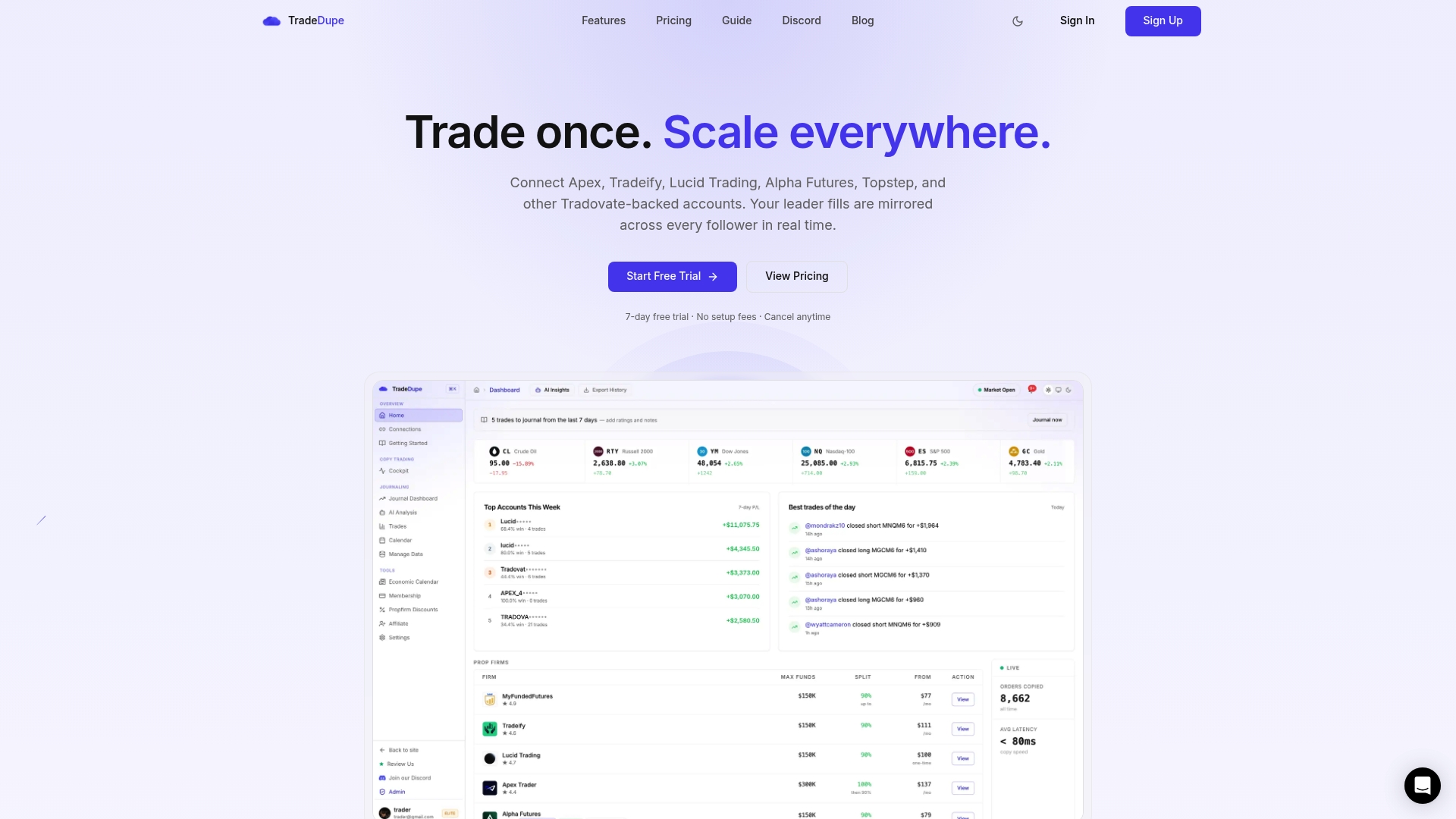
For traders scaling through evaluation stages, Apex Funding copy trading and the Lucid trade copier integrations provide session-aware syncing with built-in compliance features. Each account can be toggled independently, and rogue-trade detection runs continuously to catch disconnected positions before they become losses. If you're evaluating platforms, a direct TradeDupe vs TradeCopia comparison breaks down the feature differences across latency, recovery logic, and supported firm integrations. Most setups go live in under ten minutes.
Frequently asked questions
What is the safest way to allocate risk across multiple prop firm accounts?
Most professionals risk 0.25% to 1% per trade and track aggregate exposure across all accounts simultaneously, adjusting position size downward when correlated trades amplify directional risk.
Do I need a VPS for low-latency trade copying between accounts?
A VPS is strongly recommended for setups beyond two or three accounts, as it minimizes copy latency and removes the local hardware failure risk that can leave positions unmanaged during live sessions.
What's the typical maximum number of accounts I can manage at the major futures prop firms?
Account limits vary by firm. Topstep, for example, caps traders at 5 accounts, so always confirm the policy at each firm before building your scaling plan around a specific account count.
How important is real-time P&L aggregation for managing multiple accounts?
Critical. Centralized P&L and drawdown tracking lets you identify approaching rule violations across all accounts before they trigger breaches, which is functionally impossible with per-account manual review at any meaningful scale.
Is it possible to automate rule compliance and alerts for multiple prop firm accounts?
Yes. Modern platforms let you stagger session rules and automate alerts for drawdown thresholds and rule violations, significantly reducing the reliance on manual monitoring during live trading sessions.