
Prop Trader Dashboard Examples for Multi-Account Pros
TradeDupe
10 min read
Discover examples of prop trader dashboards that enhance multi-account management, ensuring better trading decisions and risk control.
A prop trader dashboard is a centralized platform that consolidates account equity, drawdown status, payout eligibility, and risk metrics across multiple proprietary trading accounts into a single view. The best examples of prop trader dashboards go well beyond basic P&L displays. They enforce firm-specific rulesets in real time, trigger pre-breach alerts, and surface behavioral patterns that separate funded traders from those who wash out during evaluation. For professional prop traders and firm managers running accounts across Apex, Tradeify, Lucid Trading, or Alpha Futures, the dashboard is the operational core of the entire trading business.
Examples of prop trader dashboards: multi-account management
Multi-account management is the defining feature that separates professional-grade dashboards from basic broker portals. Combining multiple accounts into a unified view reduces data fragmentation and improves risk visibility across the entire book. Manual aggregation introduces errors. Automated API or CSV import pipelines eliminate those errors and deliver accurate, real-time equity calculations.
The most effective dashboards in this category display:
- Combined P&L curves across all active accounts with per-account breakouts
- Firm-specific ruleset modeling covering consistency ratios, minimum profitable days, and tiered payout caps
- Drawdown buffer calculations that show how far each account sits from its maximum allowable loss threshold
- Account status flags indicating evaluation phase, funded status, or breach risk
Professional dashboards model firm-specific rulesets such as consistency ratios and daily loss limits in real time. That means a trader running six Apex accounts and two Tradeify accounts sees each account evaluated against its own ruleset simultaneously. Understanding how the Apex consistency rule affects payout eligibility, for example, is far easier when the dashboard flags it automatically rather than requiring manual calculation.
| Feature | Purpose |
|---|---|
| Aggregated equity curve | Shows combined account health at a glance |
| Per-account ruleset engine | Enforces firm-specific criteria without manual checks |
| Drawdown buffer display | Proactively warns before a breach occurs |
| Payout eligibility tracker | Confirms when accounts meet withdrawal conditions |

Pro Tip: Set your dashboard's drawdown buffer alert at 70% of the maximum allowable loss, not 90%. That 20% buffer gives you time to flatten positions before a violation, not after.
Real-time risk monitoring and alert systems
Real-time monitoring is the feature that prevents the most expensive mistakes in prop trading. WebSocket real-time syncing monitors balance, equity, and floating drawdown with sub-second latency. That matters most on high-volatility days when a position can move from safe to breached in seconds.
The core alert capabilities in top-tier dashboards include:
- Pre-breach notifications sent via Telegram, email, or in-app push before a drawdown limit is hit
- Floating drawdown tracking that accounts for open positions, not just closed trades
- Daily loss limit countdowns displayed as a live percentage of the remaining buffer
- Session-level risk flags that trigger when intraday losses exceed a configurable threshold
> Trader portals that embed real-time notifications with multi-account aggregated views shorten reaction time and reduce costly rule infractions. The difference between a manual refresh and a WebSocket push alert can be the difference between a funded account and a failed evaluation.
Manual refresh delays and slow broker portals are the primary cause of accidental rule violations on volatile market days. A dashboard that relies on periodic polling rather than persistent WebSocket connections introduces latency that compounds under market stress. Real-time reporting in financial platforms is not a convenience feature. It is a risk management requirement.
Pro Tip: Configure Telegram alerts for 80% drawdown consumption on each account. A Telegram push reaches your phone faster than any browser notification, and it works even when the dashboard tab is closed.
Customizable analytics and performance metrics
Customizable analytics transform raw trade data into a structured feedback loop. Dashboards with configurable analytics covering win rates, profit factors, and trade duration profiling help traders identify specific strengths and weaknesses in their execution. An interactive equity curve that breaks down performance by session, instrument, or day of week reveals patterns that a simple P&L statement never would.
The analytics features that deliver the most practical value include:
- Win rate and profit factor by instrument and session to identify where edge actually exists
- Trade duration profiling showing whether short-hold or long-hold trades produce better outcomes
- Streak analysis tracking winning and losing runs to identify overtrading patterns
- Time-of-day heatmaps displaying which hours generate consistent profits versus consistent losses
Beyond quantitative metrics, the most advanced trading dashboard examples incorporate behavioral tools:
- Pre-session psychology checklists that require traders to confirm news calendar review, bias confirmation, and emotional state before placing a trade
- Emotional state logging linked directly to trade outcomes, creating a data trail between mental state and performance
- Consistency scoring that measures whether daily results fall within the firm's required profit distribution range
- Configurable evaluation criteria that mirror the specific rules of each prop firm the trader is enrolled with
Pre-session psychology checklists improve mental readiness and reduce impulsive trades. Dashboards that enforce this step before market open treat psychological readiness as a quantifiable input, not an afterthought. Traders who log emotional state consistently build a personal dataset that reveals exactly when they are most likely to overtrade or revenge trade.
Mobile-first design and white-label branding benefits
Mobile responsiveness is a fundamental design requirement in professional prop firm portals. Over 90% of prop trader portal traffic in Q2 2026 is mobile, which means a dashboard that performs poorly on a phone is effectively broken for most of its users. Progressive Web App (PWA) technology replicates the native app experience without requiring an App Store download, covering payouts, performance checks, and certificate downloads from any device.
The mobile and branding features that define best-in-class dashboards include:
- PWA compatibility enabling full dashboard functionality on iOS and Android without a native app
- Responsive UI layouts that adapt equity curves, alert panels, and account cards to small screens without data loss
- White-label branding replacing vendor logos with the firm's own domain, colors, fonts, and navigation labels
- Branded payout certificates and performance reports that carry the firm's identity, not a third-party vendor's
White-label trader portals increase trader trust and engagement over generic vendor portals. A trader who sees the firm's brand on every screen, certificate, and notification develops a stronger association between the firm's identity and their own funded status. That psychological connection reduces churn and increases the perceived value of the trading relationship.
Selecting dashboards based on trader and firm needs
The right dashboard depends on the complexity of your account structure, your risk tolerance, and how much behavioral data you want to capture. The table below maps trader profiles to the dashboard features that matter most.
| Trader Profile | Priority Features | Why It Matters |
|---|---|---|
| Single-account evaluation trader | Drawdown buffer display, payout eligibility tracker | Prevents accidental violations during evaluation |
| Multi-account funded trader | Aggregated equity, per-account ruleset engine, real-time alerts | Manages risk across simultaneous funded accounts |
| Prop firm manager | White-label branding, bulk account monitoring, API integrations | Scales oversight without adding manual review time |
| Performance-focused trader | Time-of-day heatmaps, streak analysis, psychology checklists | Builds a data-driven feedback loop for strategy refinement |
| Risk-averse trader | WebSocket alerts, Telegram notifications, floating drawdown tracking | Minimizes reaction time on volatile trading days |
Traders running simple setups with one or two accounts can rely on dashboards with strong alert systems and basic analytics. Firm managers overseeing dozens of funded accounts need prop firm consistency rule enforcement built directly into the dashboard logic. The behavioral tools, including psychology checklists and emotional state logging, deliver the most value for traders who have already identified discipline as their primary performance constraint.
Key Takeaways
The most effective prop trader dashboards combine real-time risk monitoring, firm-specific ruleset enforcement, and behavioral analytics to protect funded accounts and improve long-term performance.
| Point | Details |
|---|---|
| Multi-account aggregation | Automated API pipelines eliminate manual errors in combined equity and drawdown calculations. |
| Real-time alert systems | WebSocket syncing with Telegram alerts prevents accidental rule violations on volatile days. |
| Customizable analytics | Win rate heatmaps and streak analysis reveal where edge exists and where discipline breaks down. |
| Mobile-first design | Over 90% of portal traffic is mobile; PWA compatibility is a baseline requirement, not a bonus. |
| White-label branding | Firm-branded portals increase trader trust and reduce churn compared to generic vendor interfaces. |
What I've learned about dashboards that actually change trading outcomes
Most traders treat the dashboard as a scoreboard. They check it after the session to see how they did. That is the wrong mental model entirely.
The dashboards that actually change outcomes are the ones traders interact with before and during the session, not just after. The pre-session checklist feature is the clearest example. Requiring a trader to confirm their bias, check the economic calendar, and log their emotional state before placing a trade sounds like overhead. In practice, it eliminates the category of trades that should never have been taken in the first place. Those are the trades that blow evaluations, not the ones with bad entries.
The real-time alert system is the second piece that most traders undervalue. A Telegram push at 80% drawdown consumption forces a decision. You either flatten and protect the account, or you consciously choose to hold. Either way, you are making an active decision rather than drifting into a breach. That shift from passive to active risk management is where the dashboard earns its place in the trading workflow.
The behavioral data is where I see the most untapped value. Traders who log emotional state alongside trade outcomes for 60 or 90 days build a personal dataset that no generic trading advice can replicate. You will see your own patterns: the sessions where overconfidence follows a strong week, the revenge trades that always happen on Thursday afternoons, the instruments where your win rate collapses after 11:00 AM. That data is worth more than any indicator or strategy tweak.
White-labeling matters more than most traders realize, too. A firm that presents a branded, professional portal signals operational maturity. Traders take the rules more seriously when the environment looks serious. That is not a soft observation. It shows up in retention rates and in how carefully traders manage their drawdown buffers.
The future of prop trader dashboards is mobile-first, deeply customizable, and psychologically aware. Firms and traders who build their workflows around those three principles will have a structural advantage over those still checking a broker portal once a day.
> — Andres
Tradedupe and your multi-account dashboard workflow
Tradedupe integrates directly with the Tradovate ecosystem to add real-time trade mirroring on top of your existing dashboard setup.
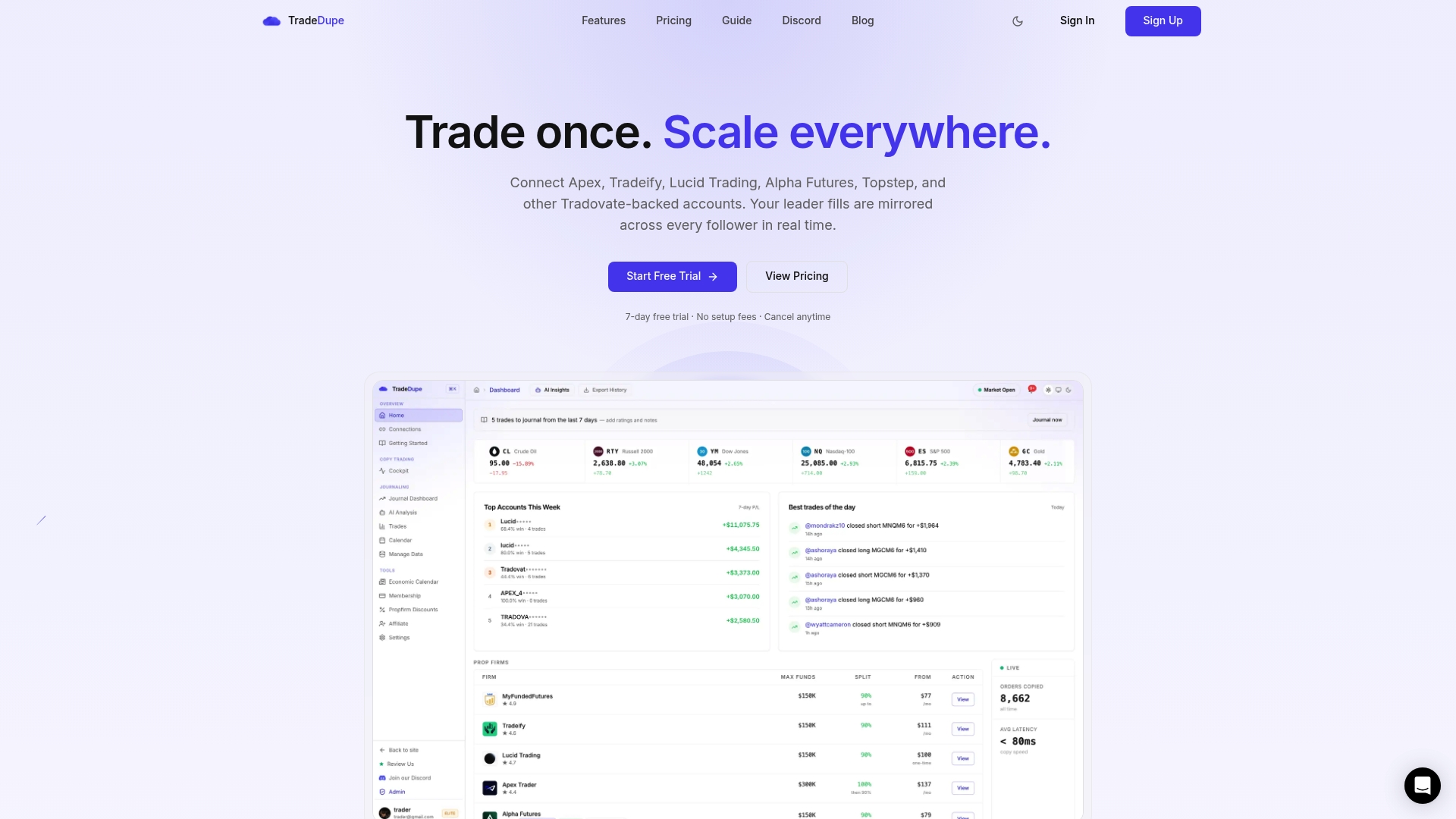
When you manage multiple funded accounts across Apex, Tradeify, Lucid Trading, or Alpha Futures, Tradedupe's copy trading platform replicates trades from a single lead account to all follower accounts with a median latency of 34ms. Rogue-trade detection, auto-recovery, and per-account toggle controls give you the same granular risk control your dashboard provides for monitoring, but applied at the execution layer. Traders who want to see how trade mirroring fits into a multi-account management workflow can get started with Tradedupe in under 10 minutes.
FAQ
What are the core features of a prop trader dashboard?
A prop trader dashboard consolidates account equity, drawdown status, payout eligibility, and firm-specific ruleset compliance into a single real-time view. The best dashboards also include pre-breach alerts, behavioral analytics, and mobile-first access.
How does real-time syncing prevent rule violations?
WebSocket real-time syncing monitors floating drawdown and balance with sub-second latency, pushing alerts before a trader reaches a critical threshold. Manual refresh methods introduce delays that can result in accidental breaches on volatile trading days.
Why do prop firm dashboards need white-label branding?
White-label branding replaces generic vendor interfaces with the firm's own domain, colors, and certificates, which increases trader trust and engagement. Traders associate the firm's identity with their funded status, which reduces churn and reinforces rule adherence.
What analytics should a funded trader prioritize?
Win rate by session and instrument, profit factor, time-of-day heatmaps, and streak analysis are the metrics that reveal where edge exists and where discipline breaks down. Psychology checklists linked to trade outcomes add a behavioral layer that quantitative metrics alone cannot capture.
Is mobile access necessary for a professional trading dashboard?
Mobile access is a baseline requirement. Over 90% of prop trader portal traffic in Q2 2026 is mobile, and PWA-compatible dashboards support every critical function, including payouts, performance checks, and certificate downloads, from any device.