
Proportional Lot Sizing Copier: Multi-Account Guide 2026
TradeDupe
11 min read
Discover how a proportional lot sizing copier ensures safe trading across multiple accounts. Maximize profits while minimizing risk!
A proportional lot sizing copier is an automated system that adjusts trade volume for each follower account based on its capital relative to the leader account. Without this adjustment, a $10,000 follower account copying a $100,000 master account runs at 10× over-leverage, which can trigger premature liquidation. The industry standard for risk per trade sits between 0.5% and 1.0% of account equity. Proportional sizing keeps every account inside that band, regardless of size. Tradedupe applies this logic automatically across Apex, Tradeify, Lucid Trading, and Alpha Futures accounts on Tradovate, making it one of the most direct solutions for prop traders running multiple funded accounts.
What is a proportional lot sizing copier and how does it work?
A proportional lot sizing copier calculates the correct trade volume for each follower account before every order is sent. The calculation uses the ratio between the master account balance and the follower account balance, then applies that ratio to the master's lot size. The result is a position that carries the same percentage risk on both accounts, even when their sizes differ by an order of magnitude.
Three core lot sizing techniques drive most trade copier software in 2026: Fixed, Multiplier, and Risk-Based. Each serves a different need.
- Fixed mode copies the exact lot size from the master account to every follower. A 2-lot trade on the master becomes a 2-lot trade on every follower, regardless of account size. This mode works only when all accounts are the same size.
- Multiplier mode scales the master lot by a set factor. A multiplier of 0.5 on a follower account turns a 2-lot master trade into a 1-lot follower trade. Setting the multiplier to 1.0 enables automatic proportional volume normalization by balance ratio.
- Risk-Based mode calculates lot size from the follower's account equity, a defined risk percentage, the stop loss distance, and the instrument's pip value. This is the most advanced approach because it maintains consistent dollar risk even when stop loss distances vary between trades.
Risk-based sizing is considered the gold standard for consistent risk management across accounts of different sizes. Fixed mode is the weakest option for multi-account management and should only be used when all follower accounts match the master exactly.
Pro Tip: Set each follower account's multiplier to the ratio of its balance divided by the master balance. A $25,000 follower on a $100,000 master gets a multiplier of 0.25. This single step eliminates most over-leverage risk immediately.
How does proportional sizing maintain consistent risk across accounts?
Balance-based lot scaling is the mechanism that keeps risk proportional. The copier divides the follower's balance by the master's balance, then multiplies that ratio by the master's lot size. A $50,000 follower on a $100,000 master receives exactly half the master's volume on every trade.

Equity-based scaling goes one step further. Instead of using static account balances, it recalculates using current open equity. This matters when accounts have open positions that are in profit or drawdown, because the effective capital available for new trades changes in real time. Equity-based scaling prevents a follower account from taking on new risk when it is already stretched by open losses.
The practical difference becomes clear with a concrete example. A master account with $100,000 places a 2-lot ES futures trade with a 10-point stop loss, risking $1,000 or 1% of capital. A $25,000 follower using balance-based proportional sizing receives a 0.5-lot trade, also risking $250 or 1% of its capital. Both accounts carry identical percentage risk. Without proportional sizing, the follower would receive the full 2-lot trade and risk 4% of its capital on a single position, a level that violates most sound risk management principles and most prop firm drawdown rules.
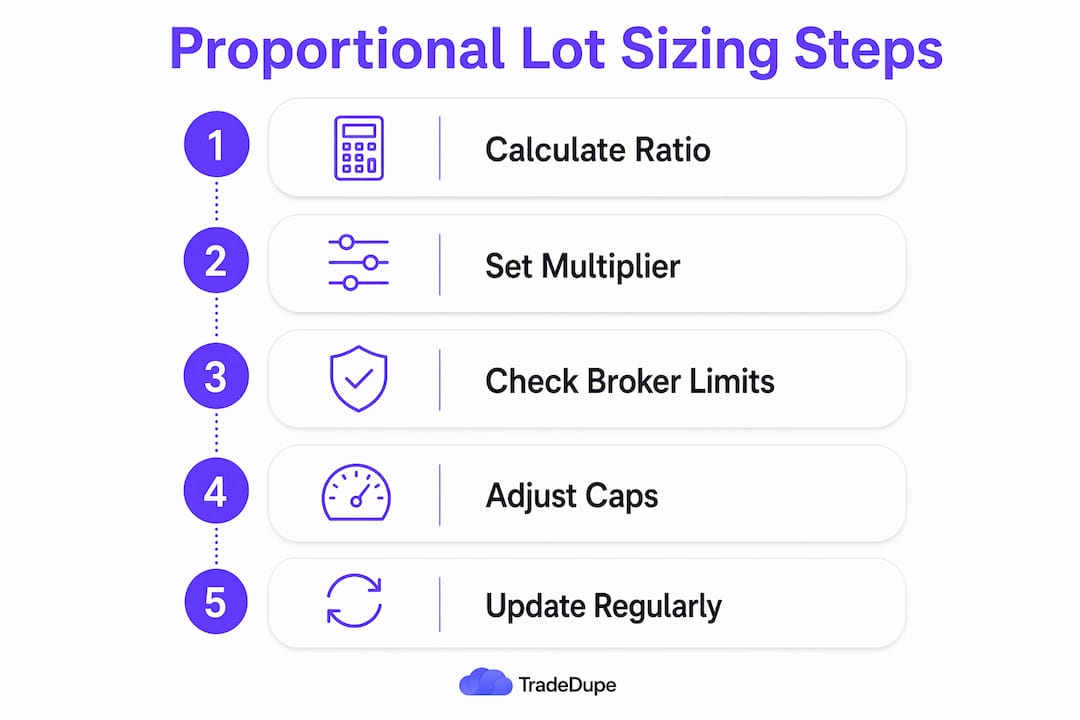
- Calculate the balance ratio: follower balance divided by master balance.
- Multiply the master's lot size by that ratio to get the base follower lot.
- Apply any manual multiplier adjustment above or below 1.0 to fine-tune exposure.
- Confirm the result falls within the broker's minimum and maximum lot constraints.
- Submit the order. If the calculated lot falls below the broker minimum, the copier should skip or flag the trade rather than send an invalid order.
Ignoring proportional sizing does not just increase risk. It can destroy a funded account. Prop firms like Apex and Tradeify impose strict daily drawdown limits, and a single over-leveraged trade can breach those limits in minutes.
What broker constraints affect proportional lot sizing in trade copiers?
Broker volume restrictions are the most common source of execution failures in multi-account copying. Every broker sets a minimum lot size, a maximum lot size, and a volume step increment. These rules exist at the exchange and clearing level, and no copier can override them.
The volume step is particularly important. If a broker requires lots in increments of 0.01, a calculated lot of 0.237 must be rounded to 0.23 or 0.24. The copier must handle this rounding automatically. If it does not, the broker rejects the order entirely.
- Minimum lot size: Most futures brokers set a minimum of 1 contract. If proportional scaling produces a lot below that minimum, the trade cannot execute on the follower account.
- Maximum lot cap: Brokers and prop firms impose upper limits on single-order volume. A copier that ignores this cap sends an invalid order and creates an orphaned trade on the master with no corresponding position on the follower.
- Volume step increments: Orders must conform to the broker's allowed lot increments. Copiers must round calculated lots to the nearest valid step before submission.
- Leverage differences: Follower accounts at different brokers may carry different leverage ratios. A lot that represents 1% risk at 10:1 leverage represents 2% risk at 5:1 leverage. The copier must factor in account-specific leverage when calculating proportional lots.
Broker volume restrictions require traders to set manual max lot caps or filters per follower account to avoid execution failures. This is not optional configuration. Skipping it means accepting the risk of orphaned trades, which leave the master account exposed without a matching hedge or exit on the follower side.
Prop firm rules add another layer. Apex and Tradeify both impose position size limits per account, and those limits can differ from standard broker maximums. A copier built for prop firm environments must read and respect those firm-specific constraints, not just the underlying broker rules.
Pro Tip: Build a simple reference sheet for each follower account listing its minimum lot, maximum lot, volume step, and leverage. Review it every time you add a new account or change a prop firm. Thirty minutes of setup prevents hours of troubleshooting orphaned trades.
How to configure proportional lot sizing settings for multiple accounts
Effective configuration starts with knowing the exact balance of every follower account before setting any multiplier. Balances change after funded payouts, drawdowns, or deposits, so multipliers need periodic review.
- Set the base multiplier per account. Divide each follower balance by the master balance. Enter that value as the multiplier in the copier's per-account settings. For a $10,000 follower on a $100,000 master, the multiplier is 0.1.
- Define a maximum lot cap per account. Set this at or below the broker's maximum lot limit. For prop firm accounts, set it at the firm's position size limit, not the broker's higher ceiling.
- Choose risk-based mode for variable stop losses. When your strategy uses different stop loss distances on different trades, fixed multipliers produce inconsistent dollar risk. Risk-based mode recalculates lot size from equity and stop distance on every trade, keeping dollar risk constant.
- Enable dynamic lot recalculation. Dynamic recalculation evaluates account balance, open equity, multipliers, max lot limits, and broker restrictions before every trade execution. This is the difference between a copier that works on day one and one that keeps working after drawdowns and balance changes.
- Monitor copier reports for failed or partial trades. Any execution failure is a signal that a constraint is being violated. Review the log, identify the account and the constraint, and adjust the settings before the next trade.
Multiplier adjustments above 1.0 intentionally increase risk on a follower account beyond the proportional default. Some traders use this to run an aggressive follower alongside a conservative master. That is a valid strategy, but it requires explicit awareness that the follower is no longer risk-proportional. Tradedupe's per-account toggle controls make it straightforward to apply different multipliers to different accounts without affecting the rest of the group.
Pro Tip: After any significant balance change on a follower account, recalculate and update its multiplier the same day. A 20% drawdown on a $50,000 account drops it to $40,000, which changes the correct multiplier from 0.5 to 0.4 on a $100,000 master. Leaving the old multiplier in place silently increases that account's risk by 25%.
Key Takeaways
A proportional lot sizing copier is the only reliable method for maintaining consistent percentage risk across follower accounts of different sizes, and it requires both correct multiplier settings and active broker constraint management to work as intended.
| Point | Details |
|---|---|
| Risk-based mode is most reliable | It maintains consistent dollar risk per trade even when stop loss distances vary between setups. |
| Balance ratio drives the multiplier | Divide follower balance by master balance to set the correct starting multiplier for each account. |
| Broker constraints require manual setup | Set max lot caps and volume step filters per account to prevent invalid orders and orphaned trades. |
| Dynamic recalculation is non-negotiable | Copiers must recalculate lot size before every trade to account for balance changes and open equity. |
| Prop firm rules add a second constraint layer | Firm-specific position limits often differ from broker maximums and must be configured separately. |
Why proportional sizing is harder than it looks
Proportional lot sizing looks simple on paper. Divide the follower balance by the master balance, apply that ratio, and you are done. In practice, I have seen traders spend weeks troubleshooting orphaned trades and execution failures because they treated that first calculation as the finish line rather than the starting point.
The part that catches most traders off guard is broker constraint interaction. You can have a mathematically perfect proportional lot, and the broker still rejects the order because it falls below the minimum contract size or does not conform to the volume step. The copier then has to decide whether to round up, round down, or skip the trade entirely. That decision has real risk consequences, and most traders never think about it until they see a failed order in the log.
The second common mistake is setting multipliers once and forgetting them. Account balances change. A follower account that takes a 15% drawdown is now carrying more risk than intended on every subsequent trade, because the multiplier was calibrated to a higher balance. Active monitoring is not optional. It is the job.
What I find genuinely useful about platforms built specifically for prop firm environments, like Tradedupe's futures trade copier, is that they build broker-specific constraint handling into the core product rather than leaving it as a manual workaround. That design choice eliminates an entire category of execution failures. The traders who get the most out of proportional sizing are the ones who understand what the software is doing and why, not just the ones who set it up and walk away.
> — Andres
Tradedupe's approach to proportional lot sizing
Tradedupe is built for prop traders running multiple Tradovate accounts across firms like Apex, Tradeify, Lucid Trading, and Alpha Futures. Its trade copier applies multiplier and risk-based sizing modes per account, handles broker-specific lot restrictions automatically, and lets you set max lot caps independently for each follower.
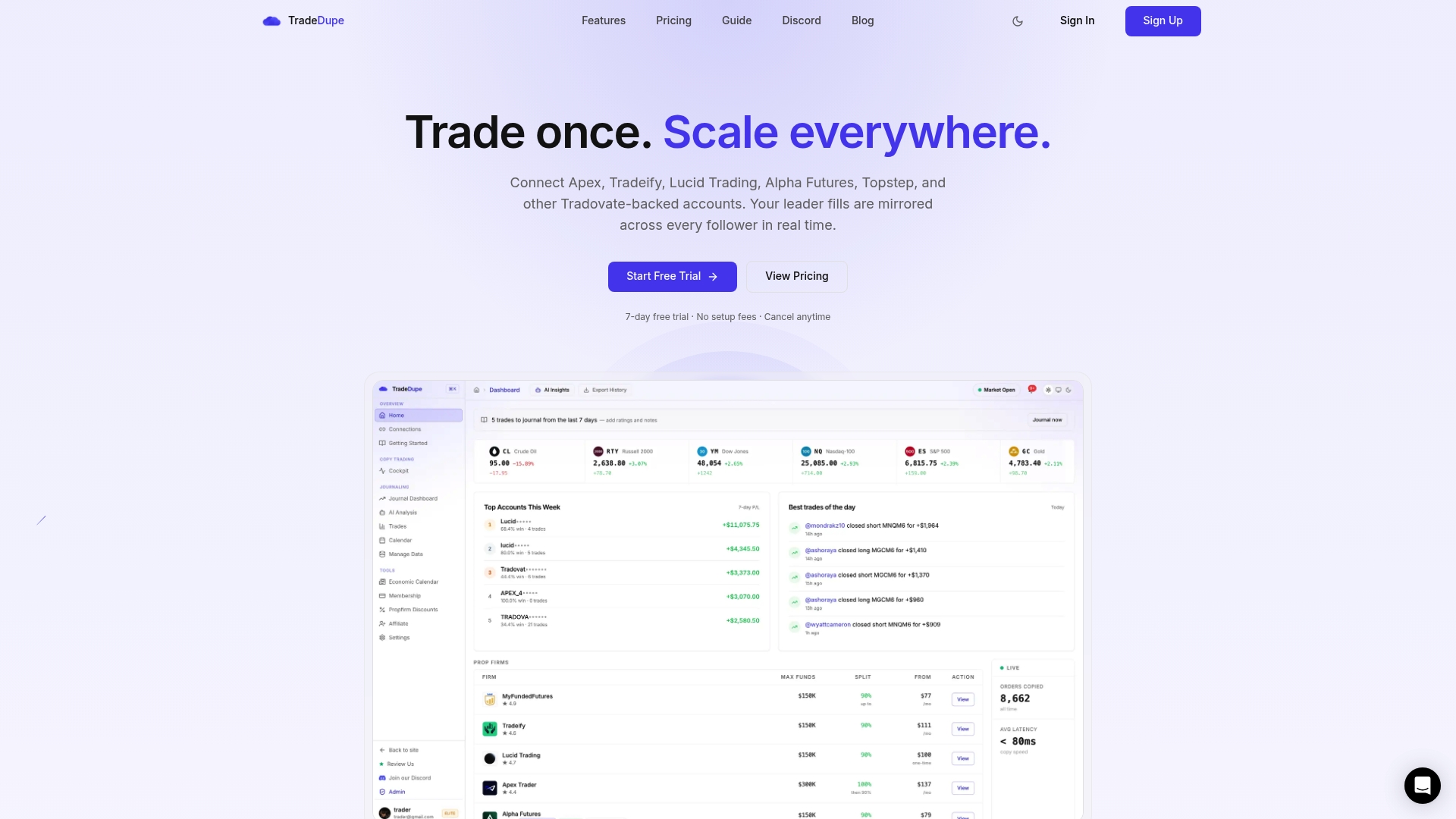
The platform's median execution latency of 34ms means proportional lot calculations happen and orders are placed before market conditions shift. Per-account toggle controls let you pause, adjust, or reconfigure individual follower accounts without touching the rest of your group. If you manage multiple funded accounts and need lot sizing that stays accurate as balances change, start with Tradedupe to see how the configuration works in practice. The getting started guide walks through the full setup in under 10 minutes.
FAQ
What is a proportional lot sizing copier?
A proportional lot sizing copier is software that automatically adjusts the trade volume sent to each follower account based on its balance or equity relative to the master account. The goal is to maintain the same percentage risk on every account, regardless of size.
What lot sizing mode is best for multi-account trading?
Risk-based mode is the most effective for multi-account trading because it calculates lot size from each account's equity, a defined risk percentage, and the stop loss distance, keeping dollar risk consistent even when trade setups vary.
What happens if I ignore broker lot constraints in a trade copier?
Ignoring broker minimum lot sizes, maximum lot caps, or volume step requirements causes the copier to submit invalid orders. The result is order rejection and orphaned trades, where the master account holds a position with no matching trade on the follower.
How often should I update multiplier settings for follower accounts?
Multipliers should be reviewed after any significant balance change on a follower account, including drawdowns, payouts, or deposits. A balance shift of 10% or more changes the correct multiplier enough to meaningfully affect risk exposure on subsequent trades.
Does Tradedupe support per-account lot sizing configuration?
Tradedupe supports independent multiplier and risk-based sizing settings for each follower account, along with per-account max lot caps. This lets one master signal be sized correctly for accounts ranging from $10,000 to $100,000 within the same copy group.