

Proprietary Trading Futures: A Practical 2026 Guide
TradeDupe
17 min read
Discover how proprietary trading futures can boost your income with firm-backed capital. Learn the steps to qualify and profit.
Proprietary trading futures means trading exchange-listed futures contracts using a firm's capital while operating under its risk rules and sharing the resulting profits. You do not need to deposit trading capital of your own; instead, you qualify through a paid evaluation that tests your profitability, risk discipline, and rule compliance in a real-time simulated environment. Pass the challenge, and the firm funds you. Three facts to anchor the model:
- How you qualify: Pay an evaluation fee, meet a profit target within defined drawdown limits, and satisfy any minimum trading-day requirements. Firms like Topstep, PropAccount, and Apex each run their own version of this challenge structure.
- What changes when you're funded: You trade the firm's capital (simulated or live-broker-backed), follow its ongoing risk controls, and cannot exceed its drawdown thresholds without risking de-funding.
- Typical profit split: Funded accounts commonly carry profit splits ranging from roughly 80% to near 100% in the trader's favor, depending on the firm and account tier.
*
Key Takeaways
Futures prop trading gives skilled traders access to firm capital through a paid evaluation, but the firms, rules, and risk structures vary enough that due diligence before paying any fee is as important as the trading itself.
| Point | Details |
|---|---|
| Evaluation is the entry gate | Pay a fee, hit a profit target within drawdown limits, and satisfy minimum trading days to qualify for funding. |
| Profit splits favor traders | Most funded accounts carry splits of 80%–90% or higher, but payout mechanics (buffers, minimums, cadence) vary significantly by firm. |
| Verify the clearing structure | Confirm whether funded accounts use a CFTC-registered FCM; simulated vs. live-capital accounts carry different protections. |
| Trailing drawdown is the critical rule | A trailing drawdown floor rises with your equity, meaning a strong early session can tighten your margin for the rest of the evaluation. |
| Scale with mirroring, not manual execution | Multiple funded accounts require server-side trade mirroring for consistency, low latency, and rogue-trade protection. |
*
Table of Contents
- What is a futures prop firm and why do these firms exist?
- How does proprietary trading futures work, step by step?
- What evaluation rules and costs should you expect?
- How do profit splits, payouts, and scaling pathways work?
- Prop trading vs live/self-funded futures trading: which path fits you?
- How to choose a reputable futures prop firm
- What are the key risks and U.S. regulatory considerations?
- How to prepare to pass a futures prop evaluation
- Why trade mirroring matters when you scale funded futures accounts
- An honest perspective on the prop trading path
- Scale your funded futures accounts with Tradedupe
- Sources
What is a futures prop firm and why do these firms exist?
A futures prop firm is a capital provider, not a retail broker and not a hedge fund employer. The distinction matters. A retail broker earns commissions on your trades regardless of your P&L. A hedge fund hires traders as employees, pays salaries, and owns the strategy. A futures prop firm does neither: it supplies risk capital to independent traders who have demonstrated skill through an evaluation, then splits the profits.
The business model is straightforward. Firms scale trader talent without the overhead of full-time employment. They monetize skill by capturing a percentage of P&L from a large pool of funded traders, most of whom trade standardized, exchange-listed futures contracts across equity indices (ES, NQ, RTY), commodities (CL, GC), interest rates (ZN, ZB), and currencies (6E, 6J) on exchanges like CME, CBOT, COMEX, and NYMEX. The liquidity and transparency of these markets make them ideal for rule-based evaluation.
Compared to institutional prop desks, retail-facing futures prop firms operate with a fundamentally different structure. Institutional desks deploy real capital from day one under regulated clearing. Retail prop firms typically run evaluations in simulated accounts that mirror live market data, then may or may not transition funded traders to accounts backed by a regulated Futures Commission Merchant (FCM). That distinction carries real implications for trader protections, which is why verifying a firm's clearing arrangements is a non-negotiable step before paying any fee.
*
How does proprietary trading futures work, step by step?
The path from aspiring trader to funded account follows a consistent sequence across most retail prop firms. Understanding each stage prevents costly surprises.
- Purchase an evaluation (the "challenge"). You pay a one-time or subscription fee to access a simulated account with a defined size, profit target, and risk parameters. This is not a deposit; it is a fee for the right to attempt qualification.
- Trade the evaluation account. You must hit the profit target while staying within the firm's drawdown limits (the maximum loss allowed, measured daily and/or cumulatively) and completing a minimum number of trading days. Consistency rules at some firms also cap how much of your target a single day's gain can represent.
- Pass and enter a simulated funded phase. Many firms run a brief intermediate stage where you trade a larger simulated account under live-market conditions. Topstep calls this the "Combine." This phase confirms you can replicate evaluation performance before the firm commits real capital.
- Receive a funded account. The firm issues a live or simulated-funded account. Profits above the firm's buffer threshold become eligible for payout. Risk rules remain active; violating them can result in de-funding.
- Request payouts and scale. Once you meet payout thresholds, you withdraw your profit share. Consistent performance over time unlocks scaling: larger account sizes, additional accounts, or higher allocation tiers.
A few terms appear constantly in this process and are worth defining precisely. Trailing drawdown means the maximum loss threshold moves up as your account equity rises, locking in a floor that follows your peak balance. Static drawdown is fixed from the start and does not move. Profit split is the percentage of net profits paid to the trader. Scaling rules are the performance milestones a firm requires before increasing your allocation.
For a closer look at how Apex structures its account tiers and rules, the Apex futures account guide on the Tradedupe blog walks through the mechanics in detail.
*
What evaluation rules and costs should you expect?
Evaluation parameters vary across firms, but the ranges below reflect what most retail-facing futures prop firms publish. Fees vary depending on account size and model, generally ranging from modest to several hundred dollars as a one-time or subscription-based charge.
| Parameter | Typical Range |
|---|---|
| Profit target | 6%–10% of account size |
| Max daily loss | 2%–3% of account size |
| Max overall drawdown | 4% (trailing or static) |
| Minimum trading days | 5–15 days |
| Allowed instruments | CME-listed futures (ES, NQ, CL, GC, and others) |
| Evaluation fee | $50–$500+ (one-time or monthly subscription) |
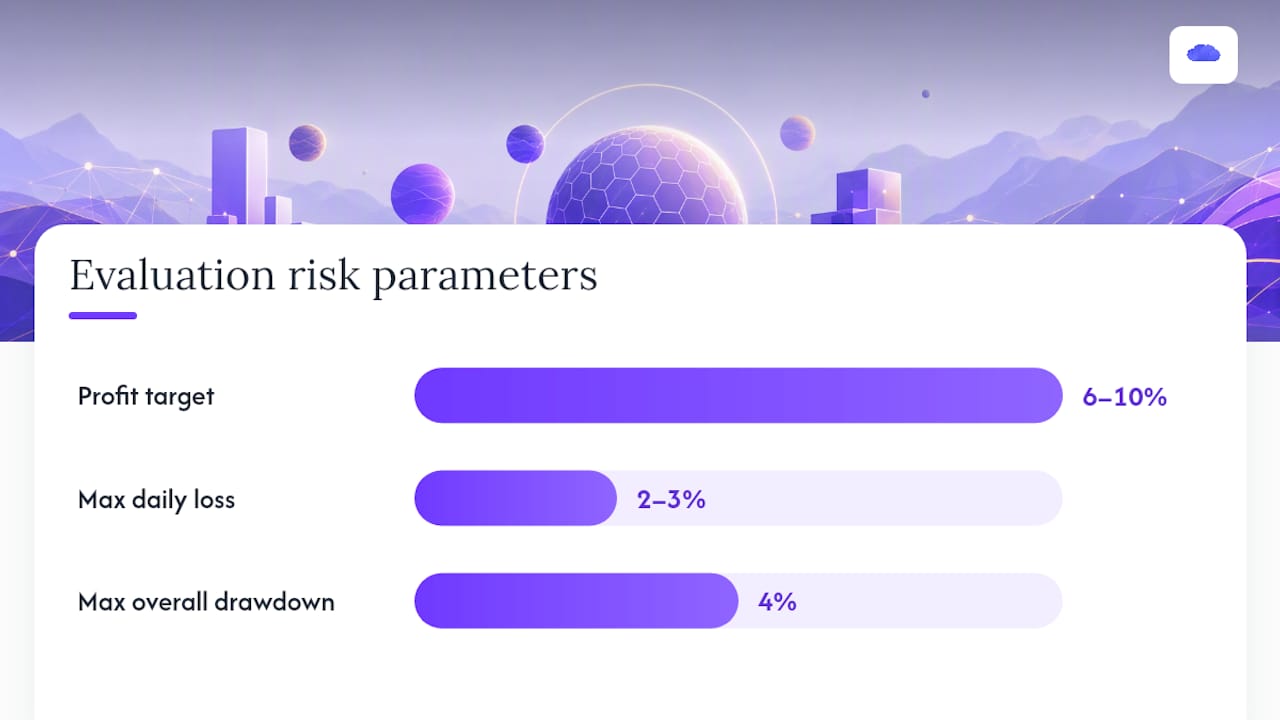
The difference between trailing and static drawdown is not a technicality. With a trailing drawdown, a strong early run raises your floor. If you make $2,000 on a $50,000 account and your trailing drawdown is $2,500, your floor has now risen by $2,000. A single bad session can trigger the limit before you expect it. Static drawdown is more forgiving in that sense: the floor never moves, so a profitable start does not tighten your margin. Traders who run high-volatility strategies often find trailing drawdowns particularly punishing.
Timeline expectations are equally important. Most evaluations have no hard deadline, but minimum trading-day requirements mean you cannot rush through in two sessions. A trader completing the minimum days at a measured pace typically finishes an evaluation in two to four weeks. Rushing to hit a profit target in fewer sessions usually produces the oversized positions that trigger drawdown violations.

Futures contracts are marked to market daily, meaning your account balance reflects unrealized P&L in real time. Micro futures (at 1/10th or smaller contract size for many major products) let traders practice position sizing within tight drawdown budgets before moving to full-size contracts.
*
How do profit splits, payouts, and scaling pathways work?
Profit splits at most retail prop firms favor the trader, typically offering a large majority share, with some firms advertising splits close to full profit for top-tier accounts. The split percentage often depends on account size, how long you have been funded, and whether you are on a subscription or one-time fee model.
Payout mechanics have more nuance than the headline split suggests:
- Buffer thresholds: Most firms require your account to remain above a minimum equity level before a payout is processed. You cannot withdraw profits that would push your balance below the firm's risk floor.
- Minimum payout amounts: Some firms set a floor (often $100–$250) below which a withdrawal request is not processed.
- Payout cadence: Firms vary widely here, from daily on-demand payouts to 48-hour processing windows to monthly cycles. Faster payout claims deserve scrutiny; verify them against published trader experiences, not just marketing copy.
- Tax and reporting: Futures profits in the United States are taxed under the 60/40 rule (60% long-term, 40% short-term capital gains rates) per Section 1256 of the Internal Revenue Code. Prop firm payouts are typically treated as ordinary income or self-employment income depending on your arrangement; consult a tax professional for your specific situation.
Scaling paths vary by firm but generally follow a performance-milestone model. After demonstrating consistent profitability over a defined period (often 30–90 days), traders may qualify for a larger account, additional funded accounts, or a higher profit-split tier. Some firms allow traders to run multiple evaluation accounts simultaneously, which is where multi-account workflows become operationally relevant. Understanding how prop firm rules affect trade copying is critical before automating across multiple funded accounts.
*
Prop trading vs live/self-funded futures trading: which path fits you?
The choice between a prop firm and self-funded trading is not purely financial. It is a question of where you are in your development, how much capital you control, and how you respond to externally imposed rules.
Prop trading advantages: You access meaningful capital (often $50,000–$150,000 or more) without risking that amount personally. Your downside is limited to the evaluation fee. The structured rules, while constraining, also function as a built-in risk management framework that many developing traders benefit from having enforced externally.
Prop trading drawbacks: You keep only a portion of profits. Rule violations can wipe your funded status instantly. Some firms run evaluations in simulated environments that do not perfectly replicate live execution, meaning slippage and fill quality may differ when you eventually trade live capital.
Self-funded trading advantages: You keep 100% of profits, trade any instrument on any schedule, and face no external consistency rules or drawdown thresholds beyond your own discipline. Your account behavior is entirely your own.
Self-funded trading drawbacks: Capital requirements are real. Trading a single ES contract requires roughly $12,000–$15,000 in margin to manage risk responsibly. Losses come directly from your personal capital, and there is no evaluation fee buffer between you and a bad month.
Decision cues: Prop trading tends to make more sense when you have a proven strategy but limited capital, when you want structured accountability, or when you are early enough in your career that the evaluation process itself serves as a forcing function for discipline. Self-funded trading is preferable when you have sufficient capital, a track record that justifies full profit retention, and the psychological maturity to enforce your own rules without external guardrails.
*
How to choose a reputable futures prop firm
Not all prop firms operate with the same transparency or financial backing. A structured evaluation process protects you from firms that profit primarily from failed evaluations rather than from trader success.
Checklist: what to verify before paying
- Transparent, written evaluation rules. Rules should be published clearly, not buried in fine print. Verify profit targets, drawdown types (trailing vs. static), minimum trading days, and consistency rules before purchasing.
- Verifiable payout proof. Look for documented, timestamped payout confirmations from real traders, not just testimonials. Forum communities and social media threads often surface genuine payout histories.
- Broker and clearing partner. Confirm which FCM or clearing broker holds the live funded accounts. Firms using regulated FCMs (registered with the CFTC and NFA) offer meaningfully stronger protections than those whose clearing arrangements are opaque.
- Platform support. Verify that the firm supports the platforms you trade on. Tradovate and TT (Trading Technologies) are widely supported; confirm compatibility before committing.
- Customer support quality. Test it before you pay. Send a pre-sale question and evaluate response time and specificity.
- Sample contract terms. Request or locate the trader agreement. Understand what triggers de-funding, how disputes are handled, and whether the firm can change rules mid-evaluation.
Questions to ask before paying:
- What is the exact payout timeline, and what documentation is required to request a withdrawal?
- What happens if a rogue trade or platform error triggers a drawdown violation?
- How does the scaling program work, and what are the specific performance milestones?
Red flags to avoid:
- Any guarantee of profit or a "can't fail" evaluation structure.
- Rules that change after you purchase an evaluation.
- No verifiable payout history from real, named traders.
- Opaque or unregistered clearing arrangements.
- Firms that require you to assume margin credit risk beyond the evaluation fee itself.
For a detailed breakdown of which firms skip consistency rules entirely, the prop firms with no consistency rule list on Tradedupe is a useful reference when comparing evaluation structures.
*
What are the key risks and U.S. regulatory considerations?
Futures trading carries risks that are structurally different from equities. The CFTC is explicit: leverage in futures can magnify losses rapidly, retail participants can lose their entire initial investment, and in certain margin structures may be required to provide additional funds when maintenance margin thresholds are breached. That warning applies whether you are trading your own capital or a firm's.
Within the prop firm context, your personal financial risk is technically limited to the evaluation fee. But that framing can create a false sense of security. Repeated failed evaluations add up. And if a firm issues a live-capital funded account rather than a simulated one, your trading activity has real market consequences and real regulatory implications.
What to verify with U.S. regulators:
- Check whether the firm's clearing broker is registered as an FCM with the CFTC and is a member of the NFA. The NFA's Background Affiliation Status Information Center (BASIC) database allows public searches of registered firms and individuals.
- Confirm whether the funded accounts you would trade are backed by real brokerage capital or are purely simulated. The answer changes your regulatory protections significantly.
- Review any investor advisories the NFA has published about retail prop trading structures before committing capital.
Futures are also marked to market daily, meaning your account balance reflects real-time P&L. A position that moves against you intraday can breach a daily loss limit before you have a chance to react, particularly in volatile markets like crude oil (CL) or equity index futures during macro events. Position sizing relative to your drawdown budget is not optional risk management; it is the mechanism that keeps you in the game.
This article provides general educational information about futures prop trading and is not a substitute for advice from a qualified financial, legal, or tax professional. Verify current rules and firm registrations with the CFTC, NFA, and your own advisors before committing capital.
*
How to prepare to pass a futures prop evaluation
Passing an evaluation is not primarily a test of market prediction. It is a test of whether your risk management holds under real-time pressure. The traders who fail most often do so not because their strategy is wrong but because they abandon it when the account is down.
Preparation checklist:
- Write a formal trade plan. Document your entry criteria, exit rules, position sizing formula, and maximum daily loss tolerance before you start the evaluation. A written plan is harder to rationalize away in the heat of a losing session.
- Backtest under challenge parameters. Run your strategy against historical data using the evaluation's exact drawdown limits and profit target. If your strategy's historical drawdowns exceed the firm's limits, you already know the failure mode.
- Forward-test in a demo account. Simulate the evaluation conditions for at least two to four weeks before paying. Track your performance against the exact metrics the firm uses.
- Practice position sizing for worst-case scenarios. Calculate the maximum number of contracts you can hold given the daily loss limit and your typical stop distance. Then trade smaller than that maximum.
- Log performance daily. A daily log of entries, exits, P&L, and emotional state reveals patterns that raw P&L data hides. Streaks of losses often precede rule violations; the log is your early warning system.
Pro Tip: Map the evaluation's minimum trading-day requirement into your calendar before you start. If the firm requires 10 trading days and you can only trade three days per week, you are committing to at least four weeks. Rushing the timeline by trading on days when your setup is absent is one of the most common evaluation failure modes.
Psychological preparation is equally concrete. Build a pre-session checklist: market context, key levels, planned trade setups, and a hard stop-loss for the day. Treat a losing streak as data, not a signal to increase size. The beginner trading mistakes to avoid resource from BigMoveAlgo covers the behavioral patterns that derail traders most frequently during evaluations.
For a comprehensive playbook on passing and retaining a funded account, the how to trade prop firms guide on Tradedupe covers the full lifecycle from evaluation prep through post-funding scaling.
*
Why trade mirroring matters when you scale funded futures accounts
Once you hold multiple funded accounts, manual execution across all of them becomes a single point of failure. A missed entry on one account, a fat-finger on another, or a connectivity drop during a fast market can create divergent P&L profiles that violate consistency rules or trigger drawdown limits on individual accounts. This is why institutional prop desks and advanced retail traders use server-side trade mirroring as standard practice.
The operational logic is straightforward: a single lead account executes the trade decision, and an automated system replicates that trade across all follower accounts with minimal latency. The benefits extend beyond convenience:
- Consistency across accounts: Every follower account mirrors the same entry, exit, and sizing logic, eliminating execution drift between accounts.
- Low-latency execution: Server-side mirroring reduces the delay between the leader trade and follower fills. Tradedupe's futures trade copier reports a median replication latency of 34ms, which matters in fast-moving markets where a few hundred milliseconds can mean a different fill price.
- Rogue-trade detection: Automated systems can flag or block fills that deviate from expected parameters, catching platform errors or errant orders before they breach a drawdown limit.
- Auto-recovery: If a follower account loses connectivity, a recovery mechanism re-syncs positions when the connection restores, preventing orphaned trades.
- Per-account toggles: The ability to pause mirroring on a single account without affecting others is critical when one account is near a drawdown limit or undergoing a rule review.
- Analytics and monitoring dashboards: Real-time visibility into sync status, leader/follower activity, and per-account P&L supports both performance management and compliance documentation.
Implementation considerations: Broker compatibility is the first constraint. Tradedupe is built specifically for the Tradovate ecosystem, which is the brokerage platform used by Apex, Tradeify, Lucid Trading, Alpha Futures, and several other major prop firms. If your funded accounts live on Tradovate, the integration is direct. For TT (Trading Technologies) users, verify platform support before committing to any copier solution. Reconciliation and monitoring dashboards are not optional features at scale; they are the audit trail that proves your accounts operated within firm rules if a dispute arises.
*
An honest perspective on the prop trading path
The prop trading model has genuine merit, and it also carries a structural tension that most marketing materials understate.
The evaluation fee model means firms collect revenue from every trader who attempts a challenge, regardless of whether that trader ever gets funded. That is not inherently predatory, but it does mean the incentive to make evaluations passable (rather than genuinely selective) is not always aligned with your long-term success. The firms that have built durable reputations, Topstep being the clearest example, have done so by maintaining consistent, transparent rules and demonstrating verifiable payout histories. The firms that have damaged the industry's credibility are those that changed rules mid-evaluation, delayed payouts without explanation, or operated with opaque clearing arrangements.
My practical recommendation: treat the evaluation as a skill-building exercise first and a funding mechanism second. If your strategy cannot survive the drawdown rules of a well-structured challenge, it will not survive a live market either. Prioritize firms that use regulated FCMs for live funded accounts, publish clear and stable rules, and have a documented payout history you can verify independently. Once you are funded and scaling across multiple accounts, the operational complexity of manual execution grows faster than most traders anticipate. That is the point at which a reliable, low-latency trade mirroring solution like Tradedupe becomes a practical necessity rather than a convenience.
*
Scale your funded futures accounts with Tradedupe
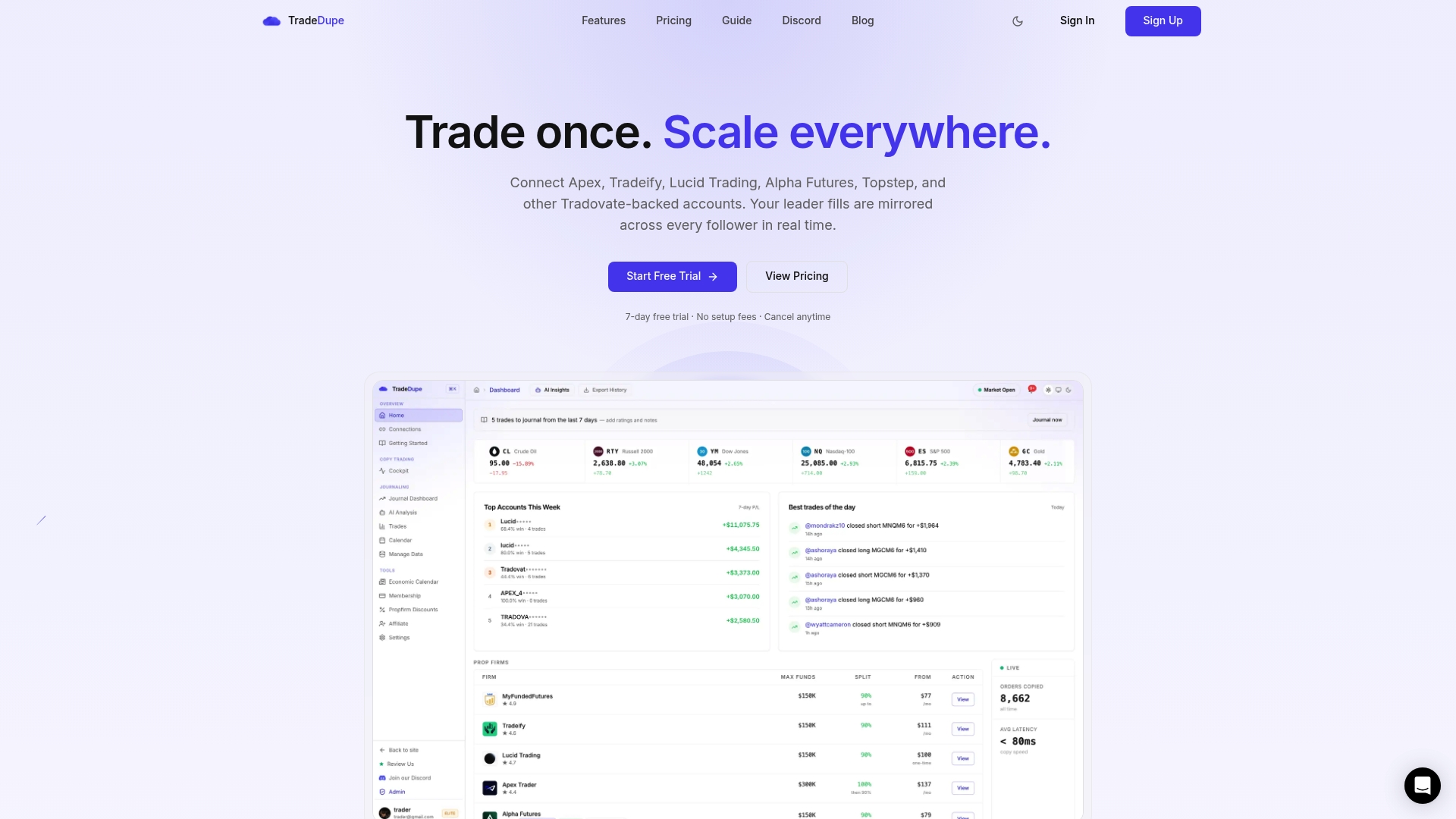
Managing multiple funded futures accounts manually is operationally fragile. Tradedupe is built specifically for prop traders on Tradovate who need reliable, server-side trade mirroring across every evaluation and funded account they hold. With a median replication latency of 34ms, rogue-trade detection, auto-recovery, per-account toggles, and real-time analytics, Tradedupe gives you the infrastructure to scale without introducing execution risk.
Supported prop firm integrations include Apex, Tradeify, Lucid Trading, and Alpha Futures. Tiered plans cover individual traders through enterprise-level prop desks, with a free trial to get started.
Start mirroring your funded accounts and see how Tradedupe handles the operational layer so you can focus on trading.
*
Sources
These are the sources worth bookmarking before you pay an evaluation fee or open a funded account.
- Basics of futures trading | CFTC
- CME Group — Learn to trade futures
- What Is Prop Trading & How Does It Work? | NinjaTrader
- Futures contracts | Investopedia
Recommended
- The Futures Day Trading Landscape in 2026: ICT, Order Flow, Prop Firms, and What Actually Works | TradeDupe Blog
- How to Trade Prop Firms (2026): A Practical Playbook to Pass and Keep a Funded Account | TradeDupe Blog
- Futures Trading Glossary | TradeDupe
- Best Futures Prop Firms 2026 — Updated Rankings | TradeDupe Blog