
Topstep Paper Trading for Tradovate Prop Desks
TradeDupe
11 min read
Explore topstep paper trading with Tradedupe for Tradovate prop desks. Achieve fast trade replication and streamline your strategies today!
For Tradovate prop desks running multi-account mirrored workflows, Tradedupe is the recommended server-side solution. It delivers API-first trade replication at a median latency of a few tens of milliseconds, with built-in rogue-trade detection, per-account toggles, auto-recovery, and analytics purpose-built for prop-firm environments. Supported integrations cover Apex, Trapeify, Lucid Trading, and Alpha Futures. A free trial is available, and onboarding guides walk your team through connecting leader and follower accounts on Tradovate without desktop software.
The phrase "topstep paper trading" as used here refers to simulated, server-side multi-account mirroring on Tradovate — the kind of paper-trading infrastructure a prop desk deploys to test and validate copy strategies across many accounts simultaneously. That is a fundamentally different workflow from single-account practice trading, and it demands a different class of tooling.
*
Table of Contents
- Why execution latency breaks your copied strategies
- How does server-side API architecture compare to terminal-based copiers?
- What features should you require from a Tradovate mirroring platform?
- How Tradedupe meets prop-desk requirements
- Step-by-step checklist to deploy mirrored paper trading safely
- What metrics prove your copier is working correctly?
- How should you size a pricing plan for your desk?
- Key Takeaways
- The case for treating latency as a first-class requirement
- Run a Tradedupe trial on your Tradovate sandbox
- Useful sources and integration documentation
Why execution latency breaks your copied strategies
Execution latency between a leader fill and follower execution is the single largest performance threat to copied strategies. Even a few hundred milliseconds of delay compounds across dozens of follower accounts, producing negative slippage and P/L drift that erodes the value of any paper-trading validation you run.
The failure modes are specific and predictable:
- Leader-fill → follower-exec delay: The gap between when the leader's order fills and when the follower's order is submitted. Every millisecond here is realized slippage on the follower side.
- Webhook-only signal loss: Signal-mode copiers that rely on webhooks miss manual trades and ATM bracket fills placed directly on the Tradovate platform. Fill-driven (execution-mode) copying captures those fills because it reads broker state, not just programmatic signals.
- Duplicate events: Poorly implemented copiers can fire multiple follower orders from a single leader fill if the event stream is not deduplicated at the application layer.
- Fractional-sizing carry issues: When sizing ratios produce non-integer contract counts, rounding logic that is not consistently applied across followers creates position drift over time.
Pro Tip: When ramping up a new mirroring setup, start with a single follower account and watch the copy log closely. Measure the fill-to-follower delta on every trade for the first two sessions before expanding to the full cohort. Report any unexpected behavior to support with the order IDs attached.
*
How does server-side API architecture compare to terminal-based copiers?
Moving from terminal-based copiers to API-based server architectures reduces VPS hardware requirements and improves reliability for desks managing 20 or more follower accounts. The architectural difference is not cosmetic — it determines where latency enters the stack and how many single points of failure exist.
| Dimension | Server-side / API-based | Terminal / VPS-based |
|---|---|---|
| Execution latency | Low; broker TCP + WebSocket fan-out only | Higher; desktop process + network hop added |
| Scalability | 20+ accounts without added hardware | Each terminal instance adds resource overhead |
| Single points of failure | Platform SLA; no local machine dependency | Local machine crash, VPS outage, or session drop |
| Maintenance burden | Vendor-managed updates | Manual patching per VPS instance |
| Security surface | Encrypted API calls; no RDP exposure | RDP/VNC access to each VPS increases attack surface |
Tradovate's WebSocket connections provide low-latency, bidirectional streams with endpoints available only over persistent sockets, making them the correct transport layer for real-time copying. The Tradovate API follows an OpenAPI 3.— specification and exposes trading, market-data, account, and order domains that a server-side copier can call programmatically without any local client running.
*
What features should you require from a Tradovate mirroring platform?
The non-negotiable baseline: server-side execution mode, a persistent WebSocket integration to Tradovate, and enterprise risk controls. Any platform missing one of those three is not production-ready for a prop desk.
Must-have feature checklist:
- Execution-mode (fill-driven) copying, not webhook-only
- Per-account position sizing with configurable ratios
- Rogue-trade detection with automatic halt capability
- Auto-recovery after connection drops or broker-side errors
- Immutable audit logs and order-map visibility
- Encryption in transit and at rest
- Published SLA terms with uptime commitments
Vendor validation sequence (run before signing):
- Connect a demo leader account and place a manual trade; confirm the follower captures it via execution mode, not just a programmatic signal.
- Measure the fill-to-follower delta across 20 trades and calculate median latency.
- Simulate a connection drop and verify auto-recovery restores sync without manual intervention.
- Request a sample audit log and confirm order IDs are immutable and timestamped.
- Ask for the SLA document and confirm uptime credits are contractually defined.
Red flags that disqualify a copier: terminal-only dependency per follower account, no immutable order map, absence of per-account toggles, and copy logs that cannot be exported or searched by order ID. See the prop firm rules guide for account-rule constraints that affect copier behavior.
*
How Tradedupe meets prop-desk requirements
Tradedupe implements server-side Tradovate mirroring with the full feature set pro desks require: low latency, granular risk controls, and analytics in one SaaS platform. No desktop software. No VPS to maintain.

| Category | Tradedupe coverage |
|---|---|
| Execution latency | Median 34 ms leader-fill to follower-execution |
| Scalability | Unlimited broker connections on enterprise plans |
| Risk controls | Rogue-trade detection, per-account toggles, auto-recovery |
| Analytics | Real-time sync dashboard, fill-to-exec delta reporting, reconciliation |
| Prop-firm integrations | Apex, Trapeify, Lucid Trading, Alpha Futures |
The 34 ms median latency figure reflects the platform-level measurement from leader fill receipt to follower order submission. At a median fill-to-exec latency of 34 ms, slippage on liquid futures contracts like ES or NQ is typically sub-tick for most market conditions. The Tradovate Partner API enables Tradedupe to create and manage organization accounts, apply risk settings, and control trading permissions programmatically — the exact capabilities a prop desk needs to provision and govern follower accounts at scale.
*
Step-by-step checklist to deploy mirrored paper trading safely
Follow this sequence to reduce slippage and catch replication issues before they reach your full account cohort.
- Connect leader and follower identities via the Tradedupe dashboard using your Tradovate API credentials.
- Select execution mode (fill-driven) rather than signal mode, unless your leader trades exclusively via programmatic orders.
- Configure per-account sizing rules — set contract ratios and maximum position sizes per follower.
- Apply per-account risk limits — set daily loss limits and max drawdown thresholds for each follower.
- Run a small cohort test with two to three follower accounts for a minimum of two full trading sessions.
- Validate reconciliation — compare leader fills against follower fills line by line and confirm no missed or duplicate orders.
- Scale to full cohort only after low median latency and slippage thresholds pass validation.
Preflight verification table:
| Item | What to verify |
|---|---|
| WebSocket auth | Persistent connection established; no token expiry during session |
| Order-map visibility | Every leader fill appears in the copier's order map within 50 ms |
| Logging / audit | Audit log captures order ID, timestamp, and fill price for every event |
| Failover behavior | Connection drop triggers auto-recovery within one reconnect cycle |
*
What metrics prove your copier is working correctly?
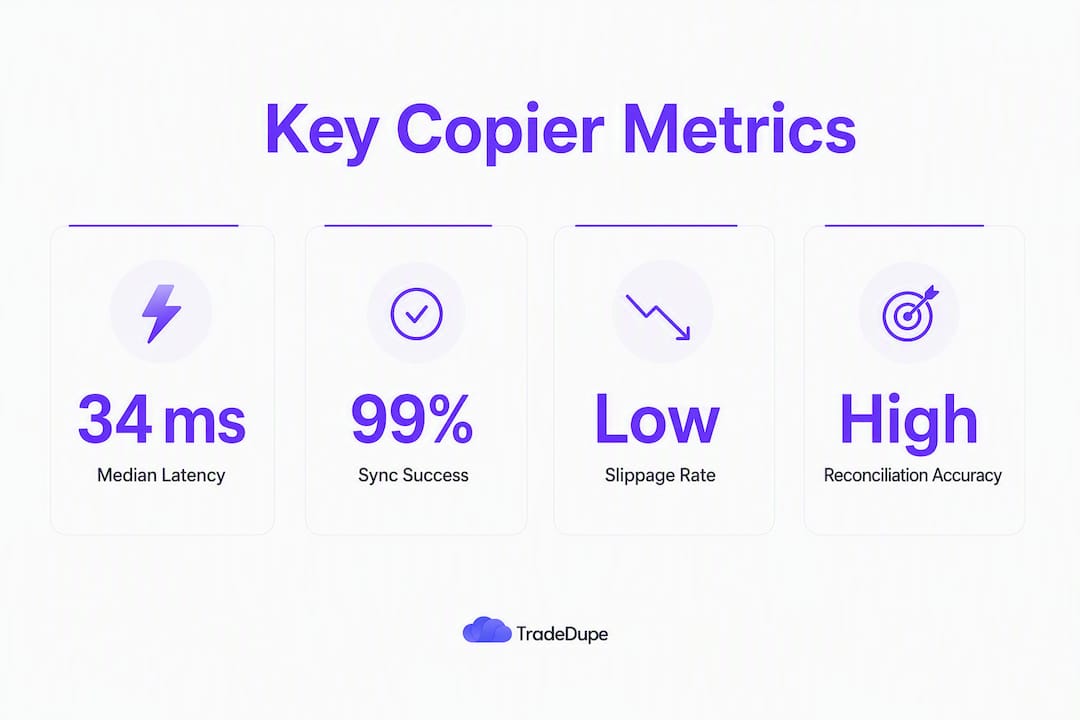
Monitor these five metrics from day one. Median latency and slippage distribution are the leading indicators; reconciliation gaps are the lagging confirmation.
| Metric | Definition | Acceptable threshold | Alert condition |
|---|---|---|---|
| Fill-to-exec delta | Time from leader fill to follower order submission | Median < 50 ms | Any single event > 200 ms |
| Slippage per trade | Follower fill price minus leader fill price | ≤ 1 tick on liquid contracts | > 2 ticks on 5% of trades |
| Sync success rate | Follower orders fired / leader fills received | 99% | < 99% over any 1-hour window |
| Reconciliation gap | Unmatched leader fills at end of session | — | Any unmatched fill |
| Auto-recovery time | Time to restore sync after connection drop | less than a minute | > 60 seconds |
When sync success rate drops below 99% over a rolling hour, pause group copying immediately and pull the copy log filtered by that window. Attach the affected order IDs when contacting support. Auto-recovery events that exceed 60 seconds warrant a review of your WebSocket token refresh logic and broker-side session limits.
*
How should you size a pricing plan for your desk?
Pricing for server-side Tradovate mirroring platforms is typically tiered by three variables: number of broker connections, follower account count, and the SLA/feature bundle included at each tier.
Key cost drivers to evaluate before selecting a plan:
- Follower account count: Most platforms gate their base tier at a low account ceiling. Confirm the per-account cost at your target scale before committing.
- SLA and uptime commitment: Enterprise SLAs with uptime credits cost more but protect P/L during outages. For live prop-desk operations, this is not optional.
- Required integrations: Prop-firm connectors (Apex, Trapeify, Lucid Trading, Alpha Futures) may be tier-gated. Verify your required integrations are included.
- Analytics and log retention: Longer retention windows for audit logs and fill-to-exec delta history increase storage costs at the platform level.
- Support and onboarding: Dedicated onboarding and priority support are typically enterprise-tier features.
For a small desk (under 10 follower accounts), a mid-tier plan with a defined SLA usually covers the need. Enterprise desks running 20+ accounts should negotiate overage pricing, uptime credits, and trial length directly with the vendor before signing. Ask specifically about what happens to in-flight orders during a platform maintenance window. The best trade copier buyer's guide covers plan-sizing considerations in detail.
*
Key Takeaways
Server-side, fill-driven trade mirroring on Tradovate is the only architecture that preserves P/L parity across 20+ follower accounts at prop-desk scale.
| Point | Details |
|---|---|
| Latency is the primary risk | Fill-to-exec delay causes slippage and P/L drift; target median < 50 ms. |
| Execution mode beats signal mode | Fill-driven copying captures manual and ATM trades that webhook-only copiers miss. |
| API architecture scales; terminals don't | Server-side copiers eliminate VPS overhead and reduce single points of failure for large account counts. |
| Validate before scaling | Run a 2-week cohort test, measure median latency and slippage, confirm reconciliation before expanding. |
| Tradedupe for Tradovate desks | Tradedupe delivers low median latency, rogue-trade detection, and Apex/Trapeify/Lucid/Alpha Futures integrations on one platform. |
*
The case for treating latency as a first-class requirement
Most prop desks that struggle with copy-trading drift focus on strategy logic when the real culprit is infrastructure. A 200 ms fill-to-exec gap on a fast-moving ES contract is not a minor inconvenience — it is a structural edge leak that compounds across every follower account, every session. The industry's shift toward server-side, fill-aware replication is not a trend; it is the correction of a fundamental design error in earlier terminal-based tools.
What often gets underestimated is how much the choice of execution mode matters even in paper-trading contexts. Teams that test with signal-mode copiers and then deploy to live accounts with execution mode are effectively running two different systems. The validation data from the paper phase does not transfer cleanly. Building your testing infrastructure on the same execution model you intend to run in production is the only way to make paper-trading results meaningful.
Tradedupe's focus on server-side Tradovate mirroring with a 34 ms median latency target, rogue-trade detection, and native prop-firm integrations reflects a deliberate product decision: build for the prop desk's actual failure modes, not the retail trader's convenience preferences. The roadmap continues to prioritize fill-fidelity, audit depth, and SLA transparency — the three things engineering teams ask about first when evaluating a platform for production use.
*
Run a Tradedupe trial on your Tradovate sandbox
Zero-latency promises are easy to make. The only way to verify them is to measure fill-to-exec delta on your own accounts, with your own leader strategy, against your actual follower cohort.
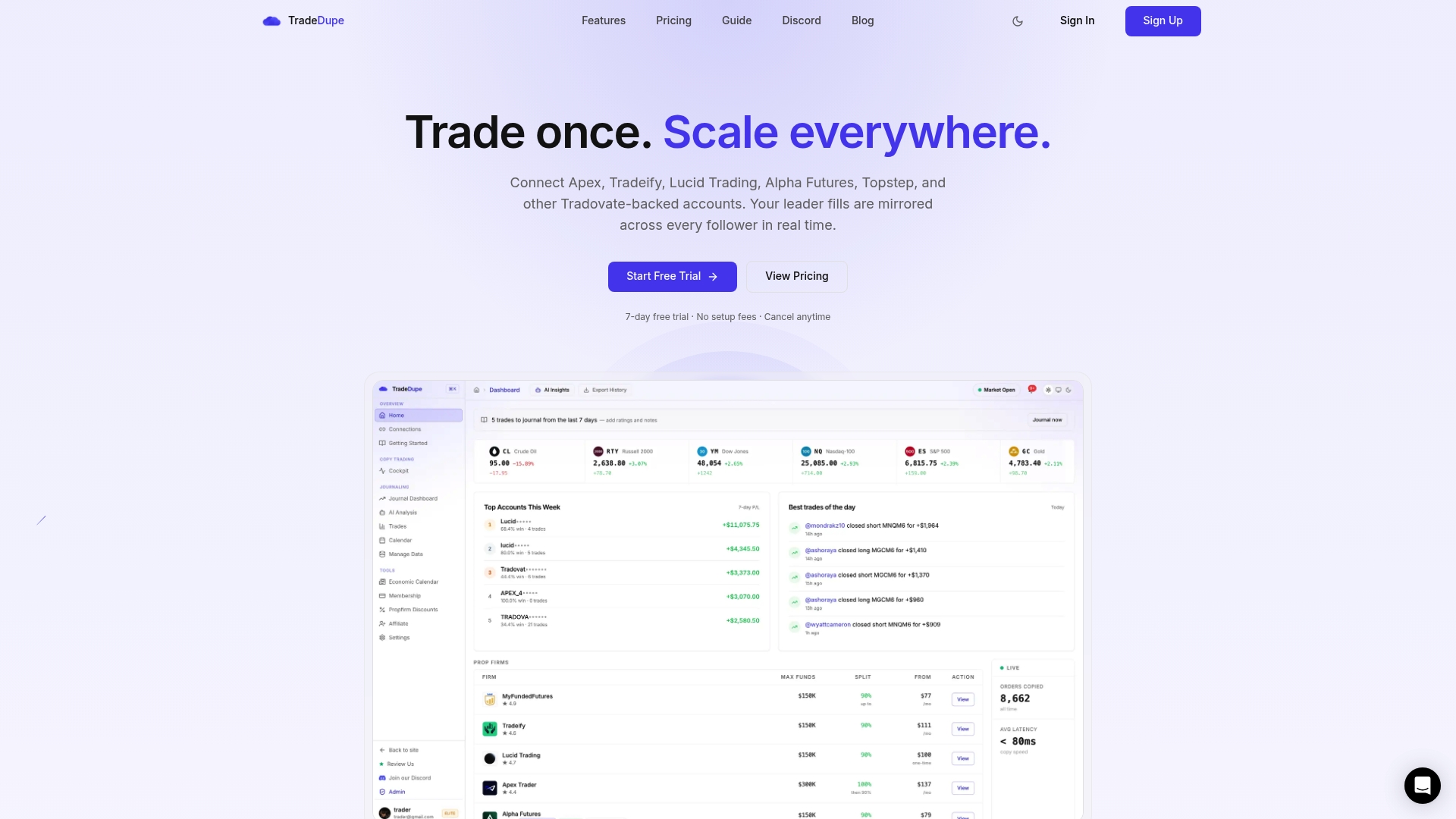
Tradedupe offers a free trial on its futures trade copier that lets you connect a demo leader account, link follower accounts across Apex, Trapeify, Lucid Trading, or Alpha Futures, and run the full analytics dashboard for 7–14 days. Before you reach out, have your Tradovate API credentials and a list of your target follower accounts ready. Enterprise desks can request SLA negotiation and dedicated onboarding support as part of the trial conversation. Start your trial at Tradedupe and measure median latency against the 50 ms threshold before making a platform decision.
*
Useful sources and integration documentation
- Tradovate Partner API — introduction and capabilities
- Tradovate WebSocket connection overview
- Tradedupe product overview and trial
- Tradedupe futures trade copier for prop firms
- Tradovate trade copier integration notes
- How prop firm rules affect trade copying
- First trading platform checklist for new traders