
Trade Copier Pricing in 2026: What Futures Traders Pay
TradeDupe
12 min read
How trade copier pricing works for futures traders with several prop firm accounts: per-account, tiered and license models, hidden costs, and a worked cost example.
Trade copier pricing comes in three main shapes: a fee per connected account, a flat tier with account limits, and a one-time software license. Which one is cheapest depends on one number, how many accounts you copy to. With two accounts, almost any model works. With ten or twenty prop firm accounts, the pricing model matters more than the headline price.
This guide breaks down each model, the extra costs that never appear on a pricing page, and a worked example for a trader running several Apex, Tradeify, Lucid, MyFundedFutures, Alpha Futures or TakeProfit Trader accounts on Tradovate. We also show where our own plans fit, using the prices published on our site.
TL;DR
- Per-account pricing looks cheap at two accounts and multiplies with every evaluation you add. Count the leader account too, because some tools bill it.
- Flat tiers cap connections and accounts, so the real question is which tier covers your accounts, not which one has the lowest sticker price.
- Hidden costs such as a VPS, a second PC license, or add-on fees can double the real monthly cost of a tool that looks inexpensive.
- Our plans are $30 per month on Standard, $60 on Pro and $120 on Elite, or $20, $45 and $90 per month billed yearly, with a 7-day free trial.
- Always confirm current prices on the provider's page, and confirm with your prop firm that copying is allowed on your account type.
Table of Contents
- The three pricing models you will see
- Costs that never appear on the pricing page
- A worked example: what ten follower accounts really cost
- How to compare tiers on what you actually get
- Where TradeDupe fits
- Our perspective: price the book you will have, not the book you have
- Before you pay for any copier: check the firm's rules
- Common pricing mistakes to avoid
- FAQ
- Sources
The three pricing models you will see
Every trade copier you find for futures fits one of three models. Knowing which one you are looking at makes comparison much faster than reading feature lists.
Per-account subscriptions
You pay a monthly fee for each account the copier connects. The appeal is obvious: a small starting price, and you pay only for what you use. The catch is arithmetic. If a tool charges a fixed amount per account per month, your bill scales linearly with the number of evaluations and funded accounts you hold.
Two details change the math:
- Whether the leader counts. Some tools bill the leader account as well as every follower. One leader plus one follower is then two paid accounts, not one.
- Volume discounts. Some providers lower the per-account rate at higher counts. Others do not, so ten accounts cost exactly ten times one.
Per-account billing also punishes the way prop trading actually works. Evaluations are bought, passed, failed and replaced. You may hold four accounts in one month and fourteen after a promotion sale. A model that charges per account makes every new evaluation more expensive than its fee suggests.
Flat tiers with connection and account limits
The second model sells plans at fixed monthly prices, each with a ceiling on connections, accounts or both. You pay the same whether you use half the allowance or all of it. This suits traders who run a stable number of accounts, and it makes budgeting easy.
The risk is the ceiling. A tier that fits twelve accounts is a poor choice if you plan to scale to thirty. Read how the provider defines the limit: per connection, per leader, or across the whole subscription. Those are very different allowances.
One-time licenses for desktop software
Some copiers run as an add-on inside a desktop trading platform and are sold as a one-time purchase, sometimes with an extra charge for each additional computer. The upfront cost can look appealing against a monthly subscription. But the software depends on your machine staying on, connected and updated, which brings us to the costs that sit outside the price tag.
Costs that never appear on the pricing page
The advertised price is rarely the full cost. When you compare, add these lines to every option.

Hosting. If the copier runs on your computer, it only copies while that computer is online and the platform is open. Traders who cannot leave a PC running all session often rent a VPS, which is a separate monthly bill. A copier that executes on the provider's servers removes that line entirely.
Extra machines. A license priced for one PC can cost more when you add a second one for a laptop or a separate setup.
Add-ons. Some providers sell fixed IP options, priority support or extra modules as separate line items. These are optional, but check whether the feature you need sits behind one.
Billing currency. A price listed in euros or another currency is not a dollar price. Card fees and exchange rates will move the real cost.
Monitoring tools. A copier that does not watch for unexpected activity pushes that job onto you. On multi-account setups that is real time spent, and a missed stray order on a follower account can cost an evaluation.
Trial and cancellation terms. A free trial is worth more when cancellation is easy. Check whether you can cancel in one step before you enter a card, and what happens to your billing date when you do.
A worked example: what ten follower accounts really cost
The numbers below are illustrative. They are not any provider's price list, except where the plan figures are ours. They show how the models diverge as accounts grow.
Assume you hold one leader and ten follower accounts across a few firms, 11 accounts in total.
| Model | Assumed rate | Billable accounts | Monthly cost |
|---|---|---|---|
| Per account, low rate | $2 per account | 11 | $22 |
| Per account, mid rate | $10 per account | 11 | $110 |
| Per account, mid rate, leader free | $10 per account | 10 | $100 |
| TradeDupe Standard, monthly | Flat | up to 20 accounts | $30 |
| TradeDupe Standard, billed yearly | Flat | up to 20 accounts | $20 |
Now double the book to twenty followers. The low per-account rate climbs to $42, and the mid rate to $210. Our Standard plan stays at $30 monthly or $20 billed yearly, because its allowance covers two connections of ten accounts each. Past that, our Pro plan covers four connections of twenty accounts each.
The lesson is not that per-account tools are bad. A trader with exactly two accounts and a very low per-account rate will pay less than any flat plan. The lesson is to find your breakeven. Multiply your realistic account count, at its peak, by the per-account rate, and compare the result with the flat tier that covers it.

How to compare tiers on what you actually get
Price per month is one column. These are the others that decide whether a tool is worth it for a trader with multiple prop accounts.
- Platform support. Confirm the copier works with Tradovate, since that is where Apex, Tradeify, Lucid, MyFundedFutures, Alpha Futures and TakeProfit Trader accounts live. A copier built for a different platform will not help, however cheap.
- How it connects. Official OAuth login means the provider never needs your password. Ask what is stored and where.
- Where it runs. Server-side execution means no PC or VPS to maintain. Local software means you are the infrastructure.
- Speed. Look for the provider's own stated latency and read it carefully. Ours is typically under 100ms, measured from a leader fill to the mirrored follower orders.
- Per-account control. You need to switch a single account off, for example when it is near its drawdown limit, without stopping the rest.
- Safeguards. Look for detection of trades the copier did not place, and for daily loss limits that the broker itself enforces rather than a tool that merely hopes to react in time.
- Limits. Find out exactly how connections and accounts are counted.
- Trial and exit. A free trial with easy cancellation lets you test on real accounts before committing.
Where TradeDupe fits
We built TradeDupe only for Tradovate prop firm traders, and our pricing reflects that focus: flat plans rather than a fee for each account.
| Plan | Connections and accounts | Monthly | Billed yearly |
|---|---|---|---|
| Standard | 2 connections, 10 accounts each | $30 per month | $240 per year ($20 per month) |
| Pro | 4 connections, 20 accounts each | $60 per month | $540 per year ($45 per month) |
| Elite | Unlimited connections | $120 per month | $1,080 per year ($90 per month) |
Every plan starts with a 7-day free trial and can be cancelled in one click. You connect each Tradovate account through Tradovate's official OAuth flow, so we never store your passwords. Copying runs on our servers, so nothing has to stay open on your PC or VPS.
See the current plans and start a trial on our pricing section. If you want the mechanics first, our page on trade copier software for futures walks through the setup.
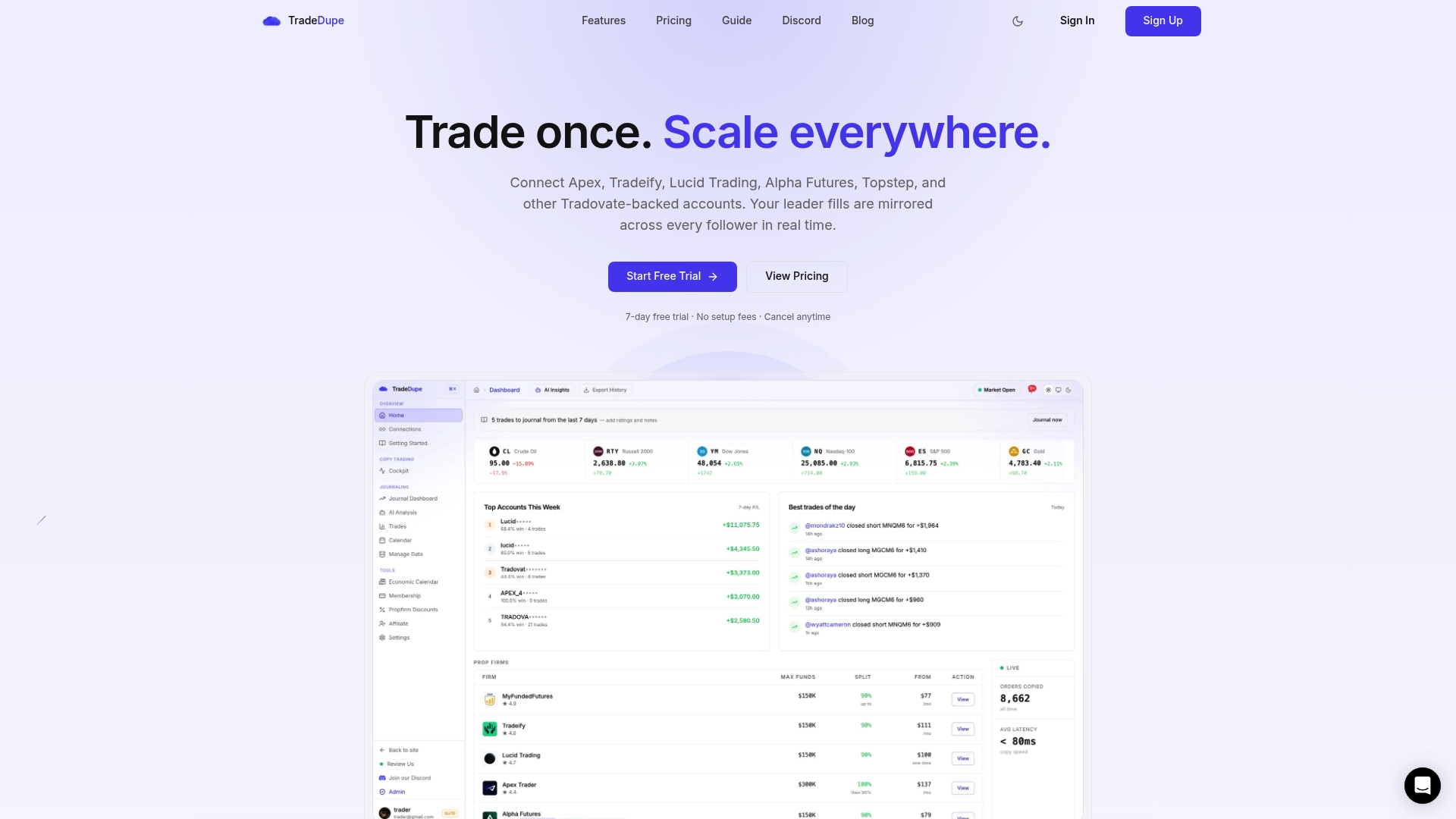
Plans also include a trade journal, analytics, reports and an economic calendar in the web and mobile dashboard. Pro and Elite add AI trade analysis, custom alerts and Discord webhook alerts. Check the full feature list to see what each tier includes.
Our perspective: price the book you will have, not the book you have
We talk to a lot of traders who start with three accounts and end up with fifteen. Prop firm evaluations are cheap relative to the capital they unlock, so the account count grows faster than traders plan for. Then the copier bill grows with it, one more line for every evaluation, and it quietly becomes a tax on scaling.
That is why we chose flat plans. A trader who buys a batch of evaluations should not also have to ask whether each one adds to the software bill. Your decision should rest on rules, drawdown and sizing, not on a fee schedule.
The second thing we would tell any trader is to weigh protection above price. A copier that mirrors every fill in real time, typically under 100ms, is also a copier that can mirror a mistake across every account at once. That is why we built rogue-trade detection, per-account toggles and execution mode controls, and why daily loss limits and profit targets are set directly on Tradovate so the broker enforces them. Saving $10 a month is meaningless if one stray order breaks the drawdown on several evaluations.
Finally, trial the tool the way you will use it. Connect real accounts, copy a few small trades in a session, and check that follower fills match the leader. Then decide.
> — Andres
Before you pay for any copier: check the firm's rules
Copier pricing is only half the budget question. The other half is whether your prop firm allows the way you plan to use it. Firms differ on whether copying across your own accounts is allowed, how many accounts you may hold, and how consistency rules treat identical trades across accounts. We do not list specific firm limits here because they change, and we will not guess at them.
Before you scale, do these three things:
- Read the current rules page of each firm you trade, and confirm with the firm's support if the wording on copying is unclear.
- Review how consistency and profit-split rules apply to you. Our comparison of prop firm consistency rules is a starting point.
- Run your payout math. The prop firm profit calculator helps you see what a larger account book is worth after software costs.
If you trade a specific firm, our guides cover Apex Trader Funding copy trading and TakeProfit Trader copy trading in detail. For background terms, see our explainer on what a trade copier is.
Common pricing mistakes to avoid
- Pricing only today's accounts. Estimate your peak account count over the next six months, then compare.
- Forgetting the leader. If the leader is billed, add one to every per-account calculation.
- Ignoring the VPS. If a copier needs a machine online, add that monthly cost to its price.
- Comparing monthly to yearly. A $20 per month yearly price is a $240 annual commitment. Compare like with like, and check whether you can leave early.
- Skipping the trial. Test on your real firm accounts, not just a demo, since firm-specific connections are where problems show.
- Paying for platforms you do not use. A multi-broker bridge may charge for flexibility you will never need if all your accounts are on Tradovate.
FAQ
How much does a trade copier cost per month?
It depends on the model. Per-account tools charge a fee for each connected account, so the bill rises with every evaluation. Flat plans, like ours at $30, $60 and $120 per month, or $20, $45 and $90 per month billed yearly, charge the same regardless of how much of the allowance you use. Always check the provider's own page for the current price.
Is a per-account trade copier cheaper than a flat plan?
Only at small account counts. With two or three accounts, a low per-account rate can undercut a flat plan. Once you hold ten or more accounts, flat tiers usually win, so multiply your peak account count by the per-account rate and compare.
Do I need a VPS to run a trade copier?
Only if the copier runs on your own computer. Local software needs a machine that stays online, and a VPS is an extra monthly cost. A server-side copier like ours runs on our infrastructure, so nothing needs to stay open on your PC.
Is there a free trial for TradeDupe?
Yes. Every plan includes a 7-day free trial, and you can cancel in one click. Connect your Tradovate accounts, test copying, and decide before the trial ends.
Does my prop firm allow copy trading?
Rules vary by firm and by account type, and they change over time. Check the firm's current rules page and ask its support team to confirm in writing if the wording is unclear. We do not guess at firm rules.
Sources
This guide draws on the pricing and feature information published on our own site:
- TradeDupe plans and pricing
- TradeDupe features
- Trade copier software for futures trading
- Prop firm consistency rules compared
- Prop firm profit calculator
- Trade copier glossary entry
Recommended
- Trade Copier: What It Means for Futures Trading
- TradeCopia Pricing \(2026\): Plans Compared + Cheaper Alternatives
- Best Trade Copier for Prop Firms in 2026
- TradeCopia Review \(2026\): Is It Worth It? Pricing, Pros, Cons
For educational purposes only. Not financial advice. Futures trading involves substantial risk of loss and is not suitable for every investor.