Tradeify Rules 2026: Drawdown, Consistency, Payouts, Copying
TradeDupe
12 min read
Tradeify's rules for Growth, Select and Lightning accounts: EOD drawdown, daily loss limits, consistency math, hedging, payouts and copying your own accounts.
Tradeify's rules depend on which account you hold. Growth, Select and Lightning share the same end-of-day trailing drawdown, the same 4:45 PM ET flat deadline and the same contract caps. They differ on daily loss limits, consistency percentages and payout timing. If you run several accounts, the practical risk is not the headline numbers. It is the small rules that trigger when you repeat one trade across accounts: hedging across accounts, inactivity and payout eligibility.
Everything below comes from the Tradeify Help Center pages as published in October 2026. Tradeify changes its rules often, so confirm any figure that affects a purchase or payout request with Tradeify's help center or support before you act.
TL;DR
- All Tradeify accounts use an end-of-day (EOD) trailing drawdown that is still enforced in real time against net liquidation value. Touching it at any moment fails the account.
- Positions must be flat by 4:45 PM ET (12:59 PM ET on early-close days). Maximum size is 1/4/8/12 minis for 25K/50K/100K/150K accounts.
- Consistency depends on the account: Growth has none in evaluation (35% when funded), Select has 40% in evaluation only, and Lightning uses a progressive 20/25/30%.
- Same-direction trades across accounts you own are allowed. Opposing positions on the same or a correlated product are hedging and can get accounts banned.
- Every account needs at least one trade per week, Monday to Friday, to avoid inactivity closure.
Table of Contents
- The three account types at a glance
- Drawdown: how the EOD trailing rule really works
- Daily loss limits and contract caps
- The consistency rule, with the math
- Restricted practices: hedging, microscalping, bots
- Copying one account to several of your own
- Payout rules in brief
- Our perspective
- Mirroring your Tradeify accounts with TradeDupe
- FAQ
- Sources
The three account types at a glance
Per the Essential Trading Rules Overview, all three account types come in 25K, 50K, 100K and 150K sizes. The rules that change from one to the next are these:
| Growth | Select | Lightning | |
|---|---|---|---|
| Evaluation | Yes | Yes | No, funded from the start |
| Daily loss limit (DLL) | Yes, in evaluation and funded | None in evaluation; Daily path has one, Flex path does not | Soft-breach DLL on 50K and larger |
| Consistency | None in evaluation, 35% when funded | 40% in evaluation only (50% add-on available) | Progressive 20% / 25% / 30% |
| Payout rhythm | 5 profitable trading days | Flex: 5 winning days; Daily: daily eligibility | No minimum days, but profit goal and consistency must be met |
The Tradeify Help Center also notes that Growth and Select evaluations have no time limit. The one-trade-per-week rule still applies while you take your time.
Select asks you to make a permanent choice after you pass. According to the Select Evaluation page, you pick either Select Flex (payouts on a 5-day cycle, up to 50% of profits) or Select Daily (daily eligibility, with a DLL and a buffer). You cannot switch later, so decide before you pass, not after.
Drawdown: how the EOD trailing rule really works
Tradeify's drawdown is easy to misread. The Essential Trading Rules Overview describes it this way:
- The drawdown level recalculates only at market close.
- It moves up only when the day ends profitable.
- It is enforced in real time against your net liquidation value, which is your balance plus open profit or loss.
- Touching the level at any moment fails the account immediately, even if you would have recovered before the close.
- On evaluation accounts the drawdown never locks.
The last point is where multi-account traders get caught. A "trailing end of day" label suggests you only need to worry at 5:00 PM. In fact, an intraday swing against an open position can breach the level while the number on your screen still looks like the day is not over.
Select evaluation drawdowns, per the Select page, are $1,000 / $2,000 / $3,000 / $4,500 for 25K / 50K / 100K / 150K, against profit targets of $1,500 / $3,000 / $6,000 / $9,000. Lightning funded drawdowns are $1,000 / $2,000 / $4,000 / $5,250 per the Lightning Funded Accounts page. That page also states that 100K Lightning accounts purchased on or after November 23, 2026 use a $3,500 drawdown and a $2,250 DLL.
Daily loss limits and contract caps
The daily loss limit is a second ceiling on top of the drawdown. According to the Essential Trading Rules Overview:
- Growth Evaluation: $600 / $1,250 / $2,500 / $3,750 (25K to 150K).
- Growth funded: $1,250 / $2,500 / $3,750 (the three larger sizes).
- Select Daily funded: $1,000 / $1,250 / $1,750.
- Lightning funded: none on 25K, then $1,250 / $2,500 / $3,000.
- Select Evaluation and Select Flex: no DLL.
The Lightning page describes its DLL as a soft breach, so check there how a hit is treated before you size a trade.
Contract caps are the same everywhere: 1 / 4 / 8 / 12 minis for 25K / 50K / 100K / 150K, with a 10:1 micro ratio. That means ten micros count as one mini.
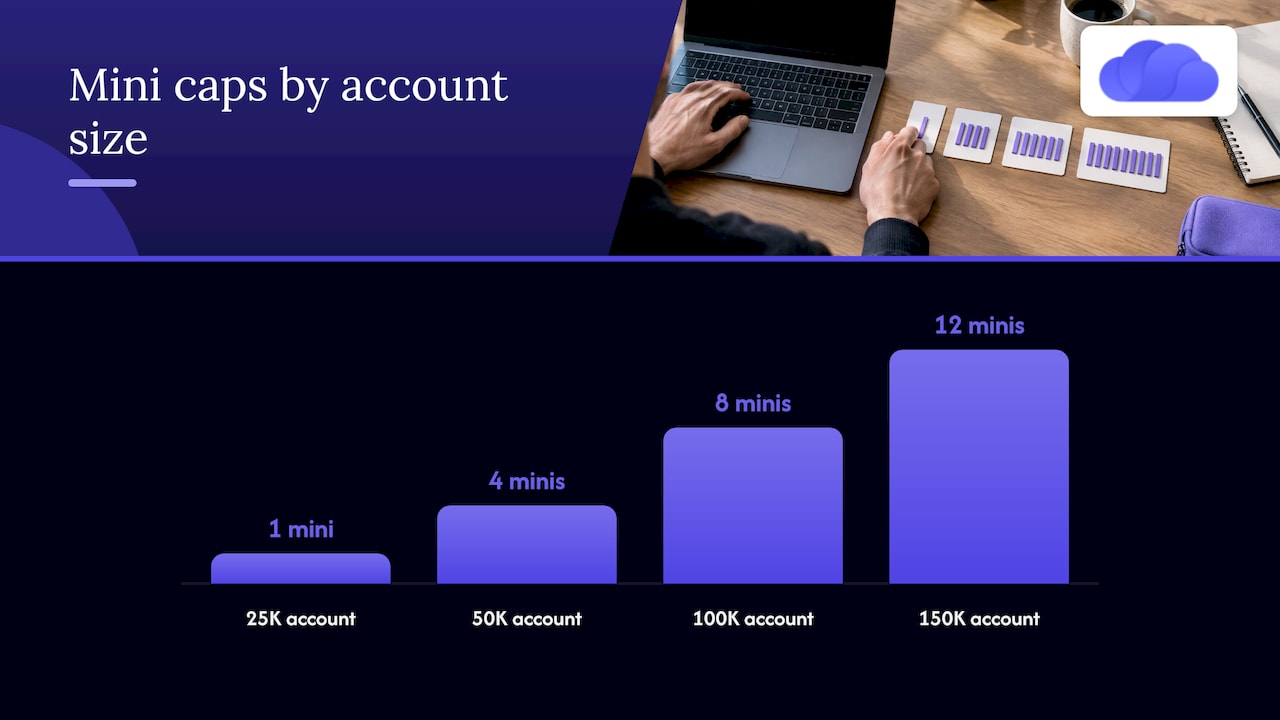
Here is why this matters when you hold several accounts. A limit that fits a 150K account is far too large for a 25K one. If you repeat one order across accounts of different sizes, scale quantity per account. Sending 4 minis to a 25K account breaks the cap even though it is perfectly legal on the 50K.
The 4:45 PM ET deadline
All positions must be closed by 4:45 PM ET on regular days and 12:59 PM ET on holiday early-close days. The trading day runs from 6:00 PM ET to 5:00 PM ET the next calendar day. According to Tradeify, positions left open at close are auto-closed without failing the account. That is forgiving, but the auto-close happens at whatever price the market gives, which can hurt a trade you meant to hold.
The consistency rule, with the math
Consistency limits how much of your total profit one day can represent. The Consistency Rule page gives the formula:
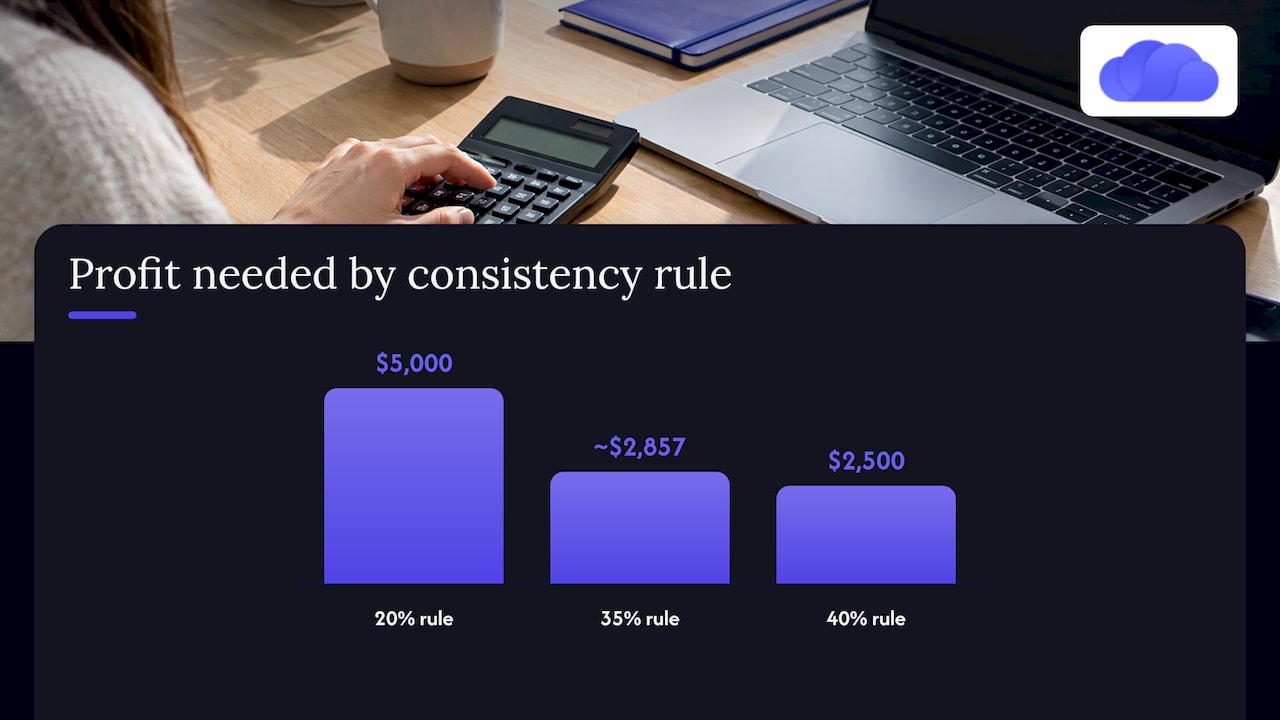
Biggest end-of-day profit ÷ consistency percentage = total profit you need
A worked example: your best day is $1,000.
- Under a 20% rule you need $1,000 ÷ 0.20 = $5,000 in total profit.
- Under a 35% rule (Growth funded) you need about $2,857.
- Under a 40% rule (Select evaluation) you need $2,500.
Two details matter. Exactly at the limit passes, and only a figure strictly above it fails. And missing the rule does not fail the account: you are simply not eligible to request a payout yet, and trading continues normally. The percentage resets after each approved payout.
Here is how it varies by type:
- Growth: no consistency rule in evaluation, 35% on funded accounts.
- Select: 40% (or 30%) during evaluation only. Per the Select page it is removed entirely on funded accounts, whether you choose Flex or Daily. It needs at least 3 trading days at 40% (4 at 30%), and a 50% add-on can shorten the evaluation to as few as 2 trading days.
- Lightning: a progressive 20% → 25% → 30% that Tradeify says is meant to identify traders focused on sustained performance.
For a deeper walkthrough, see our guide to the Tradeify consistency rule, or compare it with other firms in the consistency rule by prop firm breakdown.
Restricted practices: hedging, microscalping, bots
The Guidelines for Traders page sets out what can cost you an account.
Hedging
Hedging means holding opposing positions on the same instrument or in the same product group, in one account or across accounts. It is prohibited and can lead to a ban on every account involved. The Hedging & Correlated Products page (August 2026) says automated detection flags a breach only when three things are true at once:
- Opposing positions exist.
- The hedge lasts longer than 10 seconds.
- The hedge generates more than $150 in profit.
Cross-account and correlated-product hedging are monitored separately and reviewed by the risk team. Product groups include equity index (ES, MES, NQ, MNQ, YM), energy, metals, currencies, interest rates, grains, livestock and volatility. Minis and micros count as the same product, and a long equity index position alongside a long volatility position is treated as offsetting.
The lesson for multi-account traders: never run one account long ES while another is short ES or MES, even "just to test" a setup.
Microscalping
For funded accounts, payout requests require that more than 50% of your trades and more than 50% of your profit come from trades held longer than 10 seconds. Evaluation accounts are not subject to this. A scalping style that works in evaluation can therefore block a payout once you are funded.
Bots and automation
High-frequency bots and exploiting platform errors are forbidden. Tradeify allows a trading bot only if you prove sole ownership, the strategy is not shared with other traders or firms, and you enable the code on live video. Using a bot across firms is against policy. If your setup involves any automation beyond mirroring your own manual trades, confirm it with Tradeify before you rely on it.
Copying one account to several of your own
Copying between accounts you own and manage is allowed. The hedging page says outright that same-direction positions across accounts are fine, using the example of long ES on Account A and long ES on Account B, and describes this as how copy trading works. The opposing-position rule above is the boundary.
The Common FAQs add the structural limits:
- Up to 5 funded accounts per household.
- Only one Tradeify account per user. Personal and business accounts cannot be held in parallel.
- Copying other traders' strategies, or copying with others, is not what the rule permits. Mirror your own accounts, not signals.
A practical checklist before you mirror trades:
- Scale by account size. Respect 1/4/8/12 mini caps on each account.
- Check each account's DLL. A Growth 25K at $600 and a Select Flex with no DLL need different sizing.
- Keep every account alive. One trade per week per account, or the account can be closed for inactivity.
- Watch for stray orders. A follower fill you did not intend can create an opposing position on a correlated product.
- Mind the other firms. Rules at Apex, Lucid, MyFundedFutures and TakeProfit Trader differ, so check each firm's help center individually.
Our Tradeify copy trading guide covers this in more detail, and the list of futures prop firms that allow copy trading shows how the other firms compare.
Payout rules in brief
The Common FAQs and the Essential Trading Rules Overview set the cadence:
- Select Daily: daily payout eligibility, no minimum trading days, once the balance clears its buffer ($1,100 / $2,100 / $2,600 / $3,600 by size).
- Select Flex: payouts every 5 winning trading days, up to 50% of profits, with caps of $1,250 / $2,500 / $3,500 / $4,500 for accounts bought on or after September 1, 2026.
- Growth: 5 profitable trading days.
- Lightning: no minimum days, but you must meet the profit goal and consistency rule.
Sim funded accounts pay out on a 90/10 split. Payouts run through Rise or Plane, to a bank or crypto but not PayPal, usually within 24 hours and up to 72 over weekends. Only one payout request can be open per account at a time, and you must complete KYC (identity verification) before the first one. Tradeify says Elite Live selection, with real capital and an 80/20 split, can occur after 3 payouts on a single account or 10 total payouts since the last live transition.
For caps and timing in more depth, see our Tradeify payout rules guide, and our overview of Tradeify's rules, costs and payouts.
Our perspective
> Most blown accounts in a multi-account setup do not come from a bad read of the market. They come from the gap between what you meant to do and what each account actually did. A rule like EOD trailing drawdown, enforced live, punishes a single stray fill on a single account. > > That is why we built TradeDupe only for Tradovate prop firm traders. You connect through Tradovate's official OAuth flow, so your password is never stored. Rogue-trade detection is designed to catch follower trades the copier did not place. Daily loss limits and profit targets are set directly on Tradovate, so the broker enforces them. > > Rules differ by firm and by account, so we think the right habit is simple: read the firm's help center, size per account, and keep the copy toggle on each account under your control. > > Andres
Mirroring your Tradeify accounts with TradeDupe
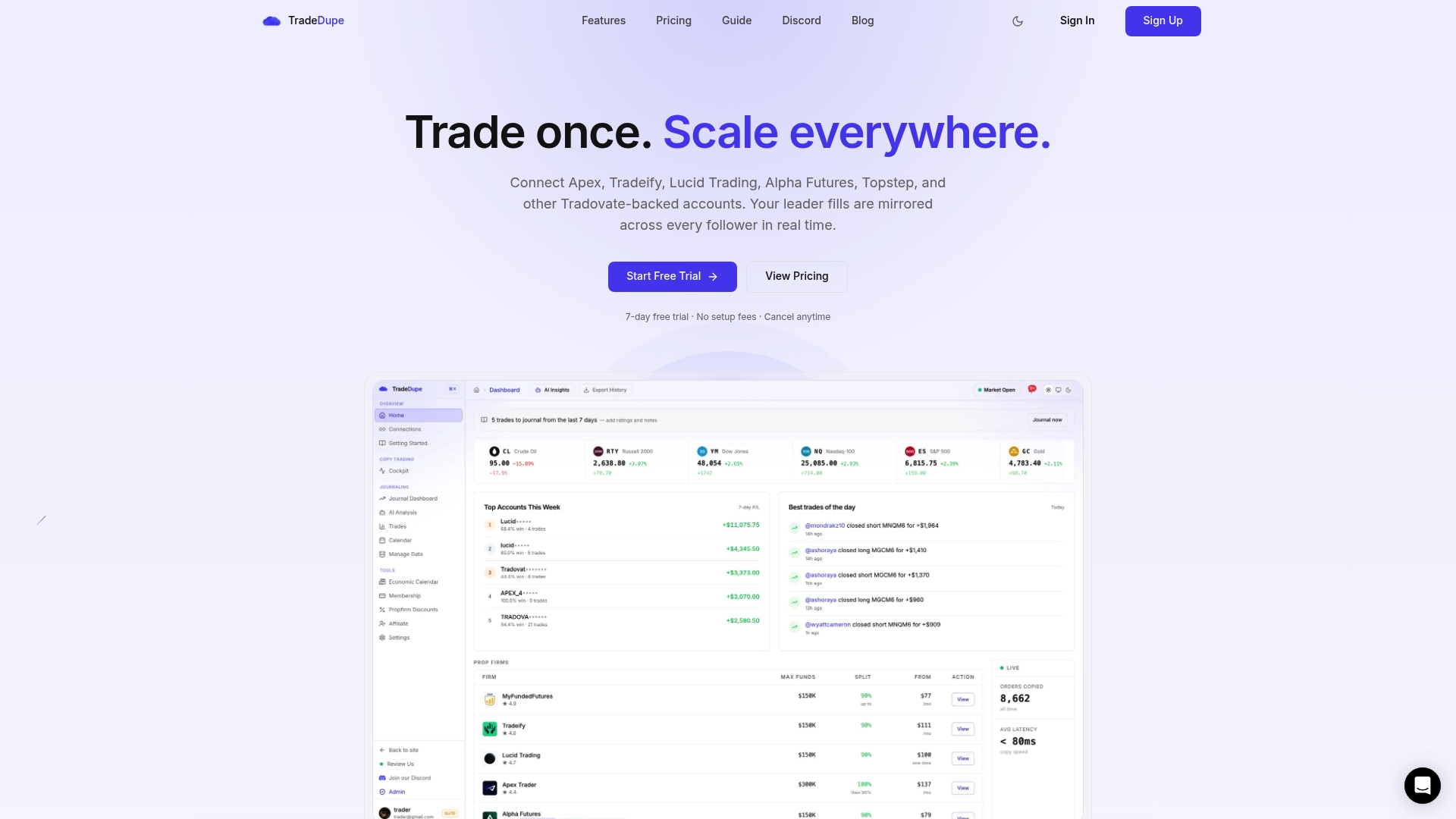
If you hold several Tradeify accounts on Tradovate and want them to follow one leader account, TradeDupe mirrors every fill on the leader to the follower accounts you enable, with per-account copy toggles and rogue-trade detection. Plans start at $20/month billed yearly, and every plan includes a 7-day free trial with one-click cancellation. Details are on the pricing and platform page, and our copy trading primer explains the concept for futures.
FAQ
Does Tradeify allow copy trading?
Yes, between accounts you own and manage. Same-direction positions across your accounts are allowed, while opposing positions on the same or a correlated product count as hedging. Copying other people's strategies is not permitted.
Is Tradeify's drawdown trailing or static?
It is an end-of-day trailing drawdown on all account types. The level recalculates at market close and moves up only after a profitable day, but a breach is checked in real time against net liquidation value. On evaluation accounts it never locks.
Does Tradeify have a consistency rule?
It depends on the account. Growth has none in evaluation and 35% when funded. Select has 40% in evaluation only, and Lightning uses a progressive 20/25/30%. Missing it only delays payout eligibility and does not fail the account.
What happens if I do not trade for a week?
Every evaluation and funded account needs at least one trade per week, Monday to Friday. Without it, the account can be closed for inactivity, even though Growth and Select evaluations have no time limit.
Sources
- Essential Trading Rules Overview, Tradeify Help Center
- Common FAQs, Tradeify Help Center
- Select Evaluation Accounts, Tradeify Help Center
- Lightning Funded Accounts, Tradeify Help Center
- Rules: Consistency Rule, Tradeify Help Center
- Guidelines for Traders, Tradeify Help Center
- Rules: Hedging & Correlated Products, Tradeify Help Center
Recommended
- Tradeify Payout Rules: Eligibility, Caps and Timing \(2026\)
- Tradeify Consistency Rule \(2026\): Growth 35%, Select None
- Tradeify Copy Trading: Mirror Your Own Accounts, Not Signals
- Tradeify vs Lucid Trading: Prop Firm Comparison \(2026\)
For educational purposes only. Not financial advice. Futures trading involves substantial risk of loss and is not suitable for every investor.