

Tradeify Copy Trading: Mirror Your Own Accounts, Not Signals
TradeDupe
10 min read
Tradeify permits copying across your own accounts, but bans outside signals and opposing positions. Confirm bot ownership and set safeguards first.
Tradeify allows copying and mirroring trades only across your own trader-controlled accounts, and only where its rules explicitly permit it. Copying trades from another individual or an external signal service is prohibited and can lead to account termination. You also cannot hold opposing positions across accounts, and any automated strategy must be one you own outright and prove ownership of if asked. Before enabling any copier, confirm the written policy with Tradeify and set per-account safeguards first.
*
> TL;DR: > > - At least 50% of account profits must come from trades held longer than 10 seconds, while shorter trades should remain a minority of activity. > - Tradeify evaluates patterns, not isolated matching trades, and may scrutinize synchronized fills, apparent risk limit avoidance, or opposing positions on correlated products. > - Tradeify may request records proving you exclusively own any automated strategy, which cannot qualify as high frequency trading under its rules. > - Set daily loss limits independently before copying, test the setup on an evaluation account, and retain timestamped logs with account identifiers. > - Tradovate’s native tools suit two or three accounts with manual oversight, while server side copiers suit traders managing four or more accounts.
*
Table of Contents
- 1. Tradeify's official rules on copying, hedging, and bots
- 2. How Tradeify enforces rules: the "totality of circumstances" standard
- 3. Ways to mirror trades across your own Tradovate accounts
- 4. Setup and compliance checklist before you mirror trades
- 5. Lessons from traders on what actually causes problems
- 6. Why compliance, not automation, is the real skill here
- 7. TradeDupe: mirroring Tradovate accounts without the guesswork
- FAQ
- Sources
1. Tradeify's official rules on copying, hedging, and bots
Tradeify's help center is direct about what crosses the line. Team trading, collaborative trading, and copying or mirroring trades from other individuals or external signal services are all grounds for termination. That rule exists to preserve the independent-trading requirement that funded accounts are built on: your results have to reflect your own decisions.
The funded trader agreement narrows the exception that matters most to you. It confirms that mirroring trades across your own trader-controlled accounts is allowed, provided the copying does not create opposing positions between those accounts. In other words, the rule targets external coordination, not a trader running several of their own evaluations in parallel.
A handful of behaviors are explicitly off-limits:
- Team trading or collaborative trading with another person
- Copying or mirroring trades from someone else's account
- Subscribing to and copying an external signal service
- Letting a third party manage or control your account's trading decisions
Algorithmic trading is permitted, but only under specific conditions. You must own the strategy exclusively, it cannot qualify as high-frequency trading, and you need to be able to prove ownership if Tradeify requests it. Hedging gets the same hard line: opposing positions on correlated products, or positions held across multiple accounts that offset each other, are not allowed under any circumstance.
One figure worth building your setup around: at least 50% of your account profits need to come from trades held longer than 10 seconds, since trades under that threshold are considered microscales that are difficult to verify and copy reliably.
2. How Tradeify enforces rules: the "totality of circumstances" standard
Tradeify doesn't flag an account because two trades happen to look similar. Its compliance team evaluates the totality of circumstances, meaning trade similarity alone doesn't prove a violation. What draws scrutiny is a pattern: fills that land within seconds of each other across linked accounts, position sizes or entries distributed in a way that looks designed to dodge daily loss limits, or opposing trades on correlated instruments that only make sense as a hedge.
A few patterns specifically invite review:
- Synchronized entries and exits across multiple accounts you control
- Activity spread across accounts in a way that appears to bypass risk limits
- Opposing positions on correlated products, such as one account long ES while another is short NQ
When something does trigger a look, Tradeify may ask for evidence: proof that you own your strategy or code, execution logs, and timestamps that show independent decision-making rather than a copied signal. Keeping clean documentation from day one saves you from scrambling if that request ever lands.
Pro Tip: Set your daily loss limit and position sizing independently on every account before you enable any copier, so a single bad signal can't cascade into a totality-of-circumstances problem across all of them.
3. Ways to mirror trades across your own Tradovate accounts
If your accounts are on Tradovate, you have three realistic paths to copy trades between them, each with a different tradeoff between simplicity and control.
- Tradovate's native group trading or SuperDOM tools, which let you place one order and route it to multiple linked accounts manually; this works for traders who want full manual control and don't mind clicking through each account.
- Third-party desktop copiers, which read your trades from one account and replicate them to others; you're responsible for keeping them updated, monitoring for missed fills, and watching for the extra risk that comes from running software locally.
- Server-side SaaS platforms, which connect to Tradovate through its official OAuth flow so your password is never stored, then mirror every fill from a leader account to your enabled follower accounts over a live connection.
Server-side platforms built specifically for Tradovate, such as TradeDupe, add safeguards that matter for staying inside Tradeify's rules: per-account copy toggles so you can pause one account without touching the others, rogue-trade detection that flags a follower trade the copier didn't place, and daily loss limits enforced directly by Tradovate rather than by the copier software itself.
A few practical notes before you scale across accounts:
- Server-side execution typically runs under 100ms, but test on an evaluation account first to confirm reliability on your specific setup.
- Native Tradovate tools suit traders who manage two or three accounts and prefer manual oversight.
- A SaaS copier earns its keep once you're juggling four or more accounts and manual clicking becomes the bottleneck.
4. Setup and compliance checklist before you mirror trades
Before you flip any copier on, work through this list in order.
- Get the policy in writing. Review the funded-trader agreement sections on independent trading and hedging, and if anything is ambiguous for your account type, ask Tradeify directly rather than guessing.
- Set per-account limits first. Configure daily loss limits and execution mode controls on each account individually, before copying is active, so the broker enforces your risk floor regardless of what the copier does.
- Test on an evaluation account. Run the copier on a low-stakes account first and keep a timestamped trade log that shows entries, exits, and account IDs.
- Check for opposing positions. Make sure no two accounts end up long and short on correlated products, and keep any trade held under 10 seconds to a minority of your activity.
- Document strategy ownership. Save source files, version history, and purchase receipts for any automated strategy so you can prove exclusive ownership if it's ever requested.
Pro Tip: Keep a simple folder with your trade logs, strategy files, and account screenshots dated by week. It takes ten minutes and it's the difference between a quick resolution and a frozen account.
5. Lessons from traders on what actually causes problems

Most compliance issues we see traced back to copying don't come from the copying itself. They come from skipping the boring setup work: leaving every account on the same default risk settings, ignoring the possibility that two linked accounts might end up on opposite sides of a correlated trade, or grabbing a signal from a group chat and calling it independent analysis.
The traders who stay out of trouble treat each funded account as its own risk unit, even when the trades originate from one decision. That means per-account toggles, independent loss limits, and a connection method that doesn't require storing a password on a personal machine. Server-side OAuth integrations reduce that operational exposure because the broker, not a local script, is the one enforcing the limits.
> Copying your own accounts isn't the risky part. Treating them as one account when the rules treat them as several is where traders get caught.
Platforms exist that handle the mirroring mechanics for Tradovate-based accounts, but the rule discipline still has to come from you.
> — Andres
6. Why compliance, not automation, is the real skill here
The conventional advice in prop trading forums treats copy trading as a technical problem: find the right tool, get the latency low, and you're set. That framing misses what actually gets accounts pulled. Tradeify's own enforcement standard, the totality of circumstances, is a judgment call built on patterns, not a line of code you can route around.
The traders who run multiple funded accounts successfully aren't the ones with the fastest copier. They're the ones who treat each account's risk settings as non-negotiable and document their process before anyone asks for it. If you take one thing from this: set your per-account limits and ownership records before you ever flip a copier on, not after you've already had a few accounts linked for weeks. The tooling matters less than the habit of keeping every account independently defensible.
7. TradeDupe: mirroring Tradovate accounts without the guesswork
If you're running several Tradovate-based evaluations, from Apex, Tradeify, Lucid, MyFundedFutures, Alpha Futures, or TakeProfit Trader, and you want one leader account to drive the rest without re-entering every trade by hand, that's exactly what we built TradeDupe for.
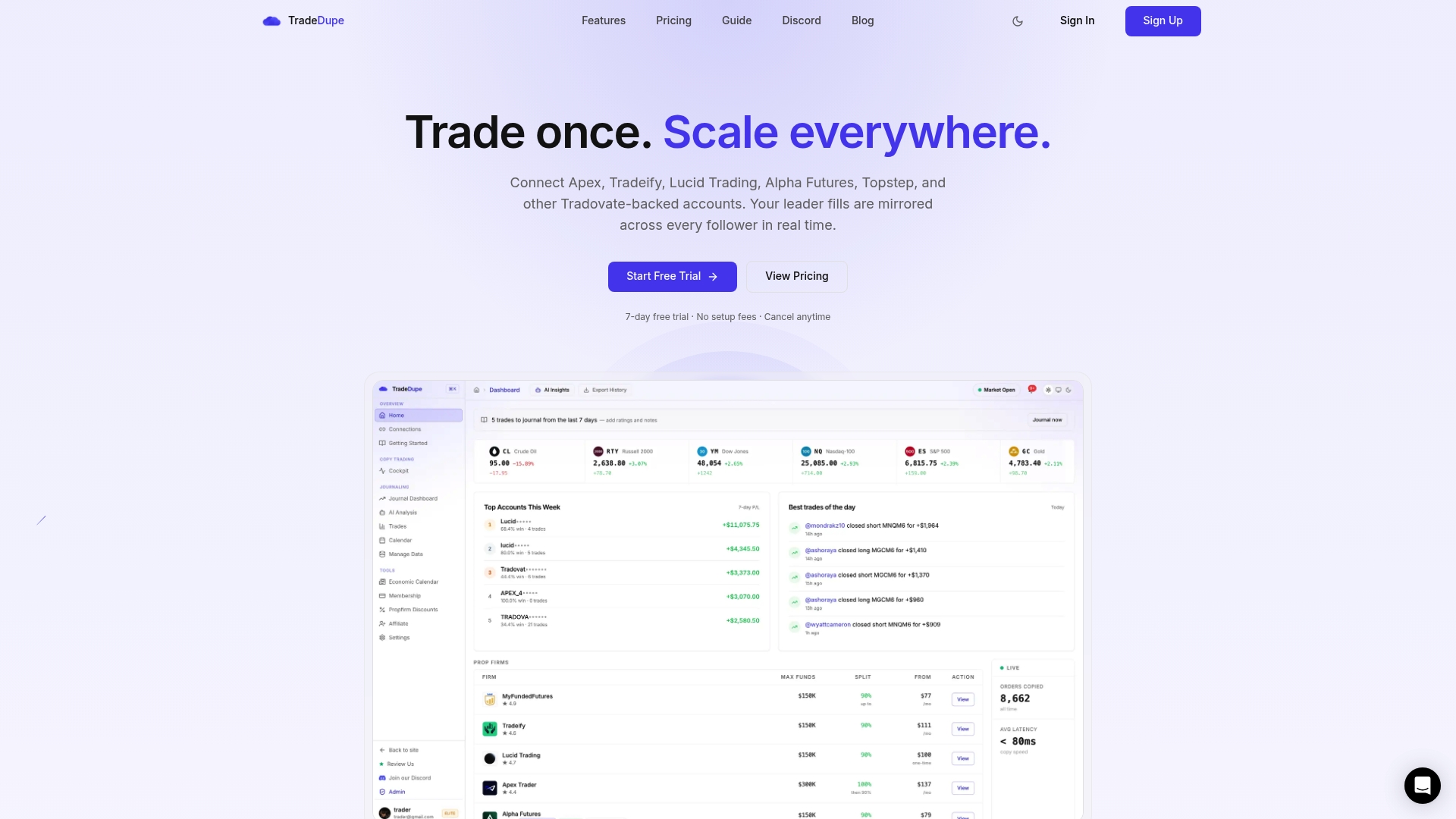
These platforms connect through Tradovate's official OAuth flow, so they never store your password, and every fill on your leader account mirrors to your enabled follower accounts over a live connection, typically in under 100ms. They include safeguards around the typical risk points such as per-account copy toggles so you can pause one account without affecting the others, rogue-trade detection for trades the copier didn't place, and daily loss limits enforced directly by Tradovate rather than by software.
- Real-time mirroring across all your Tradovate-connected prop accounts
- Per-account toggles and execution mode controls for independent risk management
- A 7-day free trial with one-click cancellation on every plan
Our plans start at $20 per month billed yearly for two broker connections, with Pro and Elite tiers for traders running more accounts. Try the Tradovate trade copier free for seven days and see how it fits your setup before committing to anything.
FAQ
Does Tradeify allow bot trading?
Yes, but only if you own the strategy exclusively, it doesn't qualify as high-frequency trading, and you can prove ownership if Tradeify asks. Running a bot you don't own or can't document is treated the same as external copying.
Which prop firms allow copy trading between your own accounts?
Several Tradovate-based firms, including Tradeify, permit copying across accounts you control yourself, though the specifics vary by firm. Always confirm the current policy directly with the firm before setting up a copier, since rules change and firms enforce them differently.
What platforms let you copy trade across your own accounts?
Options range from Tradovate's native group trading tools to third-party desktop copiers and server-side SaaS platforms. Server-side tools that connect through Tradovate's official OAuth, like TradeDupe, tend to offer more built-in safeguards such as per-account toggles and rogue-trade detection.
Which trader is best suited for copy trading across accounts?
Traders managing multiple funded or evaluation accounts on the same broker, rather than a single account, get the most practical benefit, since manual order entry across several accounts becomes the bottleneck. It's less about skill level and more about how many accounts you're trying to run in parallel.
How do I avoid getting flagged for copying trades on Tradeify?
Keep each account's risk settings independent, avoid opposing positions on correlated products, and document your strategy ownership with source files or receipts. Tradeify reviews the totality of circumstances rather than single similarities, so clean records matter more than any one trade.
Sources
- Trading rules overview | Tradeify Help Center
- Funded trader agreement | Tradeify
- Essential trading rules overview | Tradeify Help Center
Recommended
- Tradeify Futures Copy Trading (2026): Mirror Every Account
- How to Mirror Trades Across Prop Accounts: 2026 Playbook
- 100ms Trade Mirroring for Tradovate Prop Traders: Tests & Oversight
- Alpha Futures Copy Trading: 5 Accounts, Plan Caps, Setup Rules
For educational purposes only. Not financial advice. Futures trading involves substantial risk of loss and is not suitable for every investor.