

100ms Trade Mirroring for Tradovate Prop Traders: Tests & Oversight
TradeDupe
14 min read
Practical primer for Tradovate prop traders on real-time mirroring. Covers OAuth/WebSocket mechanics, typical 100ms sync, testing protocols, and required...
Real-time trade mirroring copies every executed order from a leader account into one or more follower accounts as it happens, typically within milliseconds. It suits intermediate and prop traders who run multiple funded accounts and need identical, low-latency execution across all of them. Automation removes manual delay, but it does not remove market risk or the need for active oversight.
*
> TL;DR: > > - Trade mirroring delivers trades from a leader account to followers within milliseconds, mainly benefiting intermediate and prop traders managing multiple funded accounts. > - Proper authentication relies on OAuth, and server-side systems improve reliability during network interruptions, reducing risks associated with outages. > - Risks include payload errors, connectivity drops, rogue trades, and market volatility, which require controls like detection and broker-enforced risk limits to mitigate. > - Validation through testing in low-volatility environments and continuous oversight are essential before deploying live size across accounts. > - Supported platforms like TradeDupe connect directly to Tradovate via OAuth, with clear safeguards such as rogue trade detection, account toggles, and built-in analytics, ensuring regulatory compliance and risk control.
*
Table of Contents
- How real-time trade mirroring works: leader accounts, authentication, and execution flow
- Mirror trading vs copy trading vs strategy replication
- Concrete benefits: speed, scale, and fewer manual mistakes
- Risks, failure modes, and the controls regulators expect
- A practitioner checklist for evaluating a mirroring platform
- How TradeDupe applies these controls in practice
- Integration challenges with different brokerage APIs
- How latency and network conditions affect mirroring accuracy
- Legal and compliance considerations outside the United States
- What successful mirroring setups look like in practice
- Why oversight and testing remain non-negotiable
- Getting started with TradeDupe
- Sources
- FAQ
How real-time trade mirroring works: leader accounts, authentication, and execution flow
A mirroring system connects two roles: a leader account that generates trades and one or more follower accounts that replicate them. The mechanics differ sharply depending on where the copying logic runs.
Client-side tools sit on a trader's own computer or a rented virtual machine, watching for order events and re-sending them to each follower. Server-side systems run the copy logic in the cloud, listening to a live event stream from the broker and pushing orders to followers without depending on any single machine staying online. Server-side mirroring generally holds up better under network interruptions, since the trader's own internet connection is not part of the execution path.
Authentication matters more than most traders realize. Platforms built on Tradovate's API use OAuth to connect accounts, which means a trader's password is never stored by the mirroring service, only a token the trader can revoke. Once connected, the system listens over a WebSocket stream for order and fill events, then calls endpoints like orderStrategy or startOrderStrategy to place the mirrored order, including bracket stop-loss and take-profit legs in a single bundled workflow.
Common failure points include:
- Case-sensitive endpoint names that reject a request silently.
- Malformed JSON payloads that submit a main order but drop the bracket legs.
- Hardcoded orderStrategyType values that stop working after an account-specific ID changes.
- Momentary connectivity drops between the mirroring service and the broker's servers.
Pro Tip: Ask any mirroring platform how it validates orderStrategyType IDs dynamically rather than hardcoding them; static values are a common source of bracket-order failures. A related walkthrough on bracket orders and OCO mechanics covers this in more depth.
Mirror trading vs copy trading vs strategy replication
These three terms get used interchangeably, but they describe different levels of automation and different risk profiles.
- Mirror trading replicates the exact fills from a leader account, including size, direction, and bracket levels, adjusted only by a scaling ratio the trader sets.
- Copy trading often follows a public trader's signals or portfolio allocation rather than raw fills, sometimes with a delay or manual confirmation step.
- Strategy replication deploys the underlying algorithm itself on each account, meaning the logic runs independently rather than copying another account's output.
The choice depends on the goal. A trader duplicating their own strategy across several prop firm accounts wants mirror trading's precision. Someone following an experienced trader's judgment wants copy trading. A quant firm deploying the same model across accounts wants strategy replication, since each instance can react to its own fill prices rather than inheriting a leader's slippage.
Concrete benefits: speed, scale, and fewer manual mistakes
The clearest advantage of real-time mirroring is consistency: every follower account gets the same trade at nearly the same instant, without the lag or hesitation that creeps into manual re-entry. Automated systems execute orders far faster than a person clicking through multiple platforms, and that speed compounds across accounts.
- One leader account can drive trades across a dozen or more follower accounts without additional manual work.
- Removing manual re-entry cuts out the emotion-driven second-guessing that often changes a trade's size or timing.
- Consistent execution makes it easier to evaluate a strategy's real performance, since results are not muddied by inconsistent manual copying.
- Add-on tooling such as trade journals, analytics dashboards, and alerts turns raw execution data into something a trader can actually review.
Automated trading systems occupy the fastest execution categories in modern markets, and industry guidance calls for continuously updated risk-management processes to keep pace with that speed. That single fact is the reason mirroring benefits and mirroring risks have to be discussed together, not separately.
Risks, failure modes, and the controls regulators expect
Automation changes where risk lives, not whether it exists. A mirroring system can fail at several layers, and each failure mode has a corresponding control that a serious platform should already have in place.
- Outages and connectivity drops between the mirroring service and the broker can leave follower accounts out of sync with the leader; server-side execution and automatic reconnection reduce this exposure.
- Fat-finger and payload errors, including case-sensitive endpoint mistakes and malformed JSON, can cause a main order to fill while its bracket legs fail, a pattern documented in Tradovate's developer community.
- Rogue trades, meaning fills that originate outside the mirroring system on a follower account, require dedicated detection rather than assuming every fill came from the leader.
- Market risk itself remains unchanged. Faster execution does not make a losing strategy profitable, and stop orders still may not fill at the intended price during volatile conditions.
Exchanges build their own backstops around these risks. CME Globex enforces pre-trade credit controls, including exposure limits and price validation, specifically to contain disruptive or erroneous order flow before it reaches the market. On the regulatory side, NFA guidance on automated order-routing systems requires firms to maintain written supervisory procedures, run pre-trade risk controls, and test systems before relying on them for live trading.
> Automated does not mean unsupervised. Written procedures, testing, and reconciliation are the baseline expectation, not an optional upgrade.
A practitioner checklist for evaluating a mirroring platform
Before connecting real funds to any mirroring service, work through a short due-diligence pass. The Tradovate integration guide covers several of these points in technical depth, but the checklist below is a reasonable starting point on its own.
- Authentication: confirm the platform uses your broker's official OAuth flow and never asks for or stores your password directly.
- Execution architecture: verify whether mirroring runs server-side or depends on software running on your own machine, since that affects reliability during outages.
- Order support: check which orderStrategy modes are supported, including bracket, OCO, and OSO workflows, and ask what the platform's typical execution latency looks like.
- Risk controls: confirm per-account copy toggles, rogue-trade detection, and whether daily loss limits are enforced by the broker itself rather than only inside the mirroring app.
- Testing and audit trails: ask whether you can test in a sandbox or certification environment, and whether the platform supports drop-copy reconciliation to catch missing or duplicate fills.
- Pricing and support: review the plan structure, trial length, cancellation terms, and what happens to your accounts if the service itself goes down.
Pro Tip: Run any new mirroring setup in a low-volatility session first, and compare the leader's fill log against each follower's fill log line by line before trusting it with size. The security safeguards guide walks through what a reasonable audit trail should include.
How TradeDupe applies these controls in practice
TradeDupe is built specifically for Tradovate-based prop trading accounts rather than as a generic multi-broker bridge. Traders connect through Tradovate's official OAuth flow, so passwords are never stored and nothing runs on a personal computer or VPS. Every fill on the leader account mirrors to enabled follower accounts over live WebSocket streams, typically within 100ms.
The platform's safeguards map directly onto the checklist above:
- Rogue-trade detection flags follower fills the mirroring system did not initiate.
- Per-account copy toggles let a trader pause mirroring on individual accounts without affecting the rest.
- Execution mode controls give traders choices over how orders are placed on followers.
- Daily loss limits and profit targets are set directly on Tradovate, so the broker enforces them rather than relying solely on the mirroring app.
Beyond execution, the dashboard adds a trade journal, analytics, reporting, and an economic calendar, with AI trade analysis and Discord alerts available on higher plans. New users get a 7-day free trial to validate behavior before committing real capital.
Integration challenges with different brokerage APIs
Not every futures broker exposes the same level of API access, and that gap shapes what a mirroring platform can realistically promise. Some platforms offer robust WebSocket streams with granular order events, while others limit third-party access to polling-based endpoints that introduce inherent delay. A mirroring service built around one broker's API, such as Tradovate's, can optimize deeply for that broker's order types and account structure, but the same code generally cannot be dropped onto a different broker's system without significant rework.
Authentication standards also vary. OAuth-based connections, where a trader authorizes access without sharing a password, are becoming the norm, but older or smaller brokers sometimes still rely on credential-based logins that are harder to secure and harder to revoke cleanly. Order object structures differ too: one broker's bracket order might bundle stop and target legs into a single call, while another requires three separate order submissions that must be sequenced correctly to avoid a naked position.
This is one reason platform specialization is common in this space. A service that focuses on a single broker's ecosystem can build deeper reconciliation and error handling than one trying to support a dozen brokers at a mediocre level of integration. When evaluating a platform, ask specifically how it handles the broker you actually use, not how many brokers it lists as supported.

How latency and network conditions affect mirroring accuracy
Latency is the gap between when a leader's order fills and when the same order reaches a follower account, and it determines how closely mirrored trades track the original price. Server-side execution, where the mirroring logic runs in the cloud rather than on a trader's own machine, generally cuts this gap because it removes home internet speed and computer uptime from the equation.
Network conditions between the mirroring service and the broker's servers still matter. A momentary spike in latency during a fast market can mean a follower account fills several ticks away from the leader's price, even when the mirroring logic itself works correctly. This is not a flaw unique to any one platform; it is a structural reality of routing orders through additional infrastructure layers, however fast.
Reasonable expectations help here. A platform that claims near-instant mirroring, often quoted in the range of 100 milliseconds for well-built systems, is describing typical conditions, not a guarantee that holds during every volatility spike or exchange-side slowdown. Traders should treat published latency figures as an average, not a promise, and should watch for any noticeable divergence between leader and follower fills during high-volume news events, since that is when latency differences show up most clearly.
Legal and compliance considerations outside the United States
Mirror trading itself is not illegal, but the rules governing who can offer it, and under what disclosures, vary by jurisdiction. In the United States, futures market participants operate under CFTC oversight and NFA supervisory requirements, which include expectations around written procedures and risk controls for automated order routing. Traders and firms operating outside the United States need to check their own regulator's equivalent framework rather than assuming U.S. rules apply.
Many jurisdictions regulate copy trading and mirror trading under broader investment advice or portfolio management rules, particularly when a service allows one account holder's trades to affect another's account without that person actively placing each order. Some regulators draw a distinction between a tool that simply automates a trader's own strategy across their own accounts, which raises fewer licensing questions, and a service that lets one trader's activity be copied by unrelated third parties, which can trigger advisory or asset-management licensing requirements.
Tax treatment of futures gains, margin rules, and even which exchanges a broker can legally offer also differ by country. A trader working across borders, or a prop firm operating in multiple regions, should confirm the applicable rules with a qualified professional in their own jurisdiction rather than relying on guidance written for a different market. This is a case where the technology is broadly similar everywhere, but the legal wrapper around it is not.

What successful mirroring setups look like in practice
The clearest real-world pattern for successful mirroring involves a trader who has already proven a strategy on one funded account and wants to scale it across several evaluations or funded accounts from the same prop firm, without manually re-entering each trade. Because platforms like TradeDupe work with Tradovate-based firms including Apex Trader Funding, Tradeify, Lucid Trading, MyFundedFutures, Alpha Futures, and TakeProfit Trader, a trader passing one evaluation can mirror the same approach into multiple accounts under those firms without rebuilding the setup from scratch for each one.
A second common pattern involves a small prop desk running several traders' strategies through a shared oversight structure, where each trader's leader account mirrors into a set of firm-owned follower accounts, and the desk manager monitors all of them from a single dashboard rather than watching each platform separately.
What separates a workable setup from a fragile one usually comes down to testing discipline. Traders who spend time validating fills between leader and follower accounts during a demo or low-volume period, and who keep per-account toggles ready to pause mirroring instantly, tend to catch configuration issues before they cost money. Traders who skip that step and go straight to live size across many accounts are the ones most likely to discover a payload or authentication problem the expensive way.
Why oversight and testing remain non-negotiable
Automation is often sold as a way to remove human error, but it just relocates where that error can happen: from a delayed manual entry to a misconfigured payload or an untested edge case. Treat the first week on any mirroring platform as a supervised trial, not a set-and-forget switch. Document what you tested, watch reconciliation reports closely, and know exactly how to pause every follower account before you ever rely on the system with meaningful size.
> — Andres
Getting started with TradeDupe
If you already run multiple Tradovate-based prop accounts and want to stop manually re-entering the same trade across each one, TradeDupe connects your accounts through Tradovate's own OAuth flow and mirrors fills in real time, typically within 100ms, without storing your password or requiring anything installed on a personal computer or VPS.
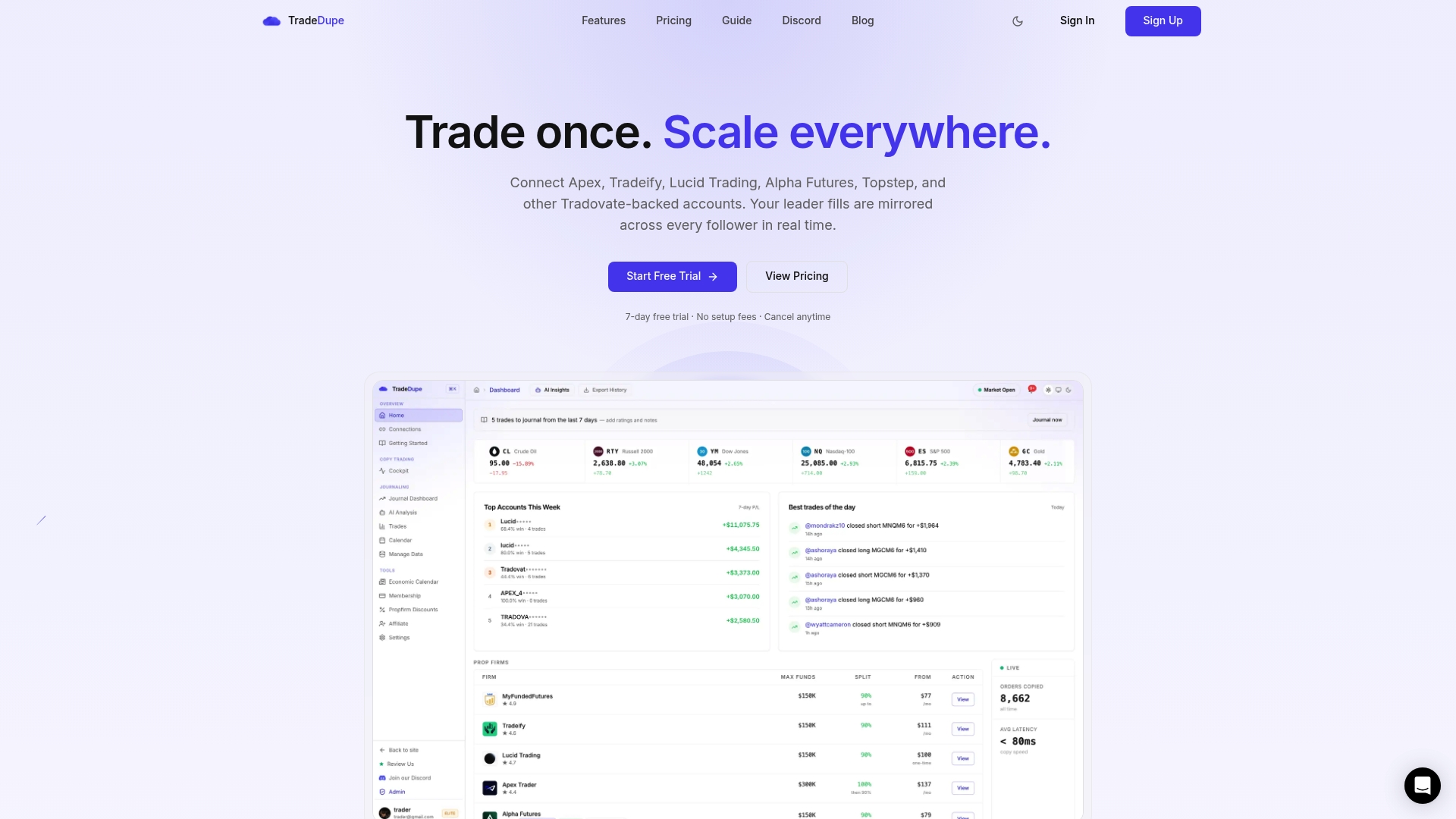
Plans are flat rather than priced per account: the Standard plan runs $20 per month billed yearly with 2 connections and 10 accounts each, Pro runs $45 per month billed yearly with 4 connections and 20 accounts each, and Elite offers unlimited connections at $90 per month billed yearly. Every plan includes a 7-day free trial with one-click cancellation, which gives you room to validate behavior before trusting it with live size.
- Start with the 10-minute getting-started walkthrough to connect your first leader and follower accounts.
- Review the copy trading overview if you want more background before connecting live accounts.
- Test your setup in a low-volatility window first, and confirm your broker's own daily loss limits and price-validation controls are active, since these regulator-aligned defenses exist independently of any mirroring software.
For traders who also want a structured way to validate a strategy before scaling it across accounts, this backtesting framework offers a useful discipline for separating a strategy that looks good on paper from one that holds up in live conditions.
Sources
- NFA interpretive guidance / rules on automated order-routing systems
- Tradovate API documentation
- CME Globex credit controls documentation
- CFTC Automated Trading in Futures Markets — Update
FAQ
Is mirror trading legal?
Mirror trading itself is legal in the United States when conducted through a broker's authorized channels and consistent with NFA and CFTC supervisory expectations for automated order routing. Outside the United States, legality depends on the local regulator's treatment of copy trading and investment advice, so traders should confirm the rules in their own jurisdiction before offering or using a copying service across unrelated accounts.
Can I make $100 a day trading?
No fixed dollar target is realistic or guaranteed for any trader, since outcomes depend on account size, strategy, market conditions, and risk management. Automation tools like real-time mirroring can improve execution consistency across accounts, but they do not change the underlying probability of a strategy winning or losing on any given day.
Which platform is best for mirror trading?
The right platform depends on which broker and account structure you use, since mirroring quality depends heavily on how deeply a service integrates with that broker's API. For traders running multiple Tradovate-based prop firm accounts, TradeDupe is built specifically for that setup, with server-side OAuth authentication and broker-enforced daily loss limits.
Is mirror trading a good idea?
Mirror trading can be a strong fit for traders who already run a proven strategy across multiple funded accounts and want consistent, low-latency execution without manual re-entry. It is a poor fit for anyone hoping automation will fix a losing strategy or remove the need for active monitoring, since regulatory guidance still expects written procedures and ongoing oversight for any automated trading setup.
Recommended
- What Is Real-Time Trade Synchronization for Prop Traders?
- Prop Desks: 100ms Tradovate Integration with T0 to T3 Audit Trail
- 34ms Mirroring: Per Account Disaster Recovery Trading on Tradovate
- How to Mirror Trades Across Prop Accounts: 2026 Playbook
For educational purposes only. Not financial advice. Futures trading involves substantial risk of loss and is not suitable for every investor.