
Prop Desks: 100ms Tradovate Integration with T0 to T3 Audit Trail
TradeDupe
11 min read
Server side Tradovate integration for prop desks: OAuth linking, WebSocket mirroring, T0 to T3 audit logs and p95/p99 latency checks.
Yes, you can integrate Tradovate accounts into a server-side copy-trading hub using Tradovate's OAuth flow and WebSocket streams to mirror fills across accounts in real time. TradeDupe does this today, typically replicating leader fills to follower accounts in around 100 milliseconds, with per-account risk controls enforced automatically. The practical next step is straightforward: start OAuth account linking on your copy platform, run staged test trades, and confirm your prop firm's copy-trading terms in writing before you scale to production size.
*
> TL;DR: > > - Most effective integrations mirror fills within approximately 100 milliseconds, but proper account linking and staged testing are essential before scaling live trading. > - Verify each Tradovate account's funded status, correct app registration, secure token storage, and a stable WebSocket connection to prevent delays or compliance issues. > - Use server-side OAuth flows to keep trader passwords secure, with tokens stored encrypted and a revoke flow available for instant disconnection. > - Proper lead/follower configurations require setting appropriate multipliers, verifying contract sizes, and aligning execution modes to prevent position mismatches and risk violations. > - Maintain an audit trail with timestamped records and monitor latency metrics, rejection rates, and divergence to ensure the system remains reliable under high-volume trading conditions.
*
Table of Contents
- What You Need Before Starting the Tradovate Integration
- How Do You Link Tradovate Accounts Through OAuth?
- Setting Up Real-Time Mirroring With Tradovate's Websocket Streams
- Configuring Leader Accounts, Multipliers, and Symbol Mapping
- How Do You Prevent a Runaway Trade From Wrecking Every Account?
- What Metrics Prove Your Mirroring Actually Works?
- Scaling the Integration Across Many Follower Accounts
- What Actually Breaks in Production (and What Doesn't)
- Put This Tradovate Integration Guide Into Practice With TradeDupe
- Sources
- FAQ
What You Need Before Starting the Tradovate Integration
A working Tradovate integration guide starts with an honest inventory. Prop desks that skip this step usually discover a missing permission or an ambiguous compliance clause after they've already gone live, which is the expensive way to find out.
Before linking a single account, confirm you have:
- Funded Tradovate accounts per firm — each account you intend to mirror into or out of needs active credentials and, where relevant, verified funded status.
- App registration credentials — a `client_id` and `redirect_uri` registered with Tradovate's partner API, required for any OAuth-based third-party access.
- An OAuth-capable server or SaaS layer — something that can complete the authorization code exchange and hold tokens securely, rather than a desktop script running on a trader's laptop.
- A secure token store — encrypted at rest, with rotation and revocation built in from day one.
You'll also want TLS-ready networking and stable WebSocket connectivity, since dropped connections during a fast market are where replication delays actually happen. Read your funded-account agreement closely, and if copy trading isn't explicitly addressed, request written confirmation from the firm before you connect anything.
How Do You Link Tradovate Accounts Through OAuth?
Tradovate requires OAuth for third-party account access, and for good reason: it means your copy-trading platform never touches or stores a trader's password. That single design choice removes an entire category of liability that plagued earlier generations of terminal-based copiers.
The linking sequence works like this:
- Redirect the user to authorization with `response_type=code`, your registered `client_id`, and the `redirect_uri` you set during app registration.
- Capture the returned authorization code from the redirect callback on your server, not client-side.
- Exchange the code server-side with a POST request to Tradovate's OAuth token endpoint, using `grant_type=authorization_code`, to receive an access token and a refresh token.
- Store both tokens encrypted, and build automatic refresh logic so sessions don't silently expire mid-session.
- Implement a revoke flow so a trader can disconnect an account instantly, without waiting on support.
Pro Tip: Never let the client secret touch a browser or mobile app. Keep the entire code-for-token exchange on your backend, and treat the refresh token with the same security posture you'd apply to a password. OAuth over static API keys is the documented best practice specifically because it supports this kind of delegated, revocable authorization.
Setting Up Real-Time Mirroring With Tradovate's Websocket Streams
Once accounts are linked, real-time mirroring depends entirely on how you consume Tradovate's WebSocket streams for order and fill events. This is the part of the integration where architecture decisions have the most consequence, because a sloppy event handler is invisible until volume spikes and something drops.
The pattern that holds up under load:
- Subscribe to the authenticated WebSocket channel for order and fill events immediately after OAuth completes.
- On event detection, write an idempotent replication record synchronously, capturing only the immutable essentials: source deal ID, requested volume, price conditions, and leader timestamp.
- Push enrichment, journaling, and anything non-critical to asynchronous workers so the hot path stays fast.
- Design your dispatch queue to preserve event order, retry failed dispatches without duplicating fills, and log the outcome on every follower account.
Production pipelines run this detection-to-dispatch sequence in roughly 100 milliseconds end to end. That number matters less as a marketing figure and more as a benchmark: any mirroring architecture worth trusting with funded capital should be able to publish its own comparable latency, not just claim "real-time."
Configuring Leader Accounts, Multipliers, and Symbol Mapping
Getting the leader/follower relationship right is where most copy-trading configurations quietly go wrong, usually through mismatched contract specs rather than a broken connection.
Start by deciding what kind of account leads. A desk master account, a demo account used for signal generation, and a trader's personal live account each carry different risk implications, and your replication rules should reflect that difference rather than treating every leader identically.
From there:
- Set a multiplier per follower account so position sizing scales correctly relative to the leader, and cap it with a max-contract limit that respects each account's evaluation or funded rules, following proven trade sizing and risk-management techniques to optimize performance.
- Maintain a per-account instrument spec table covering contract size, tick value, and symbol variant. Verifying contract size before applying multiplier math prevents the position-value divergence that can trip a firm's risk rules without anyone noticing until the account gets flagged.
- Align execution modes across accounts, deciding explicitly whether followers mirror at market or on instant-execution logic, since a mismatch here creates fill divergence even when the connection itself is healthy.
How Do You Prevent a Runaway Trade From Wrecking Every Account?
Automated mirroring multiplies your upside and your mistakes at the same speed, which is exactly why safety controls aren't optional add-ons, they're the difference between a manageable bad trade and a cascading account termination across every follower.
Build in, in this order:
- A global daily-loss disable that halts all copying the instant a threshold is hit, independent of any single account's state.
- Per-account max-drawdown limits, set directly on Tradovate so the broker enforces them rather than relying on your own software as the last line of defense.
- Rogue-trade detection, using slippage thresholds, symbol blacklists, and basic sanity checks (a 50-lot order where the leader normally trades 2 lots should never pass silently).
- An emergency stop accessible in one click, not buried three menus deep.
Pro Tip: Keep a written record of every prop firm's stance on self-account copying. Firm policy, not your software, is the actual constraint, and copy trading rules vary firm to firm even when the underlying platform is identical. Many firms permit copying across your own funded accounts but explicitly forbid distributing signals to other traders, so get that distinction confirmed in writing rather than assumed.
What Metrics Prove Your Mirroring Actually Works?
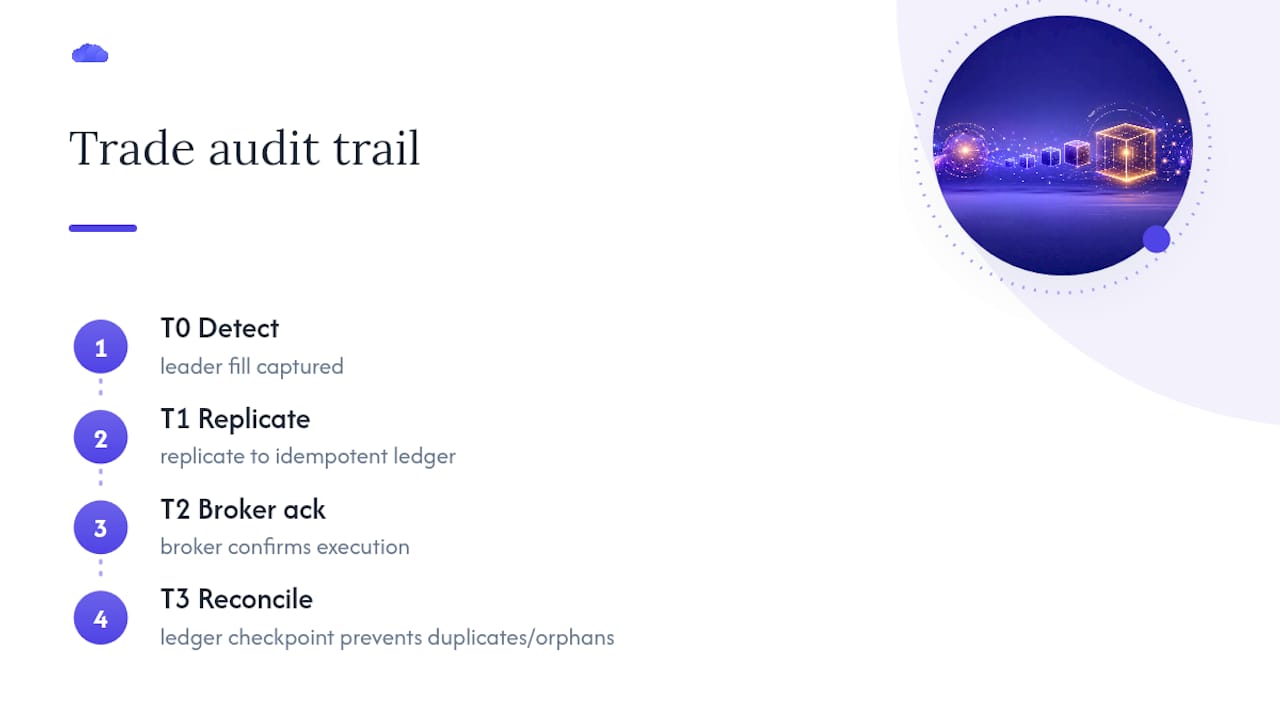
Claiming "real-time" means nothing without a test that can be audited. Run staged trades at small size before you trust the system with a full-size position, and capture four timestamps on every trade: T0 (leader fill observed), T1 (dispatch to follower), T2 (accepted by broker), and T3 (deal executed on the follower account).
| Metric | What it tells you |
|---|---|
| Replication time (T3 minus T0) | Total real-world latency, leader fill to follower execution |
| p95 / p99 latency | Worst-case performance under load, not just the average case |
| Rejection / partial-fill rate | How often follower orders fail to complete as sent |
| Fill divergence (in ticks) | Price slippage between leader entry and follower entry |
Reconcile deal IDs against your ledger after every test batch, apply auto-retry logic to anything that failed cleanly, and keep an audit trail for every replication record. Architectural analyses of mirror-trading timing treat this idempotent, timestamped ledger as the backbone of the entire system, not an afterthought bolted on for compliance.
Scaling the Integration Across Many Follower Accounts
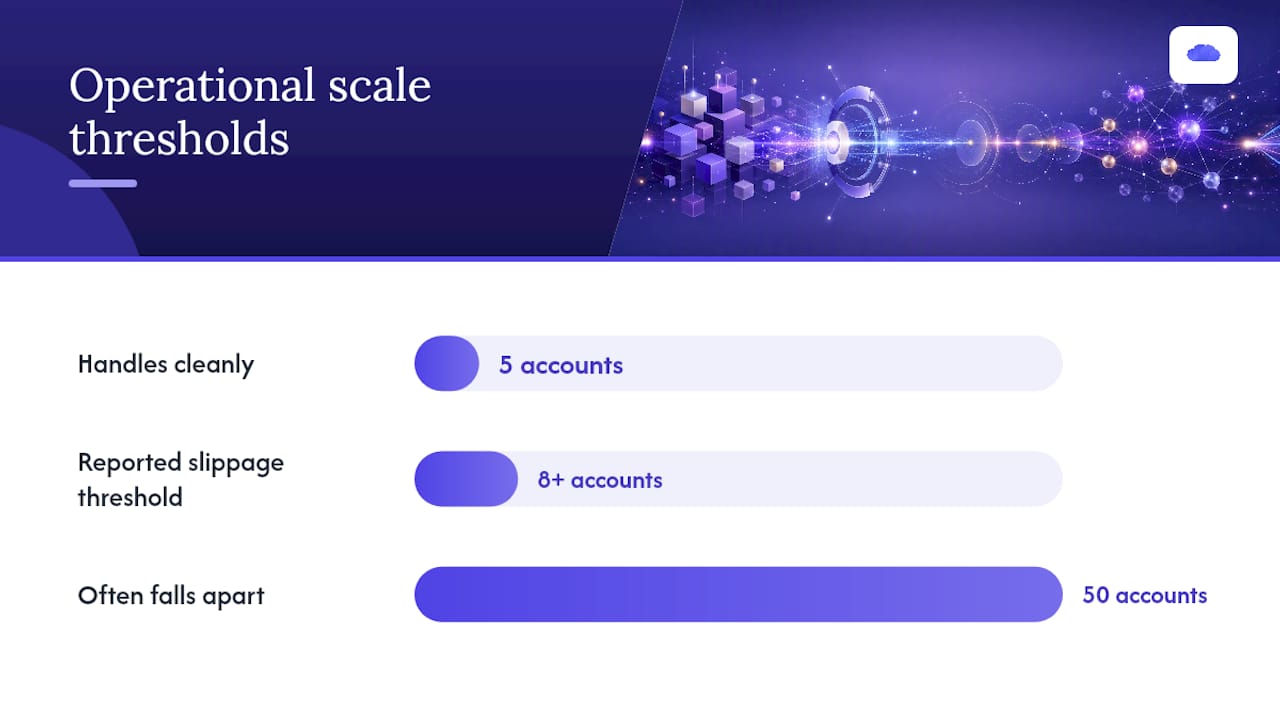
A setup that handles five follower accounts cleanly can fall apart at fifty if the underlying queue isn't built for it. Durable, idempotent queues are what let you replay events safely after a disconnect instead of guessing whether a fill already went through.
Operational priorities at scale:
- Use connection pooling and throttling to respect Tradovate's API rate limits rather than opening a fresh connection per account.
- Monitor p95/p99 latency and rejection rate continuously, not just during initial testing.
- Build an automatic disable trigger that pauses mirroring the moment failures start cascading, before a connectivity issue on one account turns into losses across a dozen.
Pro Tip: Traders running eight or more funded accounts on the Tradovate community forum consistently report slippage and fill divergence as their top operational headache, not connectivity. Budget your monitoring effort accordingly.
What Actually Breaks in Production (and What Doesn't)
The idempotent event ledger is the single highest-value investment in any Tradovate integration, full stop. Everyone focuses on shaving milliseconds off replication speed, and speed matters, but the failures that actually cost traders money are duplicate fills after a reconnect and orphaned records nobody reconciled. A clean ledger with T0 through T3 timestamps on every trade catches both before they become a support ticket or, worse, a funded account termination.
Server-side OAuth and WebSocket architecture beats local terminal plugins for one structural reason: it scales without a trader's machine being the single point of failure. A plugin running on a laptop dies the moment that laptop sleeps, loses Wi-Fi, or gets closed by accident. A server-side connection keeps running regardless of what any individual trader is doing at their desk.
None of this replaces reading your prop firm's actual terms. Get written confirmation on copy-trading permissions before you scale past a handful of accounts. Software can enforce limits perfectly and you can still lose a funded account over a policy question nobody asked out loud.
> — Andres
Put This Tradovate Integration Guide Into Practice With TradeDupe
There are copy trading platforms built around exactly the architecture this guide describes, without you having to write a line of it yourself. Account linking runs through Tradovate's official OAuth flow, so no password ever touches the platform's servers. Fills can mirror over live WebSocket streams in roughly 100 milliseconds, with rogue-trade detection, per-account copy toggles, and daily loss limits and profit targets enforced directly on Tradovate, so the broker backs the safeguard, not just the app.
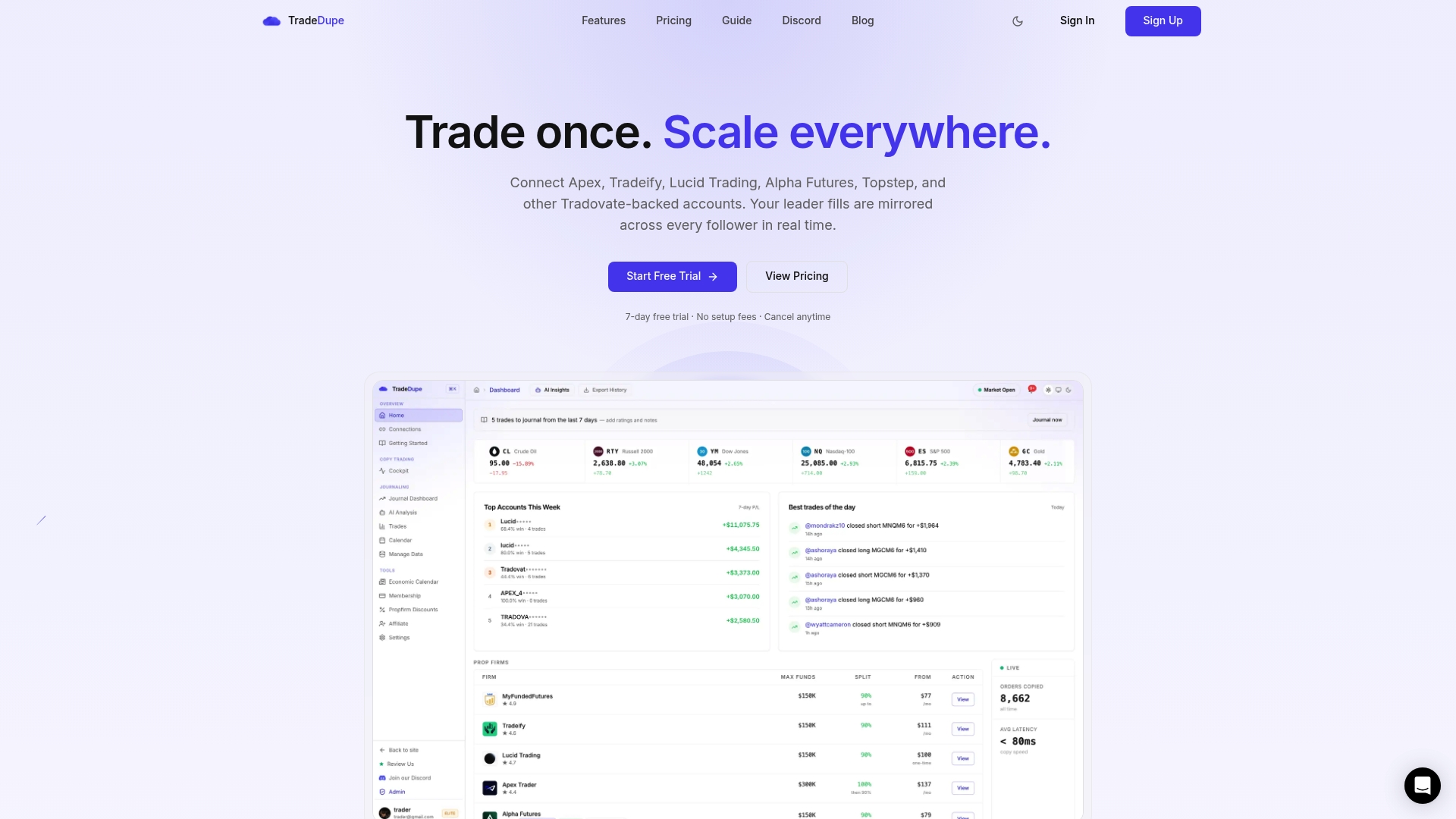
TradeDupe already works with Tradovate-based prop firms including Apex Trader Funding, Tradeify, Lucid Trading, MyFundedFutures, Alpha Futures, and TakeProfit Trader, so you're not building account-by-account custom logic. The trade copier product page walks through the same leader/follower and multiplier setup covered above. Every plan includes a 7-day free trial with one-click cancellation, so you can get started in about 10 minutes, link your accounts, and run your own staged test trades before committing size.
Sources
Readers building or auditing their own Tradovate integration should go directly to the primary technical sources rather than secondhand summaries. Tradovate's own OAuth token endpoint documentation covers the authorization code exchange in full, and the broader Tradovate API documentation details WebSocket subscription patterns for order and fill events.
For architectural depth on timestamp ledgers and latency benchmarking, the technical performance analysis of mirror-trading execution is worth a careful read. On the compliance side, PropFirmScan's guide to multi-account trade copiers and Finimize's explainer on copy trading inside prop firms both address the policy questions software alone can't answer.
- O Auth Token — Tradovate partner docs
- Tradovate API documentation
- How to Use Prop Firm Trade Copiers: The Ultimate Guide to Multi-Account Execution — PropFirmScan
- Mirror Trading Execution: Technical Performance Analysis — KittTraders
FAQ
Is Copy Trading Allowed on Tradovate-Based Prop Firms?
It depends entirely on the individual firm's terms, not on Tradovate itself. Many prop firms allow traders to mirror trades across their own funded accounts but prohibit sharing signals with other traders, so confirm the specifics in writing before connecting accounts.
How Fast Is Real-Time Trade Mirroring on Tradovate?
Well-built server-side integrations using OAuth and WebSocket streams typically replicate fills in under a second, with TradeDupe reporting mirroring around 100 milliseconds from leader fill to follower execution.
Do I Need to Store Trader Passwords for a Tradovate Integration?
No. Tradovate's OAuth flow issues access and refresh tokens after a one-time authorization, so a properly built integration, including TradeDupe, never requests or stores a trader's password.
What's the Biggest Risk in Running Multiple Tradovate Accounts With a Copier?
Mismatched contract specs and multiplier errors cause more compliance issues than latency does. Verifying contract size and symbol mapping per account before applying multiplier logic prevents most position-value divergence problems.
Can I Test a Tradovate Integration Before Trading Live Size?
Yes, and you should. Run small staged trades first, capture T0 through T3 timestamps on each one, and reconcile the results before scaling to full position size across follower accounts.
Recommended
- Trade Reconciliation Automation for Tradovate Prop Desks: 6 Essentials
- 34ms Copy Trading for U.S. Tradovate Prop Desks: Audit Logs & Controls
- Three Checks to Fix Tradovate API Error Codes for Prop Desks
- 34ms Mirroring: Link Tradovate Accounts for Prop Desks
For educational purposes only. Not financial advice. Futures trading involves substantial risk of loss and is not suitable for every investor.