34ms Copy Trading for U.S. Tradovate Prop Desks: Audit Logs & Controls
TradeDupe
8 min read
U.S. playbook for Tradovate prop desks linking NFA disclosures to server side controls: 34ms replication, rogue trade detection, audit logs.
Yes: internal, server-side copy trading for Tradovate-based prop desks is legal in the United States when the desk builds it around three non-negotiables. Proprietary results must be labeled and disclosed under NFA Rule 2-29, the automated system needs pre-trade risk controls consistent with the CFTC's Regulation AT framework, and every trade mirror must leave an auditable record. TradeDupe was built to enforce exactly these constraints.
*
> TL;DR: > > - Proprietary copy trading in the US is legal when firms label results properly, enforce pre-trade risk controls, and maintain auditable records of all trades. > - Regulators mainly focus on documentation and risk management controls, not outright bans on internal trade mirroring, provided firms can prove compliance on demand. > - Implementation requires clear labeling rules, scope restrictions to internal accounts, pre-trade limits, approval processes, and detailed recordkeeping to meet NFA and CFTC standards. > - Low-latency, server-side execution, along with automated rogue-trade detection and auto-recovery systems, are essential technical controls to ensure compliance and execution fidelity. > - Building from scratch is suitable only for simple, small-scale setups; most desks benefit from purpose-built platforms designed for robust testing, automation, and regulatory-ready features.
*
Table of Contents
- Is Copy Trading Legal in the US for Prop Desks?
- Which US Rules Apply to Prop-Desk Copy Trading?
- Building the Operational Compliance Checklist
- Technical Controls That Satisfy Regulators and Traders Alike
- Rolling Out Copy Trading Without Cutting Corners
- What Build-Versus-Buy Actually Comes Down to
- Getting Tradovate Copy Trading Live the Right Way
- Sources
Is Copy Trading Legal in the US for Prop Desks?
The short answer is that copy trading is legal in the US for proprietary trading desks, but "legal" comes with conditions most desks underestimate until an examiner asks for evidence. No federal statute bans mirroring trades from one account to several others. The exposure comes from how a desk does it, not whether it does it.
Two regulatory bodies shape the actual constraints. The National Futures Association enforces disclosure rules on proprietary performance, and the Commodity Futures Trading Commission has spent a decade pushing algorithmic and automated trading systems toward documented risk controls. Neither treats trade mirroring across a firm's own Tradovate accounts as inherently prohibited. Both expect the firm to prove it manages the risk that automation introduces.
That framing matters because it flips the compliance question. Instead of asking "can we copy trade," a desk should ask "can we prove, on demand, that our copy trading system behaves the way we say it does." That is the standard this article builds toward.
Which US Rules Apply to Prop-Desk Copy Trading?
Two regulatory anchors govern how a Tradovate prop desk can run copy trading, and neither is optional once results get shared, reported, or reviewed by anyone outside the desk.
NFA Rule 2-29 governs disclosure. If a firm holds beneficial interest in the accounts it trades, NFA guidance requires those results be labeled "Proprietary," set apart from any client-facing material, and adjusted conservatively for fees and commissions. Mixing proprietary mirrored results into marketing material without that separation is one of the most common findings in NFA disclosure reviews.
The CFTC's Regulation AT discussion sets the operational bar. It calls for pre-trade risk controls, documented testing, ongoing monitoring, and reporting standards for algorithmic and automated trading systems, including the kind of software that pushes a leader's trades to dozens of follower accounts in milliseconds.
Beyond disclosure and controls, NFA recordkeeping standards require books and records retention, typically five years with the most recent two readily accessible, plus availability on request for inspection.
Desks preparing for scrutiny should keep on hand:
- Trade and sync logs showing which follower accounts mirrored which leader trades, and when
- Pre-trade limit test results, not just the limits themselves
- A dated compliance calendar showing when controls were last reviewed
Regulators care more about documented controls than about banning internal mirroring outright — a desk that can produce test logs and limit records is in a fundamentally different position than one that cannot, even if both run identical software.
Building the Operational Compliance Checklist
Compliance for copy trading isn't a single policy document. It's a stack of smaller decisions that need to be made before the first follower account goes live, not after an examiner asks about it.
- Set proprietary labeling rules. Decide in writing how mirrored results get tagged and where the "Proprietary" label appears, per the NFA's disclosure guidance for CTAs.
- Limit scope explicitly. Restrict copy trading to a firm's own internal accounts unless legal has reviewed a broader arrangement. Industry summaries of prop-firm rules show that cross-firm or third-party copying is the single most common trigger for denied payouts and rule violations.
- Write conflict-of-interest rules. Address how leader-account selection and follower prioritization get decided when accounts compete for fills.
- Set pre-trade limits per account. Cap position size, order rate, and daily loss independently for each follower, not just at the leader level.
- Build approval gating. Require a manual or automated check before a new follower account can go live against a leader.
- Run simulation testing before go-live. Document test scenarios, not just outcomes.
- Write an incident response plan. Define what happens when auto-recovery kicks in after a disconnect or rogue trade.
- Restrict staff access by role. Only specific roles should be able to toggle follower accounts on or off.
- Draft disclosure templates in advance. Keep them ready rather than writing them reactively after a request.
- Set a document retention schedule. Align it with NFA's five-year standard and identify what stays readily accessible for two years.
Pro Tip: Write your incident response plan before you need it. Desks that draft their auto-recovery and rogue-trade procedures after a live incident almost always end up documenting the failure instead of the fix.
Technical Controls That Satisfy Regulators and Traders Alike
Regulators and traders are, oddly, asking for the same thing from different angles. A regulator wants proof the system manages risk. A trader wants the mirror to actually match what the leader did. The engineering that satisfies one satisfies the other.
Latency is the clearest example. Practitioner reports on Tradovate's own community forum describe slippage and execution inconsistency when copy trading routes through intermediate platforms, like a chain running from TradingView through NinjaTrader before it reaches Tradovate. Each hop adds delay and a point of failure. TradeDupe's server-side mirroring architecture replicates trades at a median 34ms, which matters for two separate reasons: it minimizes the price divergence between leader and follower fills, and it gives you a tight, defensible window to point to when a regulator or prop firm asks how consistent your execution actually is, demonstrating regulatory reporting automation for UK enterprises concepts in practice.
A compliant setup needs, at minimum:
- Server-side execution rather than a chain of third-party middleware
- Per-account toggles so any single follower can be paused without touching the rest
- Rogue-trade detection that flags execution outside expected parameters
- Auto-recovery that reconnects and resyncs accounts after a dropped connection
- Audit logging on every mirrored order, timestamped and retained
A monitoring dashboard that shows sync status and leader/follower activity in real time turns these controls from theoretical policy into something you can actually screenshot during an audit.
Rolling Out Copy Trading Without Cutting Corners
Deployment should follow a gate structure, where each stage has to pass before the next one starts.
- Get legal sign-off first. Confirm labeling, scope limits, and disclosure templates before any code touches a live account.
- Test in a simulated environment. Confirm pre-trade limits actually trigger under simulated stress, not just that they exist in configuration.
- Verify integration with each prop-account provider. Apex, Tradeify, Lucid Trading, and Alpha Futures each have their own account structures worth confirming individually before go-live.
- Set quantitative go/no-go criteria. Define acceptable replication latency, error rate thresholds, and confirmed pre-trade limit enforcement before flipping any follower live.
- Schedule recurring audits post-launch. Set a re-testing cadence, not a one-time check, and keep retention records ready to produce on request.
Skipping step three is the mistake most desks make. A provider integration that works in isolation can behave differently under a specific prop firm's account structure.
What Build-Versus-Buy Actually Comes Down to
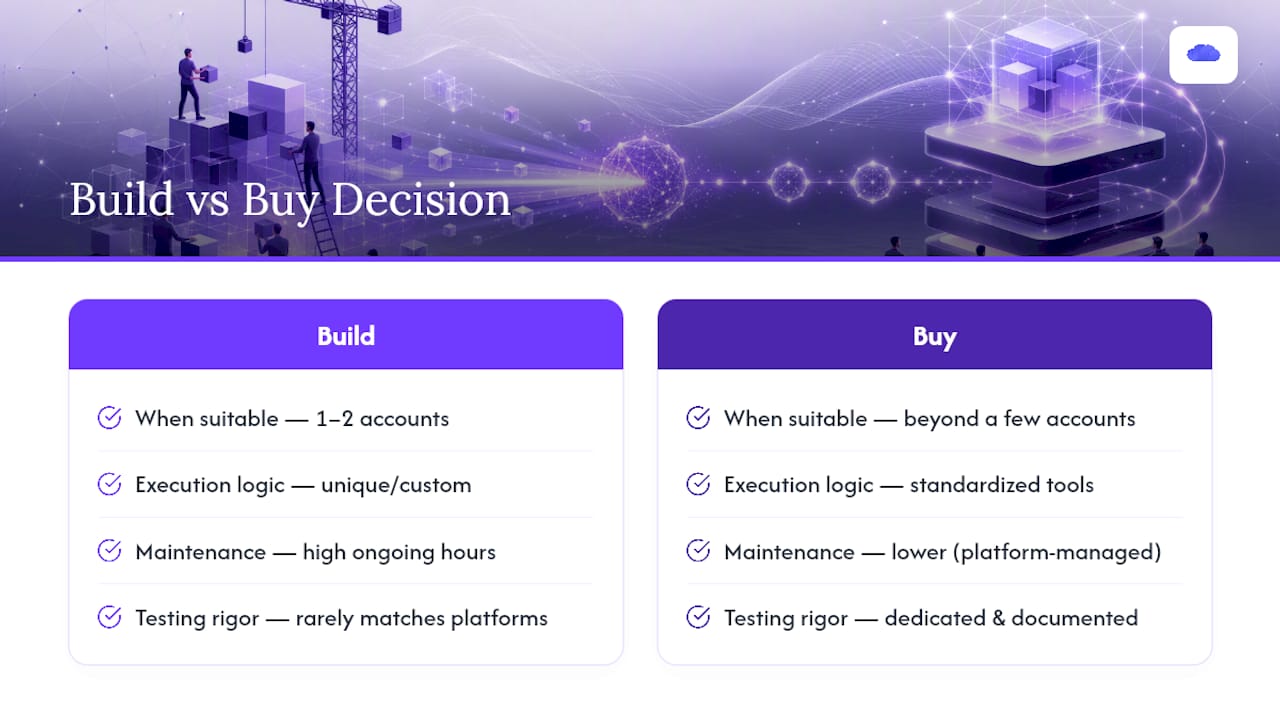
Building copy trading infrastructure in-house makes sense when a desk has one or two accounts and genuinely custom execution logic nobody else needs. Past that scale, the math changes fast. Every hour spent maintaining rogue-trade detection or reconnection logic is an hour not spent on strategy or risk oversight, and a homegrown system rarely gets the same testing rigor a dedicated platform does by default.
That's the gap a purpose-built platform closes. A specialized platform with low latency replication, rogue-trade detection, per-account toggles, and native integrations with major prop firms exists specifically because desks kept rebuilding the same controls badly. Specialized tooling doesn't remove the compliance burden. It gives you a documented, testable foundation to build that compliance on top of.
> — Andres
Getting Tradovate Copy Trading Live the Right Way
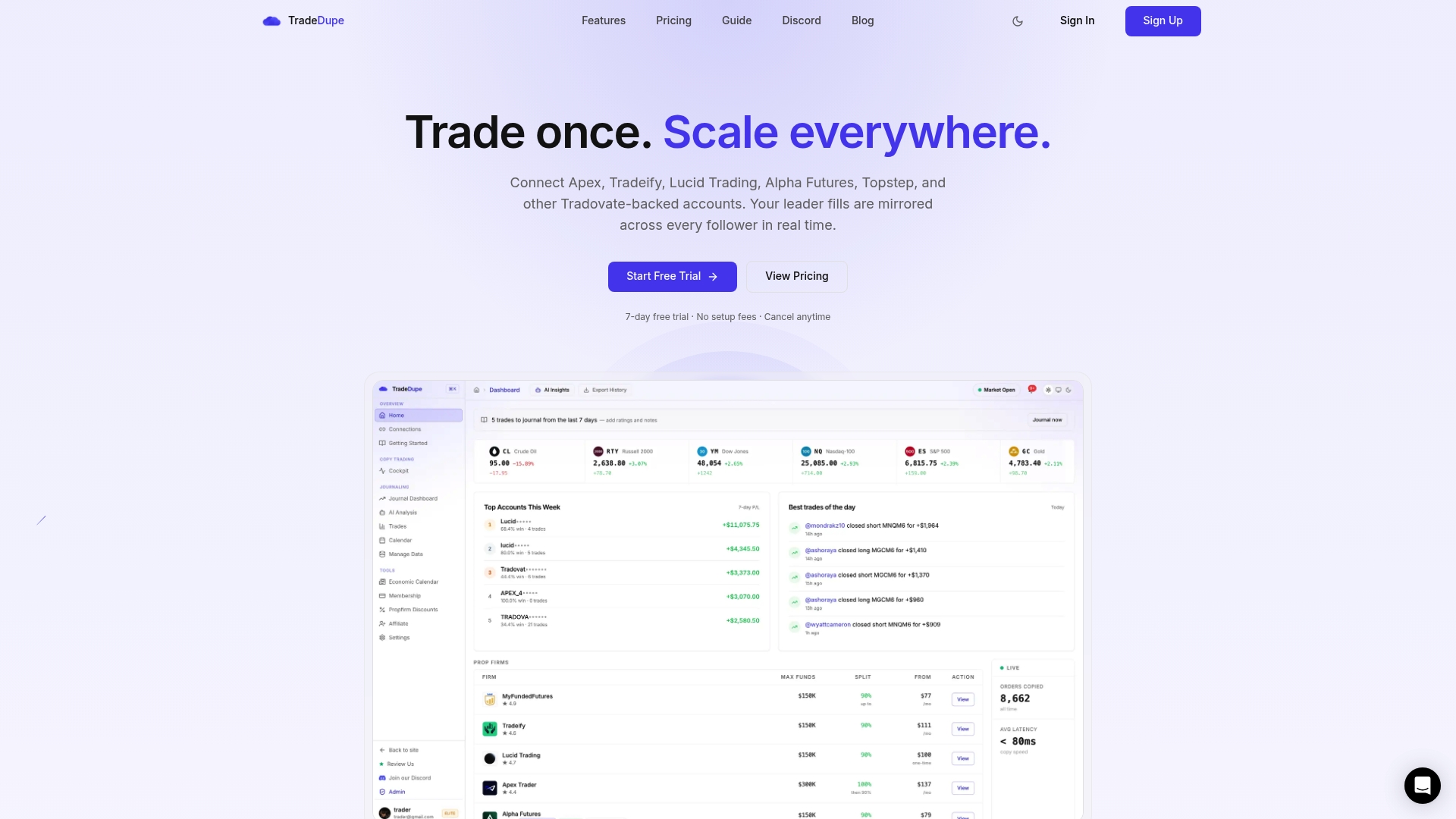
This is the practical answer to everything covered above: a platform built specifically to enforce the controls this article just walked through, not a general-purpose automation tool retrofitted for prop desks.
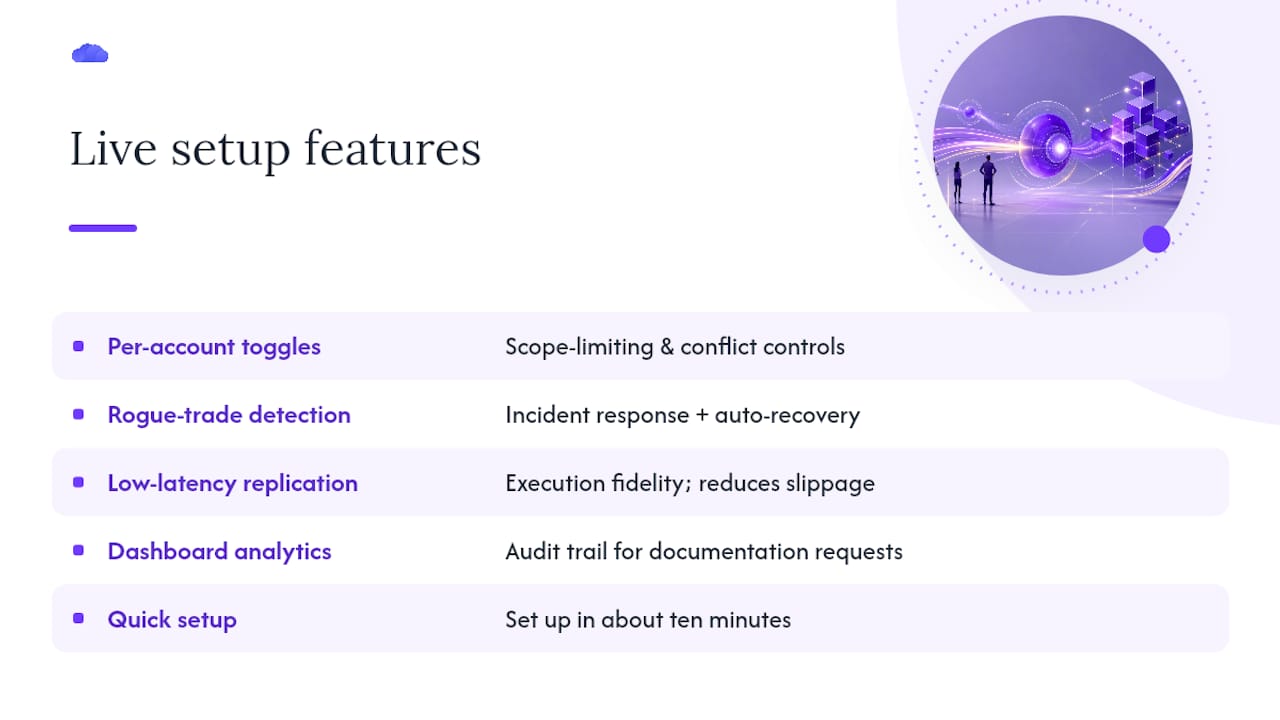
Every checklist item maps to features typically found in such platforms. Per-account toggles handle scope-limiting and conflict-of-interest controls compliance teams need. Rogue-trade detection and auto-recovery cover incident-response requirements. Low-latency replication addresses execution-fidelity concerns seen in regulatory testing and trader complaints about slippage. Dashboard analytics provide the audit trail a firm needs when documentation gets requested. Support for major prop firms means the per-broker integration verification step doesn't start from zero.
If you're evaluating whether to build this internally or deploy something tested, start with the getting-started guide and set up Tradovate copy trading on your own accounts in about ten minutes.
This article is general information, not a substitute for advice from a qualified lawyer. Consult a qualified legal professional about your own circumstances before acting on anything here.
Sources
- NFA Rule 2-29 (Disclosures)
- Regulation automated trading (Federal Register, 2015)
- Prop firm trading rules explained 2026: EAs, News, Copy Trading - PropFirmMap