
Prop Desks: Trade Copier Alerts Prove Reliability (Tradedupe 34ms)
TradeDupe
13 min read
How prop desks make trade copier alerts reliable, auditable, and secure. Covers channel redundancy, payload standards, retries, risk triggers, and a...
Trade copier alerts are the automated notifications that confirm an order has been mirrored across accounts and that the underlying copy trading system is functioning properly. A production-grade setup requires three non-negotiables: reliable delivery across multiple channels (Telegram, webhook, email), immediate system-health warnings for disconnections and equity thresholds, and timestamped audit logs that prove exactly what happened and when. Platforms like Tradedupe build alerting around these three pillars because a single missed notification can mean an unmanaged position across dozens of funded accounts.
*
> TL;DR: > > - Reliable alert channels must deliver real-time notifications via multiple methods, including Telegram, webhooks, and backup email, to prevent missed system health warnings. > - Trade signals should be validated with structured JSON webhooks and tested through dry-runs to avoid duplicate orders and ensure accurate routing across follower accounts. > - Alert payloads need to include detailed information such as account ID, symbol, side, quantity, timestamp, and correlation ID for effective reconciliation and dispute handling. > - Automated retry mechanisms with idempotency and escalation protocols are essential to handle alert delivery failures and prevent silent system failures. > - Proper access controls, encrypted communication, and strict data retention policies are critical to protect sensitive trade data and maintain compliance.
*
Table of Contents
- How Trade Copier Alerts Turn Into Copied Orders
- Which Alert Channels Actually Work for Copy Trading
- How Do You Set Up TradingView, Telegram, and Master-Account Copying?
- What Should a Trade Alert Payload Actually Contain?
- How Do You Verify That Alerts Actually Worked?
- How Tradedupe Implements Alerts for Prop Firms
- Quick Triage When Copier Alerts Go Wrong
- Security and Data Privacy for Alert Transmission
- Handling Alert Failures and Retry Mechanisms
- How Alerts Shape Risk Management and Stop-Loss Automation
- Trade Copier Integrations Across Platforms and Brokers
- Governance: Who Should Actually Watch These Alerts?
- Get Started With Tradedupe's Real-Time Alerting
- Where to Verify These Claims
- Sources
How Trade Copier Alerts Turn Into Copied Orders
Every trade copy starts as a signal from somewhere. That source might be a TradingView alert firing on a strategy condition, a fill event on a master account, or a manually typed message in a Telegram channel. What happens between that signal and the executed order on a follower account determines whether the whole system is trustworthy.
The signal first gets parsed. A structured JSON webhook is far safer than free-text Telegram parsing because the copier's engine can validate every field (symbol, side, quantity) before acting on it. Free-text messages require pattern matching that breaks the moment someone abbreviates a ticker or formats a price differently than usual. This is one reason serious operations push toward webhook-based ingestion wherever the source platform supports it.
Once parsed, the order gets routed to every connected follower account, with sizing calculated per account, whether that's a fixed lot, a ratio of the master's position, or a custom multiplier set by the operator. Routing logic also has to check per-account toggles: an account that has been paused shouldn't receive the trade at all, and the system should log that suppression as its own event.
Latency accumulates at several points in this chain:
- Signal generation and network transmission from the source
- Parsing and validation on the copier's servers
- Routing decisions across multiple follower accounts
- Broker API response time on each individual account
Server-side processing under 200 milliseconds is a realistic benchmark, but end-to-end timing still depends on the broker's own API responsiveness on the receiving end. A copier that quotes only its own internal speed without acknowledging broker-side variability is giving you half the picture.
Which Alert Channels Actually Work for Copy Trading
Different channels serve different jobs, and a mature setup rarely relies on just one.
- Telegram delivers instant push notifications and works well for both group broadcasts and direct messages to individual operators; keep the message format consistent so it's scannable during fast markets.
- Webhooks are the backbone of automated workflows. A solid webhook implementation uses structured JSON payloads, retries failed deliveries, and includes an idempotency key so a retried message doesn't get processed twice.
- Email is best for end-of-day digests and archival records rather than time-sensitive alerts. Nobody's checking email mid-trade, but compliance reviews six months later will thank you for it.
- Discord or Slack make sense as secondary channels when a team already lives in chat-based workflows. Discord in particular offers webhook and bot APIs that make it straightforward to route alerts into team channels without building custom infrastructure.
Pro Tip: Never rely on a single channel for critical system-health alerts. If Telegram goes down or your phone dies, a parallel webhook feeding a dashboard or a backup email digest is what keeps you from finding out about a disconnection three hours late.
How Do You Set Up TradingView, Telegram, and Master-Account Copying?
Getting these three common setups running correctly takes more than dropping in an API key. Each has its own failure points worth testing before real capital is on the line.
- TradingView webhook setup. Confirm your TradingView plan supports webhook alerts (this typically requires a paid tier), then build the alert message as a minimal JSON payload with fields for symbol, action, quantity, and a unique identifier. Skipping the identifier makes duplicate detection nearly impossible.
- Telegram ingestion. Route messages through a bot rather than parsing raw chat text. A bot enforcing a fixed command structure eliminates the ambiguity that free-text formatting introduces, especially when multiple people post in the same channel.
- Master-account mirroring. Decide sizing per follower account (fixed size vs. ratio-based), set toggles for which accounts are actively receiving trades, and lean toward server-side mirroring when consistency across many accounts matters more than manual oversight.
- Test before going live. Run a dry-run against a demo or small-size account, verify webhook delivery through logs, and confirm the fill on the follower matches the master's fill price and timing within an acceptable window.
Pro Tip: Send a handful of test alerts at market open, midday, and close. Latency and broker responsiveness can shift throughout the session, and a setup that looks clean at 10 a.m. might behave differently during a volatile close.
What Should a Trade Alert Payload Actually Contain?
A trade alert that's missing the right fields is nearly useless during a dispute or a reconciliation review. At minimum, every trade alert needs:
- Account ID, symbol, side, quantity, price, and a precise timestamp
- A correlation ID linking the alert to its resulting fill
- Clear labeling for system-health events: disconnection, reconnection, and sync suspension all need distinct codes, not a generic "error" tag
Risk-related alerts deserve equal weight. Equity threshold breaches, drawdown limits, and daily profit-and-loss summaries should all trigger their own notifications rather than getting buried in a general trade log. And because both humans and automated systems consume these alerts, the strongest implementations send dual-format messages: a short, readable line for the person scanning Telegram, and a structured JSON version for anything downstream that needs to parse it programmatically.
How Do You Verify That Alerts Actually Worked?
An audit log is only useful if it captures everything: every event timestamped, every trade and system message carrying a unique ID that can be traced back to its source signal. Without that granularity, reconciling what happened after a disputed fill turns into guesswork.
- Measure latency at each stage of the chain, not just the platform's internal processing time
- Run daily reconciliation that automatically matches alerts to fills rather than relying on manual spreadsheet checks
- Build automated escalation so a critical event, like a disconnection lasting more than a few minutes, triggers a call or SMS instead of sitting in an unread Telegram message
Platform-side processing under 200 milliseconds is a reasonable benchmark for the copier's own engine, though the full chain from signal to fill will always run longer depending on broker response times. Tradedupe's approach to audit logs reflects this: every sync event gets a timestamp and an ID, which makes tracing a discrepancy a matter of minutes instead of hours.
How Tradedupe Implements Alerts for Prop Firms
Tradedupe was built around the assumption that a prop desk running a dozen funded accounts can't afford a blind spot. The platform mirrors trades server-side with a median latency of 34 milliseconds, and every follower account carries its own toggle so an operator can pull one account out of the copy chain without touching the rest.
Rogue-trade detection and auto-recovery work together: if a follower account starts diverging from the leader, the system flags it and can restore correct positioning automatically, with a notification confirming the fix. The dashboard shows sync status and leader/follower activity in real time, backed by analytics and reporting tools for reviewing performance after the fact. Alert policies scale by tier, and new users can walk through the getting-started guide to see the monitoring setup firsthand.
Quick Triage When Copier Alerts Go Wrong
- Check webhook delivery logs, bot connectivity, and API key status first. Most silent failures trace back to one of these three.
- For parsing errors, validate the payload structure and confirm you're using JSON rather than free text; a missing correlation ID often points to the root cause.
- Distinguish broker rejections (visible in the broker's own order log) from late fills (a timing issue, not a rejection).
- Auto-suspend copying if repeated failures hit a threshold, then resume only after a manual test trade confirms the fix.
Security and Data Privacy for Alert Transmission
Trade alerts carry sensitive information: account identifiers, position sizes, and sometimes strategy logic embedded in the payload itself. Transmitting that data insecurely is a real exposure, not a theoretical one, especially for a prop firm managing accounts under a funding agreement with strict compliance terms.

Webhook endpoints should run over HTTPS without exception, and API keys used to authenticate alert delivery need to be treated like passwords: rotated periodically, scoped to the minimum permission needed, and never hardcoded into a shared script that multiple team members can access. Telegram bots should be locked to specific chat IDs rather than left open to any user who discovers the bot's username.
Data retention matters too. Audit logs that store account and trade details need clear policies on how long that data persists and who can access it. A copier platform that can't tell you where alert data is stored or how long it's retained is one you should question before connecting a live account. Encryption in transit is table stakes; encryption at rest for stored logs is what separates a platform built for professional operations from one built as a hobby project.
Two-factor authentication on the dashboard controlling your alert settings closes another common gap. If a single compromised password can reroute trade copies across every follower account, the alerting infrastructure itself becomes the weak point, regardless of how fast or reliable the alerts are otherwise.
Handling Alert Failures and Retry Mechanisms
Alerts fail. Networks drop, APIs time out, and Telegram occasionally has outages that have nothing to do with your setup. What separates a resilient system from a fragile one is what happens in the seconds after that failure.
A retry mechanism needs to be smart about idempotency. Simply resending a failed webhook without a unique identifier risks double execution, which in a copy trading context means a duplicated position across every follower account. The correlation ID mentioned earlier does double duty here: it lets the receiving system recognize "I've already processed this one" and discard the duplicate rather than acting on it twice.
Exponential backoff is standard practice for retry timing. Rather than hammering a failed endpoint every second, a well-built system waits progressively longer between attempts, giving a temporarily overloaded broker API or messaging service time to recover before trying again.
Dead-letter queuing matters for anything that fails repeatedly. Instead of silently dropping an alert that couldn't be delivered after several attempts, it should land somewhere visible: a failure log, a dashboard flag, or an escalation notification to whoever is monitoring the desk that day. Silent failure is the worst outcome in this entire chain, worse than a slow alert, because nobody knows to act on it.
How Alerts Shape Risk Management and Stop-Loss Automation
Alerts aren't just informational. In a properly designed system, they're the trigger mechanism for risk controls that would otherwise require constant manual attention.
An equity-threshold alert, for instance, isn't useful only as a warning; it can be wired directly into an automated response that reduces position size, halts new copies, or pulls an account out of the mirroring chain entirely until a human reviews it. That distinction, alert as notification versus alert as trigger, is where a lot of setups fall short. A message that just sits in a Telegram channel unread at 2 a.m. does nothing to protect a funded account from breaching a daily loss limit.
Stop-loss automation depends on the same reliability principles covered earlier: an alert confirming a stop has been hit needs to propagate to every follower account with enough speed that the copied stop executes near the same price as the master. A 500-millisecond delay on a fast-moving instrument can mean a meaningfully worse fill on the follower side, which compounds across every account in the chain.

Daily profit-and-loss summary alerts also function as a passive risk layer. They won't stop a bad trade in real time, but they give an operator a consistent checkpoint to catch a pattern (accounts consistently underperforming the master, or one account drifting from its expected size ratio) before it becomes a larger problem. Risk management built on alerts works best when the alerts are treated as part of the control system, not just a log of what already happened.
Trade Copier Integrations Across Platforms and Brokers
Not every trader runs the same stack, and a copier that only speaks to one broker or one charting platform limits how a desk can grow. Integration breadth matters most when a firm is running accounts across multiple prop firm evaluations or funded programs simultaneously.
TradingView remains the most common signal source thanks to its webhook alert support, but plenty of setups originate from a master account's own fills rather than an external chart signal, which requires the copier to plug directly into the brokerage's execution feed. Tradovate-based operations, for example, benefit from a copier built specifically around that ecosystem rather than a generic multi-broker tool retrofitted to work with it.
Broker-side integration depth varies too. Some copiers only support order placement, while more capable systems also pull account state (equity, open positions, margin usage) to inform sizing decisions in real time. For prop firms juggling accounts across providers like Apex, Tradeify, Lucid Trading, or Alpha Futures, the copier needs consistent behavior across all of them, not a system that works flawlessly on one and unreliably on another.
The practical test is simple: ask whether the platform's integration was purpose-built for your broker's execution environment or bolted on as a generic connector. Purpose-built integrations tend to handle edge cases (partial fills, rejected orders, margin calls) with far more precision than broad, one-size-fits-all connectors ever manage.
Governance: Who Should Actually Watch These Alerts?
Connection and equity alerts deserve top priority because they're the events most likely to cause real damage if missed. A disconnected account sitting unmanaged for twenty minutes during a volatile session is a bigger risk than almost any single trade decision. Redundant channels and clear escalation rules matter because the alert that never gets seen is functionally the same as no alert at all.
A workable structure splits ownership three ways: an operator monitoring live activity, a risk lead setting and reviewing threshold policies, and a developer maintaining the integrations themselves. Firms that skip this division tend to discover the gap only after something's already gone wrong.
> — Andres
Get Started With Tradedupe's Real-Time Alerting
Tradedupe gives prop traders and trading firms what a spreadsheet and a Telegram group never can: server-side trade mirroring with a median 34-millisecond latency, rogue-trade detection, and per-account toggles that let you pull one account out of the mix without disrupting the rest.
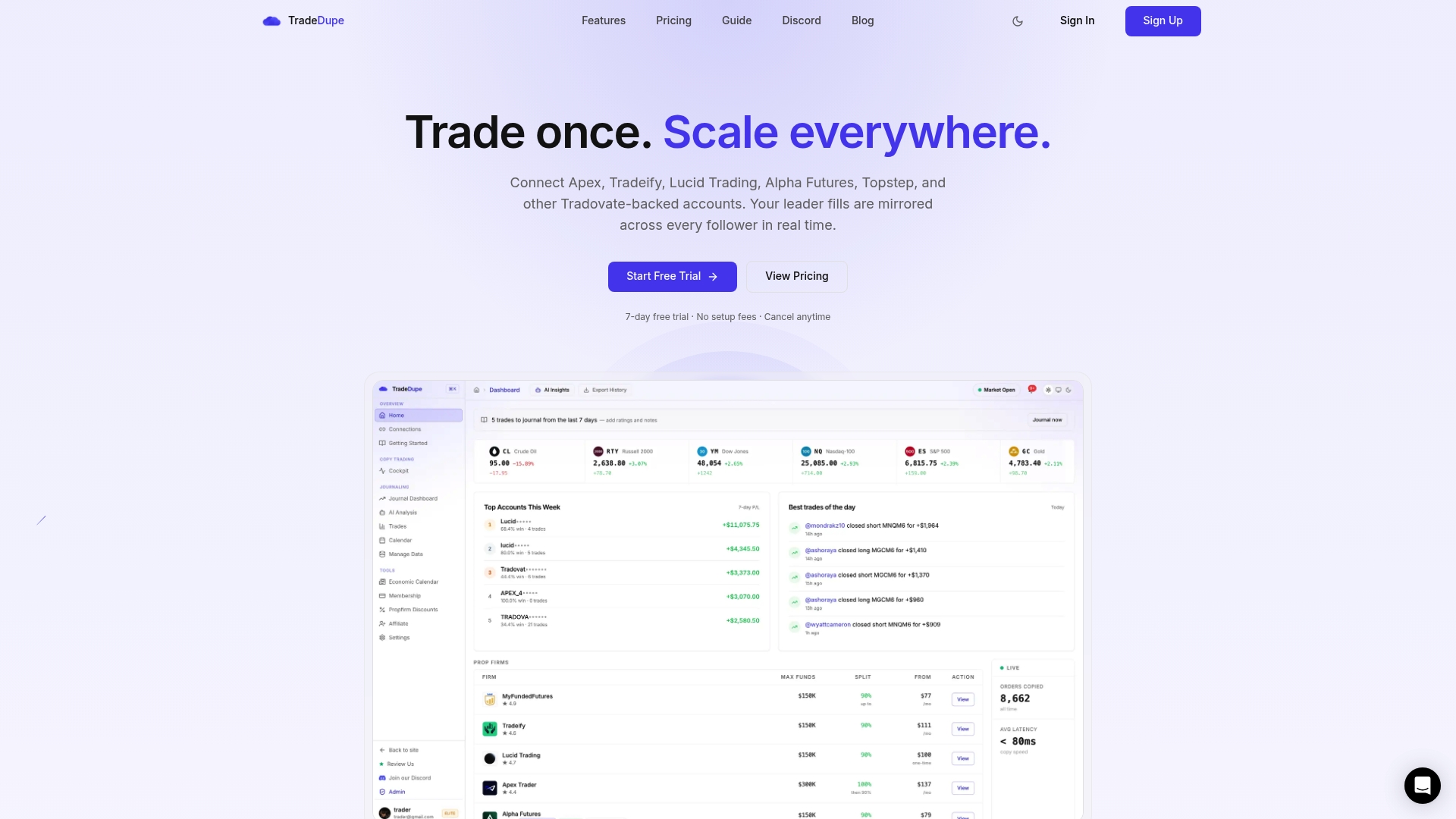
Setup takes minutes, not days. The getting-started guide walks through connecting your Tradovate accounts, configuring alert channels, and setting per-account sizing before you ever copy a live trade. Every sync event lands in a timestamped audit trail, so when a follower account needs review six weeks later, the record is already there. If you're managing more than one funded account and still relying on manual copying or a patchwork of chat alerts, start a trial with Tradedupe and see the dashboard for yourself.
Where to Verify These Claims
For market-level alerting context, Cboe's real-time alert products show how enterprise-grade alerting APIs are structured. Discord's developer documentation covers webhook and bot integration for teams using chat-based secondary channels. For a firsthand look at production alerting workflows, Tradedupe's getting-started documentation outlines onboarding and dashboard monitoring in detail.
This article is general information, not a substitute for advice from a qualified financial advisor. Consult a qualified financial professional about your own circumstances before acting on anything here.