
34ms Mirroring: Per Account Disaster Recovery Trading on Tradovate
TradeDupe
8 min read
A practical recovery playbook for Tradovate prop desks: per account drawdown aware failover, resync tests, and TradeDupe's 34ms mirroring.
Disaster recovery trading, applied to copy trading, means automated failover, state reconciliation, and per-account safety logic that kick in the moment a leader connection drops or an order queue stalls. The single metric that matters is resync speed measured against risk: how fast every follower account gets back in sync with the leader without breaching a drawdown limit. Platforms like Tradedupe exist specifically to make that resync automatic instead of manual.
*
> TL;DR: > > - A disaster recovery system must enable near-instant resynchronization of follower accounts after outages, ideally within seconds, to prevent breaches. > - State reconciliation and per-account risk logic are critical for accurate offsetting of the leader’s trade activity without risking account termination. > - Regular testing, including staged drills and disconnect simulations, ensures recovery processes remain reliable and meet strict RTO and RPO targets. > - Automated failover, heartbeat monitoring, and detailed logging are essential components to maintain continuity and auditability in copy trading. > - Platform-specific auto-recovery solutions, like Tradedupe, exemplify best practices by combining low latency, per-account safety, and real-time monitoring.
*
Table of Contents
- Key Operational Risks That Force a Recovery Plan
- What a Recovery System Actually Needs to Do
- Building the Recovery Checklist Before You Scale Followers
- Testing Cadence, KPIs, and What to Watch
- How TradeDupe Handles This for Tradovate Desks
- What Actually Matters When You Build This
- Getting Started With Automated Copy Trading Recovery
- Sources
Key Operational Risks That Force a Recovery Plan
Copy trading fails in ways that have nothing to do with strategy and everything to do with infrastructure. The most damaging failure mode is drawdown desynchronization: follower accounts often carry different trade histories, balances, and scaling ratios than the leader, so they can hit their drawdown ceiling well before the leader account shows any strain. Finimize's analysis of copy trading inside prop firms points to this account-state blindness as one of the leading causes of avoidable breaches.
A few other failure patterns show up repeatedly on multi-account desks:
- Missed closes on one or more followers, which leave a position open after the leader has flattened
- Partial fills that compound slippage across dozens of accounts simultaneously
- Prop-firm rule violations from copy software that has no awareness of per-account P&L limits or buffer zones
- Broker API outages, dropped heartbeats, or local hardware failures that sever the mirroring link entirely
Fragmented or deliberately obscured copy trading adds another layer of exposure. Finance Magnates has documented how distributed replication across accounts can dodge simple rule checks, which is why network-level correlation detection is becoming a standard ask from serious prop desks, not a nice-to-have.
Statistic Callout: Copy software that ignores individual follower account states can push accounts into breaches the leader never experiences, since prior trade history and position sizing differ account by account.
What a Recovery System Actually Needs to Do
A working disaster recovery setup for copy trading is not one feature. It is a stack of components that each solve a narrow problem, and skipping any one of them tends to be the reason recovery fails under real pressure.
- Heartbeat monitoring and automated takeover. A health check pings the connection continuously; when it misses a threshold, a master/slave or active-active failover engine takes over without a human clicking anything. A well-designed redundant pipeline treats this heartbeat as the trigger for every downstream safety action.
- State reconciliation. After any outage, the system has to re-sync open positions and pending order queues against the leader's actual state, not assume nothing changed while the connection was down.
- Per-account risk logic. Position sizes get calculated from each follower's live balance and drawdown buffer, never copied as raw lot sizes. Getting this wrong is one of the most common ways a funded account gets terminated, according to Finimize's copy trading research.
- Immutable logs and defined recovery targets. Every reconnect, resync, and override gets logged for audit, with clear Recovery Time Objective (RTO) and Recovery Point Objective (RPO) numbers attached.
On RTO and RPO specifically, the bar for automated futures copying is high. PickMyTrade's disaster recovery guide recommends near-zero targets, often seconds or sub-second, for high-frequency automated setups.
Pro Tip: When reconciliation can't complete automatically within your RTO window, don't leave the position open and hope. Build a default safe action, like a per-account flatten or pause, so an unresolved outage never turns into an uncontrolled position.
Building the Recovery Checklist Before You Scale Followers
Adding follower accounts before your recovery plan is tested is how a small connectivity blip turns into a multi-account incident. Work through this sequence before you add the next account, not after.
- Set explicit RTO and RPO targets, then map every dependency behind them, including broker APIs, colocated servers, and cloud regions.
- Configure per-account sizing rules and pre-trade checks so no follower can exceed its drawdown buffer, even during a partial outage.
- Deploy redundant execution paths and heartbeat monitors; broker gateway redundancy matters as much as your own server redundancy.
- Enable auto-recovery flows and rogue-trade detection so the system catches an unauthorized or duplicated order before it compounds.
- Configure per-account toggles and safe-stop behavior so you can pull one follower out of the mirror instantly without touching the rest.
- Schedule staged failover drills and build a post-incident reconciliation and reporting process into your routine, not as an afterthought.
A few habits separate desks that recover cleanly from desks that scramble:
- Treat multi-broker routing as a redundancy layer, not just a cost optimization, since it reduces single-API outage risk.
- Review risk management setup on your charting and execution tools alongside your copy trading controls, not in isolation.
- Never let a new follower account go live without a documented safe-stop procedure attached to it.
Redundant infrastructure paired with automated failover and real-time replication is the baseline Algovantis outlines for continuity in live trading execution, and copy trading is no exception to that baseline.
Testing Cadence, KPIs, and What to Watch
A recovery plan is only as good as its last drill. Algovantis's guidance on disaster recovery planning is blunt about this: untested failover logic is a hypothesis, not a plan.
Three test types cover most of the real failure surface: simulated disconnects (kill the connection, watch the response), integration failovers (force a broker API switch), and full disaster drills (simulate a total outage across every dependency at once).
| Metric | What it tells you |
|---|---|
| Median sync latency | How fast trades mirror under normal conditions |
| Recovery Time Objective (RTO) | How long a full recovery actually takes versus your target |
| Recovery Point Objective (RPO) | How much state (open orders, fills) you could lose in an outage |
| Reconciliation mismatch rate | How often follower state disagrees with the leader after resync |
| Auto-recovery success rate | Percent of incidents resolved without manual intervention |
Run incremental disconnect tests weekly. Reserve full disaster drills for quarterly reviews, since they take real coordination and should feed a post-test report with concrete change items, not just a pass/fail note.
- Log every drill outcome against your RTO/RPO targets, not just against "it worked."
- Feed mismatch-rate data back into your reconciliation logic; a rising rate is an early warning, not noise.
How TradeDupe Handles This for Tradovate Desks
Tradedupe was built around the exact failure modes prop desks run into most often, which is why its core engine centers on server-side execution rather than a local bridge that goes dark the moment your machine does.
- Median 34ms sync latency between leader and follower accounts, with server-side auto-recovery flows that resync state without manual reconnection.
- Rogue-trade detection that flags an order pattern that doesn't match the leader's activity before it compounds across accounts.
- Per-account toggles and scaled sizing controls, so each follower's exposure is computed from its own balance and drawdown buffer, not copied blind.
- Native integrations with the account types most prop desks already run, including Apex, Tradeify, Lucid Trading, and Alpha Futures.
- A real-time dashboard showing sync status, leader/follower activity, and reporting analytics, so an ops lead can see a desync starting before it becomes an incident.
Statistic Callout: Tradedupe's median 34ms mirroring latency is the kind of number that only matters alongside per-account safety checks, since raw speed without drawdown-aware sizing just replicates a mistake faster.
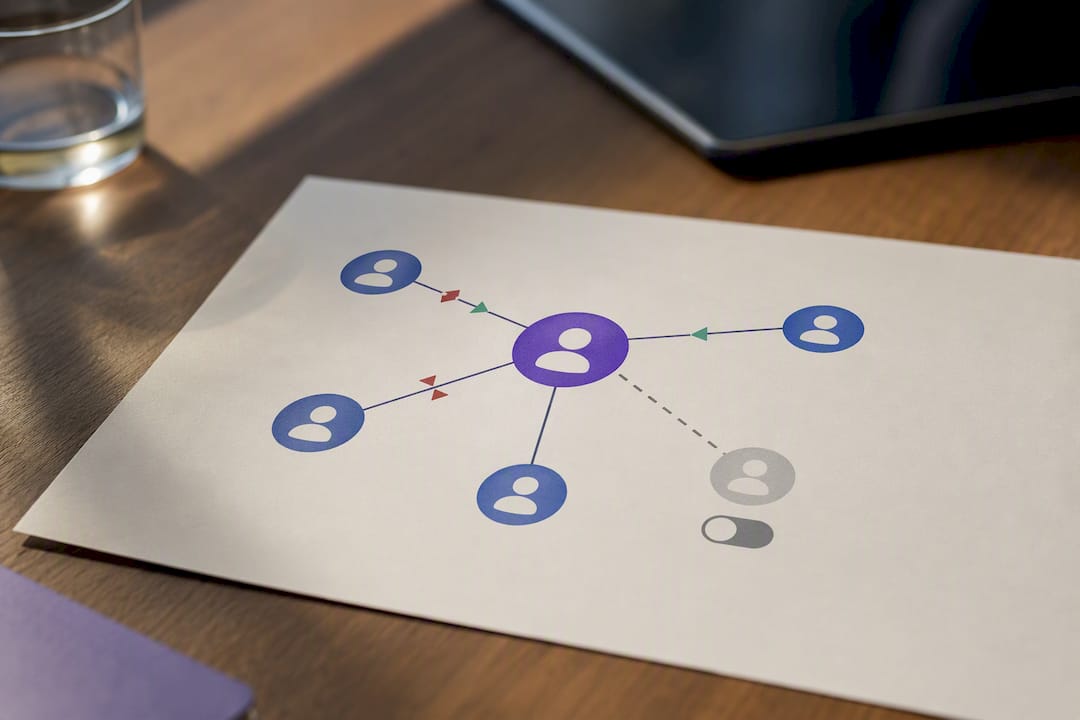
The per-account toggle system matters more than it sounds. It lets a desk operator pull one follower out of the mirror instantly, whether that account hit a rule violation, a broker-side hold, or just needs a manual pause, without disrupting the sync for every other account attached to the same leader.
What Actually Matters When You Build This
Most teams over-index on latency and under-index on auditability. Shaving milliseconds off a sync feels productive, but a system that resyncs fast and wrong is worse than one that resyncs a beat slower and correct. The practical priority is predictable, per-account recovery you can prove after the fact, not a leaderboard number.
Blind scaling is the trap. Adding followers before you've run a real disconnect drill is how a manageable outage becomes an account-ending one. Validate with staged rollouts first. When you need guaranteed, auditable resync behavior across every account, platform-level auto-recovery beats a manual watch-and-react process every time.
> — Andres
Getting Started With Automated Copy Trading Recovery
Tradedupe gives Tradovate prop desks the one thing a manual bridge can't: server-side auto-recovery that keeps every follower account drawdown-aware, even when your local connection drops. That's the concrete difference between watching a dashboard and hoping, versus a system that resyncs itself and logs exactly what happened.
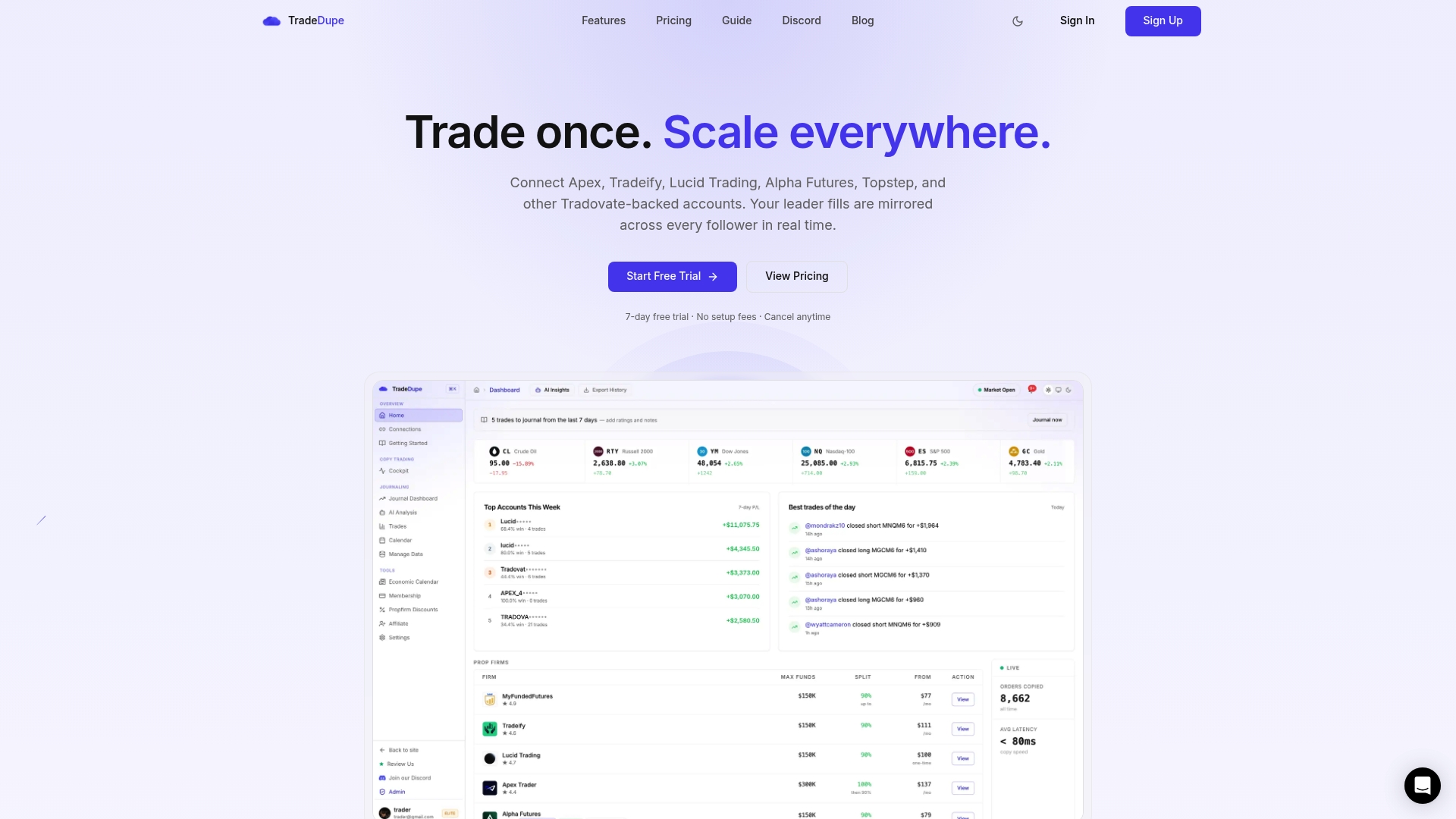
A smart way to evaluate it is a quick-start test: connect one leader account and a single follower, simulate a disconnect, and confirm the auto-recovery flow resyncs correctly before you scale to more accounts. The getting started guide walks through that setup in about ten minutes. From there, check the security and reliability page if you need the architecture detail for a compliance or ops review, and compare membership tiers to match your account count, since individual traders, small teams, and enterprise desks land on different plans. Start a trial and run the disconnect test yourself before committing a full follower roster to it.
Sources
- How Copy Trading Works Inside Proprietary Trading Firms - Finimize
- The systemic cost of copy trading in prop trading firms — Finance Magnates
- Trading Disaster Recovery guide (2026) - PickMyTrade
- Disaster recovery planning for seamless live trading execution continuity - Algovantis