
What Is Real-Time Trade Synchronization for Prop Traders?
TradeDupe
9 min read
Discover how real-time trade synchronization empowers prop traders by mirroring strategies across accounts, enhancing control and efficiency.
Real-time trade synchronization is trade mirroring: a system that copies a leader account's executed orders to follower accounts almost instantly, with per-account rules controlling how much each follower risks. For a prop desk running several Tradovate-funded accounts, that means one trader's entry, adjustment, and exit gets replicated everywhere else without anyone touching a second mouse.
The payoff is straightforward. You scale a single strategy across multiple funded accounts without multiplying your workload, you enforce identical rules everywhere instead of trusting manual execution, and you catch account-specific problems (a stuck order, a broken connection) before they turn into a blown evaluation. Tradedupe builds this specifically for Tradovate users, with server-side execution designed to keep follower accounts in step with the leader.
What real-time sync actually delivers:
- Centralized control over dozens of accounts from one leader terminal
- Consistent rule enforcement, since every follower inherits the same trade logic
- Faster response to account-level issues through live monitoring instead of after-the-fact discovery
Key Takeaways
Real-time trade synchronization works because it replaces manual, error-prone multi-account execution with automated mirroring governed by measurable latency, sizing, and risk rules.
| Point | Details |
|---|---|
| Definition matters | Real-time sync means trade mirroring with an acceptable execution delta, not identical simultaneous fills. |
| Infrastructure sets latency | Local/VPS setups reach single-digit ms; cloud/server-side transports typically run tens to hundreds of ms. |
| Test before scaling | Run full-lifecycle sandbox tests (open, partial close, trail, close) and reconnect scenarios before adding followers. |
| Treat accounts as one bankroll | Set total exposure caps and risk-percentage scaling instead of copying fixed lot sizes across accounts. |
| Tradedupe fits the Tradovate stack | It offers 34ms median server-side mirroring, rogue-trade detection, and per-account toggles built for prop desks. |
Table of Contents
- How Real-Time Trade Synchronization Works Under the Hood
- Features to Require from a Copy-Trading System
- Deploying and Validating Sync on Tradovate: A Runbook
- Risk Controls That Keep Mirroring From Amplifying Losses
- Metrics and Tests That Catch Drift Early
- When to Mirror Aggressively and When to Hold Back
- Running Real-Time Sync on Tradovate with Tradedupe
- Frequently Asked Questions
- Sources
How Real-Time Trade Synchronization Works Under the Hood
Every mirroring system runs the same basic pipeline: the leader account fires an event (open, modify, close), that event travels through a transport layer, a broker adapter translates it into an order Tradovate can execute, and the follower account fills. Where that pipeline lives determines how fast it runs.

Local or VPS-based setups process everything on infrastructure sitting close to the broker's servers, which keeps network hops to a minimum. Cloud or server-side transports route the same event through a remote service before it reaches the follower, adding a step but usually gaining resilience and easier multi-broker reach in return. A trade copier can be built either way, and local/VPS deployments typically hit single-digit millisecond latency while cloud/server-side setups usually run in the tens to hundreds of milliseconds.
That distinction matters more for some strategies than others:
- Scalpers reading order flow off single-tick moves need the fastest transport available, since even 50ms of delay can put a follower into a materially different price.
- Swing and position traders working wider stops can tolerate cloud-level latency without meaningfully changing their outcomes.
- Anyone mixing both styles across accounts should size latency-sensitive strategies to the fastest followers and route slower ones elsewhere.
Latency isn't the only source of divergence. Symbol mapping (making sure "MES" on one account maps to the correct contract on another), lot-size conversion across accounts with different position limits, and rounding when a multiplier produces a fractional contract all create small but real gaps between leader and follower fills. Good architecture accounts for reasonable network variance from VPS or server-side infrastructure before it ever reaches a live account.
Pro Tip: Don't chase mathematically identical fills across accounts. Define an acceptable execution delta up front, then monitor against that number instead of treating every microsecond gap as a failure.
Features to Require from a Copy-Trading System
A mirroring tool that only replicates trades isn't finished. Production-grade systems for trade copier software built around Tradovate need controls that catch problems before they compound across your entire account roster.
At minimum, look for:
- Per-account sizing and toggles so each follower can run its own multiplier or be switched off individually without disrupting the rest.
- Rogue-trade detection that flags orders inconsistent with the leader's intended trade, before they execute on every follower.
- Auto-recovery with idempotent operations, meaning a reconnect after a dropped session doesn't produce duplicate fills.
- A live dashboard showing sync status, latency per account, and leader/follower activity in one view.
- Logging sufficient for compliance and audits, since prop firms increasingly scrutinize identical fills across accounts.
- Per-account drawdown caps paired with disable-on-error behavior, so a single misfire doesn't cascade.
Skipping any of these doesn't just create inconvenience. It creates the exact silent drift that turns a working strategy into a blown account you didn't see coming.
Deploying and Validating Sync on Tradovate: A Runbook
Rolling out real-time synchronization without a structured process is how desks end up with mismatched positions and no idea why. Follow this sequence instead.
- Document every prop firm's rules first. Copy trading restrictions, account-identification requirements, and payout audit policies vary by firm. Secure your Tradovate credentials with unique identifiers per account before connecting anything.
- Choose your transport and infrastructure. Decide between VPS-level speed and cloud-level resilience based on the strategies you're running, not on whichever option is cheaper that month.
- Run full-lifecycle sandbox tests. Open a position, take a partial close, move to break-even, trail a stop, then close entirely, and verify every step reconciles correctly across all connected follower accounts.
- Stress-test reconnects. Kill the connection mid-trade and confirm the system recovers without duplicating fills, a scenario full-lifecycle testing across reconnects is specifically designed to catch.
- Configure sizing rules and latency thresholds, then pilot with a single follower account before scaling to your full roster.
Pro Tip: Treat the sandbox phase as non-negotiable, even if you're confident in the platform. A rounding error that only shows up on a $25,000 account with a 0.5 lot multiplier won't surface until you've already scaled to ten followers.
Risk Controls That Keep Mirroring From Amplifying Losses
Copying one trade across ten accounts doesn't diversify your risk. It concentrates the exact same position ten times over, and treating multiple funded accounts as one bankroll rather than ten separate balance sheets is the only way to see your real exposure.
Build these guardrails before you scale past a pilot account:
- Set a total exposure cap across all connected accounts, calculated as if they were a single portfolio.
- Scale by risk percentage rather than fixed lot size, so a $150,000 account and a $25,000 account each risk proportionally, not identically.
- Define per-account maximum drawdown and wire it to an automatic kill-switch, not a manual check.
- Assign unique account identifiers and keep detailed execution records, since prop firms perform ownership and IP audits at payout and can flag identical fills across accounts they don't expect to be linked.
None of this is optional paperwork. It's the difference between passing a payout review and explaining why five accounts show the exact same entry timestamp.
Metrics and Tests That Catch Drift Early
Synchronization problems rarely announce themselves. They show up as a slightly worse average fill, a follower account that's quietly two trades behind, or a reconciliation report nobody read closely enough. Weekly audits and full-lifecycle test runs catch these before they cost real money.
Slippage deserves particular attention, since differing spreads, partial fills, and latency all produce slippage independently, and market-replay testing helps you tell which cause is actually driving your numbers.
| Metric | What it signals |
|---|---|
| Sync latency (ms) | Rising latency signals infrastructure strain or network congestion |
| Slippage per trade | Wide slippage points to transport delay or thin liquidity |
| Order rejection rate | Spikes often trace to symbol mismatches or margin issues |
| Reconciliation success rate | Drops indicate duplicate fills or missed reconnects |
Automated responses should match the failure. A latency spike above a set threshold, commonly 150ms for scalping strategies or 300ms for swing setups, should pause new copies rather than force a bad fill. A failed reconciliation should queue for retry and alert a human, never fail silently.
When to Mirror Aggressively and When to Hold Back
The instinct to copy every trade across every account is understandable and usually wrong. Ultra-low-latency scalps depend on execution speed that most transport layers, even fast ones, can't guarantee will hold across five or ten accounts simultaneously. Save synchronization for strategies that tolerate tens to hundreds of milliseconds of variance without the trade thesis falling apart.
Define your acceptable execution delta before you go live, not after a bad week. If your strategy assumes fills within a few ticks of the leader, monitor for exactly that and pause when reality drifts past it.
The bigger shift is cultural. The moment you connect a second Tradovate account to a leader, you're no longer running separate accounts. You're running a fund with one consolidated bankroll, and every risk decision should reflect that math, not the comfortable illusion of ten independent shots at passing an evaluation.
Running Real-Time Sync on Tradovate with Tradedupe
Tradedupe is built around the exact architecture this article describes: server-side mirroring with a median latency of 34ms, rogue-trade detection watching every leader event, and auto-recovery that handles reconnects without duplicating fills. Per-account toggles let you pause a single follower without touching the rest, and the dashboard gives you live sync status, latency, and leader/follower activity in one screen instead of five browser tabs.
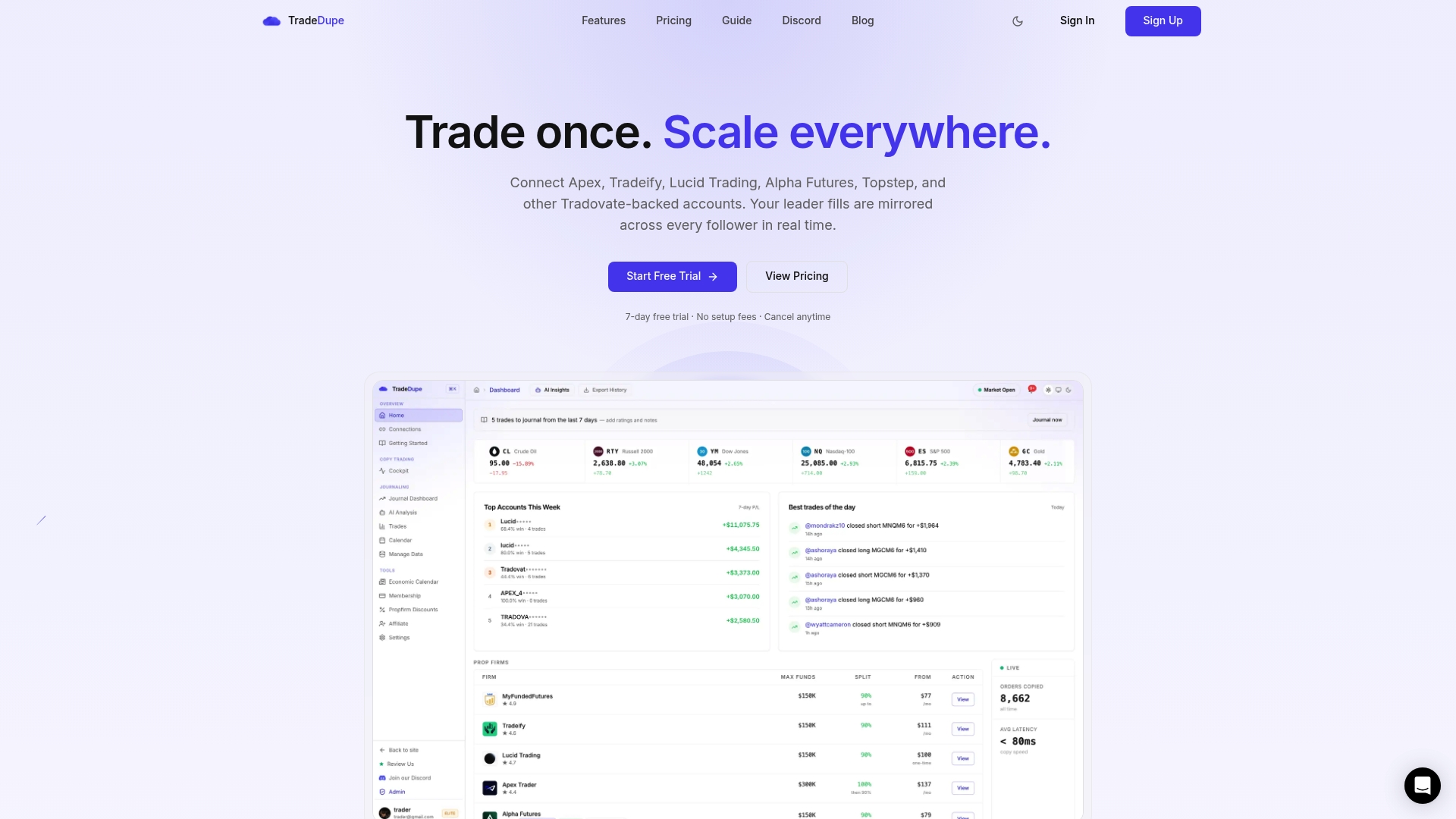
The platform connects to Tradovate alongside supported prop firm integrations including Apex, Tradeify, Lucid Trading, and Alpha Futures, with subscription tiers built for solo traders, small teams, and enterprise desks running unlimited broker connections. If you're running multiple funded accounts and still copying trades by hand, start a sandbox trial on the futures trade copier page and run your own full-lifecycle test before you scale past one follower.
Frequently Asked Questions
Is real-time trade synchronization the same as copy trading? Yes, in the multi-account prop context. Real-time trade synchronization is the technical mechanism, and copy trading (or trade mirroring) is the practical result: one leader's orders replicated to followers automatically.
What latency should I expect from a trade copier on Tradovate? It depends on your transport. Local or VPS-based systems can reach single-digit millisecond latency, while cloud/server-side transports usually run tens to hundreds of milliseconds. Match your infrastructure choice to your strategy's sensitivity to delay.
Can real-time sync cause me to breach prop firm rules? It can, if you treat connected accounts as independent risk pools instead of one combined bankroll. Document each firm's copy-trading policy, use unique account identifiers, and keep detailed logs to withstand a payout audit.
What happens if my connection drops mid-trade? A properly built system uses idempotent operations tied to unique transaction IDs, so a reconnect retries safely without producing duplicate fills. Auto-recovery should also flag the interruption for manual review.
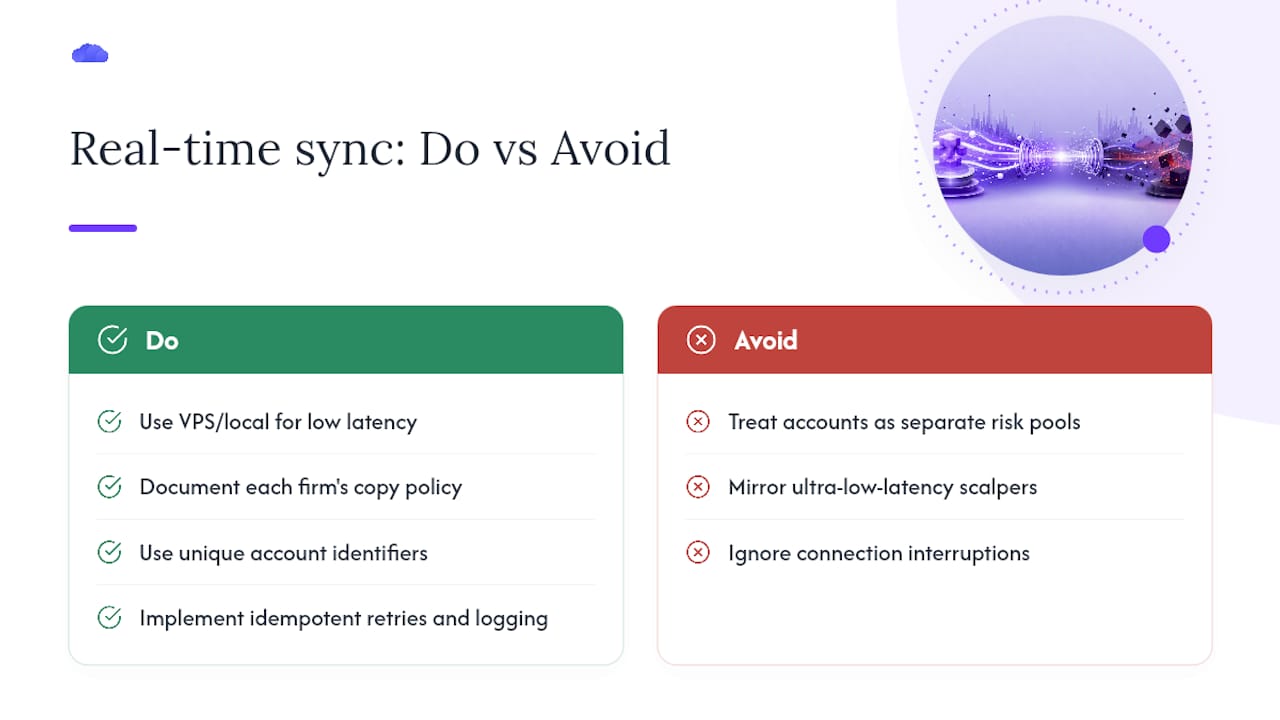
Should I mirror every strategy across every account? No. Ultra-low-latency scalping strategies often don't tolerate the delay introduced by mirroring across multiple accounts. Reserve real-time synchronization for strategies with wider tolerances and define an acceptable execution delta for each one.
Sources
- Trade Copier: How They Work and What Breaks Them — JP Trading Capital
- How to Manage Multiple Funded Accounts with a Trade Copier — TTT Markets
- Trade Copying Across Multiple Prop Firm Accounts Safely — TradingIM