High-Volume Futures Trading: A Prop Desk Operations Guide
TradeDupe
15 min read
Discover what high-volume futures trading is and how it enhances liquidity and operational efficiency for prop desks. Learn more!
High-volume futures trading describes sustained periods when contracts traded per timeframe — measured in contracts per minute or session totals — exceed normal averages by a material margin, improving liquidity and price discovery while simultaneously raising the operational bar for prop desks. For multi-account copy trading operations, that bar includes stricter margin monitoring, tighter latency requirements (Tradedupe benchmarks median leader-to-follower mirroring latency at a low value suitable for high-frequency trading), and real-time risk controls across every follower account. Three entities define the operating environment: the CFTC sets registration and reporting obligations for firms acting as intermediaries, CME Group provides the exchange liquidity infrastructure, and Tradedupe delivers the server-side copy trading architecture that keeps multi-account execution synchronized under pressure.
Key operational implications at a glance:
- Lower per-contract market impact when resting liquidity is deep, but higher competition from algorithmic participants
- Simultaneous margin exposure across all follower accounts during rapid moves, requiring automated kill-switches
- Latency sensitivity increases as volume rises — a low-latency median mirroring benchmark becomes a meaningful SLA, not just a nice-to-have
*
Table of Contents
- What Does "High Volume" Actually Mean in Futures Markets?
- When Do High-Volume Windows Occur in U.S. Futures Markets?
- Why Prop Desks Seek High-Volume Windows — and the Trade-Offs
- Execution Strategies for High-Volume Futures Environments
- Risk, Margin Mechanics, and CFTC Considerations for Prop Firms
- Multi-Account Copy Trading: Latency, Synchronization, and Controls
- Pre-Flight Checklist Before Enabling High-Volume Copy Trading
- What Does It Cost to Deploy a High-Volume Multi-Account Setup?
- How Prop Desks Should Manage High-Frequency Market Data
- Compliance Monitoring in Multi-Account Futures Environments
- Risk Management Frameworks for High-Frequency, Multi-Account Operations
- Disaster Recovery and Business Continuity for Automated Futures Systems
- Key Takeaways
- The Discipline Gap Nobody Talks About
- Tradedupe Gives Prop Desks the Infrastructure to Scale Safely
- Useful Sources and Further Reading
What Does "High Volume" Actually Mean in Futures Markets?
Volume in futures is the total number of contracts exchanged in a given time interval — a direct measure of participation intensity. "High volume" is not an absolute number; it is a relative threshold calibrated per instrument and timeframe.
Practical measurement units include contracts per bar, contracts per minute, and session totals. Open interest complements volume: rising open interest alongside rising volume signals new money entering a trend, while falling open interest during a volume spike often indicates liquidation rather than fresh positioning.
| Metric | What It Measures | Operational Use |
|---|---|---|
| Contracts/min | Execution intensity within a bar | Trigger for latency SLA checks |
| Session total | Full-day participation | Classify session as high/normal/low |
| Volume delta | Buy vs. sell aggression | Order-flow directional bias |
| VWAP deviation | Price vs. volume-weighted average | Execution benchmark and slippage reference |
| Volume profile | Price levels with concentrated trading | Support/resistance and liquidity mapping |
A practical threshold: intraday high volume often registers above 2× the rolling 20-bar average for that instrument. Session-level, the top 10% of historical session totals is a reasonable working definition — but every contract requires its own calibration.
Pro Tip: Prefer session-VWAP and rolling 5–20 bar volume-average comparisons over absolute contract counts when your desk trades multiple instruments with different contract sizes. Absolute numbers mislead; relative comparisons scale.
*
When Do High-Volume Windows Occur in U.S. Futures Markets?
Predictable windows and event-driven spikes follow distinct patterns. Trading during cash-market opens consistently produces superior liquidity and tighter spreads for U.S. equity index futures.
Recurring high-volume windows:
- 09:30 AM ET — cash equity open drives peak volume in E-mini S&P 500, Nasdaq, and Dow futures
- Cash close (3:45–4:00 PM ET) — institutional rebalancing and MOC orders create a secondary spike
- Overnight session transitions — CME Globex open (6:00 PM ET) and European cash open (3:00–4:00 AM ET) for commodity and FX futures
Event-driven spikes to monitor:
- Major economic releases: Non-Farm Payrolls, CPI, FOMC decisions
- EIA crude oil inventory reports (typically Wednesdays, with Thursday as the alternate)
- Options and futures contract rolls (quarterly for equity index, monthly for commodities)
- Geopolitical announcements and Fed speeches
Crude oil concentrates weekly volume around EIA release days, while equity index futures concentrate around the daily cash open. The practical implication: monitor real-time economic calendars and CME exchange notices rather than relying on fixed schedule assumptions alone.
*
Why Prop Desks Seek High-Volume Windows — and the Trade-Offs
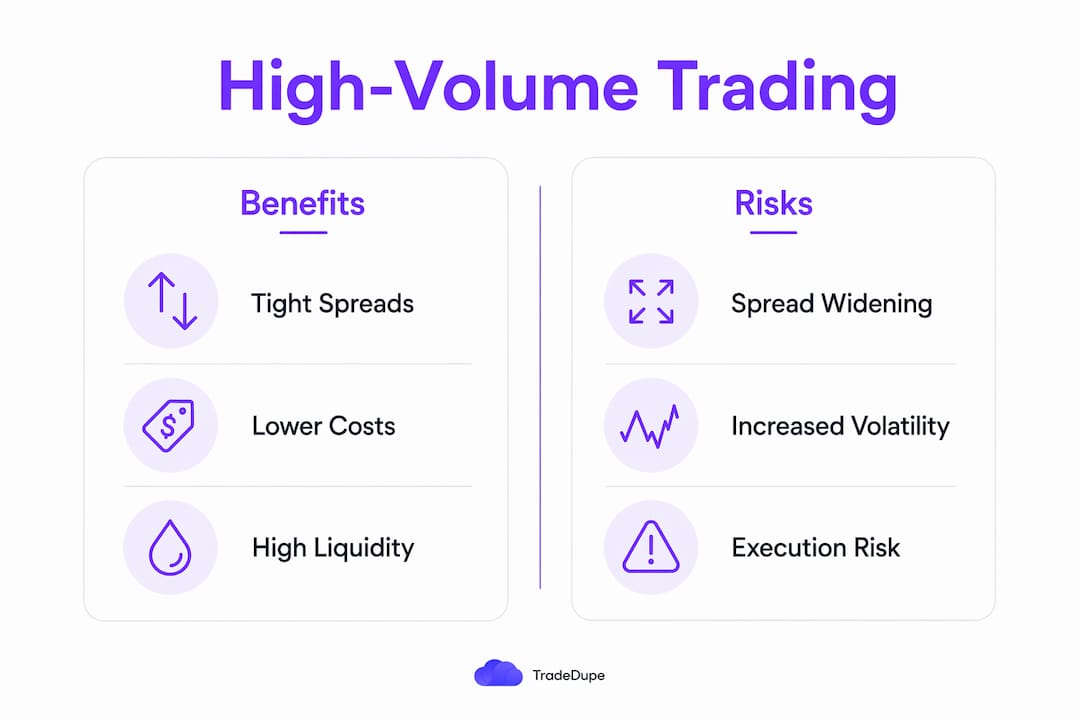
High volume is not inherently better. Experienced traders use volume alongside order-flow tools to distinguish genuine continuation signals from liquidation spikes — a distinction that separates profitable desks from those that chase noise.
| Factor | High-Volume Benefit | High-Volume Risk |
|---|---|---|
| Spreads | Tighter bid/ask, lower fill cost | Can widen instantly on news spikes |
| Liquidity depth | Larger orders with lower market impact | Algos absorb liquidity faster |
| Price discovery | Faster, more accurate | Volatile, prone to stop runs |
| Execution speed | Faster fills at target price | Requires sub-50ms infrastructure |
| Strategy fit | Scalping, VWAP capture, liquidity-seeking | Long-term mean reversion suffers |
Strategy fit matters as much as timing. Scalping and liquidity-seeking algorithms thrive in deep, fast markets. Long-term mean-reversion approaches often perform worse during high-volume windows because the noise-to-signal ratio rises sharply. Selecting strategy by market regime rather than forcing one approach regardless of conditions is the discipline that separates consistent desks from reactive ones.
*
Execution Strategies for High-Volume Futures Environments
The execution methods used in high-volume futures trading each carry specific infrastructure requirements. Order-flow and algorithmic strategies demand more operational rigor than simpler trend-following approaches — the gap shows up in both technology spend and trader discipline.
Core execution methods:
- Order-flow trading — reading the footprints left by large participants via volume delta and tape reading
- VWAP/TWAP slicing — breaking large orders into child orders that participate at a target rate relative to market volume
- Iceberg and dark-style algos — hiding order size to minimize market impact while accumulating or distributing
- Scalping — capturing small price dislocations at high frequency, requiring sub-millisecond routing
- Liquidity-seeking reversals — fading stop runs and liquidity sweeps identified through order-flow imbalances
Execution architecture requirements include colocated or low-latency servers, direct market access (DMA) to CME Group venues, smart order routing, and high-resolution Level 2 data feeds. For multi-account copy trading strategies, add deterministic order sequencing and per-account acknowledgment handling to that list.
Pro Tip: Run pre-trade slippage budgets and synthetic VWAP checks before each session. Replay historical high-volume windows in simulation before deploying any new execution algo live — a single misconfigured participation rate can move the market against you across all follower accounts simultaneously.

*
Risk, Margin Mechanics, and CFTC Considerations for Prop Firms
Futures are marked to market daily — gains are credited and losses debited every session. For a multi-account prop desk running correlated positions, a sharp adverse move can trigger simultaneous margin calls across every account, compressing clearing lines faster than manual intervention allows.
| Risk Category | Description | Mitigation |
|---|---|---|
| Margin call cascade | Simultaneous MTM losses across correlated accounts | Per-account margin buffers, automated de-risking |
| Concentration risk | All followers in the same position | Position limits per account, diversified leader strategies |
| Rogue trade | Erroneous order executed on one or more accounts | Auto-detection and kill-switch with auto-recovery |
| CFTC registration | Firms acting as intermediaries may trigger registration obligations | Legal review of activity scope before scaling |
| Synchronization failure | Leader fills without follower confirmation | Server-side ACK handling, real-time sync monitoring |
CFTC registration and reporting obligations apply depending on the nature of the activity — firms acting as commodity pool operators, commodity trading advisors, or introducing brokers face specific registration requirements. Confirm your activity scope with qualified legal counsel before scaling a multi-account operation. For risk management frameworks across leveraged instruments, the principle is consistent: size clearing lines to survive stress scenarios, not just average conditions.
*
Multi-Account Copy Trading: Latency, Synchronization, and Controls
Server-side execution is the baseline requirement for scalable multi-account copy trading. Manual mirroring introduces latency and reconciliation risk that compounds with account count — what works across three accounts breaks at thirty.
Infrastructure requirements:
- Server-side order routing with deterministic order IDs and per-account ACK confirmation
- Median leader-to-follower latency at or below 34ms as a practical SLA for high-volume sessions
- Per-account position limits and toggle controls to isolate or pause individual accounts without affecting others
- Rogue-trade detection with auto-recovery to catch and correct erroneous fills before they propagate
- Real-time dashboard showing sync status, per-account P&L, margin telemetry, and alerts for partial rejections or asynchronous fills
Slippage distribution tracking matters as much as median latency. A 34ms median with a long tail of 200ms+ outliers during high-volume windows signals a routing or network bottleneck that will cost real money at scale. Measure both median and 95th-percentile latency across sessions.
*
Pre-Flight Checklist Before Enabling High-Volume Copy Trading
| Readiness Area | Check Item | Pass Criteria |
|---|---|---|
| Technical | Stress-test replay on top 10 historical high-volume sessions | Zero synchronization failures, latency SLA met |
| Technical | Failover and DR plan documented and tested | Sub-5-minute recovery target validated |
| Risk | Per-account limit tests with simulated margin shocks | Kill-switch triggers correctly, no cascade |
| Risk | Automated kill-switch validation | Confirmed across all follower accounts |
| Compliance | CFTC registration scope reviewed by legal counsel | Activity classification confirmed |
| Compliance | Client/firm disclosures and recordkeeping in place | Audit trail complete |
| Testing | Shadow trading / market replay with increasing account counts | Staged pilot passed before production |
Pro Tip: Run your staged pilot during a known high-volume window — not a quiet session. Stress conditions reveal synchronization gaps that normal volume hides. Start with 3–5 follower accounts, validate, then double.
*
What Does It Cost to Deploy a High-Volume Multi-Account Setup?
Cost structure varies significantly by instrument, account count, and infrastructure choices. Fixed costs tend to be dominated by connectivity and market data; variable costs by per-contract commissions and slippage.
| Cost Bucket | Nature | Notes |
|---|---|---|
| Co-location / private link | Fixed | Largest fixed cost for latency-sensitive ops |
| Market data feeds (Level 2) | Fixed | Required for order-flow and VWAP execution |
| Exchange and clearing fees | Variable | Per-contract, set by CME Group and FCM |
| Per-contract commissions | Variable | Negotiable at volume with FCM |
| Platform / SaaS subscription | Fixed recurring | Scales with account count and feature tier |
| Engineering and monitoring OPEX | Fixed recurring | Grows with account count and complexity |
Sample deployment timeline:
- Discovery and design: 2–4 weeks (architecture, compliance review, broker setup)
- Integration and development: 4–8 weeks (API connections, order routing, dashboard)
- Simulated testing and pilot: 2–4 weeks (market replay, staged account ramp)
- Phased production rollout: 1–4 weeks (progressive account count increase with monitoring)
Size your clearing lines and margin buffers using stress test scenarios, not average-day assumptions. A single high-volatility session can consume multiples of normal daily margin.
*
How Prop Desks Should Manage High-Frequency Market Data
High-frequency market data acquisition, storage, and real-time processing form the backbone of any high-volume futures operation. At the data layer, the architecture splits into three distinct problems: ingestion speed, storage fidelity, and query latency.
For ingestion, direct CME market data feeds (via CME Globex or a co-located feed handler) deliver tick-by-tick Level 2 data with microsecond timestamps. Normalized feed handlers convert raw binary protocols (FIX/FAST or CME's proprietary format) into structured tick streams that downstream systems can consume. Any normalization step that adds latency is a liability during high-volume windows.
Storage requires a time-series database optimized for write throughput and columnar reads. Systems like KDB+/Q, InfluxDB, or TimescaleDB are purpose-built for this workload. Raw tick data for a single liquid futures contract can generate hundreds of gigabytes per month; retention policies should distinguish between hot storage (real-time and intraday replay) and cold storage (historical backtesting archives). Real-time processing pipelines typically use in-memory streaming frameworks to compute rolling VWAP, volume delta, and volume profile metrics with sub-second latency, feeding both execution algos and the monitoring dashboard simultaneously.
*
Compliance Monitoring in Multi-Account Futures Environments
Multi-account operations create compliance surface area that single-account desks never encounter. Every follower account is a separate regulatory entity from the perspective of position reporting, margin maintenance, and trade recordkeeping.
Effective compliance monitoring requires automated surveillance tools that flag position limit breaches, unusual order patterns, and wash-trade-adjacent behaviors across all accounts in real time. Pre-trade risk checks — maximum order size, daily loss limits, and instrument restrictions — should be enforced at the order-routing layer, not just reviewed post-trade. Post-trade reconciliation must confirm that every leader fill has a corresponding follower fill within the expected latency window; gaps require immediate investigation and documentation.
For CFTC-regulated entities, large trader reporting thresholds apply at the account level. A prop desk running many correlated accounts can aggregate toward reportable thresholds faster than expected. Designate a compliance owner whose sole responsibility is monitoring these thresholds and maintaining the audit trail required for regulatory examination. Copy trade systems built for risk managers centralize this monitoring, reducing the manual overhead that grows linearly with account count.
*
Risk Management Frameworks for High-Frequency, Multi-Account Operations
A risk management framework for high-frequency, multi-account futures trading operates across three layers: pre-trade, intraday, and post-trade.
Pre-trade controls set hard limits before any order reaches the exchange: maximum position size per account, maximum daily loss per account, instrument whitelist, and maximum order rate (orders per second). These controls live at the order-routing layer and cannot be overridden by the execution algo.
Intraday monitoring tracks real-time P&L, margin utilization, and position concentration across all accounts simultaneously. When any account breaches a threshold — say, 50% of its daily loss limit — the system should alert and optionally throttle new orders. At 80%, an automated pause; at 100%, a full kill-switch. The kill-switch must be synchronous across all follower accounts, not sequential.
Post-trade analysis closes the loop: slippage attribution, fill quality scoring, and correlation analysis across accounts identify whether losses stem from strategy, execution, or infrastructure. Reviewing slippage distribution after every high-volume session is standard practice for desks that take execution quality seriously.
*
Disaster Recovery and Business Continuity for Automated Futures Systems
Automated high-volume futures systems have a narrow tolerance for downtime. A five-minute outage during the 09:30 ET equity open can mean missed fills, unhedged positions, and margin exposure that accumulates faster than a manual team can respond.
A credible business continuity plan covers four failure modes: network outage, primary server failure, exchange connectivity loss, and software crash. For each, the plan specifies a recovery time objective (RTO) and a recovery point objective (RPO). For live trading systems, an RTO of under five minutes is the practical standard; for data integrity, an RPO of zero (no lost fills) is the goal.
Architectural mitigations include active-passive server failover with sub-second switchover, redundant network paths (primary co-location plus a secondary data center), and heartbeat monitoring that triggers automatic failover without human intervention. All open positions must be readable from the backup system at the moment of failover — position state synchronization between primary and secondary is not optional. Test the full failover sequence quarterly, during a live session, not just in a maintenance window.
*
Key Takeaways
High-volume futures trading demands synchronized infrastructure, calibrated risk controls, and CFTC-aware compliance practices before a single live order routes across multiple accounts.
| Point | Details |
|---|---|
| Measure volume relatively | Use rolling 20-bar averages and session percentiles, not absolute contract counts, to classify high-volume conditions. |
| Target 34ms mirroring latency | Median leader-to-follower latency in the low milliseconds is the practical SLA for high-volume copy trading sessions. |
| Per-account kill-switches are mandatory | Synchronous kill-switches across all follower accounts prevent margin cascade during correlated adverse moves. |
| Confirm CFTC registration scope | Firms acting as intermediaries across multiple accounts may trigger registration obligations — review before scaling. |
| Use staged pilots under stress | Replay top historical high-volume sessions with increasing account counts before any production rollout. |
| Tradedupe as infrastructure layer | Tradedupe provides server-side mirroring, rogue-trade detection, per-account toggles, and real-time dashboards purpose-built for Tradovate multi-account prop desks. |
*
The Discipline Gap Nobody Talks About
The technical requirements for high-volume multi-account futures trading are well-documented. The discipline gap is not.
Most prop desks that struggle with high-volume copy trading do not fail because of latency or infrastructure. They fail because they scale account count before they have validated their risk controls under stress. A kill-switch that works in a quiet session behaves differently when 40 follower accounts are simultaneously receiving fills during a Non-Farm Payrolls spike. The only way to know your system holds is to have tested it under those exact conditions — not similar conditions, not average conditions.
The staffing model matters too. A high-volume multi-account operation needs four distinct roles: a trading lead who owns strategy and execution decisions, an execution engineer responsible for latency and routing integrity, a risk manager monitoring margin and position limits in real time, and a compliance owner tracking CFTC thresholds and recordkeeping. Collapsing these into two people is where most mid-sized prop desks create their largest operational risk.
Scale deliberately. The desks that run high-volume copy trading profitably are not the ones with the fastest algos — they are the ones that built the risk and compliance layer first, then added accounts.
*
Tradedupe Gives Prop Desks the Infrastructure to Scale Safely
Running high-volume copy trading across multiple Tradovate accounts without server-side infrastructure means accepting synchronization errors, manual reconciliation overhead, and latency that compounds with every account you add. Tradedupe eliminates that overhead directly.
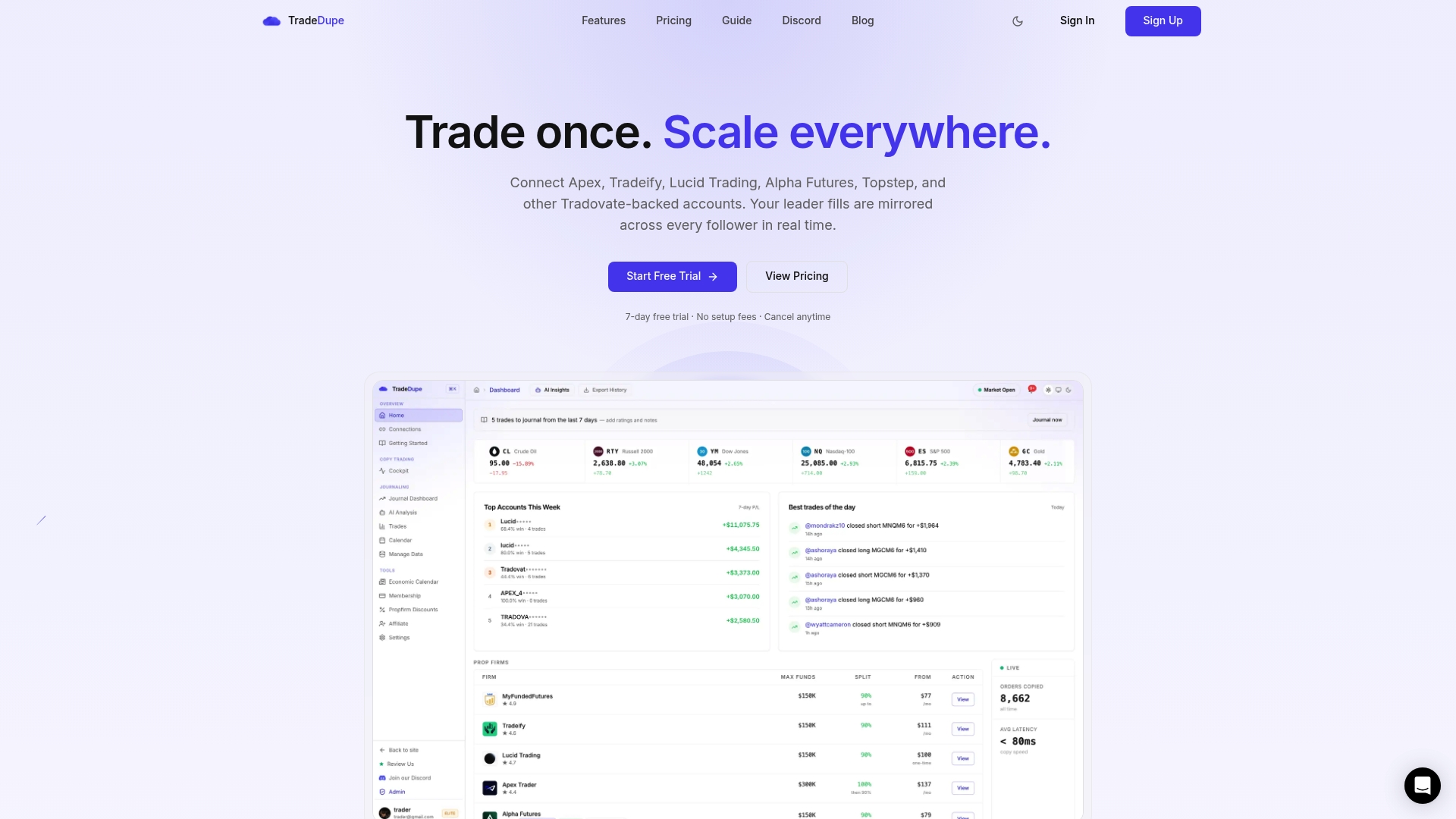
The platform mirrors trades from a single leader account to unlimited follower accounts with a median latency of 34ms, with rogue-trade detection and auto-recovery running continuously in the background. Per-account toggle controls let you pause or isolate any follower account without touching the others. The real-time dashboard surfaces sync status, per-account P&L, and margin telemetry in one view — the same view your risk manager needs during a high-volume session. Supported integrations include Apex, Lucid Trading, and Alpha Futures, making Tradedupe a natural fit for prop desks already operating within those ecosystems.
Start your staged pilot with Tradedupe and validate your multi-account setup against real high-volume conditions before committing to full production scale.
*
Useful Sources and Further Reading
- Basics of Futures Trading — CFTC: Primary regulatory reference for CFTC registration, margin, and daily mark-to-market mechanics
- Interpreting Volume in the Futures Market — Investopedia: Foundational primer on volume as a measure of market intensity
- Understanding Volume and Open Interest — TradingCharts: Explains the three-dimensional relationship between price, volume, and open interest
- Analyze Volume in Futures Markets — NinjaTrader: VWAP, volume profile, and order-flow indicator reference
- High Volume Trading Hours for Futures Markets — TradingSim: Session timing guidance and calendar-monitoring best practices
- Futures Trading Strategies Ranked by Difficulty — NinjaTrader: Execution complexity and discipline requirements by strategy type
- Futures Trade Copier for Prop Firms — Tradedupe: Core product page covering server-side mirroring, rogue-trade detection, and analytics
- Best Futures Trading Strategy for Copy Trading — Tradedupe Blog: Order flow vs. ICT strategy analysis for multi-account environments
- Futures Trading Glossary — Tradedupe: Quick reference for volume, VWAP, open interest, and execution terminology