Why Execution Speed Matters in Copy Trading for Prop Desks
TradeDupe
16 min read
Discover why execution speed matters in copy trading. Learn how latency impacts performance and profitability in your trading strategies.
Execution speed is a determinative factor in copy-trading fidelity. Every millisecond between a leader's fill and a follower's submission is a window for price to move against you, and across dozens of accounts, that divergence compounds into measurable P&L inconsistency. Tradedupe's median 34ms copy latency on Tradovate illustrates what a production-grade system can achieve. Industry benchmarking confirms the relationship: latency maps directly to slippage, with larger delays producing increasing price divergence during volatile windows.
What to measure and where to start:
- Median latency — your baseline fill quality under normal conditions
- p95 latency — the worst-case tail that determines risk on fast-moving entries
- Jitter — variance between fills that creates unequal P&L across follower accounts
- Slippage average and fill rate — the realized cost of latency in dollar terms
Run a 20–50 trade benchmark across each broker and session you intend to trade before committing to any architecture or vendor.
*
Table of Contents
- How latency turns milliseconds into real price divergence
- Which strategies are most sensitive to execution speed
- Which latency metrics actually matter for your prop desk
- A practical testing plan for copy-trading latency and slippage
- Technical architecture that materially reduces latency and variance
- Operational controls that limit divergence and contain failures
- When faster isn't always better: real tradeoffs to weigh
- How to evaluate a copy-trading vendor: what to require
- How Tradedupe addresses execution speed and operational risk
- Recommended next steps for your prop desk
- How network infrastructure shapes your execution speed
- How order types and routing affect latency and slippage
- How exchange matching engine speed and location affect copy trade execution
- Real-time monitoring and alerting for latency spikes
- How to synchronize order submissions across multiple accounts
- Key Takeaways
- Why modern prop desks treat execution speed as a competitive edge
- Tradedupe: a proven low-latency option for Tradovate prop desks
How latency turns milliseconds into real price divergence
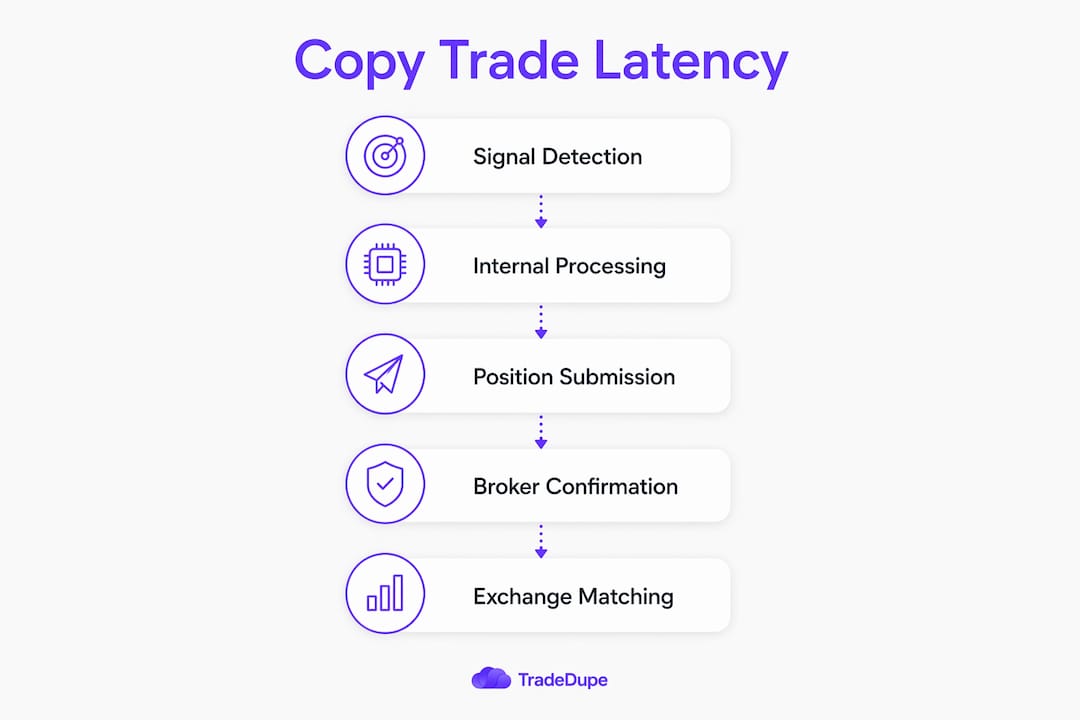
The copy-trade pipeline has six distinct stages where time is consumed: signal detection, internal processing, position sizing, API submission, broker-side processing, and exchange matching. Each stage adds latency, and the stages compound sequentially. A 50ms delay at the API layer plus a 150ms broker queue plus a 30ms matching engine round-trip produces a 230ms total exposure window before the follower's order even reaches the book.

During high-volatility windows, small delays that are irrelevant in calm markets produce significant slippage and stop-out risk. On calm, liquid markets, execution times often sit in the 150–400ms range, but during low liquidity or extreme volatility that figure climbs substantially.
| Latency Band | Typical Scenario | Practical Effect on Fills |
|---|---|---|
| 2–8ms | Colocated server-side copier | Near-identical entry prices; slippage negligible |
| 20–70ms | Cloud-based copier, optimized routing | Minimal slippage on most instruments |
| 150–400ms | Standard broker API, calm market | Acceptable for swing trades; marginal for scalps |
| 500ms–3s | PC relay, congested network | Visible slippage; scalp viability compromised |
*
Which strategies are most sensitive to execution speed
Not every strategy suffers equally from latency. The practical consequence of a 300ms delay on a 3-day swing trade is negligible. On a 10-tick NQ scalp, that same delay can consume the entire intended edge.
- Scalping and high-frequency intraday — require sub-50ms median; even p95 above 100ms creates unacceptable fill variance. Execution speed directly affects scalping viability; swing trades tolerate latency far better.
- Momentum and intraday breakout — sub-150ms median is the practical threshold; news-driven entries are especially sensitive to tail latency (p95).
- Spread-based and mean-reversion — moderate tolerance, but fill-rate consistency matters more than raw speed; partial fills distort the spread leg.
- Swing and position trading — can operate at 400ms+ without material P&L impact; focus shifts to reliability and reconciliation accuracy rather than raw latency.
Pro Tip: Map each strategy in your book to a latency tier before running a pilot. This prevents over-engineering infrastructure for swing trades and under-investing for scalps.
*
Which latency metrics actually matter for your prop desk
Measuring latency correctly requires end-to-end timestamps: signal detection time, API submit time, broker acknowledgment, and confirmed fill time. Without synchronized clocks across all nodes, your measurements will carry systematic error that masks real performance.
- Detection-to-submit (total latency) — the primary operational KPI; this is what you control
- Median — baseline performance under normal load
- p95 / p99 — tail behavior during peak load or volatile sessions; the metric that determines worst-case risk
- Jitter — variance across fills; high jitter means follower accounts receive unequal prices even when median looks acceptable
- Slippage average — realized cost in ticks or dollars per trade
- Fill rate and rejection rate — a fast copier with a 15% rejection rate is operationally worse than a slower one with 99.5% fill rate
Pro Tip: Segment all metrics by symbol, broker, order type, and market session. A system that performs at 40ms during regular hours may degrade to 300ms during the CME open or a Fed announcement. Session-segmented data reveals the real operational envelope.
*
A practical testing plan for copy-trading latency and slippage
Vendor latency claims are marketing until you validate them on your own brokers, in your own sessions, with your own instruments. Here is a structured approach:
- Define test parameters — select 2–3 instruments you trade in production, the brokers you intend to use, and the sessions (pre-market, regular, news windows).
- Run a baseline sample — execute 20–50 real micro-trades per broker per session; this sample size is sufficient to observe patterns without material capital exposure.
- Control variables — use the same order type (market vs limit) within each test batch; test both types separately and log results independently.
- Stress-test news events — run at least one test batch during a scheduled macro release (CPI, FOMC, NFP); this is where tail latency and slippage diverge most sharply from calm-market baselines.
- Load test at scale — simulate your full follower account count submitting simultaneously; unequal fan-out latency only appears under load.
- Capture raw logs — record signal timestamp, submit timestamp, broker acknowledgment, and fill price for every order; require vendors to supply these logs in exportable format.
- Apply decision thresholds — scalping strategies: reject any vendor with median above 50ms or p95 above 150ms; intraday: median below 150ms, p95 below 400ms; swing: fill rate above 99% is the primary criterion.
- Repeat quarterly — broker infrastructure changes; a vendor that passed six months ago may have degraded.
*
Technical architecture that materially reduces latency and variance
Cloud-based copiers typically deliver 20–70ms latencies, while PC-based relays can reach 200ms or worse. The architectural choices that drive this gap are specific and reproducible.
- Server-side execution — the copier runs on a cloud server, not a local PC; eliminates home network variability and OS scheduling delays
- WebSocket pipelines — persistent connections reduce handoff gaps versus polling-based REST; critical for sub-100ms total latency
- Colocation or edge proximity — servers placed near broker datacenters shorten the physical path; even 10ms of network round-trip reduction is meaningful at scale
- Parallelized fan-out — follower orders submitted simultaneously via non-blocking I/O, not sequentially; sequential submission creates a latency gradient where account 10 always fills worse than account 1
- API batching where supported — reduces per-order overhead when brokers allow grouped submissions
Pro Tip: Instrument per-account submit queues in your monitoring layer. A queue depth that grows during load is the earliest signal of fan-out degradation, appearing before slippage shows up in trade logs.
*
Operational controls that limit divergence and contain failures
Fast execution without operational guardrails creates a different class of risk: a rogue fill that replicates across 20 accounts before anyone notices. These controls are the second half of a production-grade copy-trading operation.
- Real-time reconciliation — compare leader position state against each follower continuously; flag any account whose position diverges from the expected state
- Per-account enable/disable toggles — allow the ops desk to isolate a single account without stopping the entire copy session; critical during broker-side issues
- Rogue-trade detection — automated rules that flag or block fills that exceed predefined size, price, or instrument parameters before they replicate
- Auto-recovery and retry policies — on a missed fill, the system should attempt resubmission within a defined window (typically 1–3 seconds), then alert the ops desk if the retry fails
- Emergency kill-switch — a single action that halts all replication immediately; must be accessible from the monitoring dashboard without additional authentication steps
- Latency spike alerts — threshold-based alerts (e.g., p95 exceeds 200ms for 3 consecutive trades) that trigger before slippage becomes visible in P&L
*
When faster isn't always better: real tradeoffs to weigh
Colocation and low-latency infrastructure carry real costs, and speed-first configurations sometimes sacrifice order-structure fidelity.
- Infrastructure cost — colocated servers and premium API tiers add recurring expense; the ROI is clear for scalping desks but marginal for swing-only operations
- Market-order mode vs precise replication — speed-first configurations often convert all orders to market orders for fastest submission; this destroys bracket and limit-chain structure that many intraday strategies depend on
- Broker-dependent ceilings — order routing and broker infrastructure materially affect fill quality even when the copier is fast; a 30ms copier cannot compensate for a 500ms broker endpoint
- Operational complexity — lower latency systems require more monitoring, more instrumentation, and faster incident response
The practical guidance: use speed-first market-order mode for pure scalping strategies, and precise replication mode for structured entries with brackets or OCO chains. Document the per-strategy rule in your SOP so ops staff apply the correct mode without judgment calls under pressure.
*
How to evaluate a copy-trading vendor: what to require
Treat vendor selection as a structured procurement process. The questions below are the minimum due-diligence standard for a prop desk.
- Require median and p95 latency figures measured to your specific broker endpoints — not generic "under 100ms" marketing claims
- Ask for documented testing methodology — how were the numbers measured, over what sample size, and in which market sessions?
- Confirm server-side execution and data-center proximity to your broker's infrastructure
- Require a real-time monitoring dashboard with per-account status, latency display, and alerting
- Verify per-account toggles, auto-recovery, and audit logs are present and accessible to ops staff
- Request an SLA covering platform availability and bug-response time
- Ask about multi-account copy trading support — specifically fan-out architecture and simultaneous submission
Pro Tip: Require a measurable pilot of 20–50 live trades across each broker you plan to use, and ask the vendor to supply raw execution logs. Any vendor unwilling to provide logs for independent validation is telling you something important about their confidence in their own numbers.
*
How Tradedupe addresses execution speed and operational risk
Tradedupe is built specifically for Tradovate-based prop desks and addresses the latency and operational control requirements described throughout this guide.
- Server-side execution with a median 34ms copy latency on Tradovate, validated in production
- Per-account enable/disable toggles that let ops staff isolate accounts without interrupting the full copy session
- Rogue-trade detection with configurable rules that block anomalous fills before they replicate
- Auto-recovery that resubmits missed fills within the defined retry window and alerts the desk on failure
- Real-time dashboard showing sync status, leader and follower activity, and latency metrics per account
- Support for Apex, Tradeify, Lucid Trading, and Alpha Futures accounts alongside standard Tradovate connections
- Unlimited broker connections on enterprise tiers, with AI-powered trade analysis for post-session review
A prop desk running multiple funded evaluation accounts across Apex and Tradeify can use Tradedupe to mirror a single leader across all accounts simultaneously, with each follower receiving the same fill within the same latency window. Consistent execution across accounts means consistent P&L attribution, which is the operational foundation for scaling a funded prop operation. Explore the full futures trade copier feature set to see how the platform maps to your specific broker configuration.
*
Recommended next steps for your prop desk
Prioritize these actions in order. The first two cost nothing but time; the last two require vendor commitment.
- Instrument latency metrics now — add detection-to-submit timestamps to your current setup, even if the numbers are uncomfortable. You cannot improve what you have not measured.
- Run a 20–50 trade pilot across each broker and session in your production plan; use the thresholds from Section 5 to score results.
- Require raw execution logs from any vendor under evaluation — median and p95 figures without supporting logs are unverifiable.
- Enable auto-recovery and per-account limits before scaling — operational controls must be in place before you add follower accounts, not after the first incident.
Decision rule for ops teams: if your strategy mix includes any scalping or intraday momentum positions, sub-150ms median latency with server-side execution is a hard requirement, not a preference. For swing-only desks, prioritize fill rate and reconciliation accuracy over raw speed.
*
How network infrastructure shapes your execution speed
Network path quality between your copier and the broker's matching engine is often the largest single variable in total latency. A colocated server in the same data center as the broker's API endpoint can achieve round-trip times under 1ms on the network leg alone. A home broadband connection routed through multiple ISP hops adds 20–80ms before the broker even sees the order.
Dedicated leased lines and direct market access (DMA) connections reduce both latency and jitter by eliminating shared-network congestion. For prop desks running high-frequency strategies, the network path deserves the same engineering attention as the copier software itself. Fintech workflow automation patterns confirm that reducing infrastructure bottlenecks compounds performance gains across the entire execution stack.
*
How order types and routing affect latency and slippage
Order type selection is an execution decision, not just a strategy decision. Market orders submit immediately and fill at the best available price, minimizing submission latency but accepting price uncertainty. Limit orders add a price-check step that introduces a small processing delay but cap slippage at the defined level.
For copy trading specifically, the routing path matters as much as the order type. A copier that converts all leader orders to market orders for speed will produce faster fills but may diverge from the leader's intended entry structure. Desks running bracket orders or OCO chains need a copier that preserves order structure through the replication pipeline, even at a small latency cost. The right choice depends on strategy type: market orders for scalps, structure-preserving replication for everything with conditional exit logic.
*
How exchange matching engine speed and location affect copy trade execution
The matching engine is the final step in the pipeline, and its speed and geographic location set a floor on achievable latency. CME Group's Globex matching engine, which handles most US futures contracts, is located in Aurora, Illinois. A copier server in the same region will see materially lower round-trip times than one hosted on the West Coast or in Europe.
Matching engine processing time itself is typically sub-millisecond for liquid futures contracts under normal load. The geographic and network path to reach that engine, however, can add 5–50ms depending on server location. For prop desks trading CME products, hosting the copier in a Chicago-area data center is the single highest-leverage infrastructure decision available.
*
Real-time monitoring and alerting for latency spikes
A monitoring dashboard is not optional for a production copy-trading operation. Latency spikes during live trading are often the first signal of a broker-side issue, a network degradation, or a fan-out queue backup, and they appear in latency data before they appear in P&L.
Effective monitoring covers per-account submit latency, fill rate by account and session, queue depth on the fan-out layer, and broker acknowledgment time. Alert thresholds should be set below the point of material slippage for your strategy mix: a p95 alert at 200ms gives the ops desk time to respond before a scalping session is materially damaged. Tools like Grafana or Datadog can ingest timestamped execution logs and surface these metrics in real time; the key requirement is that the copier platform exports per-order timestamps in a format these tools can consume.
*
How to synchronize order submissions across multiple accounts
Unequal latency distribution across follower accounts is one of the most underappreciated sources of P&L inconsistency in multi-account copy trading. When a fan-out queue processes accounts sequentially, account 15 may receive its fill 200ms after account 1, at a meaningfully different price during a fast-moving entry.
The solution is parallelized, non-blocking order submission: all follower orders are dispatched simultaneously in a single fan-out event rather than processed one by one. This requires the copier to maintain persistent, pre-authenticated connections to every follower account so there is no connection overhead at submission time. Pre-authenticated trade copier software with parallel fan-out is the architectural standard for desks where P&L consistency across accounts is a compliance or risk-management requirement. Signal quality also matters upstream: clear, unambiguous long/short trading signals reduce the processing time between detection and submission, tightening the entire pipeline.
*
Key Takeaways
Execution speed is a measurable operational KPI that directly determines copy-trading fidelity, slippage, and P&L consistency across follower accounts.
| Point | Details |
|---|---|
| Latency maps to slippage | Delays above 150ms produce visible slippage on scalping and intraday strategies; swing trades tolerate up to 400ms. |
| Measure median, p95, and jitter | Median shows baseline performance; p95 reveals tail risk; jitter causes unequal fills across follower accounts. |
| Pilot before committing | Run 20–50 live trades per broker and session; require raw execution logs from any vendor under evaluation. |
| Architecture drives the floor | Server-side execution with parallelized fan-out and colocation near broker datacenters produces the lowest achievable latency. |
| Tradedupe on Tradovate | Tradedupe delivers a median 34ms copy latency with server-side execution, per-account toggles, and auto-recovery for Tradovate-based prop desks. |
*
Why modern prop desks treat execution speed as a competitive edge
The conventional framing treats execution latency as a technical detail, something the engineering team handles while traders focus on strategy. That framing is wrong, and the cost of holding it shows up in P&L.
Execution is the value multiplier: intelligence only creates value when the enterprise can act on it quickly. For a prop desk, that principle is literal. A well-researched entry signal that arrives at the matching engine 400ms late is not a slightly worse version of the same trade. It is a different trade, at a different price, with a different risk profile. Multiply that across 20 follower accounts with unequal fan-out latency, and you have a risk-management problem masquerading as a strategy problem.
The operational vignette that illustrates this most clearly is the news-event scenario. A desk running a momentum strategy during a CPI release has a valid signal and a defined entry. With a 30ms copier and colocated infrastructure, all 15 follower accounts fill within the intended price range. With a PC-relay copier at 400ms, the first three accounts fill near the intended price, the next five fill 8 ticks worse, and the last seven miss the move entirely. The strategy did not fail. The infrastructure did. And the ops team will spend the next hour reconciling why the same strategy produced five different P&L outcomes across accounts that were supposed to be identical.
Lower execution latency also shortens learning cycles. When fills are consistent and logs are clean, you can attribute P&L variance to strategy decisions rather than infrastructure noise. That clarity accelerates iteration. Desks that treat execution speed as a strategic infrastructure investment compound that advantage over time.
*
Tradedupe: a proven low-latency option for Tradovate prop desks
Prop desks that have worked through the benchmarking and architecture analysis in this guide consistently arrive at the same requirement: server-side execution, parallelized fan-out, and operational controls that work without manual intervention. Tradedupe delivers all three, purpose-built for Tradovate.
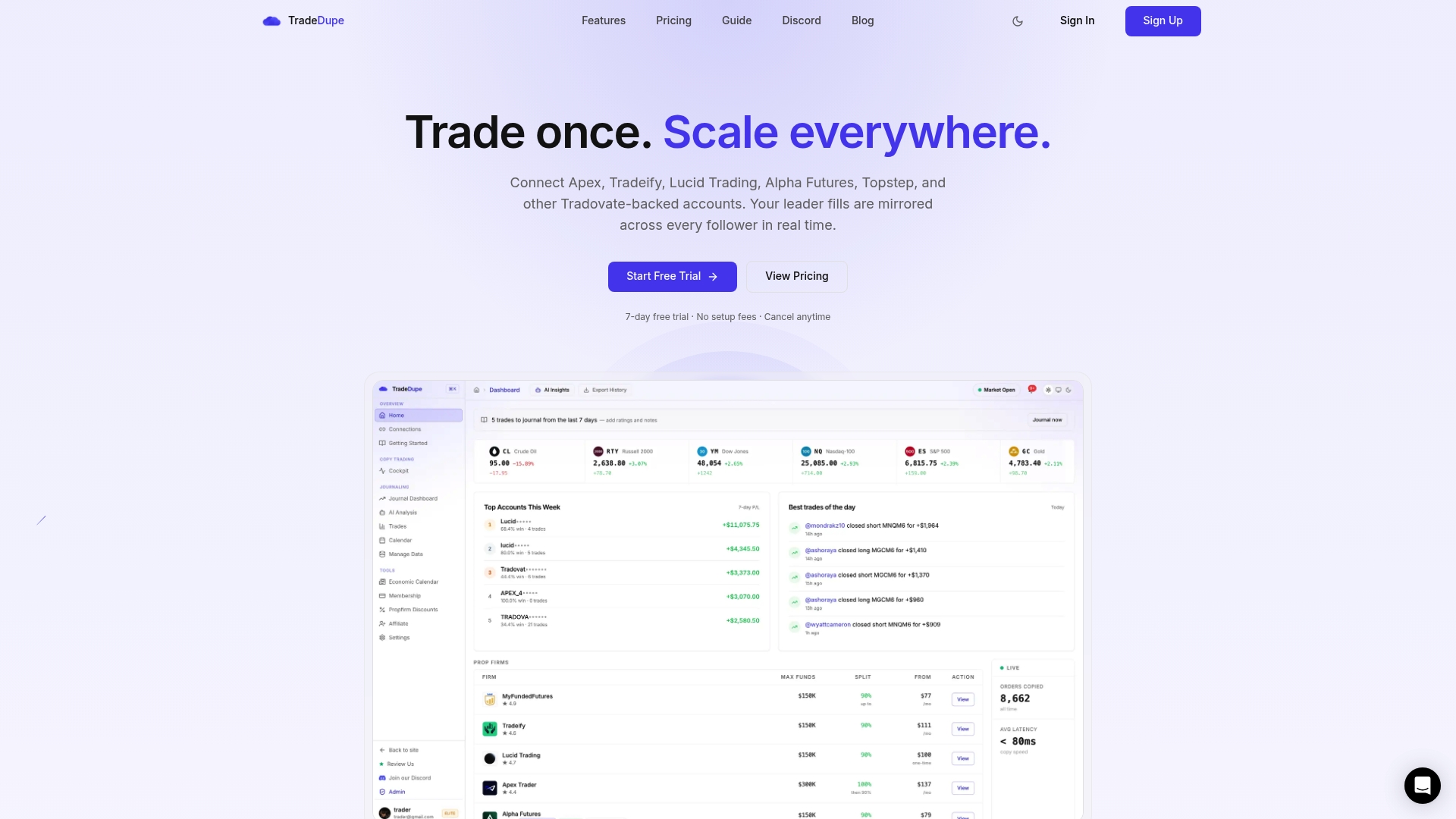
The platform's median 34ms copy latency is a production figure, not a lab result. Per-account toggles, rogue-trade detection, and auto-recovery are standard features, not enterprise add-ons. If you are running funded evaluation accounts across Apex, Tradeify, or Lucid Trading, Tradedupe mirrors the leader to every account simultaneously, with consistent fills and a real-time dashboard that surfaces latency and sync status per account.
The recommended first step is a structured pilot: 20–50 live trades across your brokers, with raw execution logs available for independent review. Get started with Tradedupe to configure your pilot environment, or review the full futures trade copier feature set to confirm it maps to your broker configuration before you begin.