
AI Trade Analysis for Tradovate Copy Trading: What to Demand
TradeDupe
8 min read
Unlock the power of AI trade analysis in copy trading. Ensure fast replication, safety caps, and actionable insights for better decision-making.
AI trade analysis, in a copy-trading context, means the analytics layer that watches leader-to-follower replication and flags what a human should review: sync latency, execution anomalies, and account-level risk breaches. It is not a chart-reading signal generator. If you run a Tradovate desk with multiple follower accounts, insist on three things before anything else: replication fast enough that fills stay tight (TradeDupe reports a median 34ms latency), per-account toggles and caps that fail closed under stress, and anomaly detection that ranks alerts for a person to review rather than acting alone. IOSCO's copy-trading guidance treats this kind of oversight as a supervisory expectation, not an optional extra.
- Real-time mirroring with low, published median latency
- Per-account toggles, caps, and sizing rules that default to safe when something breaks
- AI anomaly ranking with a human decision owner, not a black box
Key Takeaways
Reliable AI trade analysis for copy trading requires low-latency mirroring, per-account risk controls that fail closed, and human-reviewed anomaly detection backed by an audit trail.
| Point | Details |
|---|---|
| Latency sets the floor | Median replication delay at 34ms, like TradeDupe's benchmark, keeps slippage manageable across follower accounts. |
| Choose the right copy mode | Execution mode captures manual fills and ATM legs; order mode preserves signal-level order types for pure automated flows. |
| Stage the rollout | Build the evidence chain first, back-test next, then run 30 days of shadow mode before enabling live automated responses. |
| Governance is not optional | Maintain an AI model inventory, version testing, and reproducible logs to satisfy IOSCO-aligned oversight expectations. |
| TradeDupe covers the checklist | Per-account toggles, rogue-trade detection, audit logs, and native Apex, Tradeify, Lucid Trading, and Alpha Futures integrations. |
Table of Contents
- What Does AI Trade Analysis Mean Inside a Copy-Trading Stack?
- Key Features and Evaluation Criteria for AI Trade Analysis
- Execution Mode Vs Order Mode: Which Fits Your Desk?
- Building a Days 1–90 Rollout Playbook
- How Do You Monitor AI Alerts Without Drowning in Noise?
- Why Rules-Plus-AI Beats AI-Only Detection
- Getting TradeDupe Running on Your Tradovate Desk
- Sources
What Does AI Trade Analysis Mean Inside a Copy-Trading Stack?
Scoped correctly, AI trade analysis covers sync health, latency drift, fill discrepancies, and behavioral outliers across leader and follower accounts. It has nothing to do with predicting the next candle. That distinction matters for prop desks because the problem they actually have isn't "where will price go," it's "did every follower account replicate the leader's trade correctly, and is anyone doing something they shouldn't."
Prop firms lean on this kind of analysis for scale and surveillance. A desk running a handful of accounts can eyeball fills manually. A desk running dozens of Tradovate sub-accounts across Apex, Tradeify, Lucid Trading, and Alpha Futures cannot. Industry reporting on prop-firm AI adoption notes that firms use these tools primarily to analyze trader behavior across large account pools rather than to forecast markets, surfacing inconsistencies faster than a compliance officer scrolling through logs ever could.
Inside a functioning stack, AI typically handles four jobs:
- Ranking anomalies by severity so analysts triage the worst cases first
- Analyzing sequences of trades, not just single fills, to catch patterns a snapshot would miss
- Baselining behavior against peer accounts, since "normal" varies by strategy
- Producing explainable output, meaning every flagged event comes with the features that triggered it
Key Features and Evaluation Criteria for AI Trade Analysis
Evaluating an AI trade analysis platform for a Tradovate copy-trading setup comes down to five categories. Skip any one of them and you're running blind in at least one direction.
- Latency and throughput. Replication delay compounds slippage across every follower account simultaneously. A median latency in the tens of milliseconds, like TradeDupe's 34ms benchmark, keeps fills close enough to the leader's price that copy drag stays manageable across large fills.
- Per-account risk controls. Toggles, position caps, size multipliers per follower, and a fail-closed default when connectivity drops. If a follower account should not have traded that instrument, the control should have stopped it before the fill, not flagged it after.
- Auditability. Every copied trade needs a leader-to-follower map, a timestamp, and a reproducible copy log, so audit trails hold up under a compliance review or a client dispute.
- AI capabilities. Anomaly ranking, sequence analysis, peer-aware baselining, and model versioning with explainability, since regulators expect testing and version tracking for any system making risk-relevant judgments.
- Operational resilience. Rate limits, drift correction after a reconnect, and a clear recovery mode when a feed drops mid-session.
Pro Tip: Ask any vendor exactly how their system behaves during a five-minute internet outage on a follower account. The answer separates production-grade platforms from demo-ware fast.
Execution Mode Vs Order Mode: Which Fits Your Desk?
Tradovate copiers generally run in one of two modes, and the choice changes what actually gets replicated. Order mode copies at the signal level, preserving the order type sent by a webhook, stop, limit, or bracket structure intact. Execution mode copies at the fill level, mirroring whatever the broker actually filled, including manual clicks placed directly inside Tradovate.
That fill-level view is why execution mode tends to be the stronger default for desks that mix automated signals with manual discretion. Tradovate's own copier documentation confirms order mode won't see a manual trade placed outside the signal path, while execution mode captures it because it mirrors the broker fill itself, ATM bracket legs included.
The tradeoffs worth knowing before you configure a follower group:
- Execution mode often converts orders to market fills on the follower side, which can widen slippage on illiquid contracts
- Reconnecting after downtime has limits. Neither mode fully replays every missed fill, so drift correction closes the gap rather than reconstructing history
- Mixed desks running both algo signals and manual overrides usually need execution mode; pure signal-driven desks with no manual intervention can run leaner on order mode
Building a Days 1–90 Rollout Playbook
Deploying AI trade analysis across a live Tradovate copy-trading operation works better as a staged rollout than a single flip of a switch. A narrow, well-defined problem with a named human owner outperforms a broad AI deployment with no accountability, a pattern industry analysis of prop-firm AI adoption keeps confirming across firms that got this wrong.
- Inventory before you deploy. Map every leader and follower account, confirm feed coverage, set risk templates per follower, and document rate limits for your broker connections.
- Days 1 to 30: build the evidence chain. Confirm every trade produces a timestamped, reproducible copy log before you trust any AI output layered on top of it.
- Days 31 to 60: back-test against historical data. Run the anomaly model against known-good and known-bad historical sessions to calibrate thresholds before live exposure.
- Days 61 to 90: shadow mode, then gradual enablement. Let the system flag without acting, review every alert manually, then enable automated responses one follower group at a time.
- Set monitoring checkpoints. Schedule reconciliation checks, replica verification, and at least one incident drill before scaling past a pilot group.
Pro Tip: Write your escalation runbook before your first live shadow-mode alert fires, not after. Deciding who owns a 2 a.m. anomaly ping in the moment is how good systems get ignored.
How Do You Monitor AI Alerts Without Drowning in Noise?
Hard controls come first, always. Position limits, account segregation, independent P&L verification, and daily reconciliation catch most problems before any model needs to. AI trade analysis sits on top of that foundation, correlating signals a human reviewer would otherwise have to piece together manually, exactly the sequencing operational best practice for rogue-trade surveillance recommends.
Good alert design prioritizes cases with corroborating evidence, meaning a flagged trade backed by unusual size, timing, and account independence outranks a single soft signal. Track these operational metrics weekly, not quarterly:
- Alert-to-investigation time, since a queue that grows faster than it clears is a staffing problem, not a model problem
- Time-to-disposition on flagged cases
- Missing or degraded feed incidents per account
- Model drift, meaning how often live outcomes diverge from back-tested expectations
Model governance matters just as much as the alerts themselves. IOSCO's AI risk management guidance calls for a maintained inventory of every AI system in use, version-controlled testing, periodic stress tests, and evidence that's reproducible if a regulator or an internal auditor asks how a specific alert got generated.
Why Rules-Plus-AI Beats AI-Only Detection
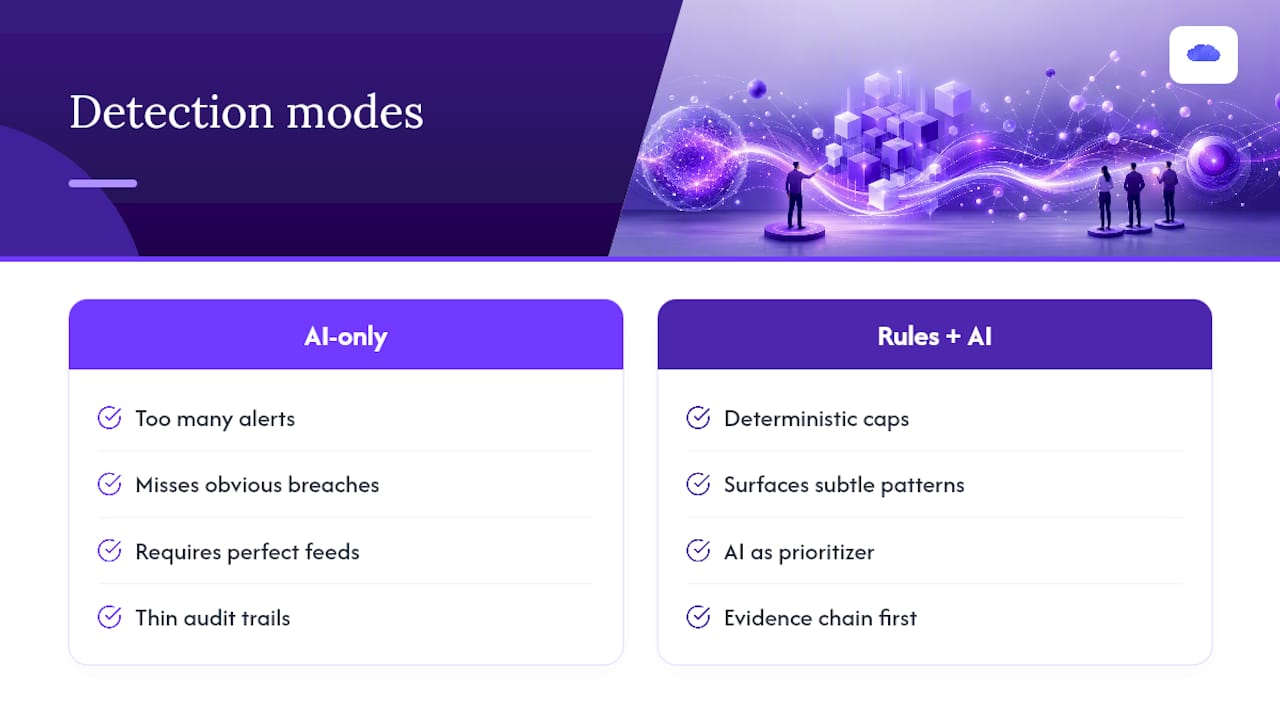
Pure AI-only anomaly detection sounds appealing until you actually run it against live accounts. In practice, a model without hard rules underneath it produces either too many false positives to act on or misses the obvious cases a simple position cap would have caught instantly. Combining deterministic controls with AI ranking gives you both: the caps stop the worst outcomes before they happen, and the model surfaces the subtler patterns a rule can't anticipate.
The most common failure I see isn't a bad model. It's insufficient feed coverage, skipped shadow-mode testing, or audit trails too thin to survive a real review. Desks that build the evidence chain first and treat AI as a prioritization layer, not a decision-maker, scale without a surveillance blind spot. Schedule a model review every quarter and name one person who owns escalation. Vague ownership is where good playbooks quietly stop working.
> — Andres
Getting TradeDupe Running on Your Tradovate Desk
TradeDupe is the direct route to everything covered in this checklist, built specifically for Tradovate desks running multiple follower accounts, not a generic copier retrofitted for it. The median 34ms latency keeps replication tight across every account you manage, and per-account toggles let you cap, pause, or resize exposure on any single follower without touching the rest of your book.
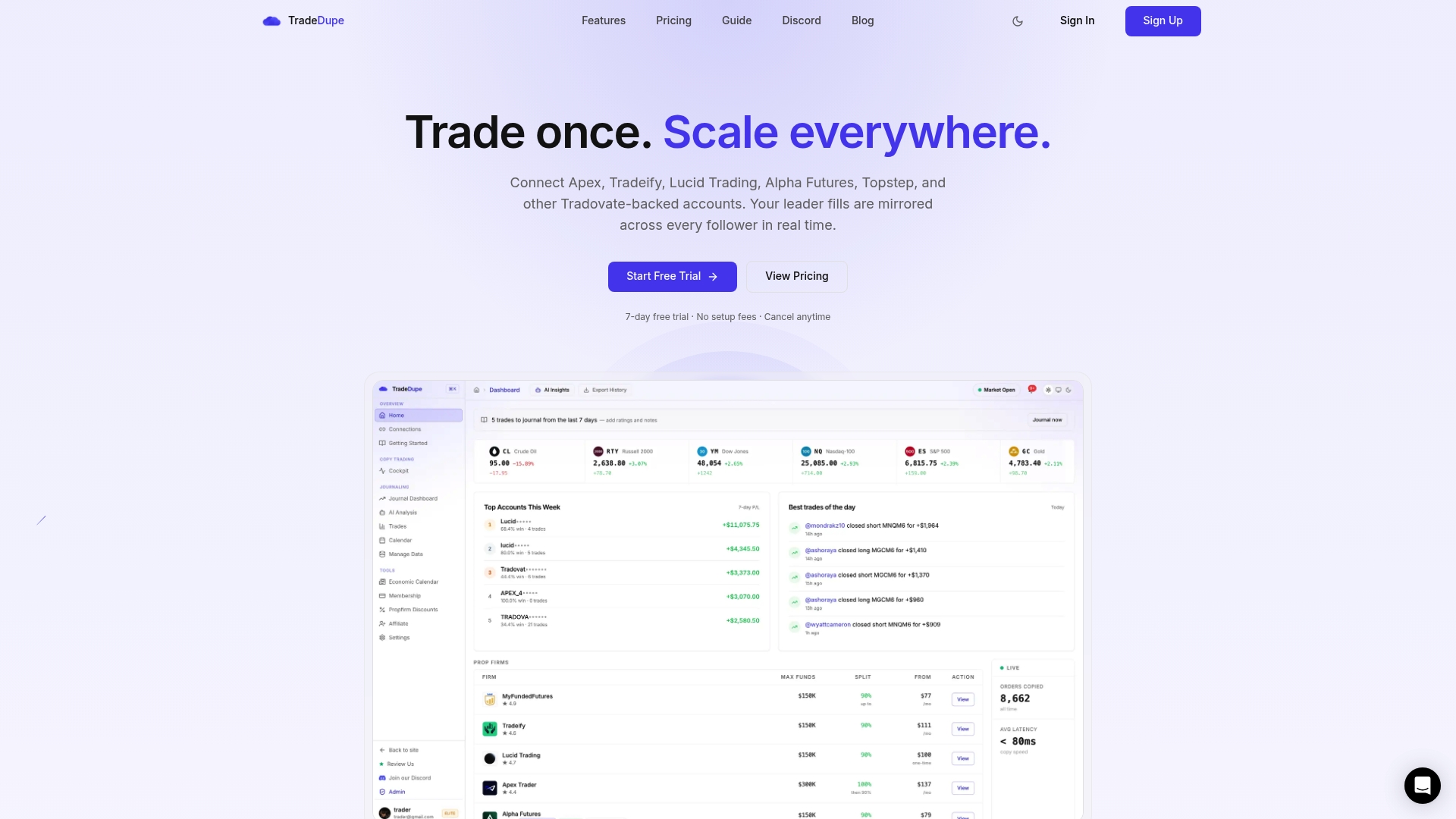
Rogue-trade detection and auto-recovery run alongside timestamped copy logs, so every fill has a reproducible trail if you need to reconcile or answer a compliance question. TradeDupe integrates directly with Apex, Tradeify, Lucid Trading, and Alpha Futures, which covers the prop-firm workflows most Tradovate desks already run. Review the security and reliability details if your operations team needs the specifics before signing off, then walk through the getting-started guide to set up a shadow-mode test on one follower group before scaling to the rest of your accounts.
Sources
- FR/06/2025 Online Imitative Trading Practices: Copy Trading, Mirror Trading, Social Trading
- IOSCO: AI System Risk Management and Supervisory Guidance
- tradovate-copier
- AI Rogue-Trader Detection: Controls & Benchmark