

Avoid Size Creep: Copy Trading Allocation for Futures (3 Spreadsheet Examples)
TradeDupe
16 min read
Spreadsheet ready allocation formulas for futures copy trading, three worked examples, and an NFA and CFTC aligned checklist.
Use fixed-size allocation when every follower account is roughly the same size, switch to proportional percent-of-equity when account sizes differ, and lean on volatility- or risk-scaled sizing whenever margin and leverage are material to the outcome. Each method trades simplicity for precision differently, and the right choice depends on account distribution, instrument liquidity, and how much rounding and fee drag your operation can tolerate. Regulatory guidance also expects a documented, consistent methodology rather than ad hoc judgment calls.
*
> TL;DR: > > - Fixed-amount copying is simple but can lead to uneven risk when follower accounts differ significantly in size or liquidity is low. > - Proportional and volatility-scaled methods offer more accurate risk alignment but require careful rounding, frequent recalibration, and higher setup effort. > - Margin, leverage, and slippage risks necessitate setting maximum position caps and staggered entries, especially for volatile or thinly traded instruments. > - Regulatory standards demand documented, objective allocation procedures with an audit trail, including logs of orders, fills, and fairness checks. > - Operational features like per-account toggles, real-time mirroring, and risk limits are critical for compliance and effective performance tracking.
*
Table of Contents
- 1. Allocation methods, formulas, and trade-offs
- 2. How do you choose the right allocation method?
- 3. Worked examples you can replicate in a spreadsheet
- 4. Margin, leverage, and execution risk change the math
- 5. Operational safeguards and the regulatory basics
- 6. How platform features map to these allocation safeguards
- 7. Measuring performance and attributing results correctly
- 8. How a leader's changing behavior affects your allocation
- 9. Tax treatment of gains and losses from copied trades
- 10. What experienced allocators get wrong
- TradeDupe: matching the checklist to a real setup
- FAQ
- Sources
1. Allocation methods, formulas, and trade-offs
Every copy trading allocation method answers one question: how much of a leader's position should each follower account take? The five families below cover nearly every practical case, from single-account mirroring to multi-leader desks managing dozens of followers.
Fixed-amount copy assigns a static lot or contract count to every follower, regardless of account size. The formula is simple: follower size = fixed constant, set once per account or per instrument. This works well when accounts are nearly identical in size and the leader trades liquid, low-slippage instruments, but it breaks down fast once account equity diverges, because a trader with $150,000 and one with $15,000 end up carrying wildly different risk per trade.
Fixed-ratio or proportional copy scales each follower's position to its share of the leader's equity: follower size = leader size × (follower equity ÷ leader equity). If a leader trades 10 contracts on $100,000 of equity and a follower runs $25,000, the follower takes 2.5 contracts, rounded to whole lots per the platform's rounding rule. Proportional copying keeps relative exposure consistent across mismatched accounts, which makes it the default choice for most multi-account futures operations.
Percent-of-equity allocation sizes each position as a fixed percentage of current account equity rather than a ratio to the leader. This method self-adjusts as equity grows or shrinks, which is useful for accounts that compound gains or draw down meaningfully over a quarter.
Volatility-scaled or risk-parity sizing adjusts position size so that each account carries roughly equal dollar volatility, typically using Average True Range (ATR) or historical volatility as the scaling input. The Investor makes a point worth repeating here: equal dollar exposure is not the same as equal risk once leverage enters the picture, and volatility-scaling is one of the more reliable ways to correct for that gap.
Fixed-risk-per-trade sizes positions so that a hit stop-loss cost a predetermined dollar amount, regardless of instrument or current volatility. Position size = (target dollar risk) ÷ (stop distance in points × point value). This method is popular among risk-focused traders because it normalizes risk across instruments with very different tick values, like comparing a micro E-mini contract to a full-size crude oil future.
Each method carries operational friction worth weighing before you commit:
- Fixed-amount: easiest to implement, but ignores account size differences and concentrates risk on smaller accounts.
- Proportional copy: fair across mismatched accounts, but rounding to whole contracts can create meaningful tracking error on small accounts.
- Percent-of-equity: self-adjusting, but requires a margin-to-contract conversion step that introduces calculation lag.
- Volatility-scaled: aligns actual risk across accounts, but needs a reliable, updated volatility input and more computation per trade.
- Fixed-risk-per-trade: normalizes risk across instruments, but depends entirely on accurate stop-loss data from the leader.
A quick way to compare implementation difficulty against precision:
- Fixed-amount: lowest setup effort, lowest precision for mixed account sizes.
- Proportional copy: moderate setup, strong precision for equity-weighted fairness.
- Percent-of-equity: moderate setup, strong precision with self-adjusting sizing.
- Fixed-risk-per-trade: higher setup effort, highest precision for cross-instrument risk normalization.
- Volatility-scaled: highest setup effort, highest precision for leveraged, multi-instrument books.
Fee and slippage impact scales with how many rebalancing or rounding adjustments a method forces. Proportional and volatility-scaled methods tend to generate more small corrective trades than fixed-amount copying, which means fee drag deserves its own line item in any allocation decision.
2. How do you choose the right allocation method?
The right method depends less on theory and more on the practical shape of your accounts. Before configuring any copy trading setup, answer these questions honestly.
- How spread out are your follower account sizes? Tight clustering favors fixed-amount; wide variance favors proportional or percent-of-equity.
- What are your margin and leverage caps per account? Accounts near their margin ceiling need volatility-scaled or fixed-risk sizing to avoid margin calls during a leader's larger positions.
- What is the leader's maximum position size? A leader who occasionally trades oversized positions can force followers into uncomfortable exposure under proportional copying unless a max-lot cap is in place.
- How liquid are the traded instruments? Thin liquidity amplifies slippage on every allocation method, but especially on ones that generate frequent rebalancing trades.
- What do fees and rollover costs look like per account? Smaller accounts absorb per-trade fees as a larger percentage of equity, which can erode the benefit of frequent rebalancing.
Operationally, confirm your platform supports per-account toggles so you can disable copying on a single account without halting the entire group, along with partial-fill handling that does not silently drop the remainder of an order, and per-account maximum lot limits that cap worst-case exposure regardless of the formula's output.
Running more signal providers than that tends to multiply correlation risk faster than it diversifies return.
Pro Tip: Run your chosen allocation formula against six months of a leader's historical fills in a spreadsheet before connecting live capital, and check whether the rounding behavior changes your smallest account's risk by more than half a percentage point.
3. Worked examples you can replicate in a spreadsheet
Numbers make allocation formulas concrete. These three examples use round figures for clarity.
- Fixed-amount across equal accounts. Three follower accounts each hold $50,000. The leader trades 6 contracts of a micro index future. Fixed-amount copy assigns each follower 2 contracts (6 ÷ 3), evenly split since equity is identical. If equity were slightly uneven, say $50,000, $48,000, and $52,000, fixed-amount copying would still assign 2 contracts to each, leaving the $48,000 account carrying proportionally more risk than the $52,000 account. That mismatch is the method's core weakness.
- Proportional copy across mixed accounts. A leader runs $200,000 of equity and trades 8 contracts. Follower A holds $50,000 (25% of leader equity), so Follower A takes 2 contracts (8 × 0.25). Follower B holds $30,000 (15% of leader equity), so Follower B takes 1.2 contracts, rounded down to 1 contract under a conservative rounding rule, or rounded to the nearest whole number depending on the platform's policy. That rounding decision alone can shift a follower's realized risk by 20% or more on small accounts, so document the rule you use.
- Volatility-scaled sizing for a futures leader. Suppose an instrument's 14-day ATR is 40 points, with a point value of $5. Dollar volatility per contract is 40 × $5 = $200. A follower account targeting $400 of dollar volatility exposure per position would size 2 contracts ($400 ÷ $200). If the ATR expands to 60 points the next week, dollar volatility per contract rises to $300, and the same $400 target now calls for 1.33 contracts, rounded to 1. This is why volatility-scaled sizing requires a periodically refreshed ATR input rather than a static figure set once at account opening.
Across all three examples, minimum-contract constraints matter: futures contracts cannot be fractional, so any method that produces a non-whole-number result needs a documented rounding rule, consistently applied, to avoid the appearance of preferential treatment. Partial fills complicate the math further. When a leader's order fills in pieces, followers should mirror the same fill ratio rather than assuming the full intended size executed.
4. Margin, leverage, and execution risk change the math
Percent-of-equity allocation can understate real risk once leverage is involved, because effective exposure equals position notional value divided by account equity, not the percentage you allocated on paper. A 2% equity allocation on a contract with 10-to-1 effective leverage can produce swings far larger than 2% of equity, which is exactly the distinction the Investor.gov leveraged investing bulletin warns traders to understand before using margin, futures, or leveraged products.
Futures margin typically runs 2% to 10% of notional value, with daily mark-to-market settlement, according to the CFTC's futures market basics. That means a small notional allocation can still demand meaningful maintenance margin on a volatile day, which matters when sizing followers near their margin ceiling.
Slippage and partial fills show up operationally as follower trades that execute at worse prices or smaller sizes than the leader's fill, often because of thin liquidity or a delay between leader execution and follower mirroring. Practical mitigations include:
- Set a per-account maximum position size that caps exposure regardless of what the formula outputs.
- Use staggered entries on large leader orders instead of one-shot mirroring, which reduces market impact on thinner instruments.
- Run pre-trade checks that reject a copy order if the account is already near its margin limit.
- Enforce daily loss caps at the broker level so a bad sequence of trades cannot cascade past a predetermined threshold.
- Apply a stop propagation procedure so a leader's stop-loss adjustment copies to followers without manual intervention.
5. Operational safeguards and the regulatory basics
Traders running copy groups across multiple accounts fall under the same conceptual framework that governs commodity trading advisors managing bunched orders. The NFA's guide to CTA disclosure documents describes the core expectation clearly: allocation must follow a predetermined, objective, and consistently applied methodology, with an audit trail that demonstrates fairness over time rather than trade-by-trade parity.
That standard is not just bureaucratic language. The CFTC's statement on the LJM Funds Management settlement shows what happens when risk disclosure and allocation controls fail: misrepresented risk profiles and inadequate disclosure contributed to catastrophic investor losses, which is precisely why auditability is treated as a core safeguard rather than an afterthought.
For any trader or small desk running a copy group, a practical records checklist includes:
- Written allocation instructions showing the formula and rounding rule in use.
- Per-order allocation records showing exactly how each bunched order was split.
- Partial-fill handling records showing how incomplete fills were distributed.
- Quarterly fairness checks comparing realized allocation outcomes across comparable accounts.
| Safeguard | What it demonstrates |
|---|---|
| Predetermined allocation formula | Objective, non-preferential methodology |
| Per-order allocation log | Audit trail for each bunched order |
| Partial-fill handling record | Consistent treatment when fills are incomplete |
| Quarterly fairness review | Allocation methodology evaluated for drift over time |
6. How platform features map to these allocation safeguards
A platform built specifically for Tradovate-based prop accounts shows how these principles translate into software. TradeDupe connects accounts through Tradovate's official OAuth flow, so passwords are never stored, and mirrors every leader fill to enabled follower accounts over live WebSocket streams, typically within 100 milliseconds. Rogue-trade detection flags follower trades the copier did not originate, per-account copy toggles let a trader disable a single account without halting the group, and daily loss limits and profit targets are enforced directly on Tradovate rather than relying on a third-party script. Built-in analytics and reporting give traders a record to check against the fairness and audit-trail expectations described above.
7. Measuring performance and attributing results correctly
Judging whether an allocation method worked requires separating the leader's trading performance from the allocation method's execution quality. A follower account can underperform its leader purely because of rounding, slippage, or fee drag, not because the underlying signal was weak. Tracking realized slippage per trade, average fill delay, and the dollar gap between intended and actual position size gives a clearer picture than comparing raw account returns alone.
Attribution gets more complicated with multiple leaders. When two signal providers trade correlated instruments, a drawdown can look like an allocation failure when it is actually a correlation problem. Breaking down performance by leader, by instrument, and by allocation method separately helps isolate which variable actually drove the result. A trade journal that logs the allocation method used per trade, alongside the leader's original size and the follower's copied size, turns this from guesswork into a repeatable review process.
Rebalancing frequency also affects attribution. The Investor.gov beginners guide to asset allocation notes that rebalancing windows commonly run every six to twelve months, or trigger when holdings drift past a preset threshold. Copy trading allocations benefit from the same discipline: comparing performance across a rebalancing cycle, rather than day to day, separates noise from a genuine method mismatch.
8. How a leader's changing behavior affects your allocation
Allocation formulas assume a leader's trading behavior stays reasonably stable, but that assumption breaks down more often than traders expect. A leader who gradually increases position size after a winning streak, often called size creep, can quietly push proportional followers into larger absolute risk than they originally agreed to carry. A fixed-risk-per-trade method catches this automatically, since it recalculates position size from the stop distance rather than copying the leader's raw contract count.

Leaders also change instruments, trading frequency, and stop-loss discipline over time. A leader who historically traded one contract per signal and suddenly starts scaling into positions changes the risk profile of every proportional follower simultaneously, without any explicit announcement. This is one of the practical reasons a maximum position-size cap at the follower-account level matters regardless of which allocation formula is in use.
Periodic review catches these shifts before they compound. Comparing a leader's trailing 30-day average position size against their 90-day average flags size creep early, and tracking the ratio of winning to losing streaks helps distinguish a leader who is trading well from one who is simply increasing size after a lucky run.
9. Tax treatment of gains and losses from copied trades
Gains and losses from copy trading follow the same tax treatment as any other trading activity conducted through the underlying account, since copying is an execution method rather than a distinct financial instrument. For US futures traders, many exchange-traded futures contracts fall under Section 1256 of the tax code, which applies a 60/40 blend of long-term and short-term capital gains treatment regardless of actual holding period, though the specific tax treatment depends on the instrument and account structure involved.
Because each follower account is a separate legal account, gains and losses typically do not net across accounts for tax purposes, even when every account is copying the same leader. A losing month on one follower account generally cannot offset a winning month on another unless they share the same tax reporting entity, which matters for traders running several prop firm accounts under different arrangements.
Record-keeping discipline pays off at tax time the same way it does for compliance purposes. The per-order allocation logs and trade journal entries recommended earlier double as the documentation needed to reconcile realized gains and losses across multiple accounts. Because tax treatment varies by instrument, account structure, and jurisdiction, confirming specifics with a qualified tax professional before year-end remains the reliable path, rather than assuming one account's tax treatment applies to all.
10. What experienced allocators get wrong
The most common mistake is not a bad formula, it is running too many leaders at once and mistaking correlation for diversification. A trader following three signal providers who all trade the same index futures during the same session hours is not spreading risk, just multiplying it. The second mistake is under-testing fills: a formula that looks clean on paper can produce messy rounding and slippage once real partial fills enter the picture.
A short, prioritized checklist: test the formula against historical fills first, document the rounding rule in writing, cap exposure per account regardless of what the formula outputs, and audit allocations quarterly for drift. Start with small live size before scaling capital into any new allocation method.
> — Andres
TradeDupe: matching the checklist to a real setup
Everything covered above points to the same operational requirements: a documented allocation method, per-account controls, real-time execution, and a record you can audit later. We built TradeDupe around exactly that checklist for traders running multiple Tradovate accounts across prop firms like Apex Trader Funding, Tradeify, MyFundedFutures, and others. Accounts connect through Tradovate's official OAuth flow, so your password is never stored, and every leader fill mirrors to enabled followers over live WebSocket streams, typically within 100 milliseconds. Rogue-trade detection flags follower trades the copier did not place, per-account toggles let you disable a single account without touching the rest of the group, and daily loss limits and profit targets are enforced directly on Tradovate rather than by a script that can fail silently.
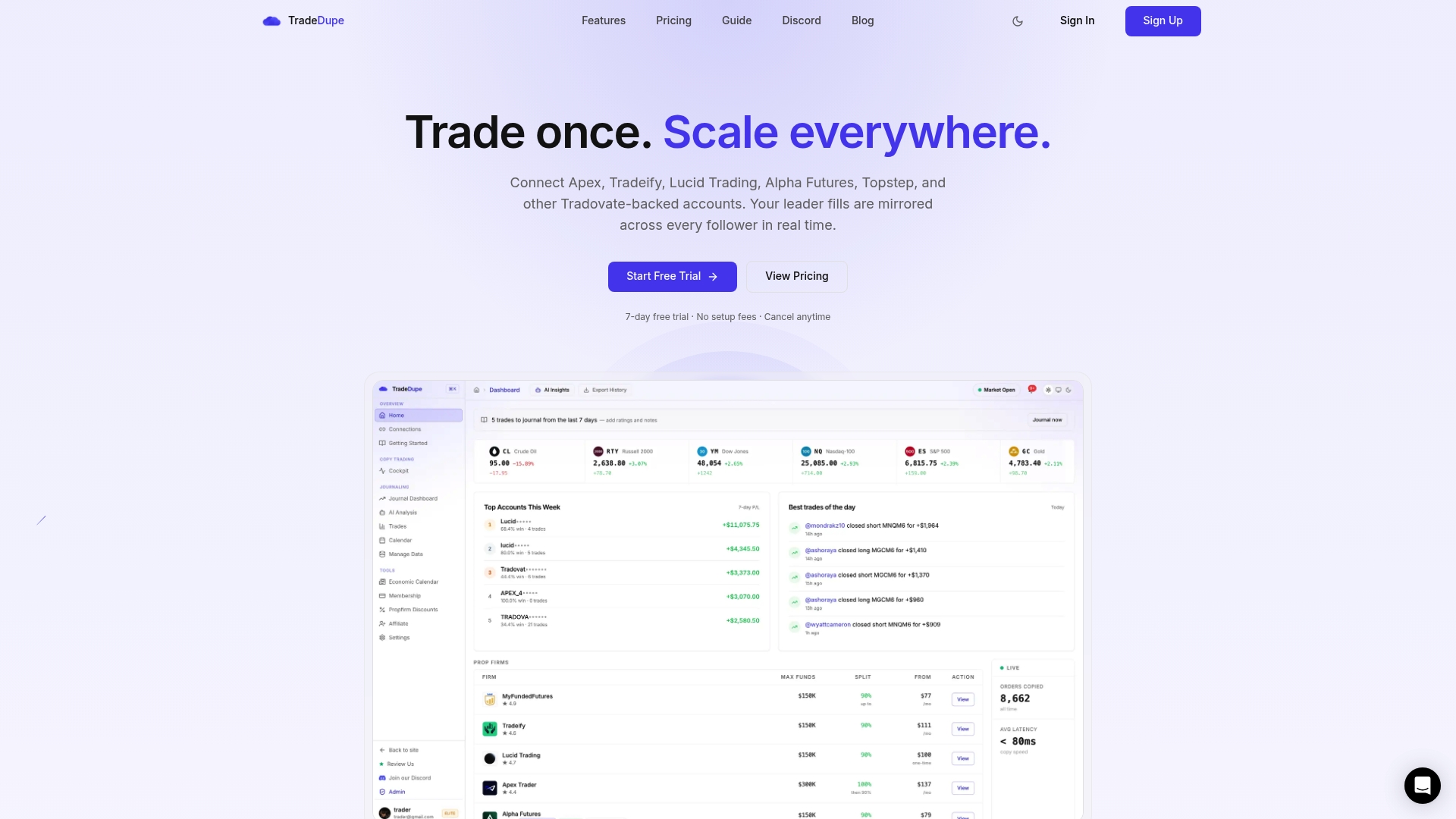
If you want to see how these allocation methods behave on your own accounts, our getting started guide walks through connecting Tradovate accounts and configuring per-account limits in about ten minutes, and every plan includes a 7-day free trial with one-click cancellation. For a broader primer on how copy mechanics work before you commit capital, our copy trading explainer covers the fundamentals in more depth.
This article is general information, not a substitute for advice from a qualified financial advisor. Consult a qualified financial professional about your own circumstances before acting on anything here.
FAQ
What is the best strategy for copy trading?
There is no single best strategy, because the right allocation method depends on whether your follower accounts are similarly sized, how much leverage is in play, and how liquid your instruments are. Fixed-amount works for closely matched accounts, while proportional or volatility-scaled sizing fits mixed account sizes with meaningful leverage.
What is the 3-5-7 rule in trading?
It is not a regulatory standard, and definitions of the exact percentages vary across trading communities.
Can I make $1,000 per day from trading?
Daily profit targets like this depend entirely on account size, position sizing, and market volatility, and no allocation method can guarantee a specific daily dollar outcome. Leveraged instruments such as futures can produce large swings in either direction, which is why Investor.gov's leveraged investing guidance stresses understanding the risk of loss before relying on leverage to hit an income target.
What is the 7% rule in trading?
Like the 3-5-7 rule, this is a popular heuristic rather than a formal regulatory requirement, and traders apply it differently depending on their own risk tolerance.
Does TradeDupe support the allocation methods described here?
TradeDupe mirrors a leader account's fills to enabled follower accounts in real time, with per-account toggles and daily loss limits enforced directly on Tradovate, which supports the kind of per-account controls that fixed-risk and volatility-scaled methods rely on. Plans start at $20 per month billed yearly on the Standard plan, with a 7-day free trial available on every tier.
Sources
Recommended
- TradingView Trade Copier | Automate Follower Accounts
- 100ms Sync for Futures Copy Trading: Checklist for Prop Traders
- Best Scalable Copy Trading Infrastructure for Prop Desks
- Futures Position Size Calculator
For educational purposes only. Not financial advice. Futures trading involves substantial risk of loss and is not suitable for every investor.