

100ms Sync for Futures Copy Trading: Checklist for Prop Traders
TradeDupe
15 min read
Test driven checklist for prop traders: validate 100ms fill sync, reconciliation, and broker limits before running futures copy trading.
For prop traders running multiple Tradovate accounts, the fastest practical way to automate and scale is a server-side copier built specifically for Tradovate. TradeDupe fits that need with OAuth-based connections, real-time mirroring, and broker-enforced safeguards. The reasoning comes down to execution reliability, not marketing claims: what matters is fill synchronization, recovery after disconnects, and risk controls the broker itself enforces. The evaluation checklist and rollout plan below show exactly how to verify that before committing funded capital.
*
> TL;DR: > > - Reliable copy trading systems must provide precise fill synchronization and reconciliation logs to prevent silent state drift between leader and followers. > - The system's failure handling, including reconnect recovery and duplicate-order prevention, must be tested thoroughly in sandbox environments before live deployment. > - Broker-enforced risk controls, such as daily-loss limits, are the most dependable backstops, not just software-display warnings. > - OAuth-based connections ensure account security by preventing password storage, and real-time WebSocket fill mirroring reduces lag to around 100 milliseconds. > - Costs escalate quickly with multiple funded accounts unless using flat-tier pricing plans, which include essential reconciliation tools and are more predictable for scaling.
*
Table of Contents
- How Automated Futures Copy Trading Actually Works
- The Seven-Point Technical Checklist Before You Trust a Copier
- How to Test and Roll Out an Automated Copier Safely
- Where TradeDupe Fits the Checklist
- What Regulations Actually Say About Automated Copy Trading
- What Automated Copy Trading Actually Costs
- Security Measures and Data Privacy in Automated Copy Trading
- How to Choose a Reliable Copy Trading Provider
- Performance Reporting Standards That Actually Matter
- The Failure Modes Nobody Talks About Until They Hit You
- Get Started With TradeDupe's Tradovate Copy Trading
- Primary Sources for Deeper Technical Review
- Sources
- FAQ
How Automated Futures Copy Trading Actually Works
Copy trading for futures sounds simple: one account trades, others follow. The mechanics that make it reliable are not simple at all, and the gap between a copier that works and one that quietly drifts out of sync is almost always technical.
The core model is leader to follower. A leader account places trades, and enabled follower accounts mirror those trades based on account size or a fixed multiplier. The question that separates a production-grade system from a toy is what triggers the copy. Systems built on execution-event syncing react to execution reports and order acknowledgements, the same message types CME's Drop Copy service uses to give firms real-time, reconciled visibility into fills. Systems built on UI mirroring simply replicate a click, with no confirmation the click actually became a filled order.
That distinction shows up the moment a partial fill happens, a rejection hits, or a broker feed hiccups. Execution-event systems know precisely what filled, at what price, and reconcile the follower against it. UI-mirroring systems can send an order that never fills, or worse, send a duplicate.
Deployment architecture matters just as much:
- Cloud or server-side execution runs independently of your computer, so a dropped Wi-Fi connection or a sleeping laptop does not stop your followers from copying.
- Local or VPS-based execution depends on a machine staying online and often adds a network hop between the software and the broker, which can widen latency.
- Server-side systems generally offer better uptime for funded accounts precisely because the account state lives on infrastructure the trader does not have to babysit.
The Seven-Point Technical Checklist Before You Trust a Copier
Before connecting a single funded account to any automated copier, run it through a structured technical review. Feature lists and screenshots tell you nothing about what happens when an order gets rejected at 2:00 a.m.
- Fill synchronization and reconciliation. Does the system track partial fills, rejected orders, and replace/cancel events, and does it produce a reconciliation log you can audit after the fact?
- Failure handling and recovery. Ask how the system behaves on restart. Idempotent event processing and duplicate-order protection are what prevent a reconnect from firing the same trade twice.
- Latency and execution path. A copier built on WebSocket streams or drop-copy style feeds should mirror fills within roughly 100 milliseconds. A webhook-only design, by contrast, often depends on polling intervals that introduce lag measured in seconds.
- Risk enforcement. Confirm that daily-loss limits and profit targets are enforced by the broker itself, not just displayed in a dashboard, and that per-account toggles let you pull one follower without disturbing the rest.
- Account-program compatibility. Some prop firms require an exact match between program type and account size before copying is even allowed. Top One Futures' copy trading policy is explicit that mismatched copying between programs can be treated as a violation.
- Scalability. How many concurrent followers, orders per second, and quantity multipliers can the system handle without queuing delays?
- Operational tooling. Audit logs, a trade journal, alerting, and exportable reconciliation reports turn a black box into something you can actually defend to a funding evaluator.
Pro Tip: Ask any provider for a sample reconciliation log before you connect a live account. If they can't produce one, assume the system has never been tested against a partial fill.
How to Test and Roll Out an Automated Copier Safely
Rolling out automated futures trading systems on funded accounts without a validation phase is how a small software bug becomes a blown account. The sequence below minimizes that risk.
Start in a sim or test environment before touching production capital. Confirm the copier correctly sets automation flags where required. Tradovate's API, for instance, requires an `isAutomated` flag on programmatic orders, and a copier that ignores this can trigger account-level flags with your prop firm.
Run a deliberate test matrix rather than hoping problems surface on their own:
- Simulate partial fills and confirm the follower reconciles to the actual filled quantity.
- Force a rejection and verify the copier does not silently retry into a duplicate.
- Kill the connection mid-trade, reconnect, and check that no orphaned position or double order appears.
- Test a symbol rollover and a bracket order to see how stop and target legs behave on the follower side.
- Deliberately trigger a daily-loss limit in testing to confirm the enforcement path actually blocks new orders rather than just displaying a warning.
Pro Tip: Write a one-page incident runbook before you go live: a kill switch, the exact steps to flatten every follower, log preservation instructions, and your broker's support contact. You want this open in a tab, not something you're improvising during a live disconnect.
Once the matrix passes, scale in waves. Enable copying on two or three followers, monitor reconciliation for several sessions, then expand.
Where TradeDupe Fits the Checklist
TradeDupe was built around the exact failure points funded traders worry about most, rather than as a general-purpose bridge between arbitrary brokers.
- Connection security: Accounts connect through Tradovate's official OAuth flow, so passwords are never stored, and nothing runs locally on your PC or a VPS.
- Execution speed: Fills mirror over live WebSocket streams, typically within 100 milliseconds of the leader's execution, closer to the drop-copy model exchanges use for reconciliation than to a delayed webhook relay.
- Safety layers: Rogue-trade detection flags follower trades the copier did not originate, per-account copy toggles isolate a single follower without disabling the rest, and daily loss limits and profit targets are enforced on Tradovate itself, meaning the broker, not the software, is the backstop.
- Operational visibility: The dashboard includes a trade journal, analytics, and reporting, so reconciliation is something you can actually review after the session closes.
TradeDupe works across Tradovate-based prop firms including Apex Trader Funding, Tradeify, Lucid Trading, MyFundedFutures, Alpha Futures, and TakeProfit Trader. Plans include a free trial period with simple cancellation, allowing traders to test before committing funded capital.
What Regulations Actually Say About Automated Copy Trading
There is no dedicated "copy trading license" for retail futures traders in the United States, but two regulatory realities apply directly to anyone automating trade replication across accounts.
First, the CFTC has issued a direct advisory warning that AI cannot predict markets, and that marketing claims promising guaranteed returns from automated trading bots are a red flag for fraud. The advisory recommends demanding operational evidence, meaning logs, rejection handling, and reconciliation records, rather than accepting performance claims at face value. This applies just as much to a copier vendor's marketing as it does to a signal-selling bot.
Second, enforcement history shows the CFTC has taken action against sellers of automated trading systems specifically for misleading profit claims. That history is a reminder that "automated" is not a regulatory exemption. If a provider promotes guaranteed returns or hides how fills are actually synced, that is precisely the pattern regulators have pursued before.
Beyond federal oversight, the more immediate compliance layer for funded traders is the prop firm's own rulebook. Firms that permit copy trading typically require an exact match between account program and size, and some prohibit cross-program copying entirely. Violating that rule is not a regulatory matter, but it can void an evaluation or a funded account just as fast. Read your specific firm's copy trading policy before enabling any follower account, since these rules vary by provider and change without much notice.
What Automated Copy Trading Actually Costs
Pricing for futures copy trading platforms tends to follow one of two models: per-account fees or flat tiered subscriptions. The difference matters more as you scale past two or three funded accounts.
Per-account pricing looks manageable with two followers and becomes expensive fast once you are running five or six funded accounts across multiple prop firms, since the cost scales linearly with every account you add.
Flat-tier pricing avoids that scaling problem. TradeDupe offers a Standard plan billed yearly with flat tiered pricing for multiple broker connections and accounts. Higher-tier plans offer increased connections and account allowances, with monthly billing priced proportionally higher than yearly billing.
The total cost calculation should include more than the subscription line. Factor in:
- Broker and exchange fees, which apply regardless of which copier you use.
- Trial cost, effectively zero with a 7-day free trial and one-click cancellation, giving you a real test window before paying anything.
- Time cost of manual reconciliation if you choose a cheaper tool that lacks audit logs, since hours spent manually verifying fills across accounts have a real dollar value.
For a trader managing four or more funded accounts, a flat monthly tier that includes reconciliation tooling tends to work out cheaper than a lower headline price that charges per connection.
Security Measures and Data Privacy in Automated Copy Trading
The single biggest security question to ask any copy trading provider is simple: does it ever see or store your broker password? The answer should be no.
A copier built on OAuth authenticates directly with the broker's own servers, meaning your Tradovate credentials never pass through or get stored on the copier's infrastructure. That is a meaningfully different security model from tools that ask you to enter your broker login into a third-party dashboard, which creates a stored credential that becomes a target if that vendor is ever breached.

Server-side execution also affects your personal security surface. When trade mirroring runs on the provider's infrastructure rather than a local script or a VPS you maintain, you are not the one responsible for patching an operating system or securing a remote desktop connection against intrusion. That does shift trust onto the vendor's own infrastructure, which is exactly why audit logs and transparent reconciliation records matter: they let you verify the system is behaving as described rather than taking that on faith.
Ask any provider directly how account data is encrypted in transit and at rest, whether the connection uses the broker's official API rather than screen-scraping or credential storage, and what happens to your data if you cancel. A provider unwilling to answer those questions plainly is not one to trust with funded capital.
How to Choose a Reliable Copy Trading Provider
Selecting a provider comes down to verifiable operational evidence, not feature checklists or testimonials.
Start with the connection method. A provider using a broker's official OAuth flow, rather than asking for stored credentials, has already made a meaningfully safer architectural choice. Next, ask for specifics on execution path: does the system react to execution reports and acknowledgements, the same message layer CME's Drop Copy uses for reconciliation, or does it just mirror clicks with no fill confirmation?
Request evidence of failure handling. Any provider should be able to describe, in specific terms, what happens when a follower disconnects mid-trade or when an order gets rejected. Vague reassurance is not evidence; a documented recovery policy is.
Check whether risk limits are broker-enforced or software-displayed. A daily-loss cap that lives only in a dashboard is a suggestion. A cap enforced by the broker itself, the way Tradovate enforces limits directly on the account, is a backstop that holds even if the copier software crashes.
Finally, look at pricing structure relative to your account count. A provider charging per broker connection instead of per account tends to scale more predictably as you add funded accounts across multiple prop firms.
One useful piece of background reading here comes from redundancy architecture in the broader copier space: trade copier redundancy patterns explain why failover design, not just headline features, is what prevents orphaned positions when something goes wrong mid-session.
Performance Reporting Standards That Actually Matter
Transparency in copy trading is not a marketing page showing a clean equity curve. It is the ability to reconstruct, trade by trade, exactly what happened on the leader and confirm the follower matched it.
A reliable system produces a reconciliation record for every copied trade: the leader's fill price and quantity, the follower's fill price and quantity, and the time delta between them. Without that record, you have no way to detect state drift, the gradual misalignment between leader and follower positions that happens when fills, cancellations, or rollovers get missed silently.

A trade journal that logs every copied execution, alongside analytics that break down performance by account, session, or instrument, turns "trust the system" into "verify the system." That distinction matters when you are answering to a prop firm's risk desk or your own year-end review of which accounts are actually profitable after fees.
Reports should also be exportable. If a prop firm evaluator or your own accountant asks for trade-level detail across ten accounts, generating that from a dashboard export beats manually reconstructing it from broker statements one account at a time.
The Failure Modes Nobody Talks About Until They Hit You
Most copier failures are not dramatic. They are quiet.
State drift is the one to watch closest. It happens when a partial fill or a rejected order gets processed once on the leader and never gets acknowledged on the follower, so the two positions slowly diverge without any error message. The fix is idempotent event processing and duplicate-order protection, but you can only trust that a provider has built it correctly by testing it, not by reading about it.
Second, a green "connected" status in a dashboard tells you the software is running. It tells you nothing about whether the risk-limit enforcement path actually works. Test it directly by forcing a limit breach in a sandbox.
Third, treat any "AI-powered profit" claim with the same skepticism regulators apply. Analytics that summarize your trade history are useful. Promises of predictive edge are not evidence, they are marketing.
Build the habit of small follower subsets and scheduled log audits. It is unglamorous work, and it is the actual job.
> — Andres
Get Started With TradeDupe's Tradovate Copy Trading
TradeDupe gives Tradovate-focused prop traders something the generic multi-broker bridges cannot: a copier built exclusively around Tradovate's OAuth connection, with none of the password-storage risk or local-software dependency that comes with a general-purpose bridge.
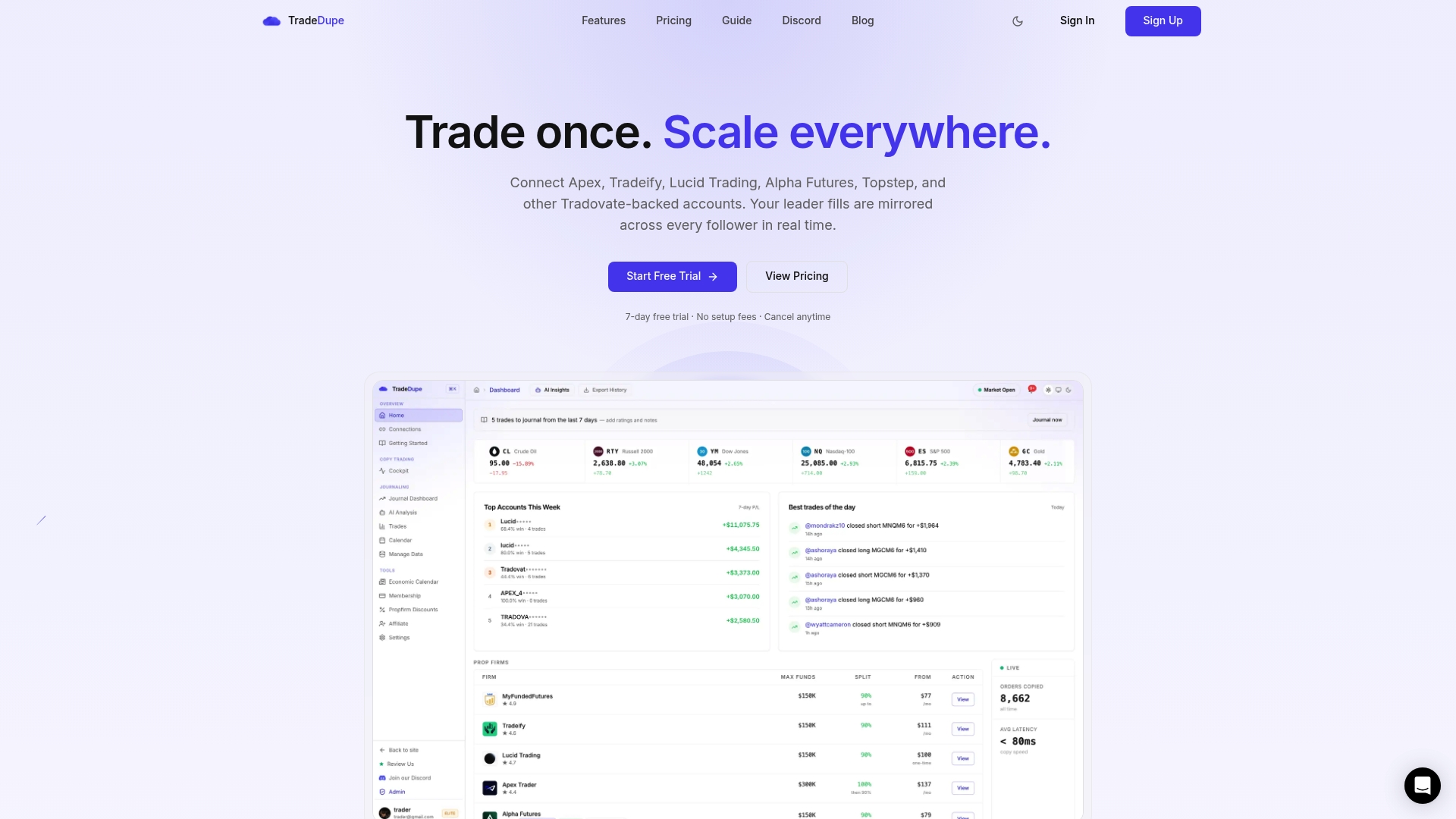
Setting up a trial takes a few minutes. Sign up, connect your Tradovate accounts through the official OAuth flow, and choose the plan tier that matches your follower count. If you are testing with a couple of accounts, the Standard plan covers two connections with up to ten accounts each, more than enough runway to run a full validation before scaling further.
Use the 7-day free trial for exactly what it is meant for: run the test matrix. Force a partial fill, trigger a rejection, disconnect and reconnect, and confirm your daily-loss limits actually block new orders. TradeDupe's getting-started guide walks through Tradovate connection setup step by step, and the copy trading learning page covers the underlying mechanics if you want the full technical picture before your first follower goes live. Cancellation is one click, so there is no reason to skip the validation phase.
Primary Sources for Deeper Technical Review
For traders who want to verify the technical claims in this article directly rather than take them on faith, the following primary sources cover the exchange, regulatory, and API layers involved in automated copy trading.
- CME's Drop Copy documentation explains how execution reports and acknowledgements flow through FIX-based feeds for real-time monitoring and reconciliation.
- The CFTC's advisory on AI trading bots details the specific fraud patterns regulators warn against in automated trading marketing.
- Tradovate's API documentation covers the `isAutomated` flag requirement and the risk-control endpoints every serious copier should be tested against.
- CME Globex Credit Controls documentation shows how exchange-level exposure and quantity limits function as a backstop beyond any single vendor's software.
This article is general information, not a substitute for advice from a qualified financial advisor. Consult a qualified financial professional about your own circumstances before acting on anything here.
Sources
- Drop Copy - CME Group
- Customer advisory: AI Won’t Turn Trading Bots into Money Machines | CFTC
- Tradovate API documentation
- Copy Trading Policy | Top One Futures Help Center
FAQ
Can I make $1,000 a day from trading?
No amount of automation, including automated futures copy trading, guarantees a specific daily profit figure. The CFTC's advisory on trading bots specifically warns that guaranteed-return claims are a hallmark of deceptive marketing, and any provider promising a fixed daily number should be treated as a red flag rather than a credible offer.
What is the best futures trade copier?
The strongest choice depends on which broker infrastructure you actually trade on. For traders running multiple Tradovate accounts across prop firms, TradeDupe is built specifically around that ecosystem, with OAuth-based connections, real-time mirroring, and broker-enforced risk limits rather than generic multi-broker bridging.
Which automated futures trading bot is the best?
There is no single best bot for every trader, since performance depends heavily on strategy, account structure, and risk tolerance. What separates a reliable system from a risky one is documented operational evidence, reconciliation logs, tested failure handling, and broker-enforced risk controls, rather than marketing claims about win rates.
Is copy trading actually profitable?
Profitability in copy trading depends entirely on the underlying strategy being copied, not on the copying mechanism itself. A well-built copier like TradeDupe removes execution lag and manual replication error, but it cannot make a losing strategy profitable, and any provider suggesting otherwise is not being straight with you.
How much does automated futures copy trading cost?
TradeDupe's plans start at $20 per month for the Standard plan billed yearly, scaling up to $45 per month for the Pro plan and $90 per month for the Elite plan with unlimited connections, both also billed yearly. Every plan includes a 7-day free trial with one-click cancellation.
Recommended
- TradeSyncer vs TradeCopia: Honest 2026 Comparison for Futures Traders
- 3 Safeguards Prop Firm Traders Need for Futures Copy Trading Security
- 5 Fast Checks to Diagnose Copy Trading Desync for Prop Desks
- What Is Real-Time Trade Synchronization for Prop Traders?
For educational purposes only. Not financial advice. Futures trading involves substantial risk of loss and is not suitable for every investor.