

Copy Trading Slippage: Why Fills Lag Across Tradovate Prop Accounts
TradeDupe
12 min read
Learn why copied futures trades slip across Tradovate prop accounts, how latency, order types, liquidity, and sizing affect fills, and what to measure first.
If your follower fills and returns trail the leader account, the cause is not mysterious: it is the cumulative slippage from latency in the copy chain, the order types in use, liquidity conditions, and sizing mismatches. Each is measurable and each responds to specific fixes in order type defaults, lot sizing, and execution pacing. The fastest path forward is measuring slippage first, then adjusting one control at a time.
*
> TL;DR: > > - Measure each follower’s fill against the same timestamped top of book price, then log order type, instrument, and market conditions consistently. > - Compare capture, relay, broker receipt, and exchange confirmation times on each follower connection; target the consistently slowest handoff before changing execution settings. > - Use protected or marketable limit orders for price control, but expect partial fills or missed trades during volatile markets and news releases. > - Round position sizes to clean whole contract multiples; fractional copy ratios distort risk, especially when one contract represents a large share of a scalping position. > - Build a slippage distribution by market condition, not just an average, and test one adjustment at a time against a comparable sample.
*
Table of Contents
- What slippage means for a follower: arrival price vs fill price
- The copy-trade execution chain and where latency accumulates
- How order types change fill outcomes for copied accounts
- Sizing, lot steps and proportionality: why follower PnL diverges
- Liquidity, volatility and adverse selection: what the research shows
- How to measure slippage on your copied accounts
- Practical mitigation tactics you can apply now
- Backtesting and modeling slippage to match live results
- The short checklist I use when I copy trades
- How a Tradovate-focused copy platform reduces execution friction
- FAQ
- Sources
What slippage means for a follower: arrival price vs fill price
Slippage is the gap between the price you expected when a trade was triggered and the price you actually got. In copy trading, the cleanest way to define this is through arrival price, the price available at the moment the leader's order was generated, compared against the fill price your follower account receives once the order clears your broker and reaches the exchange.

Using the leader's own execution price as your reference is tempting but misleading, because the leader already absorbed some slippage before you ever saw the signal. A better practice is to log the last observed top-of-book price at the moment your platform captured the leader's fill, then measure your own execution against that same timestamp. This isolates the slippage your copy chain adds, rather than mixing in slippage the leader already experienced.
Expressing slippage consistently matters more than most traders realize:
- Ticks or points work well for single-instrument tracking, since they map directly to dollar value per contract.
- Percentage of price helps when comparing slippage across instruments with different tick values.
- Basis points suit traders running the same strategy across multiple futures products with varying volatility.
Pick one unit and stick with it across every account you monitor. Mixing units across Apex, Tradeify, or MyFundedFutures accounts makes it nearly impossible to spot which account is underperforming and why.
The copy-trade execution chain and where latency accumulates
Every copied trade travels through a sequence of handoffs, and each one adds a small delay. Understanding this chain helps you figure out where your real cost is coming from, rather than blaming "bad luck" or a noisy market.
The path typically runs through four stages:
- Leader execution capture, where your copy platform detects the leader's fill through a live data feed or websocket stream.
- Relay processing, the time your platform takes to translate that fill into an order instruction for each follower account.
- Broker internal routing, where Tradovate receives the instruction and validates it against account rules, margin, and permissions.
- Exchange matching, the final step where CME Group's matching engine executes against the live order book.
None of these steps takes long in isolation, often just milliseconds each, but they compound. A delay at capture, another at relay, and a routing delay at the broker can add up to a window where the market has already moved, particularly during fast conditions. This is why two followers running the same strategy on different accounts can see noticeably different fills: the delays are not identical across every connection.
To diagnose where your own delays concentrate, track:
- Timestamp of the leader's fill versus the timestamp your platform registered it.
- Time between your platform issuing the order and Tradovate confirming receipt.
- Time between order submission and exchange confirmation.
If one of these intervals is consistently larger than the others, that is where your mitigation effort should start.
How order types change fill outcomes for copied accounts
The order type your copy setup uses by default has a direct effect on how much slippage you absorb, and the tradeoffs are not the same for every market condition.
Market orders fill fast but carry no price protection. According to CME Group's order type documentation, market orders have no built-in price boundary unless the platform applies one, which means a market order submitted during a volatility spike can fill meaningfully worse than the price you expected. Limit orders solve the price problem but introduce fill risk, the order may simply never execute if the market moves away before it is reached.
A middle ground exists in market orders with protection, which restrict execution to a defined price range around the current market. CME documentation notes these can result in partial fills or outright cancellations when volatility exceeds the protected range, so understanding your platform's specific protection behavior matters before you rely on it. IOC (immediate-or-cancel) and FOK (fill-or-kill) orders behave similarly: they demand an immediate fill within set terms, and in high-volatility windows that often means no fill at all rather than a bad one.
- Market orders: fastest execution, worst price control.
- Limit orders: best price control, highest chance of missing the trade entirely.
- Market orders with protection: a balance, but partial fills are possible in fast markets.
- IOC/FOK: good for avoiding stale fills, but expect more rejections during news events.
Pro Tip: Test your copy platform's protected market order settings on a demo or small account before relying on them during a live funded evaluation.
Sizing, lot steps and proportionality: why follower PnL diverges
Even when execution timing is tight, two accounts copying the same leader trade can post different results because of how position size gets translated across accounts. Futures contracts trade in whole-lot steps, there is no fractional contract, so when a copy platform tries to scale a leader's size proportionally to a smaller or larger follower account, rounding has to happen somewhere.
If the leader trades 3 contracts and your account is sized to copy at 60% of that, the math suggests 1.8 contracts, which gets rounded to either 1 or 2. That rounding difference changes your exposure relative to the leader's intended risk, and it shows up as a PnL gap that has nothing to do with slippage on price.
- Lot quantization: fractional sizing gets rounded, which shifts your actual risk away from the leader's intended ratio.
- Proportional mismatches: accounts of very different sizes copying the same leader will diverge more as the size ratio moves further from a clean multiple.
- Scalping impact: strategies targeting small point moves are especially sensitive, because a one-contract rounding difference can represent a large percentage of the intended position.
If you run several prop firm accounts of different sizes, whether Apex, Lucid, or Alpha Futures, check how your copy tool handles non-integer multipliers before assuming slippage alone explains a performance gap.
Liquidity, volatility and adverse selection: what the research shows
Some of the slippage you experience is not about your setup at all. It is a structural feature of trading in fast, thin, or latency-sensitive markets, and the research on this is fairly consistent.
A large-scale empirical study of live trading on Bybit and Binance found a measurable latency-induced adverse selection effect: orders that looked profitable in backtests often received worse-than-expected fills once executed live, with failure-to-fill rates and price worsening both correlating with volatility, latency, and limited order book liquidity, according to research published on SSRN. In plain terms, the market tends to move against you more often right when you can least afford it, because the orders most likely to be profitable are also the ones competing hardest for the same liquidity.
For a copy trader, this means the moments you most want a clean fill, during a breakout or a fast reversal, are statistically the moments you are least likely to get one. Thin order books during low-volume sessions amplify this further, since there simply is not enough resting liquidity to absorb a market order without moving the price.
Watch for these conditions, which raise your odds of adverse selection:
- Scheduled news releases and economic data drops.
- The open and close of the regular trading session.
- Rapid, visible changes in the order book depth just before you submit.
None of this means copying is unworkable. It means timing and order type choices matter more during these specific windows than during calm, liquid stretches of the session.
How to measure slippage on your copied accounts
You cannot fix what you have not measured, and slippage tracking does not need to be complicated to be useful.
- Calculate per-trade slippage using arrival price minus executed price for buys, and executed price minus arrival price for sells.
- Normalize the result to ticks or a percentage so trades across different instruments or contract sizes are comparable.
- Log every trade with its timestamp, instrument, order type, and the volatility condition at the time (calm, moderate, elevated).
- Build a distribution, not just an average, since a handful of extreme outliers during news events can hide an otherwise healthy median.
- Slice by condition, comparing your slippage during calm markets against news windows or session opens separately.
- Use a meaningful sample of trades per condition before drawing conclusions, since a handful of trades can be dominated by one bad fill.
Once you have a baseline, any change you make, a new order type, a throttle setting, a sizing adjustment, should be measured against that same baseline over a comparable sample before you decide it worked.
Practical mitigation tactics you can apply now
A few operational changes tend to produce the largest reduction in slippage for copy traders running multiple accounts, and they can be implemented without rebuilding your entire setup.
- Switch to marketable limit orders or protected market orders where your platform supports them, instead of defaulting to unprotected market orders.
- Align lot sizing with clean multipliers and avoid fractional proportional settings that force rounding on every trade.
- Throttle and stagger your fan-out so that follower orders across multiple accounts do not all hit the broker in the same instant, which can itself create a small queuing delay.
- Pause copying around scheduled news releases and other known high-volatility windows where fill quality predictably worsens.
- Run a quick pre-trade margin and liquidity check before the session, confirming each account has room to take the position without a last-second rejection.
- Change one control at a time and compare your slippage distribution before and after, rather than adjusting several settings simultaneously and losing track of what actually helped.
Pro Tip: If you manage accounts across Apex, Tradeify, and MyFundedFutures simultaneously, stagger your fan-out order across accounts rather than sending all orders at once, which may reduce the chance of a burst overwhelming your broker connection.
Backtesting and modeling slippage to match live results
A backtest that assumes instant, costless fills will almost always overstate your edge, sometimes by a wide margin once you trade it live. The fix is not to abandon backtesting, but to build slippage into the model from the start.
- Apply a fill-worsening distribution to simulated trades, rather than assuming the backtest price is the price you would have received.
- Add a failure probability for marketable limit orders, since in live conditions some percentage of these will not fill at all, particularly in fast markets.
- Stress-test your strategy against simulated latency delays, thin liquidity periods, and scheduled news windows, since these are exactly the conditions where live results diverge most from backtested ones.
A strategy that only looks profitable with zero-slippage assumptions is not ready for a funded account.
The short checklist I use when I copy trades
Before enabling any copy relationship across my accounts, I run through the same short list. Verify order type defaults and confirm lot step sizes match clean multipliers, not fractional ones that invite rounding. Confirm daily loss limits and per-account toggles are active, and pause copying manually around major news releases rather than trusting it to resolve itself. Track the slippage distribution daily, and investigate any persistent skew before assuming it is noise.
> — Andres
How a Tradovate-focused copy platform reduces execution friction
Much of the slippage described above comes down to how many hops your order takes and the safeguards available to you. We built TradeDupe specifically around that problem for traders running multiple Tradovate-based prop accounts.
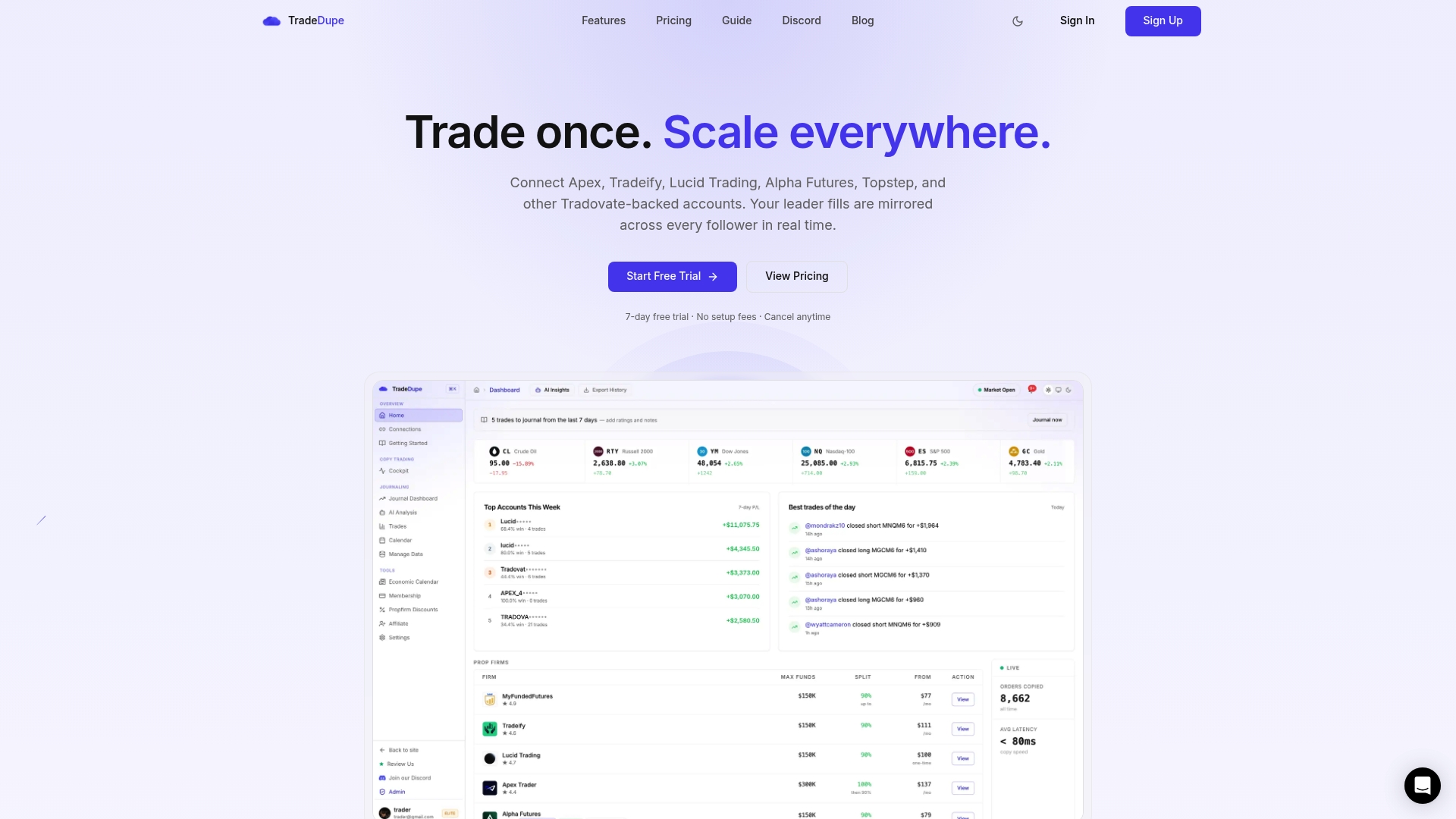
We connect through Tradovate's official OAuth flow, so your password is never stored, and we mirror leader fills to your enabled follower accounts over live WebSocket streams. We include per-account copy toggles, execution mode controls, and rogue-trade detection to catch follower trades you did not place, along with daily loss limits enforced directly through Tradovate and analytics to track your fills over time. If you are running accounts across Apex, Tradeify, Lucid, MyFundedFutures, Alpha Futures, or TakeProfit Trader and want to see whether this fits your setup, our copy trading page walks through the process, with details about available plans and trial terms.
FAQ
Is 0.1 slippage good?
A slippage figure only means something relative to the instrument's tick size and typical volatility, so a small number of points is excellent on some futures contracts and negligible on others. Compare your own slippage against your historical baseline for that specific instrument rather than against a fixed number.
What is the 3-5-7 rule in trading?
The 3-5-7 rule is a risk management guideline some traders use for position and loss limits across a portfolio, rather than a standard tied specifically to slippage or copy trading. Definitions vary across trading communities, so confirm the version your mentor or firm references before applying it.
Is copy trading a good strategy?
Copy trading can work well when you understand and actively manage the execution gap between the leader and your accounts, including order types, sizing, and timing. Regulators including FINRA caution that automation does not remove market risk, so verify any platform's legitimacy and monitor your results rather than assuming the leader's performance will transfer automatically.
How to avoid slippage trading?
You cannot eliminate slippage, but you can reduce it by using marketable limit or protected market orders instead of unprotected market orders, avoiding high-volatility windows like scheduled news, and sizing positions with clean multipliers. Measuring your slippage distribution regularly lets you confirm whether a specific change actually helped.
Sources
- The Good, the Bad, and Latency: Exploratory Trading on Bybit and Binance by Jakob Albers, Mihai Cucuringu, Sam Howison, Alexander Y. Shestopaloff :: SSRN
- Order Types for Futures and Options - CME Group Client Systems Wiki - Confluence
- Finra
Recommended
- Order Fill Mismatch: A Playbook for Tradovate Prop Desks
- Protect Prop Desk Capital With 34ms Tradovate Selective Copy Trading
For educational purposes only. Not financial advice. Futures trading involves substantial risk of loss and is not suitable for every investor.