

Prop Firms: Copy Futures Trades During News With Broker Enforced Caps
TradeDupe
9 min read
Prop firm playbook for copying futures through scheduled news. Use broker enforced loss caps, 100ms mirroring and a pre release symbol check.
Copying trades during scheduled high-impact news is not a blanket yes or no. It is conditional on one control: whether your broker or prop firm enforces server-side loss caps and flatten rules ahead of the release. Written firm policy governs the answer, not general market opinion, and the safest default is to enforce bracket exits and daily loss limits before the event, not react after it.
*
> TL;DR: > > - Copy trading during news depends entirely on whether your broker or prop firm enforces server-side loss caps and flatten rules before the release. > - Many firms require accounts to close or flatten positions within minutes of scheduled news, and prohibit strategies like straddles or strangles that mask news bets. > - Liquidity typically recedes moments before a news release and surges afterward, making automated fills more prone to slippage, disconnection, and timing issues. > - Using OAuth-based server-side mirroring and setting stops at the broker level help ensure more reliable execution during volatile news events. > - Confirm your provider’s policies in writing, particularly on flatten windows, profit and loss counting, order types permitted, and broker-enforced risk limits before copying trades around scheduled news.
*
Table of Contents
- What prop firms and brokers typically require around news events
- Why high-impact news creates real risk for copy trades
- Practical safeguards checklist for copy trading around scheduled news
- Configuring your copy system so execution behaves predictably
- Questions to ask your prop firm, broker, or leader before copying news
- What years of watching order flow around news taught me
- How TradeDupe puts these safeguards into practice
- Sources
- FAQ
What prop firms and brokers typically require around news events
Firm policies on news trading vary, but the patterns repeat across help-center documentation. Many firms require accounts to flatten open positions or cancel resting orders within a defined window, often several minutes on either side of a scheduled release. Others prohibit specific strategies outright, such as straddles or strangles built to catch a directional spike without real market conviction, or trades that look designed to mask a news bet as routine flow.
Profit and loss treatment during these windows also differs by firm and by account phase. Some evaluations weight gains earned inside the news window differently from gains earned outside it, while funded accounts sometimes carry stricter enforcement because real capital is on the line.
- Flatten or close-order requirements typically apply within a set number of minutes before and after a scheduled release.
- Certain strategies, including straddles and strangles timed to news, are commonly restricted or banned outright.
- Evaluation phases often carry looser tolerance than funded accounts, where rule violations can trigger immediate account termination.
The written policy from your specific firm is the only authoritative source. Marketing claims about "news-friendly" evaluations do not override the fine print in the help center.
Why high-impact news creates real risk for copy trades
News windows behave differently from normal trading hours, and copy systems inherit that difference the moment a leader's order fires. Automated trading activity often pulls back just before a scheduled announcement, then surges immediately afterward, which narrows the window where liquidity is thin and slippage risk climbs, according to CFTC research on macro announcements.
A one-standard-deviation surprise in the nonfarm payrolls report can add a very large number of contracts of interest rate futures volume in the first minute after release, according to CME Group's research on economic indicators. That kind of spike compresses execution timing for every account in a copy chain, not just the leader.
- Liquidity often withdraws in the seconds before release, widening spreads and increasing the odds a stop order fails to fill at the expected price.
- Automated mirrors face execution latency that can put follower fills meaningfully behind the leader's, a form of adverse selection.
- Contract-roll timing and symbol mismatches can break the copy link entirely, sending orders to the wrong expiry.
Practical safeguards checklist for copy trading around scheduled news
Treat scheduled news as an operational event, not just a market event. The controls below apply before, during, and after the release, in that order.
- Before the event, verify every follower account's symbol mapping and contract expiry match the leader's, then run a small test copy on a low-impact release to confirm the pipeline behaves as expected.
- At entry, attach bracket exits (stop and target) rather than relying on a follower-side reaction, and size positions to the event's expected range instead of a flat contract count.
- At the broker or system level, require server-side daily loss caps and order-size limits so the exchange or broker enforces the boundary, not just your dashboard.
- During the event, consider pausing copying altogether for Tier-1 releases, or switch to a reduced-size mode with tighter per-account scalars.
- After the event, reconcile every follower fill against the leader's, review the trade journal for slippage patterns, and adjust leader permissions if the behavior around news was erratic.
Pro Tip: Scale follower size down for Tier-1 releases even when your bracket orders are in place. A well-placed stop still loses ground when the fill price gaps past it.
Regulatory guidance backs this layered approach. NFA rules on automated order-routing systems require firms to maintain written supervisory procedures and pre-trade risk controls, which means relying on follower-side software alone is a weak substitute for broker-enforced limits.

Configuring your copy system so execution behaves predictably
The mechanics of how your copy platform connects to your broker matter as much as the trading rules themselves. A system that mirrors orders through a local application on your PC or a VPS introduces latency and a single point of failure that a server-side, OAuth-based connection avoids.
- Use OAuth-based, server-side mirroring instead of a locally hosted copier, and confirm the platform's stated mirroring latency in milliseconds.
- Set stops and take-profits to attach at the broker level at entry, not only inside the copy software, and test that behavior against simulated slippage before relying on it live.
- Map each leader symbol to its follower equivalent explicitly, and before any contract roll, manually check that every follower account is pointed at the same active expiry as the leader.
- Apply per-account size scalars and confirm daily loss caps are enforced by the broker itself, not just flagged by the copy dashboard.
Pro Tip: Run your symbol-mapping check the morning of a quarterly roll, not the night before. Charts can flip to the new contract while open positions and pending orders stay on the old one, an issue documented in Tradovate community reports on the September roll.
Questions to ask your prop firm, broker, or leader before copying news
Get these answers in writing before your first news session with copying enabled.
- Ask for the firm's exact news-trading policy, including the precise minute count for any flatten or close-order window.
- Ask how profits and losses generated inside that window are counted toward evaluation targets or funded payouts.
- Confirm which order types are permitted and how the platform handles stop orders during extreme price moves, since some venues convert an unfilled stop into a limit order rather than filling it at any price.
- Verify whether daily loss caps or stop enforcement exist at the broker level, independent of any third-party software you run.
What years of watching order flow around news taught me
Most traders overestimate their ability to react manually inside a news spike and underestimate how much a firm's flatten window can cost them if they misjudge the timing by even a minute. The traders who avoid blown evaluations are not the ones who predict the number correctly. They are the ones who had a bracket order and a broker-enforced loss cap already in place before the release printed, so the outcome was bounded regardless of the headline.
TradeDupe's approach reflects that discipline: connecting through Tradovate's OAuth flow rather than storing passwords, mirroring fills over live WebSocket streams typically within 100 milliseconds, and enforcing daily loss limits and profit targets directly on Tradovate so the broker, not the software, holds the line. Rogue-trade detection and per-account toggles give a second layer of control when a leader's behavior turns erratic mid-release.
> — Andres
How TradeDupe puts these safeguards into practice
Every control on the checklist above maps to a specific feature rather than a manual habit you have to remember at 8:29 AM before the number drops.
- OAuth-based, server-side mirroring removes the PC or VPS dependency and keeps fills syncing in real time.
- Rogue-trade detection flags follower trades the copier did not place, catching the exact failure mode that shows up during volatile fills.
- Per-account toggles let you pause a single follower instead of shutting down the entire copy setup during a scheduled release.
- Daily loss limits and profit targets are enforced directly on Tradovate, so the broker holds the boundary even if the dashboard is closed.
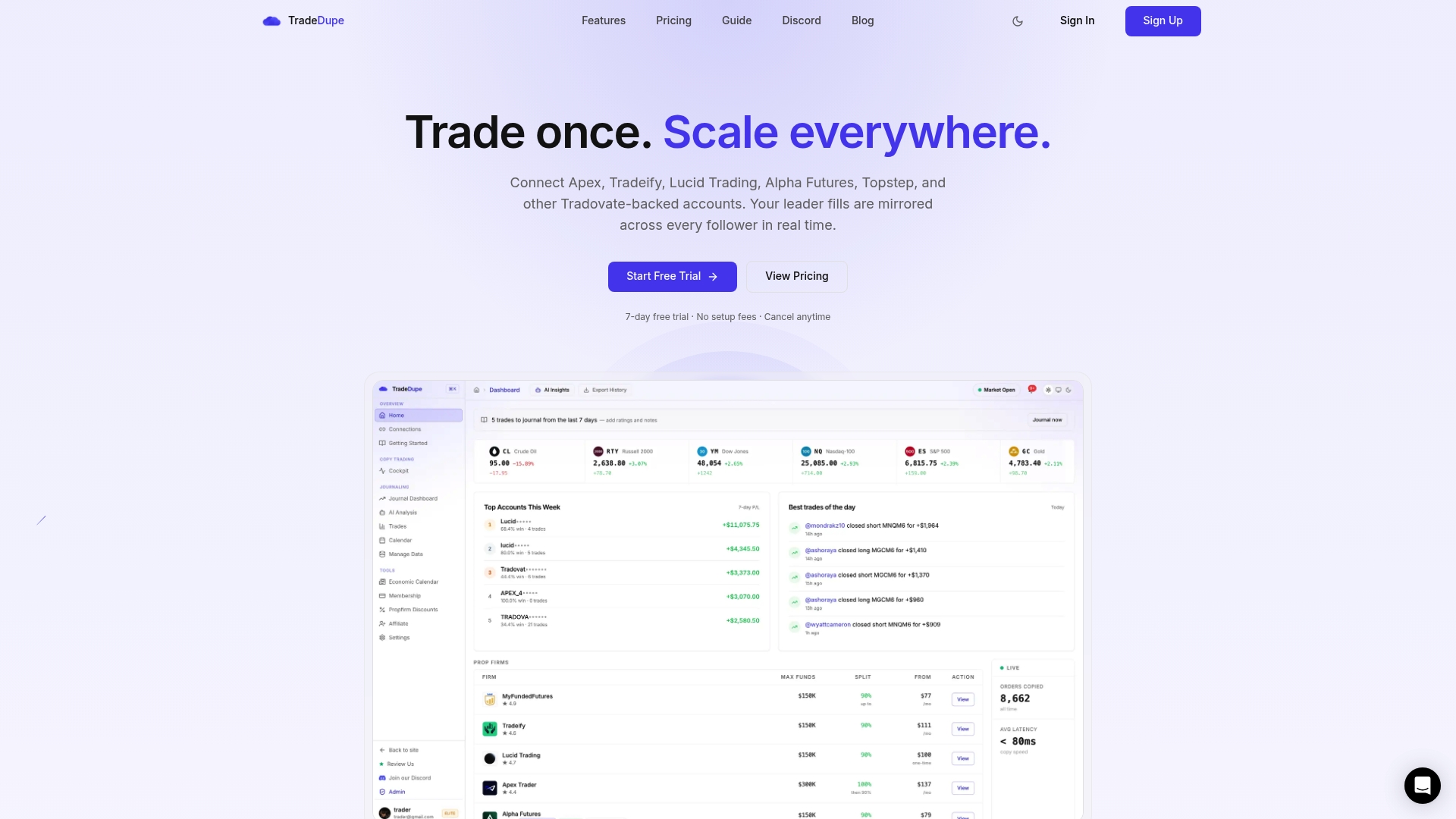
Start with a Standard plan connection on a test Tradovate account, enable a single follower, and run a simulated event-day test during the free trial before scaling to a full account roster. The copy trading learning hub walks through setup and terminology if you want the full picture before connecting your first account.
Sources
For deeper reading on volume spikes, automated trading behavior, and supervisory requirements, see CME Group's research on economic indicators, the CFTC's analysis of macro announcements, and your firm's own help-center policy pages. Traders looking to understand broader price discovery mechanics around scheduled events may also find Notstocks' overview of prediction markets a useful supplementary read.
This article is general information, not a substitute for advice from a qualified financial advisor. Consult a qualified financial professional about your own circumstances before acting on anything here.
- Economic indicators that most impact markets - CME Group (2025)
- Macro news announcements and automated trading - CFTC
- NFA rule references on automated systems
FAQ
Can you trade a funded futures account during news?
It depends entirely on your firm's written policy, since some funded programs prohibit trading within a set window around scheduled releases while others allow it with restrictions. Always confirm the exact flatten or close-order timing with your firm before copying trades near a release.
Is it good to trade during news events?
News windows carry higher volatility and often thinner liquidity right before the release, according to CFTC research, which raises slippage risk for anyone without broker-enforced stops in place. Experienced traders who trade news typically do so with bracket orders and reduced size rather than unmanaged exposure.
Is copy trading actually profitable?
Copy trading's profitability depends on the leader's strategy, the risk controls in place, and market conditions rather than the copying mechanism itself. A copy setup with server-side stops, per-account loss limits, and rogue-trade detection reduces downside risk but does not guarantee returns.
Can you make $1,000 a day with day trading?
Daily results vary widely by strategy, account size, and market conditions, and no futures trading approach produces a fixed daily figure. Traders focused on consistency generally prioritize risk controls, such as bracket exits and daily loss caps, over chasing a specific dollar target.
What should I check with my provider before enabling copy trading around news?
Confirm the provider uses server-side execution rather than a local application, since that affects latency and reliability during volatile fills. Also verify that daily loss limits and symbol mapping are enforced at the broker level, not just inside the copy dashboard.
Recommended
- Futures Trade Copier for Prop Firms (2026): Mirror One Account to Many on Tradovate
- How Prop Firm Rules Affect Trade Copying in 2026
- 3 Safeguards Prop Firm Traders Need for Futures Copy Trading Security
- Best Trade Copier for Prop Firms (2026): Rules + Setup
For educational purposes only. Not financial advice. Futures trading involves substantial risk of loss and is not suitable for every investor.