How Trading Firms Scale Operations: Tradovate Blueprint
TradeDupe
13 min read
Discover how trading firms scale operations effectively. Learn essential strategies, from KPI measurement to automation, for success.
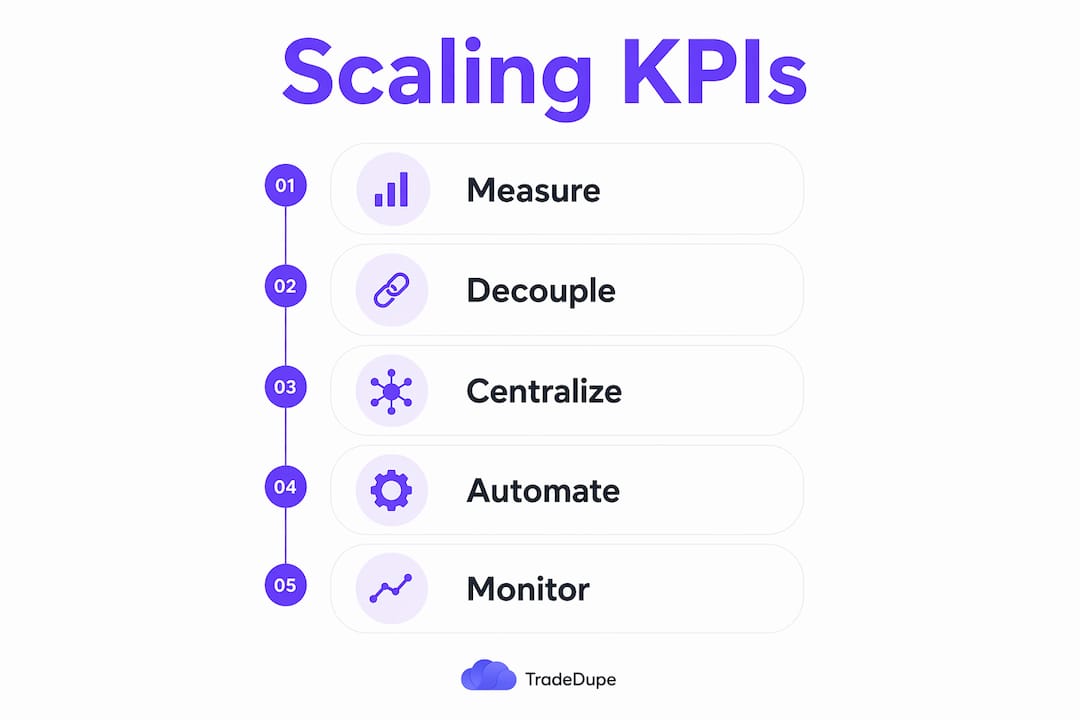
Scaling trading operations comes down to architecture and sequencing, not capital alone. The proven path: measure your critical KPIs first, decouple order routing from your matching engine, layer in centralized real-time risk controls, then automate back-office and compliance workflows. Firms that invert this sequence consistently hit execution bottlenecks or compliance failures before they reach meaningful account counts.
Three immediate actions to start now:
- Map your baseline KPIs and SLOs — latency (median, P95, P99), fill rate, slippage, and mean time to recovery (MTTR), before touching any infrastructure.
- Decouple order routing from matching — this single architectural change unlocks horizontal scaling and safer feature rollouts.
- Enable centralized real-time risk alerts — automated drawdown cut-offs across all accounts, not per-desk manual checks.
For Tradovate-based prop desks, server-side trade mirroring via Tradedupe connects a single leader account to multiple follower accounts across Apex, Tradeify, Lucid Trading, and Alpha Futures with a low median latency, making it a practical first step for multi-account execution.
*
Table of Contents
- How do trading firms scale operations in four phases?
- What KPIs and SLOs should you track to scale safely?
- How should you architect execution for real-time multi-account mirroring?
- How do centralized risk controls and pod-based portfolios reduce systemic risk?
- What is the right sequence for back-office and compliance automation?
- What does a 90/180/365-day implementation checklist look like?
- Tradedupe: real-time mirroring built for Tradovate prop desks
- How do you build an incident playbook for scaled trading operations?
- Key Takeaways
- Why sequencing is the real edge in scaling operations
- Tradedupe fits where your scaling roadmap needs it most
- Useful sources and further reading
How do trading firms scale operations in four phases?
The canonical sequence matters because each phase creates the foundation the next one depends on. Running them out of order is the most common cause of stalled growth.
- Phase 1 — Measure (Days 1–90): Instrument every layer before changing anything. Log order latency at P50/P95/P99, fill rates, slippage per instrument, and onboarding throughput. Success at 90 days means you have a live dashboard and can identify your single binding constraint. Gate criterion: all core KPIs are instrumented and baselined.
- Phase 2 — Execution decoupling (Days 90–180): Separate the routing layer from the matching engine. This enables stateless routing, horizontal scaling, and safer upgrades without disrupting matching capacity. For Tradovate-based desks, this is also where server-side mirroring replaces client-side copy logic. Gate criterion: routing and matching operate independently; a routing restart does not interrupt open positions.
- Phase 3 — Liquidity and centralized risk (Days 180–270): Add prime-of-prime liquidity aggregation and deploy automated, account-level risk cut-offs. Pod-based portfolio structure (4–10 independent strategies under one risk umbrella) belongs here. Gate criterion: automated drawdown limits are live and tested under simulated volatility.
- Phase 4 — Back-office automation (Days 270–365): Automate KYC, commission payouts, reconciliation, and transaction monitoring only after execution is stable. Compliance costs and alert volume scale poorly without automation and risk-based triage. Gate criterion: daily new applications can be processed without manual intervention.
*
What KPIs and SLOs should you track to scale safely?
Mean latency alone is misleading. A 34ms median can coexist with a P99 of 400ms, and that tail latency is what causes missed fills during volatility. Track the full distribution.
| Metric | Definition | Suggested Target |
|---|---|---|
| Latency P50 | Median order-to-fill round trip | ≤ 50ms |
| Latency P95 | 95th-percentile round trip | — |
| Latency P99 | 99th-percentile round trip | ≤ 300ms |
| Fill rate | Filled orders ÷ submitted orders | — |
| Slippage | Avg execution price vs. signal price | ≤ 1 tick per trade |
| RTO | Recovery time objective after outage | < 30 minutes |
| RPO | Recovery point objective (data loss window) | < 1 minute |
| MTTR | Mean time to restore service | < 60 minutes |
| Onboarding time | Application to funded account | — |
| KYC turnaround | Identity verification cycle time | ≤ 4 hours (automated) |
| Payment success rate | Successful payouts ÷ attempted | — |
> Benchmark: Trading-system RTO under 30 minutes and RPO under 1 minute are documented recovery targets for production brokerage infrastructure. Disaster-recovery rehearsals every 60 days are the standard readiness cadence.
Use these metrics as gating rules, not just dashboards. If P99 latency exceeds 300ms under load testing, do not advance to Phase 3. If KYC turnaround exceeds 24 hours at current volume, automate before scaling application throughput.
*
How should you architect execution for real-time multi-account mirroring?
The core pattern is a stateless routing layer sitting in front of an isolated matching engine, with server-side mirroring handling follower account replication independently of strategy logic.
Key architectural controls:
- Stateless routing layer: Routes orders without holding state, so any routing node can fail and restart without orphaning positions.
- Matching engine isolation: Decoupling routing from the matching engine enables horizontal scaling and safer feature rollouts without disrupting matching capacity.
- Active-active data centers: Running active-active rather than active-passive increases usable capacity and reduces failover delay, though it carries roughly a 20% infrastructure premium.
- Server-side mirroring: For Tradovate follower accounts, server-side execution means the mirror logic runs on the platform, not the trader's desktop, eliminating client-side connectivity as a failure point.
- Per-account toggles: Disable or re-enable individual follower accounts without stopping the leader or affecting other followers.
- Rogue-trade detection and auto-recovery: Automated identification of out-of-band orders with immediate isolation and position reconciliation.
Tradedupe's median latency of 34ms for Tradovate mirroring is a practical benchmark for server-side copy trading. Partial fills, order modifications, and rejections each require explicit reconciliation logic — a missed partial fill that goes unreconciled compounds into a position mismatch across dozens of follower accounts.
Pro Tip: Keep state persistence and structured logging outside strategy logic entirely. When auto-recovery triggers, it needs a clean state snapshot to re-sync followers without replaying stale signals. Structured logs also make post-trade reconciliation auditable and repeatable.

*
How do centralized risk controls and pod-based portfolios reduce systemic risk?
The pod model, used by multi-strategy institutions, runs 4–10 independent strategies under a single centralized risk umbrella. Moving from one strategy to five or six yields significant risk diversification: individual pod drawdowns no longer translate directly into firm-level drawdowns. The math behind this has been published and validated since Markowitz's 1952 work and is directly applicable regardless of account size.
Centralized risk design for multi-account Tradovate desks:
- Automated drawdown cut-offs: Per-account and firm-level limits that trigger position flattening without manual intervention.
- Real-time exposure monitoring: Aggregate net exposure across all follower accounts, not just the leader, updated on every fill event.
- Per-pod capital allocation: Each strategy receives a defined capital slice; a pod hitting its drawdown limit loses allocation, not the whole desk.
> Automated real-time monitoring of risk thresholds across all accounts is the technological linchpin for adding traders without diluting risk standards.
Exposure-aware routing pairs with liquidity aggregation. Deeper liquidity without exposure-aware routing creates invisible counterparty concentration — a firm can appear well-hedged while accumulating correlated exposure across multiple LPs during a volatility spike. The routing layer must factor counterparty exposure, not just price and fill probability.
*
What is the right sequence for back-office and compliance automation?
Automating back-office before execution is stable is the single most common sequencing error. Manual reconciliation running in parallel with automated execution creates latency creep and audit gaps that compound at scale.
The correct sequence:
- Unify the data model — single source of truth for accounts, positions, and transactions before any automation layer touches it.
- Automate KYC and transaction monitoring — eKYC providers with real-time identity verification; automated triage for transaction-monitoring alerts.
- Event-driven commission and payout automation — triggers on fill events eliminate manual spreadsheets and reduce reconciliation delays.
- Real-time reconciliation — position and cash reconciliation running continuously, not end-of-day.
Common failure modes to avoid:
- Introducing back-office automation before execution-layer decoupling is complete.
- Running manual reconciliation alongside automated execution (creates divergence).
- Deploying sanction screening at scale without load testing the alert volume first.
Operational rule: when daily new applications exceed 200, real-time eKYC and automated triage are no longer optional. Compliance costs and transaction-monitoring alert volume scale poorly without automation. Maintaining a full audit trail for multi-account setups is also a regulatory baseline, not a nice-to-have. Prop firm rule compliance during copy trading adds another layer — understanding how prop firm rules affect trade copying is a prerequisite before automating payout flows.
*
What does a 90/180/365-day implementation checklist look like?
90 days — Measure and quick wins:
- Instrument all core KPIs (latency P50/P95/P99, fill rate, slippage, MTTR).
- Run one disaster-recovery drill; document gaps.
- Configure payment routing for your top three corridors.
- Baseline onboarding throughput and KYC turnaround.
180 days — Decouple and automate risk:
- Complete execution-layer decoupling (routing independent of matching).
- Deploy centralized risk automation with automated drawdown cut-offs.
- Roll out automated KYC flows; target ≤ 4-hour turnaround.
- Implement event-driven commission and payout triggers.
- Expand LP and PSP connections.
365 days — Full-scale operations:
- Deploy active-active data center architecture.
- Complete back-office automation (reconciliation, transaction monitoring, audit trail).
- Establish global support shifts and formal failover testing cadence.
- Run quarterly runbook tests; rehearse disaster recovery every 60 days.
Test plan essentials: Smoke-test mirroring after every infrastructure change. Rehearse runbooks every 60 days, not just after incidents. Log P99 latency, fill rate, and MTTR during every drill — these numbers tell you whether your SLOs hold under realistic failure conditions. Fannie Mae's proof-of-concept simulation approach — building a model in 90 days to identify bottlenecks and test peak-volume resilience — is a useful template for capacity planning before you hit scale.
For desk-level efficiency as headcount grows, trading desk workflow improvements at the hardware and ergonomics layer compound meaningfully across a larger team.
*
Tradedupe: real-time mirroring built for Tradovate prop desks
Tradedupe is purpose-built for the Tradovate ecosystem, handling the execution-layer mirroring that the phased roadmap above requires.
Core features:
- Server-side real-time mirroring with a published median latency of 34ms.
- Per-account toggle controls to enable or disable individual follower accounts instantly.
- Rogue-trade detection with automated isolation.
- Auto-recovery with state persistence for post-incident re-sync.
- Real-time dashboard monitoring sync status, leader and follower activity, and risk exposure.
- AI-powered trade analysis and comprehensive reporting.
Supported integrations: Tradovate (primary broker), with compatible prop firm account support for Apex, Tradeify, Lucid Trading, and Alpha Futures.
| Feature | Tradedupe Specification |
|---|---|
| Median mirroring latency | low median latency |
| Execution model | Server-side (no desktop dependency) |
| Rogue-trade detection | Automated, real-time |
| Auto-recovery | Yes, with state persistence |
| Per-account toggles | Yes |
| Supported prop platforms | Apex, Tradeify, Lucid Trading, Alpha Futures |
| Broker connections | Unlimited (enterprise tier) |
| Analytics | Real-time dashboard + AI-powered reporting |
Tiered subscription plans cover individual traders, small teams, and enterprise prop desks. A free trial is available. Setup takes approximately 10 minutes via the getting-started guide.
*
How do you build an incident playbook for scaled trading operations?
Detection speed determines everything. An undetected mirroring failure that runs for 20 minutes across 50 follower accounts creates a reconciliation problem that takes hours to unwind.
Incident playbook steps:
- Detection (0–2 min): Automated alerting on latency spike, fill-rate drop, or sync-status anomaly. On-call escalation within 2 minutes of alert trigger.
- Triage (2–5 min): Identify scope — single follower, all followers, or leader account. Maximum 15-minute response time for critical issues.
- Isolation (5–10 min): Use per-account toggles to isolate affected followers. Pause leader if the issue is upstream.
- Failover/auto-recovery (10–20 min): Invoke auto-recovery; target RTO under 30 minutes. Confirm state persistence loaded correctly before re-enabling followers.
- Re-sync and reconciliation (20–30 min): Verify position parity across all follower accounts. Log every discrepancy for postmortem.
- Postmortem (within 24 hours): Root cause, timeline, impact scope, and runbook update.
Tradedupe's security and reliability architecture supports auto-recovery and state persistence natively, which shortens the isolation-to-recovery window materially.
Pro Tip: Run disaster-recovery rehearsals every 60 days, not just after incidents. Log P99 latency and MTTR during every drill. A runbook that has never been rehearsed under realistic conditions is a document, not a plan.
*
Key Takeaways
Prop firms that scale Tradovate operations reliably follow a strict sequence: measure KPIs first, decouple execution next, add centralized risk controls, then automate back-office workflows.
| Point | Details |
|---|---|
| Sequence is the strategy | Measure → decouple execution → centralized risk → back-office automation; inverting this order causes execution failures. |
| RTO and RPO are non-negotiable | Target RTO under 30 minutes and RPO under 1 minute; rehearse disaster recovery every 60 days. |
| Pod model reduces systemic risk | Running 4–10 independent strategies under centralized risk controls prevents individual drawdowns from cascading firm-wide. |
| Compliance automation comes last | Automate KYC and reconciliation only after execution-layer decoupling is complete; premature automation creates audit gaps. |
| Tradedupe for Tradovate mirroring | Tradedupe delivers server-side mirroring at 34ms median latency with auto-recovery and support for Apex, Tradeify, Lucid Trading, and Alpha Futures. |
*
Why sequencing is the real edge in scaling operations
The firms that stall during scaling almost always share one trait: they treated growth as a marketing or capital problem rather than an operations architecture problem. Compliance automation designed as an afterthought, execution layers that were never properly decoupled, risk controls that exist on paper but have never been tested under realistic failure conditions — these are the actual failure modes, and they show up predictably at the same inflection points.
The phased roadmap in this guide is not theoretical. The measurement-first discipline, the insistence on execution-layer decoupling before adding accounts, the pod model's risk diversification math — these are patterns that institutional desks have used to compound through volatile periods while single-strategy operations struggled. The technology to apply them at the prop-firm level now exists.
For Tradovate-based desks specifically, the execution-layer question has a concrete answer. A platform with a published median latency, documented auto-recovery, rogue-trade detection, and per-account controls is a measurable reliability signal. Audit trails, state persistence, and structured logging are not features to evaluate later — they are the operational foundation that makes the rest of the roadmap possible. Look for those signals before you commit to any mirroring infrastructure.
*
Tradedupe fits where your scaling roadmap needs it most
When you are running multiple Tradovate accounts across Apex, Tradeify, Lucid Trading, or Alpha Futures, the execution-layer gap is the first thing that limits growth. Tradedupe closes that gap with server-side real-time mirroring at 34ms median latency, automated rogue-trade detection, per-account toggles, and auto-recovery built in from day one.
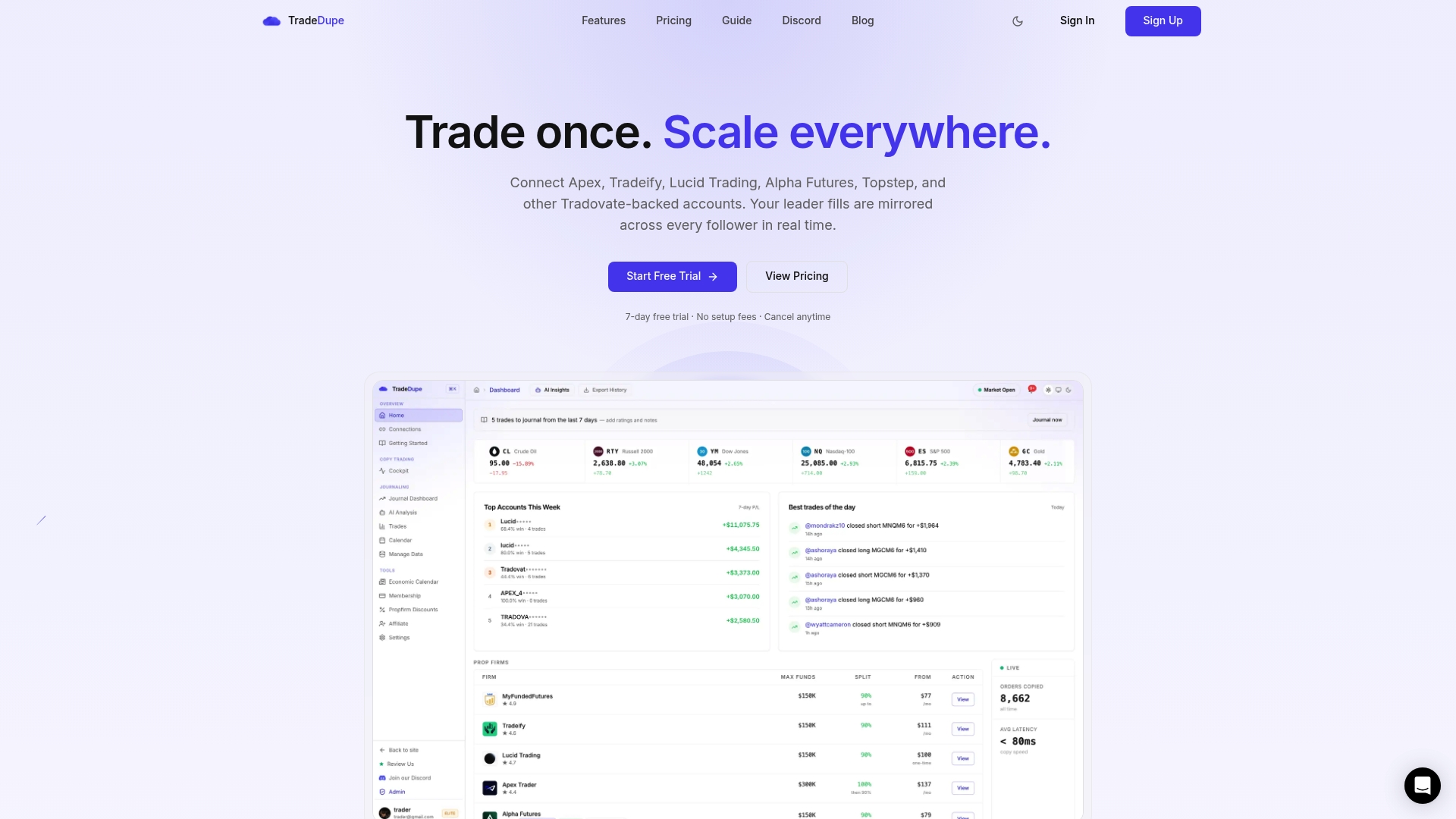
Prop desks that need to move from manual multi-account management to a reliable, auditable mirroring infrastructure can set up Tradovate copy trading in approximately 10 minutes. A free trial is available, and the desktop setup guide walks through authentication and account configuration step by step. If you are evaluating enterprise features, the admin verification workflow covers governance and access controls for larger prop desks.
*
Useful sources and further reading
The following sources provided benchmarks, architectural patterns, and vendor-specific guidance used throughout this guide.
- Scaling Your Forex Brokerage from 500 to 20,000 Clients — Finxsol: Benchmarks for RTO/RPO targets, compliance automation sequencing, and disaster-recovery rehearsal cadence.
- How to Scale a Brokerage Infrastructure in 4 Phases — B2Broker: Architectural patterns for execution-layer decoupling, active-active data centers, and exposure-aware routing.
- Enterprise Trading: How Brokers Build Scalable Infrastructure — Leverate: Event-driven back-office automation, unified data models, and integration complexity as a scaling constraint.
- Building Trade Assistant: Jefferies and AWS: AI-driven query agents for democratizing data access and reducing IT bottlenecks in front-office operations.
- From Startup to Global Prop Firm: Scaling Up Without Losing Control — Axcera: Real-time risk monitoring as the linchpin for adding traders without diluting oversight standards.
- TradeDupe Product Pages: Server-side mirroring specifications, supported integrations, latency benchmarks, and subscription plan details for Tradovate-based prop desks.