
Lucid Pro Payout Rules (2026): Caps, Buffer, Consistency
TradeDupe
11 min read
LucidPro payout rules as of November 2026: the $500 minimum, payout caps by account size, the buffer, the 40% consistency rule and how to request.
A LucidPro payout requires four things in the same cycle: at least a $500 request, a cycle profit goal that scales with account size, a largest day of no more than 40% of cycle profit, and a balance above the buffer. Every payout is also capped by account size and payout number. These rules are from Lucid's own LucidPro Payouts help-center page, checked in November 2026. This guide walks through each one with worked numbers and flags the changes that trip up traders holding several Lucid accounts.
TL;DR
- Minimum request: $500, and never above the cap for your account size and payout number.
- Caps: Payout 1 is $1,000 (25K), $2,000 (50K), $2,500 (100K) and $3,000 (150K). Payouts 2 and later are $1,500, $2,500, $3,000 and $3,500.
- Cycle conditions: a minimum profit goal ($250 to $1,000 by size), a largest day of 40% or less of cycle profit, a balance above the buffer, and no rule violations.
- Split: 90% to you and 10% to Lucid on current accounts. Accounts bought or reset before 11/28/2025 at 3:00 PM EST keep older terms.
Table of Contents
- How a LucidPro payout cycle works
- Payout caps and your share by account size
- The profit buffer, explained
- The 40% consistency rule with real numbers
- How to request a LucidPro payout
- What happens after five payouts
- Pro versus Flex: why the rules differ
- Mistakes that delay a LucidPro payout
- Several Lucid accounts: keep every cycle straight
- Perspective
- Run your Lucid accounts from one
- FAQ
- Sources
How a LucidPro payout cycle works
A payout cycle is the stretch of trading between one approved payout and the next. Lucid measures your eligibility inside that cycle, and everything resets after a payout is approved. The profit goal starts over, and so does the consistency calculation.
Lucid's official page lists four conditions that must hold at the same time:
- You reached the minimum profit goal for your account size.
- Your largest single-day profit is no more than 40% of total cycle profit.
- Your balance exceeds the buffer.
- You have no rule violations.
Miss one and the request is not eligible, however good the other three look. According to Lucid's general FAQ, eligibility updates with end-of-day accounting, so a strong afternoon is not reflected until the session closes.
Payout caps and your share by account size
The cap is the most you can request in a single payout. It rises after the first payout and scales with account size. These figures come from Lucid's LucidPro Payouts table:
| Account size | Min. profit goal per cycle | Payout 1 cap | Payout 2+ cap |
|---|---|---|---|
| 25K | $250 | $1,000 | $1,500 |
| 50K | $500 | $2,000 | $2,500 |
| 100K | $750 | $2,500 | $3,000 |
| 150K | $1,000 | $3,000 | $3,500 |
The minimum request is $500 on every size. On a 25K account, the window between minimum and cap is narrow, so plan the first request around that range rather than around total profit sitting in the account.
Funded payouts are split 90% to you and 10% to Lucid. The exception is accounts purchased or reset before 11/28/2025 at 3:00 PM EST, which receive 100% on the first $10,000, per the same page.
Which account terms apply to you
The 11/28/2025 cutoff matters for anyone who has held an account for a while. Lucid states that funded consistency changed from 35% to 40% for accounts purchased or reset on or after that moment, and that earlier accounts keep 35%. If you reset an old account, you move to the new terms. If you hold several accounts bought at different times, they may not share the same rules, so check each one in your dashboard.
The profit buffer, explained
The buffer is a balance floor. Lucid defines it as your Initial Max Loss Limit plus $100, and your balance has to exceed it. On a 50K account that works out to $52,100.
The buffer applies to the request itself. A professional comparison of 25K rules shows how this plays out: on a fresh 25K LucidPro account you need at least $26,600 for the $500 minimum request, $27,100 to support the $1,000 first maximum and $27,600 for a later $1,500 maximum. A profit goal can be met while the balance is still short of the buffer, particularly after a drawdown early in the cycle.

A simple way to read it: the buffer decides whether you can request at all, the profit goal decides whether the cycle counts, and the cap decides how much you can take.
The 40% consistency rule with real numbers
Consistency means no single day dominates your cycle profit. Lucid says the rule exists so profits come from steady trading and not from one unusually large day. The calculation is your largest winning day divided by total cycle profit, and the result must be 40% or lower.
Lucid's own example: a $1,000 best day on $4,000 of cycle profit is 25%, which passes.
Here is a stricter case on a 50K account:
- Cycle profit is $3,000 and the best day is $1,500. That is 50%, so the cycle fails.
- To pass with a $1,500 best day, you need at least $3,750 of cycle profit (1,500 divided by 0.40).
- Alternatively, keep trading with smaller days until total profit grows enough to dilute the big day.
Because one day can carry at most 40% of the total, at least three profitable days are mathematically required in every cycle. Two days at the 40% ceiling total only 80%. Once a payout is approved, a large day from the closed cycle does not carry into the next calculation.
The same concentration logic appears elsewhere in markets: one outsized number can distort the picture, as in market cap versus liquidity for stocks and crypto. For a side-by-side of how other firms set their percentages, see our prop firm consistency rules comparison.

Passing the evaluation fast does not mean a fast payout
A one-day evaluation pass does not translate into a one-day first payout. The consistency requirement only starts in the funded stage, and it needs a minimum of three profitable days, as one analysis points out. Build your first-payout plan around at least three green days and a balance that clears the buffer.
How to request a LucidPro payout
Per Lucid's FAQ, the process runs like this:
- Trade until your end-of-day accounting shows the cycle conditions are met.
- Open Dashboard → Payouts and submit a request between $500 and your cap.
- Complete KYC (identity verification) if Lucid prompts you.
- Choose a payout method.
Timing depends on the method and provider. Lucid lists typically 5 to 15 minutes for Plaid and up to 2 business days for international payouts. A professional review notes that Lucid's Terms set disbursement within two business days as the binding figure and that there is no fixed monthly payout window. Treat the shorter figures as typical, not guaranteed.
Right Now Money
Lucid launched an on-demand feature called Right Now Money on October 18, 2026. Capital Critic reports that DLL-On LucidPro accounts can request mid-session payouts from that session's profit between 6:00 PM and 3:45 PM ET. The launch left the payout rules unchanged: the $500 minimum, buffer, consistency and profit goals all still apply. It changes when you can ask, not what you must meet. Confirm current eligibility with Lucid's Help Center before relying on it.
What happens after five payouts
Published guides describe a limit on simulated payouts. BestProps reports that the fifth LucidPro payout is the last before a discretionary live review, and that you have 24 hours after the email to choose between live trading and the cashout. It also notes that accounts on or before February 27, 2026 carry legacy live terms. Because live terms differ by account date and can change, confirm yours with Lucid's Help Center before you plan around a live transition.
Pro versus Flex: why the rules differ
If you hold both programs, do not mix up the checklists. According to Lucid's FAQ, LucidFlex requires five profitable trading days at the required daily minimum plus positive net profit for the cycle, with no consistency rule or buffer. LucidPro requires the minimum profit goal, 40% consistency and the buffer.
On a 50K account, a plan comparison shows Flex paying 50% of profit up to $2,000, while Pro pays up to $2,000 first and $2,500 later with the $52,100 buffer intact. Pro rewards patient, steady cycles with higher caps. Flex lets you request on a simpler day count.
Mistakes that delay a LucidPro payout
- Chasing one big day. A 3R runner at the open can put you over 40% for the whole cycle. Size it to your plan, or keep trading to dilute it.
- Requesting before end-of-day updates. Eligibility refreshes after accounting, so check the dashboard the next morning.
- Ignoring the buffer. Profit goal met, balance below the buffer: no request.
- Applying legacy terms to a new account. The 35% consistency and 100% on the first $10,000 apply only to accounts purchased or reset before 11/28/2025 at 3:00 PM EST, and should not be applied to newer purchases.
- Trusting a summary over the policy. Guides sometimes disagree on small points. One flags that the Pro overview's "no simulated payout caps" wording conflicts with the detailed table, and the table is what governs. When in doubt, confirm with Lucid.
Several Lucid accounts: keep every cycle straight
Each account runs its own cycle, buffer and consistency count. If you trade the same setup across several Lucid accounts, results will look similar, but different sizes, purchase dates and payout histories mean the caps, goals and consistency terms differ per account. Track each one separately before you request.
Before you copy trades between accounts, check the firm's current rules on copying in its Help Center. Rules on trade copying vary by firm and can change. If you are unsure, confirm with the firm. Our page on which futures prop firms allow copy trading summarizes what we found, and our Lucid versus Apex comparison shows how the payout structures differ.
Perspective
> Payout rules are arithmetic, and most denied requests come from arithmetic nobody ran. A 40% ceiling, a buffer and a cap are three numbers you can check before you place a trade, not after the day closes. > > When you run several Lucid accounts on Tradovate, the hard part is keeping each account's cycle clean. That is why we built TradeDupe for Tradovate prop traders: you choose a leader account, every fill is mirrored to the follower accounts you enable, and per-account copy toggles let you pause one account while its cycle recovers. Daily loss limits are set directly on Tradovate, so the broker enforces them. > > Know the firm's copy trading rules first, then size every trade with the consistency math in mind. > > Andres
Run your Lucid accounts from one
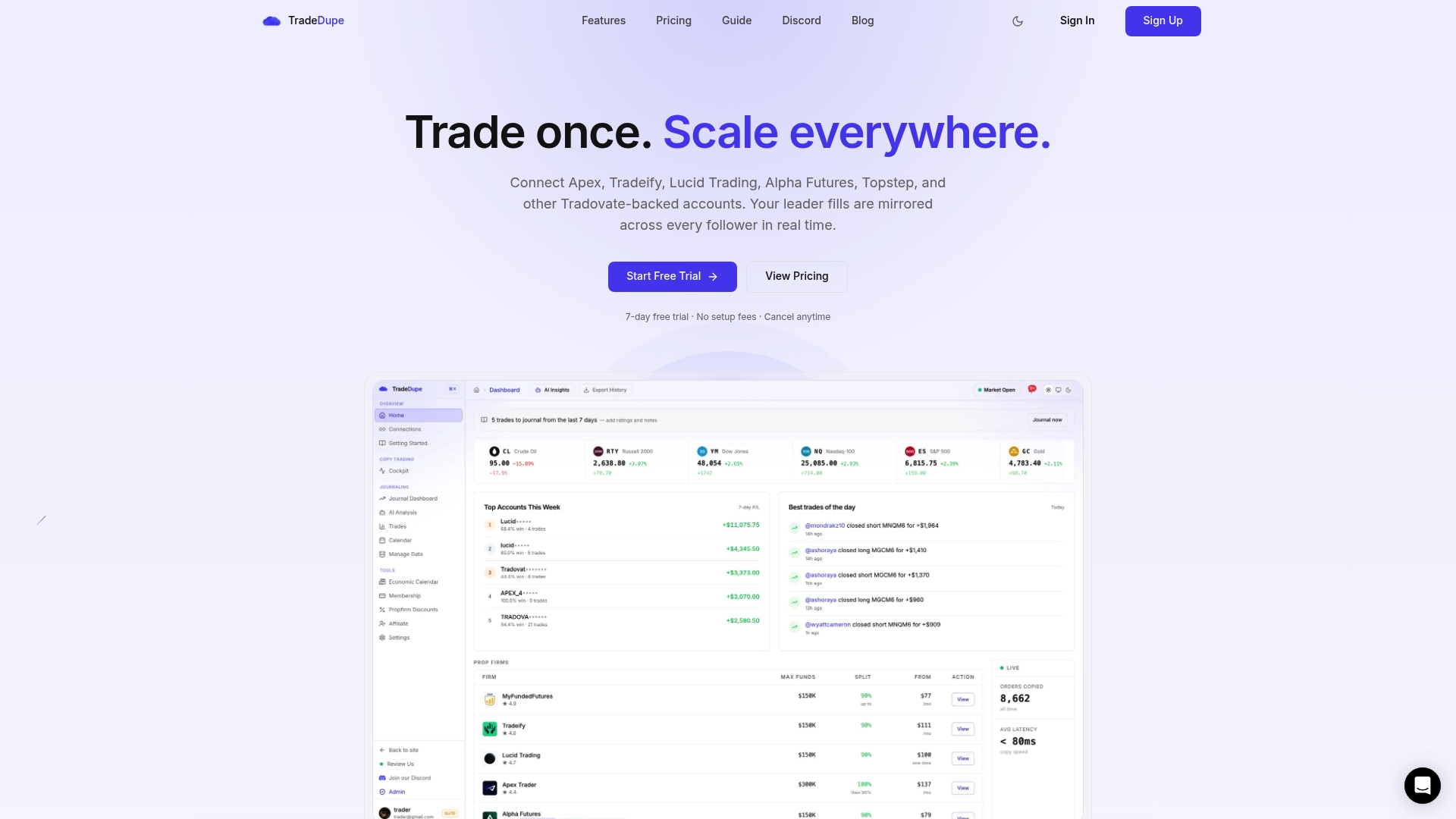
If you hold several Tradovate-based prop accounts, TradeDupe mirrors your leader account's fills to the followers you enable. You connect through Tradovate's official OAuth flow, so your passwords are never stored. Plans start at $20/month billed yearly, and every plan includes a 7-day free trial with one-click cancellation. See how it works on our futures trade copier page.
FAQ
What is the minimum payout on Lucid Pro?
The minimum request is $500, per Lucid's LucidPro Payouts page. The request also has to stay at or below the cap for your account size and payout number. You must meet the cycle's profit goal, consistency and buffer conditions as well.
How much of a Lucid Pro payout do I keep?
On current accounts you keep 90% of the approved amount and Lucid keeps 10%. Accounts purchased or reset before 11/28/2025 at 3:00 PM EST receive 100% on the first $10,000. Check your account's purchase or reset date to see which applies.
How long does a Lucid payout take?
Lucid's FAQ lists typically 5 to 15 minutes for Plaid and up to 2 business days for international payouts. Timing depends on your method and provider. Request after end-of-day accounting has updated your eligibility.
Does the consistency rule reset after a payout?
Yes. The cycle resets after an approved payout, and a large day from the closed cycle does not carry into the next calculation. The profit goal restarts too. Your next request needs a fresh cycle that meets every condition again.
Sources
- LucidPro Payouts | Lucid Trading Help Center
- LucidPro Consistency Percentage | Lucid Trading Help Center
- Futures Trading & Prop Firm FAQ | Lucid Trading
- Lucid 25K Rules: Flex, Pro, Daily and Direct Compared
- Lucid Consistency Rules: Percentages, Phases and Examples
- LucidFlex vs LucidPro vs LucidDirect: Account Rules Compared
- Lucid Trading Payout Rules: Requirements by Account
- Lucid Trading Review 2026
- Lucid Trading On-Demand Payouts: Rules, Plans and Prices
- Lucid Pro Payout Rules, Max Payouts & Eval Rules
- Exit Risk: Market Cap vs Liquidity for Stocks & Crypto
Recommended
- Apex Trader Funding Consistency Rule \(2026\): How It Works & The 30% Math
- Prop Firm Consistency Rule Guide \(2026\): Topstep, Apex, Tradeify, MFFU Rules Explained
- Apex Consistency Rule: 50% Cap and Legacy 30% \(2026\)
- Consistency Rule by Prop Firm \(2026\): Apex 30%, MFFU 40%, Tradeify, Topstep 50%
For educational purposes only. Not financial advice. Futures trading involves substantial risk of loss and is not suitable for every investor.