
MFFU Consistency Rule 2026: 30% and 50% Explained
TradeDupe
14 min read
How the MyFundedFutures consistency rule works by plan, how to calculate your best-day percentage, and what to do when one big day pushes you over the limit.
The MyFundedFutures (MFFU) consistency rule caps how much of your total profit any single day can represent. Per the MyFundedFutures help center (September 2026), the cap is 30% on Rapid EOD evaluations and 50% on Rapid Intraday and Pro evaluations. Builder has no evaluation consistency rule but applies 50% in the simulated funded stage. Going over the cap does not breach your account. It delays your pass or payout until more trading dilutes your best day.
TL;DR
- Rapid EOD evaluation: your best day cannot exceed 30% of total evaluation profit. Rapid Intraday and Pro evaluations: 50%.
- Builder: no consistency rule in the evaluation, then 50% of profit within each payout cycle in the simulated funded stage. The calculation resets after each approved payout.
- The math: best-day profit divided by total net profit. Or flip it: best-day profit divided by 0.50 (or 0.30) is the total profit you need.
- Going over is a gate, not a breach. You keep trading until the ratio falls under the limit, but a losing day can push it back up.
- Rules change. Confirm every number on the MyFundedFutures help center before you size a trade around it.
Table of Contents
- What the MFFU consistency rule actually limits
- MFFU consistency rule by plan
- How to calculate your consistency percentage
- The minimum number of winning days is built into the percentage
- What happens if your best day goes over the limit
- Evaluation versus simulated funded: where the rule applies
- Payout checks beyond consistency
- Common calculation mistakes
- Planning your sessions around the rule
- Running several MFFU accounts without the ratios drifting
- Where this article may be out of date
- Perspective
- Keep your accounts in sync with TradeDupe
- FAQ
- Sources
What the MFFU consistency rule actually limits
The rule is about the shape of your profit, not its size. Your single largest profit day cannot account for more than a set share of the total profit you have made. MFFU's own explanation of the rule says it exists so profits come from steady, repeatable performance rather than one outsized trade.
For a trader, the practical meaning is simple. A $3,000 evaluation target reached by one $2,800 day and a handful of scratch days will not clear a 50% rule. The same $3,000 reached over four or five reasonable days will. The rule rewards a pace you can repeat, and it punishes the all-in session that happens to work.
It also helps to understand the logic behind it. Firms use consistency rules to filter out lottery-ticket trading, where a trader sizes up far beyond a normal plan, hits once and passes. If you are curious how that behavior shows up in evaluation results, this breakdown of why prop firm challenges fail covers the habits consistency rules are designed to catch. Seeing the rule that way makes it easier to plan around: you are not fighting it, you are building the kind of equity curve it measures.
MFFU consistency rule by plan
The threshold depends on the plan and on the stage of the account. This table summarizes what the MyFundedFutures help center listed in September 2026.
| Plan | Evaluation | Simulated funded / payout |
|---|---|---|
| Rapid EOD | 30% | None |
| Rapid Intraday | 50% | None |
| Pro | 50% | None |
| Pro One Day Pass | None | See plan page |
| Builder | None | 50% per payout cycle |
| Flex | 50% | None during payout |
A few details from the plan pages are worth knowing:
- Rapid 50K: according to the Rapid Plan 50K guide (August 2026), it uses a 50% rule in evaluation only, with a $3,000 profit target, a $2,000 maximum loss limit, no daily loss limit and 2 minimum trading days. The Sim Funded stage has no consistency rule.
- Pro 50K, 100K and 150K: the redesigned Pro plan page lists a 50% rule and 2 minimum trading days.
- Flex 50K: the Flex Plan guide lists a 50% rule during the evaluation only, a $3,000 profit target and no consistency rule in the payout stage.
- Builder: the payout policy overview (August 2026) says you must stay within 50% consistency of total profit made to request a payout.
The same percentage does not always mean the same measurement window. PropTradingVibes points out that Rapid and Pro measure against total evaluation profit, while Builder measures against profit within the current payout cycle. Do not carry a calculation from one plan to another just because the percentages match.
How to calculate your consistency percentage
The calculation takes a minute once you have your daily results. Use net profit for each trading day, not gross wins.
- Write down net profit for each trading day. MFFU's trading day runs from 6:00 PM ET to the 4:10 PM ET close, according to BestProps, so a session that starts the evening before belongs to the next day.
- Find your largest single-day profit and your total net profit for the relevant window: the whole evaluation, or the current payout cycle on Builder.
- Divide the best day by the total and multiply by 100. If the result is at or below your plan's threshold, you satisfy the rule.
- Or work backward. Divide your best day by 0.50 (or 0.30). That is the total profit you need. You pass once your actual total meets or exceeds it.
BestProps adds a useful point: your real finish line is the higher of that required total and the plan's profit target.
Worked examples
MFFU's own example for a 50K account at 50%: with a $3,000 profit target, the most you should make in one day is $1,500, which is the target divided by 2.
On Rapid EOD at 30%, the $3,000 target means your best day can contribute no more than $900. Finance Magnates notes that a $1,200 best day would require at least $4,000 in total profit, since $1,200 divided by 0.30 is $4,000.
Here is a simple Pro evaluation, with numbers made up for illustration:
| Day | Net P&L | Running total |
|---|---|---|
| 1 | $600 | $600 |
| 2 | $1,200 | $1,800 |
| 3 | $400 | $2,200 |
| 4 | $900 | $3,100 |
The best day is $1,200. Divided by $3,100 that is about 38.7%, well under 50%. The $3,000 target is also met, so the evaluation clears, provided you have met the minimum trading days and stayed inside the drawdown.
Now change day 2 to $2,000 and keep the rest. The total becomes $3,900 and the best day is $2,000, which is about 51.3%. You are over 50%, and you need a bit more profit: $2,000 divided by 0.50 is $4,000 total. You would need roughly $100 more in net profit across further days.

The minimum number of winning days is built into the percentage
The rule also sets a floor on how many profitable days you need. BestProps explains that at a 50% limit you need at least two profitable days, and at 30% at least four, because three days at 30% only add up to 90% of the total. That is why Rapid EOD's 4-day minimum and its 30% rule line up.

This matters for planning. On a 30% plan you cannot finish in three days no matter how evenly you trade. On a 50% plan, two days can work only if they are almost equal, which is rare in real markets. Most traders land in the three-to-five-day range.
What happens if your best day goes over the limit
Nothing breaks. The help center states that exceeding the consistency targets does not breach the account. You need to trade additional days until consistency is met. BestProps describes the rule as a gate: an oversized day delays your pass, or on Builder your payout request, until further profit makes the best day a small enough share.
You can keep trading, and extra profit dilutes the percentage. There are two traps:
- A loss day raises the ratio. Your best day stays the same in dollars while your total falls. PropTradingVibes gives an example: a Pro evaluation with a $900 best day and $1,800 total profit sits at exactly 50%. After a $300 loss the total is $1,500 and the ratio becomes 60%.
- A new winner can become the new best day. If you press to catch up and have a bigger day, the numerator grows too. Recalculate after every session.
The practical response to being over the limit is not to swing harder. It is to trade your normal size, take your regular setups, and let a few ordinary days build the denominator.
Evaluation versus simulated funded: where the rule applies
Most confusion comes from stage changes. As of the September 2026 plan matrix, Rapid, Pro and Rapid EOD sim-funded accounts have no consistency rule, while Builder applies 50% to each payout cycle.
For Builder, the evaluation has no consistency rule and, per PropTradingVibes, can be passed in one trading day on the 25K and 50K versions. Once you are in the simulated funded stage, each payout request is checked against a 50% best-day rule, and the measurement resets after an approved payout. MFFU's blog adds that the Builder 50% rule does not apply once a trader moves to a Live Funded account.
On a Builder funded account, the total for consistency is only the profit in the current cycle. So a huge day early in the cycle can hold up your payout request, but after the payout is approved you start fresh.
Payout checks beyond consistency
Consistency is rarely the only gate. Before you request a payout, check the following against your plan page:
- Buffer. The Rapid 50K sim-funded stage requires a $2,100 buffer in realized profits before a payout request, with no consistency requirement for payouts.
- Minimum trading days and winning days. The Flex 50K payout policy lists 5 winning days with at least $150 net P&L each, $500 net profit between payouts and a $500 minimum payout.
- Withdrawal limits. Builder lists a $250 minimum on 25K and $500 on 50K, with maximum requests of $1,000 and $2,000 respectively.
- Other rules. Drawdown and news trading restrictions still apply.
The Pro plan has an 80/20 profit split on the sim-funded account, and MFFU reviews you for a live account after three consecutive payouts, reaching the $100,000 payout cap, an invitation from risk management, or $20,000 in profit. These are the help center's figures as of the dates on the linked pages; plan details get redesigned, so verify before you rely on them.
Common calculation mistakes
- Using gross profit. Your net total is what counts. A losing day lowers the total without lowering your best day.
- Mixing up windows. Evaluation total is everything made in the evaluation. Builder funded total is the current cycle only.
- Forgetting the reset. After an approved Builder payout, the calculation starts over.
- Applying a rule from the wrong plan. A Rapid EOD 30% limit is not a Pro 50% limit, even on the same account size.
- Ignoring the trading-day boundary. The 6:00 PM ET start means an evening session lands on the next trading day.
- Calculating only at the end. Check the ratio daily so you know whether to keep your size or stop.
Planning your sessions around the rule
A workable approach is to set a daily profit ceiling before you start. On a $3,000 target at 50%, any day above $1,500 is a problem. On Rapid EOD at 30%, the ceiling is $900. If you hit that early, you can stop for the day or trim size, which keeps the best day from swallowing the total.
Then track three numbers in a journal: best day, total net profit, and the ratio. When the ratio is above the limit, the number you need to move is the total, not the best day, so your job becomes steady days rather than a single large one.
If you run several accounts, remember that each has its own best day and its own total. Accounts at different stages or on different plans will have different ratios even if you take the same trades.
Running several MFFU accounts without the ratios drifting
Traders with multiple Tradovate-based accounts often copy one leader account to followers. When fills are mirrored, every follower shows the same best day in the same proportion, which keeps your ratios aligned across accounts of the same plan. Whether copying is allowed, and under what conditions, is set by each firm, so read the firm's current automation and copy trading policy on its help center before you connect anything. For a view across firms, see our guide to which futures prop firms allow copy trading, and for how the rules compare, the prop firm consistency rules overview.
Where this article may be out of date
The figures here come from the MyFundedFutures help center pages dated August and September 2026, checked in November 2026, and from analysis sites that track those pages. Firms redesign plans often, and some third-party pages show different percentages for the same plan. If a number on a summary page disagrees with the help center, the help center wins. If you are unsure about any rule, confirm it with MFFU support before you trade toward it.
Perspective
> Most traders who get stuck on a consistency rule did not trade badly. They traded one very good day and then had to wait. The rule rewards the dull part of the job: the same size, the same setups, day after day. > > We build TradeDupe for traders who run several prop firm accounts on Tradovate, and the lesson we keep coming back to is that the numbers have to be easy to see. You connect through Tradovate's official OAuth flow, pick a leader account and mirror fills to your enabled followers. The dashboard's trade journal and analytics give you the daily results you need for the best-day math, and daily loss limits and profit targets are set on Tradovate so the broker enforces them. > > Our advice is to treat the ratio as a daily number, not a surprise at payout time. Know your ceiling before the session, write the result down after it, and keep the rules of every firm you trade in front of you. > > Andres
Keep your accounts in sync with TradeDupe
If you trade more than one Tradovate prop account, TradeDupe's futures trade copier mirrors every fill from your leader account to your enabled follower accounts in real time, with per-account copy toggles and rogue-trade detection. Plans start at $20/month billed yearly, and every plan includes a 7-day free trial with one-click cancellation.
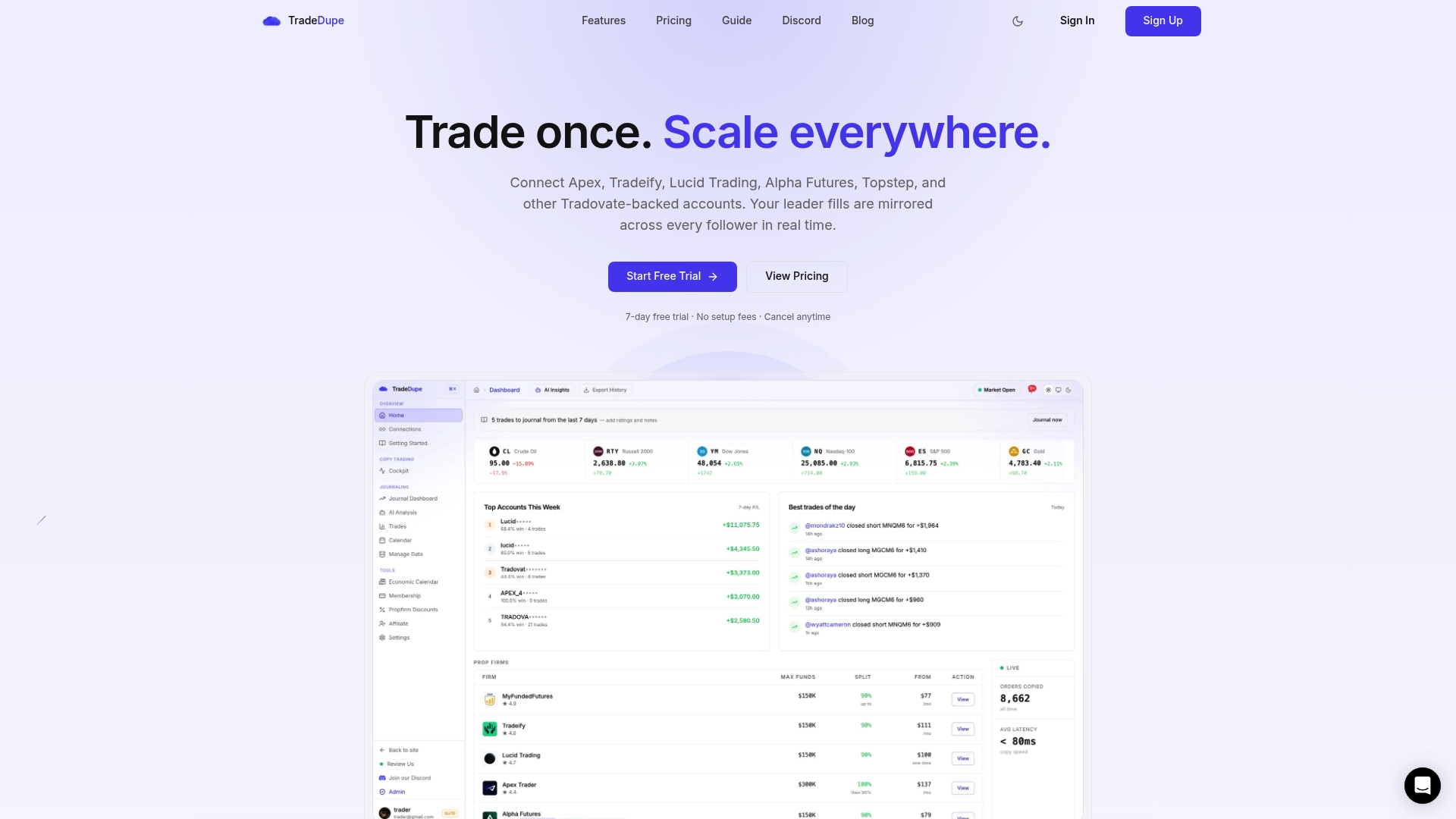
The journal and reports also make it easier to see your best day against your running total after each session. Check your firm's current copy trading policy first.
FAQ
Does MFFU have a consistency rule?
Yes, on some plans and stages. Rapid EOD uses 30% in evaluation, Rapid Intraday and Pro use 50% in evaluation, and Builder uses 50% per payout cycle in the simulated funded stage. Pro One Day Pass has no consistency rule. Check your specific plan page for the current terms.
How do I calculate the MFFU consistency rule?
Divide your largest net profit day by your total net profit for the evaluation or payout cycle, then multiply by 100. You pass if the result is at or below your plan's limit. As a shortcut, divide your best day by 0.50 or 0.30 to find the total profit you need.
What if one day is more than 50% of my profit?
Your account is not breached. You continue trading until your total profit grows enough that the best day falls to 50% or less. Be careful, because a losing day lowers your total and raises the ratio.
Does the consistency rule apply to my funded account?
It depends on the plan. Rapid, Pro and Rapid EOD sim-funded accounts have no consistency rule as of the September 2026 plan matrix. Builder applies 50% to each payout cycle and resets after an approved payout, and the rule does not carry into a Live Funded account.
Is the MFFU rule the same as other firms' rules?
No. Percentages and measurement windows differ by firm and by plan. For a side-by-side look, see our prop firm consistency rule guide and the list of prop firms with no consistency rule, and confirm each firm's current terms on its own help center.
Sources
- MyFundedFutures help center: Consistency Rule
- MyFundedFutures blog: What is the consistency rule
- MyFundedFutures help center: Rapid Plan 50K
- MyFundedFutures help center: Redesigned Pro Plan
- MyFundedFutures help center: Flex Plan $50,000
- MyFundedFutures help center: Payout Policy Overview
- PropTradingVibes: MyFundedFutures consistency rule calculator
- PropTradingVibes: MyFundedFutures 2026 plan matrix
- BestProps: My Funded Futures consistency rule
- Finance Magnates: 30% consistency rule
- Prop firm challenge failure reasons
Recommended
- Consistency Rule by Prop Firm \(2026\): Apex 30%, MFFU 40%, Tradeify, Topstep 50%
- Consistency Rule by Prop Firm \(2026\): Apex 30%, MFFU 40%, Tradeify, Topstep 50%
- Consistency Rule by Prop Firm \(2026\): Apex 30%, MFFU 40%, Tradeify, Topstep 50%
- Prop Firm Consistency Rule Guide \(2026\): Topstep, Apex, Tradeify, MFFU Rules Explained
For educational purposes only. Not financial advice. Futures trading involves substantial risk of loss and is not suitable for every investor.