

Best prpd.io Alternatives for Tradovate Prop Desks
TradeDupe
11 min read
Explore the best prpd.io alternatives for Tradovate prop desks. Discover automated trading solutions like Tradedupe for optimal performance.
For professional prop traders running multiple Tradovate accounts, Tradedupe is the strongest prpd.io alternative for automated copy trading, delivering a median 34ms latency with native Tradovate integration, server-side execution, and purpose-built risk controls.
Quick shortlist:
- Tradedupe — Tradovate-native, server-side mirroring with rogue-trade detection and per-account toggles; the default choice for multi-account prop desks
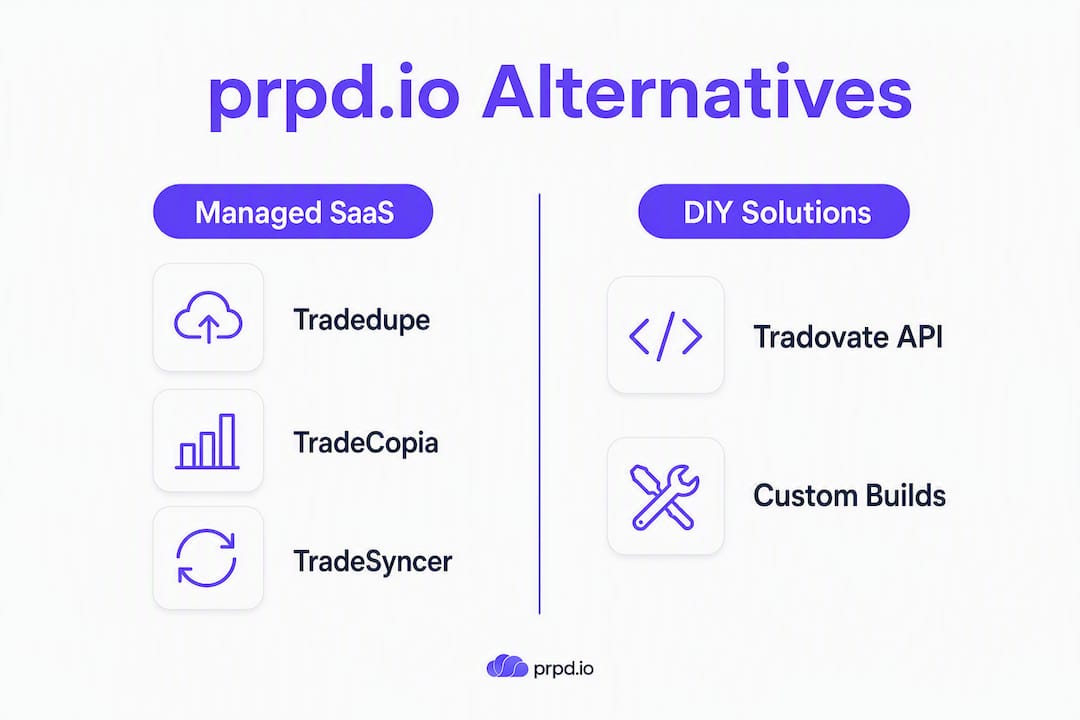
- TradeCopia / TradeSyncer — cloud copiers with broader platform support but less Tradovate-specific depth
- Tradovate API (DIY) — full control for enterprise desks with in-house development resources
One clarification worth making upfront: prpd.io (PROPPED) is a prop-firm research hub that tracks and compares over 30 futures prop firms with verified rules, discount codes, and community reviews. It is not a trade-execution or copy-trading platform. Searching for "prpd.io alternatives" usually means you want a Tradovate copier, not a competing research hub.
*
Table of Contents
- How do the main prpd.io alternatives compare for Tradovate?
- How to choose the right copy-trading solution for your prop desk
- Tradedupe: the recommended Tradovate-native copier for prop desks
- TradeCopia: quick snapshot for prop-desk traders
- TradeSyncer: quick snapshot for prop-desk traders
- When does building on the Tradovate API make sense?
- What prpd.io actually is and why search results get confusing
- Which prop-firm rule signals matter most for copy trading?
- What does setup cost and how long does it take?
- Key Takeaways
- The case for prioritizing execution architecture over feature lists
- Tradedupe: start your Tradovate copy-trading trial today
- Useful sources and further reading
How do the main prpd.io alternatives compare for Tradovate?
| Dimension | Tradedupe | prpd.io (Research Hub) | TradeCopia | TradeSyncer | Tradovate API (DIY) |
|---|---|---|---|---|---|
| Latency / execution speed | Median 34ms (published benchmark) | N/A (no execution) | Low-latency cloud | Low-latency cloud | Depends on your infra |
| Native Tradovate support | Native, server-side | N/A | API-based | API-based | Full API access |
| Risk controls | Rogue-trade detection, auto-recovery, per-account toggles | N/A | Basic controls | Stealth/prop-firm compliance features | Custom-built |
| Accounts supported | Unlimited broker connections | N/A | Multi-account | Multi-account | Unlimited (dev effort) |
| Pricing model | Tiered SaaS subscription, free trial | Free (research tool) | Subscription | Subscription or one-time license | Dev cost + hosting |
| Setup time & dev work | Minutes, no code | None | Low | Low | Weeks to months |
| Best for | Multi-account prop desks on Tradovate | Firm research & discount codes | Small teams, multi-platform | Prop-firm compliance focus | Enterprise custom logic |
| US availability | Yes | Yes | Yes | Yes | Yes |
prpd.io's value is real but narrow: it curates trusted futures trading software and firm comparisons rather than executing trades. Think of it as your pre-trade research layer, not your execution layer.
When DIY makes sense: full proprietary risk models, custom order-routing logic, or regulatory requirements that no SaaS vendor can satisfy. When a managed copier wins: you need audit logs, sub-100ms latency, and support without maintaining a VPS.
*
How to choose the right copy-trading solution for your prop desk
Native Tradovate execution with a proven, median 34ms published latency benchmark is the single most important factor. Everything else builds from there.
- Latency SLA — demand a published benchmark (median 34ms), not a vague "low latency" claim
- Risk-control feature set — rogue-trade detection, per-account toggles, and auto-recovery are non-negotiable for multi-account operations
- Audit logs and payout verification — logs must be exportable and time-stamped so you can verify follower payouts without ambiguity
- Supported account types — confirm compatibility with your specific prop firms (Apex, Tradeify, Lucid Trading, Alpha Futures, etc.)
- Scalability — test whether the platform has been validated at your target account count, not just in demos
- Support hours and SLAs — live trading does not pause; 24/5 or better coverage matters
- Security model — server-side execution removes the local-VPS attack surface; verify encryption and access controls
Red flags to avoid: opaque payout verification with no exportable logs, retroactive rule changes with no documented history, forced manual VPS dependency, and vendors who cannot demonstrate multi-account scaling under real load. Understanding how prop firm rules affect trade copying before you commit to any platform will save you significant operational pain.
*
Tradedupe: the recommended Tradovate-native copier for prop desks
Tradedupe mirrors a single leader account to unlimited follower accounts in real time, entirely server-side, with no local software to maintain. The median 34ms execution latency benchmark is published and reflects the platform's architecture: trades are processed on Tradedupe's servers, not on a trader's local machine.
> Supported prop firms include Apex Trader Funding, Tradeify, Lucid Trading, and Alpha Futures — the firms where most Tradovate-based prop desks operate.
Risk controls go beyond simple mirroring. Rogue-trade detection flags anomalous orders before they propagate across followers. Per-account toggles let you pause or disconnect individual accounts without disrupting the rest of the desk. Auto-recovery handles connection drops without manual intervention. The admin verification process and encrypted access controls address the security requirements that enterprise prop desks typically require.
Pricing follows a tiered SaaS model with a trial option, so you can validate latency and account compatibility before committing. Setup for a standard multi-account mirror takes minutes, not days.

Pro Tip: Before your trial, run a latency check during your primary trading session hours, not off-hours. Execution speed under live market conditions is what actually matters for prop-firm evaluations.
*
TradeCopia: quick snapshot for prop-desk traders
TradeCopia is a cloud-based copy-trading platform that supports multiple brokers, including Tradovate via API integration. It targets traders who need multi-platform flexibility rather than deep Tradovate-native optimization.
Key features:
- Cloud execution with low-latency claims across supported brokers
- Multi-account support with basic risk controls
- Subscription pricing with tiered account limits
Pros for prop firms: straightforward setup, multi-platform reach, no local software. Cons: API-based Tradovate integration adds a layer of latency compared with native server-side execution; risk controls are less granular than purpose-built Tradovate copiers. For a detailed head-to-head, the TradeDupe vs TradeCopia comparison covers the feature tradeoffs directly.
*
TradeSyncer: quick snapshot for prop-desk traders
TradeSyncer positions itself as a cloud copier with prop-firm compliance features, including stealth mode options designed to avoid triggering firm-side detection of mirrored activity.
Pro Tip: Stealth features vary significantly between platforms. Before relying on any compliance mode, verify with your specific prop firm that the execution pattern it produces is within their stated rules.
Feature highlights:
- Cloud-based copy with low-latency claims
- Prop-firm compliance and stealth features
- One-time license or subscription pricing options
The one-time license model appeals to traders who want to avoid recurring fees. The tradeoff is that ongoing updates, support, and infrastructure maintenance become your responsibility. For a prop desk scaling beyond a handful of accounts, the operational overhead of self-managed infrastructure tends to outweigh the subscription savings.
*
When does building on the Tradovate API make sense?
DIY is the right call for enterprise desks with proprietary risk models, custom order-routing logic, or compliance requirements that no off-the-shelf SaaS can satisfy. For everyone else, the time-to-production cost is prohibitive.
A realistic minimum viable copier timeline:
- Architecture and design — 1–2 weeks (API structure, data model, risk logic spec)
- Core development — 4–8 weeks (order mirroring, error handling, reconnection logic)
- Testing and simulation — 2–4 weeks (paper trading, edge-case validation, latency profiling)
- Production hardening — 2–3 weeks (monitoring, alerting, failover, security review)
Total: roughly several months with a competent developer, plus ongoing maintenance. Hosting, latency optimization, and audit-log infrastructure add further cost. The Tradedupe futures trade copier documentation is worth reviewing even if you plan to build, because it illustrates the feature surface a production-grade copier actually needs.
*
What prpd.io actually is and why search results get confusing
prpd.io (PROPPED) is a prop-firm research and comparison hub, not a trade-execution platform. It tracks over 30 futures prop firms with verified rules, discount codes, and community-driven reviews. Searching for "prpd alternatives" to find a copy-trading tool is a category mismatch.
What prpd.io provides:
- Verified firm rules database (drawdown type, profit targets, daily loss limits)
- Exclusive discount codes negotiated directly with firms
- Ranked firm comparison with metadata across 30+ firms
- Community Discord with live rule-change alerts
- Curated software partner recommendations for futures traders
The confusion compounds because "PRPD" also refers to Phase-Resolved Partial Discharge, an electrical-engineering diagnostic technique that dominates many search results. "PRD" adds another layer of noise, surfacing product-requirements tools like BuildBetter that are entirely unrelated to trading.
Pro Tip: Add "prop firm" or "Tradovate copier" to your search query. "prpd.io prop firm" or "Tradovate copy trading" will filter out the engineering diagnostics and product-management tools that otherwise crowd the results.
*
Which prop-firm rule signals matter most for copy trading?
Drawdown type is the single variable that most frequently breaks a copy-trading deployment. Trailing drawdowns move with your high-water mark in real time; static end-of-day drawdowns reset once per session. A copier that does not account for this distinction can breach a trailing limit before the desk operator even notices.
Key rule signals to verify before mirroring:
- Drawdown type — trailing vs. static EOD, and whether the copier's auto-close logic is calibrated accordingly
- Daily loss limit — confirm per-account toggles can enforce this independently across followers
- Consistency rules — some firms require that no single day exceeds a set percentage of total profits; firms without a consistency rule offer more flexibility for mirrored strategies
- Payout frequency and verification — require exportable audit logs that confirm follower accounts received credited payouts
- 12-month track record requirements — some firms require documented trading history before scaling; verify requirements before deploying mirrors
The prop-firm FAQ on PROPPED is a practical starting point for verifying these rule variables across firms before you configure your copier.
*
What does setup cost and how long does it take?
Managed SaaS is faster and carries predictable recurring costs. DIY is cheaper per month once built but front-loads significant development time and ongoing maintenance.
| Milestone | Managed SaaS (e.g., Tradedupe) | DIY (Tradovate API) |
|---|---|---|
| Initial configuration | Minutes to 1 hour | several months |
| First live mirror | Same day | After full test cycle |
| Ongoing maintenance | Handled by vendor | In-house developer |
| Audit log availability | Built-in | Custom-built |
| Typical pricing model | Monthly/annual subscription, tiered by accounts | Dev cost + hosting fees |
| Trial / demo | Free trial available | N/A |
Subscription pricing for managed copiers typically scales with the number of broker connections and feature tier. Enterprise plans with unlimited connections and AI-powered analytics sit at the top of the range. The getting-started guide walks through Tradedupe's configuration steps if you want a concrete benchmark for what "minutes to live" actually looks like.
*
Key Takeaways
For Tradovate prop desks evaluating copy-trading options, Tradedupe's native server-side execution, published 34ms latency benchmark, and built-in risk controls make it the strongest managed alternative to building on the raw API.
| Point | Details |
|---|---|
| prpd.io is a research hub | PROPPED compares 30+ prop firms with rules and discount codes; it does not execute trades. |
| Latency benchmark matters | Demand a published figure (median 34ms) before trusting any "low latency" claim. |
| Risk controls are non-negotiable | Rogue-trade detection, per-account toggles, and auto-recovery are required for multi-account prop desks. |
| DIY suits enterprise custom logic | Building on the Tradovate API takes several months and requires ongoing developer maintenance. |
| Tradedupe is the recommended option | Native Tradovate integration, server-side execution, and free trial make it the default choice for most prop desks. |
*
The case for prioritizing execution architecture over feature lists
The most common mistake prop desks make when evaluating copy-trading tools is optimizing for the feature list rather than the execution model. A platform can advertise rogue-trade detection, per-account toggles, and a clean dashboard, but if the underlying execution runs through a local VPS or a generic API wrapper, the latency floor is set by your internet connection and your machine's uptime, not the vendor's infrastructure.
Server-side execution is not a premium add-on. For a multi-account desk running evaluations simultaneously, it is the architectural baseline that makes everything else reliable. A 34ms median latency is only meaningful when it is consistent across accounts under live market conditions, not just in a controlled demo. That consistency is what separates a production-grade copier from a tool that works fine until it does not.
The prop-firm research layer (prpd.io) and the execution layer (Tradedupe) solve different problems. Using both together, one for firm selection and rule verification, the other for execution, is the professional approach.
*
Tradedupe: start your Tradovate copy-trading trial today
Prop desks that need a tested, Tradovate-native copier without a multi-week build cycle get exactly that with Tradedupe. The platform mirrors a leader account to unlimited followers at a published median 34ms latency, with server-side execution, rogue-trade detection, and per-account risk controls built in from day one.
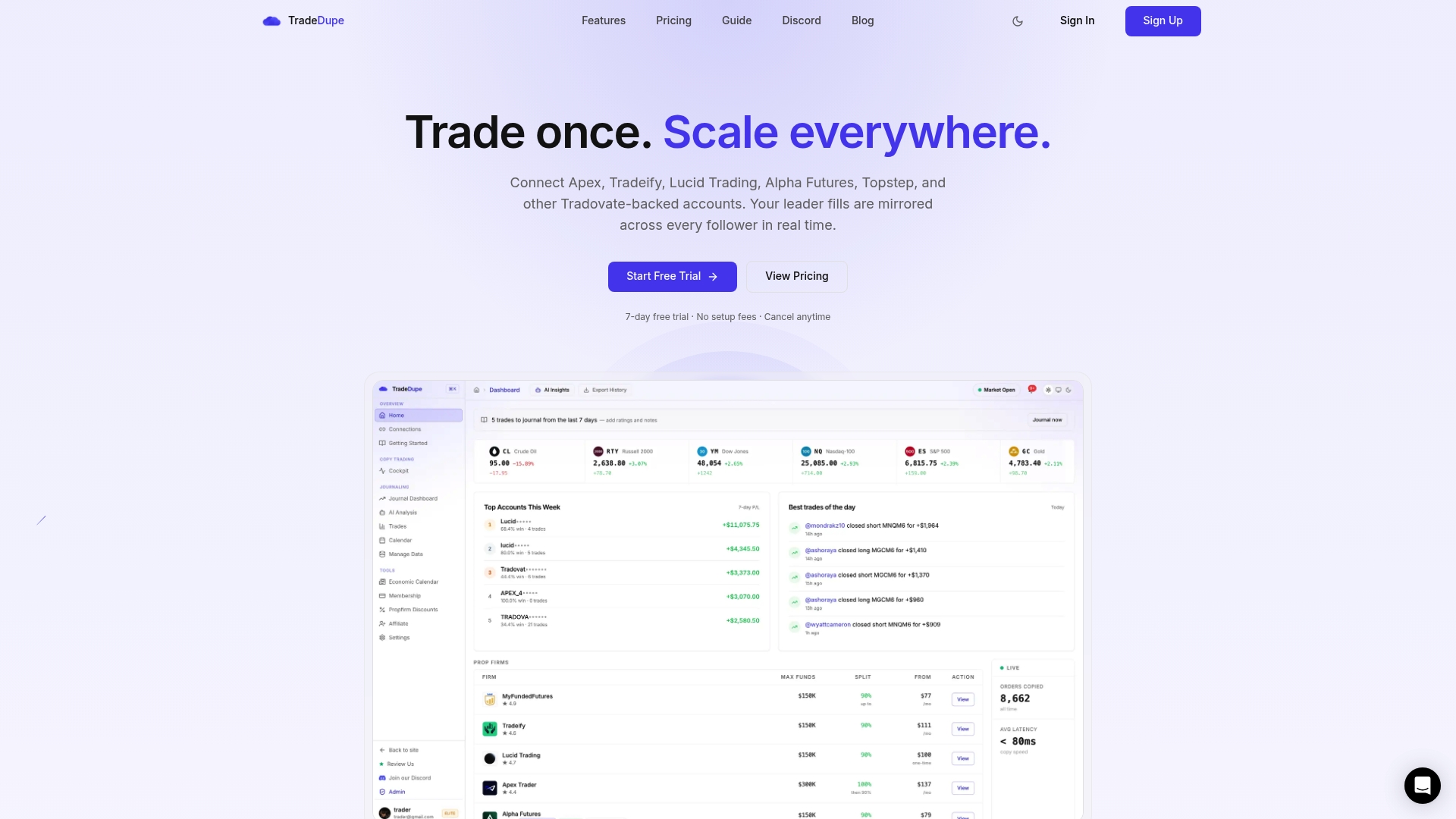
Getting started takes minutes, not days. The free trial lets you validate latency, confirm prop-firm compatibility (Apex, Tradeify, Lucid Trading, Alpha Futures), and test risk controls against your actual account setup before any subscription commitment. Support is available throughout onboarding.
Start your trial at tradedupe.com/futures-trade-copier or review the full feature set at tradedupe.com.
*
Useful sources and further reading
- Tradedupe Admin Verify — platform proof points, latency benchmark, and security documentation
- Tradedupe Futures Trade Copier — core product page with setup guidance
- EA Technology — Partial Discharge Analysis — explains why "PRPD" returns electrical-engineering results in search
Search tip: when researching prop-firm copy-trading tools, always include "Tradovate" or "prop firm" in your query. "PRPD" and "PRD" return engineering diagnostics and product-management software that have no relevance to futures trading.