
Best Tradesyncer.com Alternatives for Prop Traders in 2026
TradeDupe
9 min read
Discover the best tradesyncer.com alternatives in 2026 for prop traders. Explore options like Tradedupe and TradeCopia for better performance!
What are the best Tradesyncer alternatives for futures traders and prop firms?
The strongest Tradesyncer alternatives for U.S. professional futures traders in 2026 are Tradedupe, TradeCopia, and a handful of platform-native solutions built specifically for NinjaTrader environments. Each takes a different architectural approach, and that difference shows up directly in execution speed, broker compatibility, and how much operational control you retain over your funded accounts.
Here is a quick-reference shortlist:
- Tradedupe — Cloud-based mirroring on Tradovate with median 34ms latency, rogue-trade detection, and native integrations for Apex, Tradeify, Lucid Trading, and Alpha Futures
- TradeCopia — Cross-broker copying with prop safety nets, useful for traders managing funded accounts across multiple brokers
- Platform-native NinjaTrader copiers — Local plugins that bypass cloud routing entirely, achieving execution speeds around 1.6ms at the cost of requiring a dedicated machine
- Affordable Indicators — A local, platform-level tool inside NinjaTrader with trade scaling, reversing, and filtering controls
| Platform | Best for | Architecture | Latency | Prop firm integrations |
|---|---|---|---|---|
| Tradedupe | Tradovate multi-account prop trading | Cloud (purpose-built) | ~34ms median | Apex, Tradeify, Lucid, Alpha Futures |
| TradeCopia | Cross-broker funded account management | Cloud | Not publicly listed | Multiple brokers |
| Native NinjaTrader copiers | Ultra-low latency NinjaTrader setups | Native plugin | ~1.6ms | NinjaTrader-compatible brokers |
| Affordable Indicators | Tight execution control inside NT8 | Local platform-level | Not publicly listed | NinjaTrader only |
The right choice depends on whether you prioritize ecosystem fit, raw execution speed, or cross-platform flexibility.

*
How do these platforms compare on latency, broker support, and pricing?
Latency is where the architectural divide between cloud and native solutions becomes impossible to ignore. Cloud-based copiers typically operate in the 30ms–100ms range, while native platform-level plugins achieve approximately 1.6ms by executing directly inside the brokerage environment. For futures traders working volatile instruments like ES or NQ, that gap can translate into measurable slippage on fast-moving fills.
Tradedupe sits at the better end of the cloud spectrum. Its median latency of 34ms is paired with auto-recovery and per-account toggle controls, which matter more than raw speed for prop firm operators managing multiple evaluation and funded accounts simultaneously. The platform connects directly with Tradovate and supports Apex copy trading, Tradeify, Lucid Trading, and Alpha Futures out of the box.

TradeCopia addresses a different problem: traders who need to copy across brokers rather than mirror within a single ecosystem. Its prop safety nets and flexible broker compatibility make it a practical option for funded traders who hold accounts at more than one firm. Pricing is not publicly listed on a flat schedule, so you will need to contact them directly for current tiers.
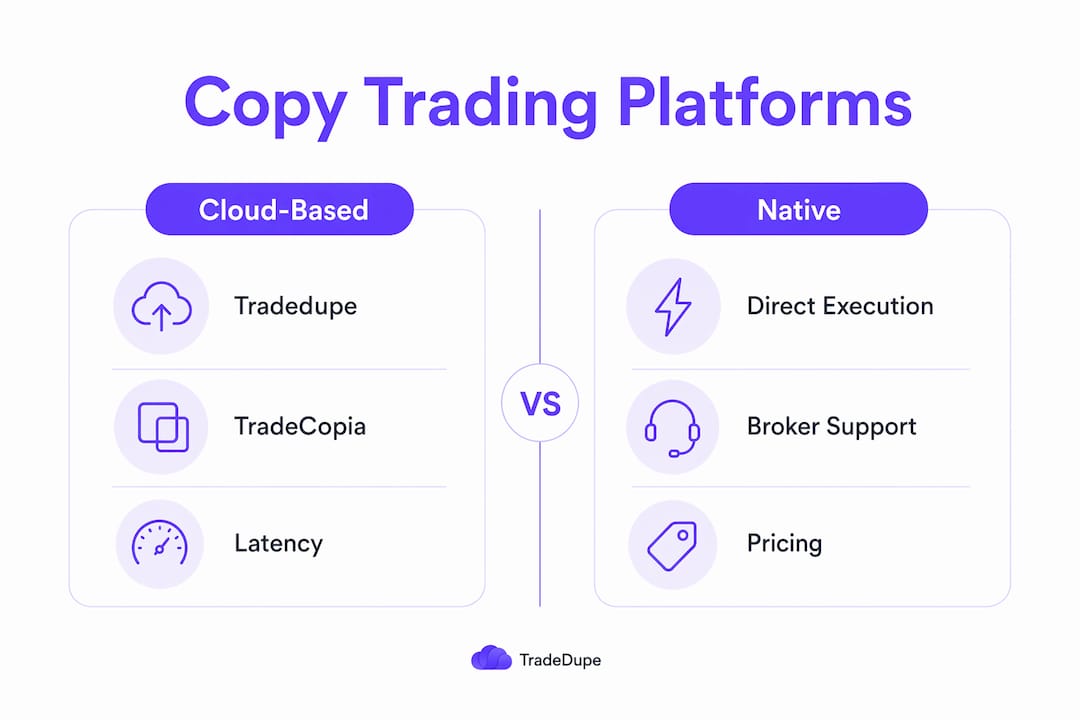
Native NinjaTrader solutions deliver the fastest execution. One well-known option in this category achieves approximately 1.6ms execution speed with zero cloud dependency, persistent settings that auto-restore after a restart, and a full risk management system including trailing drawdown tracking and eval consistency rules. The trade-off is real: you need a dedicated machine or VPS running continuously, and setup is more involved than a cloud subscription.
Affordable Indicators operates entirely inside NinjaTrader, giving you trade scaling, reversing, and filtering without any external app. It suits traders who want precise, hands-on control over how orders replicate across accounts.
> Latency callout: Consistent low variance in execution speed matters as much as average speed. A copier that averages 40ms but occasionally spikes to 300ms will hurt fill quality on fast markets more than one that holds steady at 60ms.
Key feature differences at a glance:
- Security and risk controls: Tradedupe includes rogue-trade detection and auto-recovery; native plugins typically offer trailing drawdown, eval tracking, and funded consistency rules; cloud-only tools vary widely
- Broker integrations: Tradedupe is Tradovate-native; TradeCopia supports multiple brokers; native NinjaTrader tools stay within the NT8 ecosystem
- Subscription pricing: Tradedupe offers tiered plans for individuals through enterprise prop desks; TradeSyncer's published pricing runs $39–$149/month depending on connection count; native plugin alternatives can run lower on a per-month basis
- Trial availability: Most platforms in this category offer free trials or demos so you can test execution behavior before committing to a subscription
Pro Tip: Before signing up for any platform, run the trial during a live session in a volatile market. Latency numbers on a spec sheet are averages. What you need to see is how the copier behaves when order flow spikes.
*
How do you choose the right copy trading platform for prop firms?
The single most important filter is broker compatibility. A platform with excellent latency numbers is useless if it does not connect to the prop firm accounts you actually trade. Start there, then work through the following criteria:
- Execution speed and variance: Cloud solutions work for most prop firm setups, but if you are trading highly time-sensitive strategies, a native plugin's ~1.6ms execution may justify the added setup complexity
- Risk management controls: Look for per-account toggles, rogue-trade detection, trailing drawdown enforcement, and auto-flatten capabilities. These are not optional features for funded traders; they are the difference between passing an evaluation and blowing it on a copier malfunction
- Multi-account scalability: If you are running five or more funded accounts, the platform needs to handle simultaneous replication without degrading performance on any single account
- Security architecture: Understand whether your credentials are stored locally or on a third-party server. Cloud copier security depends heavily on how the provider handles authentication and whether they offer two-factor verification
- Ease of setup and ongoing use: A platform that takes three hours to configure and requires manual reconnection after every update will cost you more in operational friction than its subscription fee saves
- Support quality: Prop firm traders operate during market hours. A support team that responds in 48 hours is not useful when your copier drops mid-session
Trial periods are your best due-diligence tool. Most platforms offer at least a short window to test live behavior. Use it on a day with real volatility, not a quiet Friday afternoon.
*
What is copy trading and why does it matter for futures traders?
Copy trading is the automated replication of trades from one lead account to one or more follower accounts in real time. When the lead account enters a long position on ES, every connected follower mirrors that entry simultaneously, with position sizing adjusted according to each account's parameters.
For prop firms and professional futures traders, the practical value is straightforward:
- Scalability: A single trader can manage multiple funded accounts across different prop firms without manually entering each trade
- Consistency: Every follower account receives the same entry and exit, eliminating the execution drift that comes from manual replication
- Efficiency: Time spent on trade management drops significantly when one decision propagates across an entire account portfolio
The risks are equally real. A misconfigured copier can replicate a bad trade across every account at once, amplifying losses rather than spreading risk. Prop firm evaluation rules add another layer: some firms restrict or flag copy trading activity, so confirming your firm's terms of service before deploying any copier is non-negotiable. Latency issues can also cause follower fills to differ materially from the leader's fill, especially in fast-moving futures markets where a few ticks matter.
*
What metrics and trust signals should you evaluate before choosing a platform?
Reliability in a cloud vs. native trade copier context comes down to architecture first, then the provider's operational track record. Cloud platforms introduce server-side dependencies that can create single points of failure during outages. Native plugins tether execution directly to the brokerage platform, which removes that dependency but introduces its own risks if the local machine goes offline.
Key metrics to request or verify before committing:
- Uptime history: Ask for documented uptime statistics over the past 12 months. Any provider unwilling to share this is a red flag
- Latency benchmarks: Average latency matters, but variance matters more. Request p95 or p99 latency figures if available
- Security protocols: Two-factor authentication, encrypted credential storage, and audit logs are baseline expectations for professional platforms
- Broker and prop firm partnerships: Direct integrations with named prop firms signal that the platform has been tested in real funded-account environments, not just retail setups
Trust signals worth weighing:
- Published user reviews on independent platforms
- Active community presence in futures trading forums
- Transparent pricing with no hidden per-account fees
- Documented latency reduction practices and infrastructure details
Red flags to watch for: vague uptime claims, no trial period, pricing that scales steeply with account count, and the absence of any risk management controls beyond basic order mirroring.
Questions to ask any provider directly: What happens to open positions if the server goes down? How does the platform handle prop firm-specific rules like trailing drawdown or consistency requirements? Is there a dedicated support channel during U.S. market hours?
*
Tradedupe is built for exactly this type of trading
If your operation runs on Tradovate and you manage multiple prop firm accounts at Apex, Tradeify, Lucid Trading, or Alpha Futures, Tradedupe is purpose-built for your workflow. It is not a generic copy trading tool retrofitted for futures. Every feature, from rogue-trade detection to per-account toggle controls, was designed around the specific demands of prop firm evaluation and funded account management.
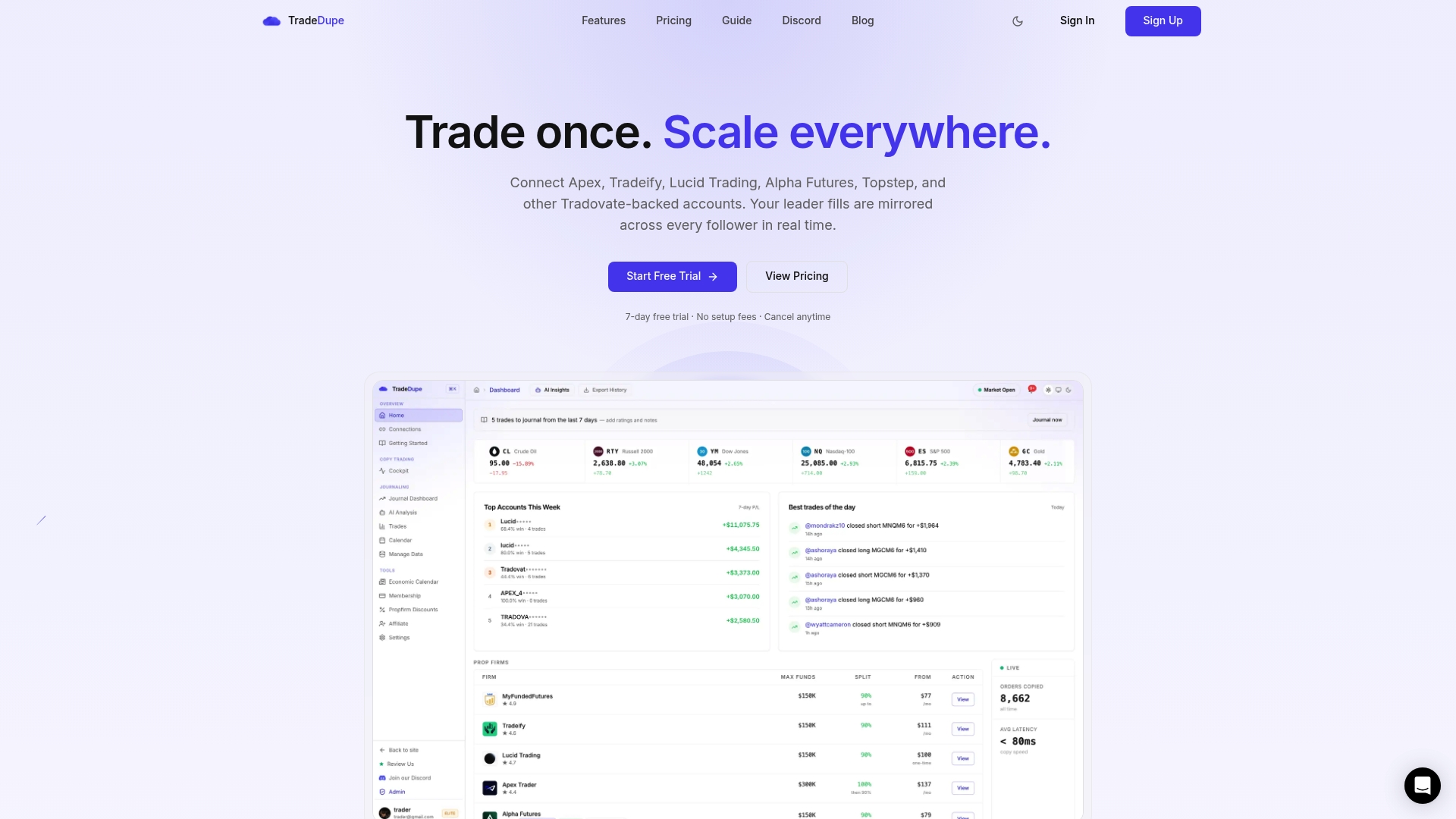
Tradedupe's median 34ms latency sits at the better end of cloud-based performance, and the platform's auto-recovery means a dropped connection does not leave your follower accounts in an undefined state mid-session. The dashboard gives you real-time visibility into sync status, leader and follower activity, and risk exposure across every connected account. Tiered plans cover solo traders through enterprise prop desks, with futures trade copier capabilities that scale as your account count grows.
Getting started takes about 10 minutes. See how Tradedupe mirrors your Tradovate accounts in real time by starting your setup today.
*
Key Takeaways
Tradedupe is the strongest cloud-based Tradesyncer alternative for prop traders on Tradovate, offering 34ms median latency, rogue-trade detection, and direct integrations with Apex, Tradeify, Lucid Trading, and Alpha Futures.
| Point | Details |
|---|---|
| Latency drives fill quality | Cloud copiers run 30ms–100ms; native plugins reach approximately 1.6ms. Match architecture to your strategy's speed requirements. |
| Broker compatibility is the first filter | A platform must connect to your actual prop firm accounts before any other feature matters. |
| Risk controls protect funded accounts | Rogue-trade detection, per-account toggles, and auto-recovery prevent a copier fault from cascading across all accounts. |
| Trial periods reveal real behavior | Test any platform during a volatile session, not a quiet market, to see how latency and reliability hold under pressure. |
| Tradedupe fits Tradovate prop traders | With 34ms median latency and native Apex, Tradeify, and Alpha Futures integrations, Tradedupe is built for multi-account prop firm workflows. |