

Prop Traders: Trailing Drawdown Protection, Buffer Math, TradeDupe
TradeDupe
11 min read
Prop traders: calculate your trailing floor, size trades from your buffer, set 70%/90% alerts, and use TradeDupe to avoid account closures.
Trailing drawdown protection is a rule that ties your maximum permitted loss to your account's highest equity point, not to your starting balance. The floor only moves in one direction: up. That single mechanic means profit doesn't just pad your account, it can quietly shrink the room you have left to breathe, which is why traders get terminated on accounts that are still sitting above where they started.
*
> TL;DR: > > - Trailing drawdown protection can tighten your buffer unexpectedly if open unrealized gains raise your high-water mark before locking in profits. > - Intraday models update your floor continuously, increasing the risk of termination from temporary equity spikes, unlike end-of-day or static systems. > - Always verify if your firm recalculates the floor after withdrawals or switches from trailing to static, which can significantly impact your buffer size. > - Sizing trades should be based on your current buffer, not total account balance, to avoid accidental breaches during volatility. > - Implement thresholds at 70% and 90% of your buffer to prevent breaches and monitor your risk actively during each trading session.
*
Table of Contents
- What Trailing Drawdown Protection Actually Means
- Intraday, End-of-Day, and Static: Three Different Games
- How to Calculate Your Trailing Floor and Buffer
- Building a Daily Playbook Around Your Buffer
- Firm Rules That Change Everything: The Questions to Ask Support
- Three Scenarios That Show the Trap in Action
- Operational Controls That Reduce Accidental Breaches
- The Discipline Trailing Drawdown Actually Demands
- Where TradeDupe Fits Into Your Drawdown Protection Setup
- Where to Read the Original Rulebooks
- Sources
- FAQ
What Trailing Drawdown Protection Actually Means
The whole system runs on three terms, and mixing them up is how traders get blindsided.
Your high-water mark is the highest equity value your account has ever touched, tracked tick by tick or session by session depending on the firm. It never resets downward. Once your account hits $105,000, that number becomes permanent history, even if you close the day at $98,000.
Equity and balance are not the same thing. Balance reflects only your closed, realized profit and loss. Equity includes unrealized gains and losses from positions still open. A firm that measures drawdown off equity will ratchet your floor the instant an open trade shows a big paper profit, before you've locked in a dime.
The floor is your termination line: high-water mark minus the allowed drawdown amount. The buffer is the distance between your current equity and that floor, the actual working capital you have left before the account gets shut down. Everything in trailing drawdown risk management comes down to watching that buffer, not your total balance.
- High-water mark: the peak, never decreases
- Equity: balance plus open, unrealized P&L
- Floor: high-water mark minus allowed drawdown
- Buffer: current equity minus the floor
Intraday, End-of-Day, and Static: Three Different Games
Not every firm enforces trailing drawdown the same way, and the variant you're trading under changes almost everything about how you should size and hold trades.
- Intraday real-time trailing. The floor updates continuously as your equity moves, tick by tick, including unrealized P&L on open positions. A trade that spikes $3,000 in your favor and then retraces can ratchet your floor upward before you've closed anything, permanently tightening your buffer.
- End-of-day (EOD) trailing. Only your closing balance or equity at the end of the trading day moves the floor. Intraday swings, even large ones, don't count until the session closes. This variant is far more forgiving for traders who hold through volatility.
- Static and hybrid lock-at-breakeven. A static floor is anchored to your starting balance and never moves. Hybrid models start static, then lock permanently once your floor climbs to breakeven, after which some firms convert the account to a fixed drawdown entirely.
There are three widespread models in use across the industry: real-time equity trailing, EOD trailing, and static drawdown, and each produces meaningfully different survivability for the identical drawdown percentage, according to comparative analysis of trailing versus static rules. A scalper who closes every position within minutes barely notices intraday trailing. A swing trader holding overnight runners under an intraday model is playing a much harder game than someone under EOD rules with the exact same stated drawdown limit.
How to Calculate Your Trailing Floor and Buffer
The formula is simple, but the consequences aren't always intuitive until you run the numbers.
Floor = Peak Equity − Allowed Drawdown
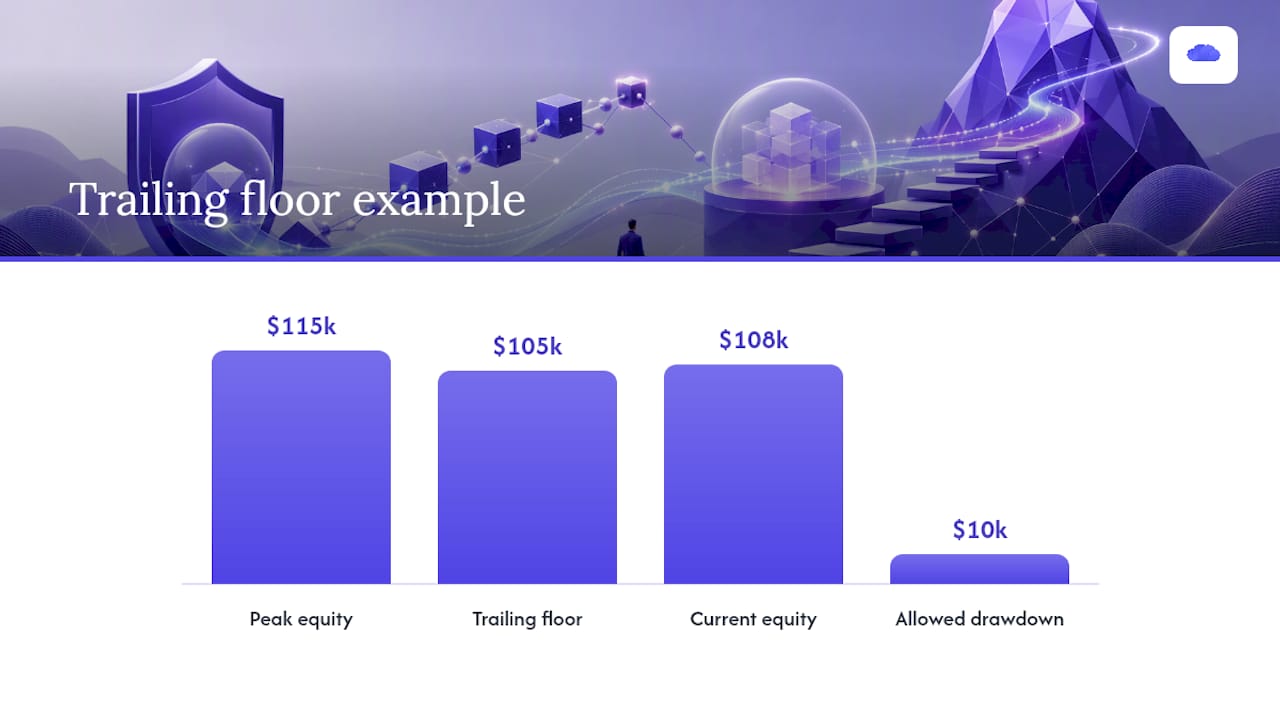
Say you're trading a $100,000 account with a $10,000 trailing drawdown allowance. Your equity climbs to $115,000 at some point during the session. Your floor is now $105,000, permanently. On a $100,000 account with a $10,000 trailing allowance, an intraday peak of $115,000 sets the floor at $105,000, meaning the account can be terminated while still up 5% overall the moment equity dips below that line, per worked examples of trailing drawdown math.
Your buffer is current equity minus the floor. If equity sits at $108,000 against that $105,000 floor, your usable buffer is $3,000, not the $8,000 of "profit" the raw numbers might suggest.
- Peak equity: $115,000
- Allowed drawdown: $10,000
- Floor: $105,000
- Current equity: $108,000
- Buffer: $3,000
Translate buffer into position sizing directly: if your per-contract risk on a stop-loss is $400, a $3,000 buffer supports roughly 7 contracts before a single bad trade could breach the floor, not the 20 or more your total balance might otherwise justify.
Edge cases matter here too. Some firms recalculate the floor after a withdrawal using your post-withdrawal balance, which can tighten your buffer even though your account looks unchanged on paper. Others convert the trailing floor to a static one once you reach funded status. Always confirm which applies to your account before you assume anything.
Building a Daily Playbook Around Your Buffer
Trading under trailing drawdown protection means sizing off your buffer, not your account balance, every single session.
- Calculate your buffer before you place a single trade. Pull current equity, subtract the floor, and write the number down. This takes thirty seconds and prevents the single most common mistake in funded trading.
- Set hard usage thresholds. Treat 70% buffer usage as a warning zone where you cut size in half, and 90% usage as a hard stop for the day. Alert thresholds set at 70% and 90% of buffer usage materially change trader behavior by creating firm stop triggers before a breach happens, according to analysis of trailing drawdown mitigation tactics.
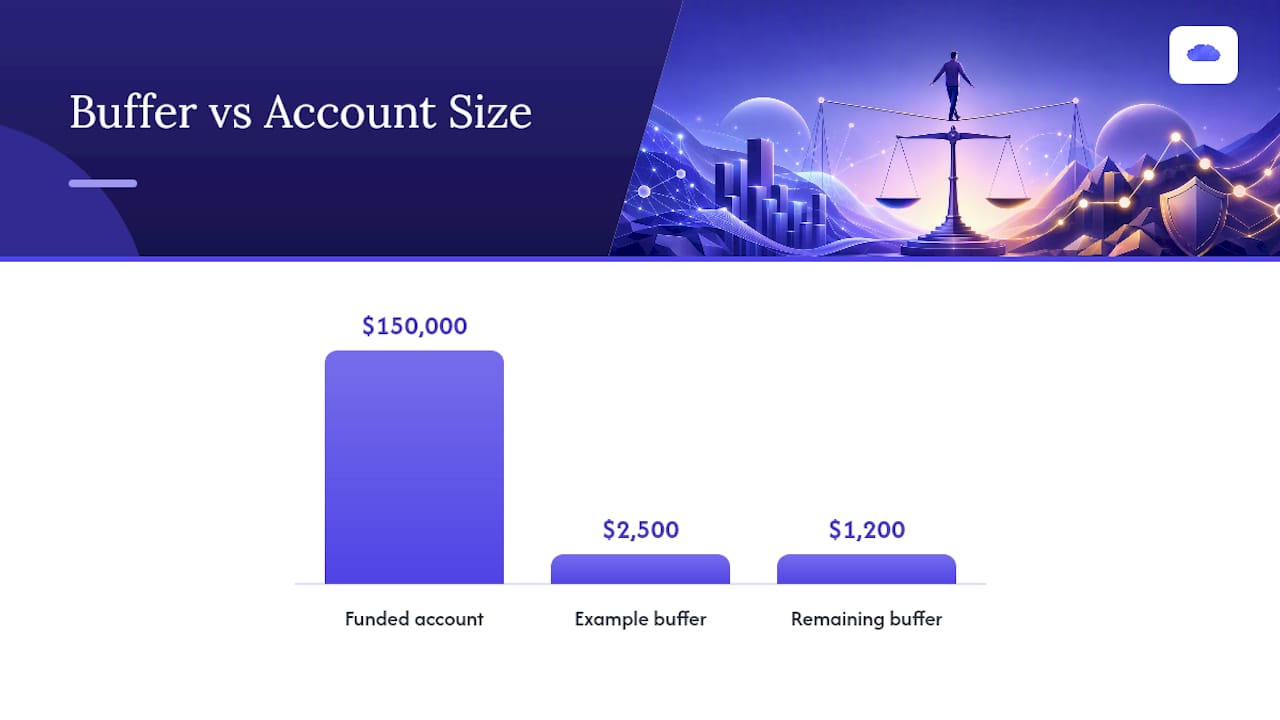
- Size every trade against the buffer, not the account. A $2,500 buffer on a $150,000 account should be sized like a $2,500 account, full stop.
- Take profit in increments rather than letting winners run unchecked. Scaling out locks in realized gains and avoids letting a large unrealized spike ratchet your floor higher than your actual banked profit justifies.
- Set alerts and monitoring on your platform, not in your head. Manual mental math under live market pressure is where discipline breaks down fastest.
Pro Tip: Treat your remaining buffer like its own micro-account. If it's $1,200, size your trades as if you were trading a $1,200 account from scratch, not a fraction of your six-figure funded balance.
Traders who consistently bank smaller wins rather than chasing every winning trade to its peak tend to avoid the ratchet trap altogether, and that habit shows up directly in funded-account survival data.
Firm Rules That Change Everything: The Questions to Ask Support
The exact wording in your firm's contract determines whether your account survives a rough week or gets closed on a technicality. Get these answers in writing, not from a forum post.
- Is the drawdown reference equity (includes unrealized P&L) or balance (realized only)? This single distinction changes how aggressively the floor ratchets.
- What's the update frequency? Per tick, end-of-day, or only on closed trades?
- Does withdrawing profit recalculate the floor from your post-withdrawal balance? Some firms advertise a fixed drawdown but effectively turn it into trailing-like the moment you take a payout, according to rule breakdowns on withdrawal behavior.
- Does the account convert from trailing to static once you hit funded status, and at what threshold?
- Ask support to confirm each answer over chat or email, then save the transcript. Firm rulebooks change, and a saved screenshot is your only real protection.
Three Scenarios That Show the Trap in Action
These situations repeat constantly across funded-account communities, and each one has a one-line fix.
- Intraday spike then retrace: Equity hits $115,000 intraday, floor locks at $105,000, price pulls back to $104,500. Account terminated, still up overall. Fix: scale out before large unrealized gains ratchet the floor.
- Identical closed P&L, different outcome: Two traders close the day up $5,000. One trades under intraday rules and got stopped out earlier on an intraday spike; the other trades EOD and survives untouched. Fix: know your variant before you size risk.
- Withdrawal reset trap: A trader withdraws $5,000 in profit, and the firm quietly recalculates the floor off the new lower balance, tightening the buffer overnight. Fix: test with a small withdrawal first and confirm the recalculation rule in writing.
Operational Controls That Reduce Accidental Breaches
Most trailing drawdown breaches aren't strategy failures. They're operational failures, a missed alert, a fat-fingered size, a trade left open too long across multiple accounts.
- Broker-enforced daily loss limits set directly on Tradovate mean the limit is enforced by the broker itself, not by a script that can fail silently.
- Per-account copy toggles let you disable mirroring on any single follower account instantly if it's approaching its floor.
- Rogue-trade detection flags trades that weren't placed by the copier, a common cause of unexpected equity spikes across managed accounts.
- Custom alerts on Pro and Elite plans give you the 70%/90% buffer warnings before a breach, not after.
Traders managing several funded accounts at once benefit most from checking a prop desk risk control setup against these tools before problems compound across accounts.
The Discipline Trailing Drawdown Actually Demands
Trailing drawdown protection punishes greed more than it punishes bad analysis. Most traders who blow funded accounts weren't wrong about direction, they just let an open winner ratchet their floor before locking anything in. My rule before every session: calculate the buffer first, size second, trade third. Skip that order and the math will eventually catch you.
> — Andres
Where TradeDupe Fits Into Your Drawdown Protection Setup
Certain platforms act as operational layers that keep trailing drawdown protection working as intended, especially when managing more than one funded account at a time. Instead of manually watching equity curves across separate accounts, these tools mirror a leader account's fills to every enabled follower in real time, while daily loss limits and profit targets can stay enforced directly on the broker platform itself, not on a script that can quietly fail.
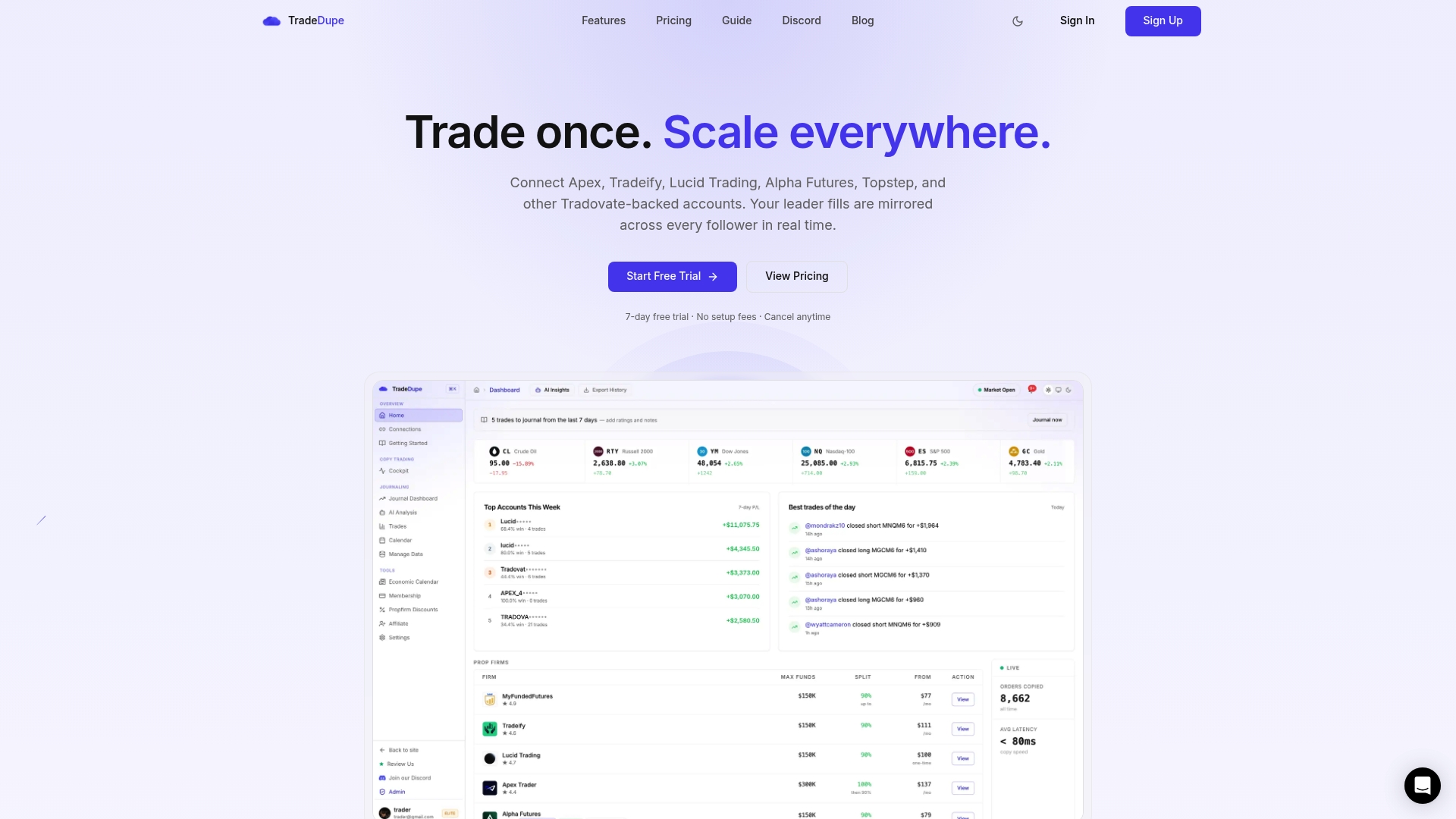
Some copy trading tools offer per-account toggles to shut off a single follower instantly if it nears its floor, and rogue-trade detection features to catch copier errors before they cause unexplained equity spikes. Such tools do not change a firm's contract terms or trailing drawdown rules but aim to reduce operational mistakes that trigger breaches. Subscription plans for these platforms start at affordable monthly rates billed yearly, often including a free trial with easy cancellation. Set up your Tradovate copy trading in about ten minutes and see how the daily loss limits hold up against your own buffer math.
Where to Read the Original Rulebooks
For the primary math and firm-specific breakdowns behind everything covered here, these explainers are worth saving directly:
- Trailing Drawdown Explained: How Prop Firms Calculate It for the core mechanics and withdrawal-reset behavior.
- Trailing Drawdown Rules in Prop Firm Evaluations for buffer-based sizing frameworks.
- Trailing vs Static Drawdown in Prop Firms for a side-by-side of the three models.
Screenshot your own firm's written answers to the questions above and keep them alongside these references.
Sources
- Trailing Drawdown Explained: How Prop Firms Calculate It
- Trailing Drawdown Rules in Prop Firm Evaluations: The Mechanic Behind Every Funded Account Blowup - NexusFi Academy
- Trailing vs Static Drawdown in Prop Firms | ForexMechanics
- Trailing Drawdown: The Hidden Rule That Fails 70% of Prop Traders | PropJournal
FAQ
Is Trailing Drawdown Good or Bad?
It's neither inherently, it's a risk control that protects the firm's capital while forcing you to trade with more discipline than a static drawdown requires. It becomes a problem only when traders don't understand that unrealized profit can ratchet their floor before they've locked in a single dollar.
What Does "Trailing Lock Drawdown" Mean?
This refers to a hybrid model where the trailing floor stops moving once it reaches your starting balance, effectively locking in a breakeven guarantee. After that point, some firms convert the account to a fully static drawdown for the remainder of the evaluation or funded stage.
Does Trailing Drawdown Reset Every Day?
No, the high-water mark itself never resets daily, it only ever moves upward as your equity climbs. What can change daily is which reference point counts: intraday models update continuously, while end-of-day models only recalculate the floor once at the close of each session.
What Are the Disadvantages of a Trailing Stop-Loss Approach Under This Rule?
The main disadvantage is that it punishes holding open winners, since an intraday spike in unrealized P&L can permanently raise your floor before you close the trade and lock in the gain. Traders using trailing stop-loss strategies without accounting for this can find themselves terminated on a retrace even while sitting on an overall profitable account.
How Do I Calculate My Buffer Right Now?
Subtract your account's allowed drawdown from its peak equity to find your floor, then subtract that floor from your current equity to get your buffer.
Recommended
- Prop Desk Playbook: Daily Drawdown Protection (34ms sync)
- Apex Trader Funding Copier: Scale Multiple Apex Accounts Safely (2026)
For educational purposes only. Not financial advice. Futures trading involves substantial risk of loss and is not suitable for every investor.