Prop Desk Playbook: Daily Drawdown Protection (34ms sync)
TradeDupe
17 min read
Prop desk playbook. Map provider drawdown rules, set per account risk controls, and test automated close logic with low latency sync.
Daily drawdown protection is an automated intraday guardrail that tracks live account equity against a provider's daily loss limit and intervenes before the trader breaches it, usually by closing positions or blocking new orders. The value is straightforward: it removes the split-second reaction time a human needs to catch a fast-moving loss. The catch is that no two providers enforce it the same way, so the mechanics behind the guardrail matter as much as the concept itself.
*
> TL;DR: > > - Automated daily drawdown protection varies widely in enforcement, with some providers tracking floating equity and others using account balance or high-water mark methods. > - The calculation reset time, anchor point, and breach consequences differ among firms, significantly impacting how traders manage overnight or swing trades. > - Reliable protection depends on real-time equity feeds, instant auto-close capabilities, and multi-account monitoring features, not just marketing claims. > - Building a personal risk system involves setting a buffer below the provider’s limit, sizing trades accordingly, and stress-testing auto-close behavior regularly. > - Missteps like revenge trading, holding positions across resets without understanding timing, and uncoordinated multi-account strategies are the main causes of daily drawdown breaches.
*
Table of Contents
- What Is Daily Drawdown Protection, and How Does It Differ From Max or Trailing Drawdown?
- How Does Automated Drawdown Protection Logic Actually Work?
- How Do Prop Firms Calculate and Enforce Daily Drawdown Differently?
- What Platform Features Actually Deliver Reliable Drawdown Protection?
- How Do You Actually Implement Protection in Daily Trading?
- Monitoring and Testing: A Practitioner's Operational Playbook
- What Mistakes Trigger Most Daily Drawdown Breaches?
- How Does Daily Drawdown Protection Affect Trader Psychology and Discipline?
- What Strategies Help You Trade Effectively Within Daily Limits?
- Do Daily Drawdown Rules Differ Across Asset Classes?
- What Regulatory and Compliance Factors Apply to Daily Drawdown Protection?
- Why Protection Should Set Your Ceiling, Not Your Strategy
- Get Automated Protection Built for Multi-Account Prop Trading
- Sources
What Is Daily Drawdown Protection, and How Does It Differ From Max or Trailing Drawdown?
Daily drawdown is a loss limit that resets on a clock, typically once every 24 hours at a fixed time set by the provider. If a funded account starts the trading day with a certain balance and the daily limit is a fraction of that, the account cannot lose more than that fraction in that session before triggering enforcement action. Once the reset hits, the clock restarts and the trader gets a fresh allowance, regardless of what happened the day before.
Max drawdown and trailing drawdown work on a completely different timescale. Daily drawdown is time-bound, while max drawdown tracks cumulative losses over the account's entire lifespan, and trailing drawdown moves the floor upward as the account's equity climbs to new highs. A trader can be well within their max drawdown allowance and still get flagged for a daily breach on a single bad session. That distinction trips up a lot of new funded traders who assume one number governs everything.
The anchor point is where things get genuinely confusing across providers:
- Starting balance anchor: the daily floor is calculated from the balance at the start of the trading day, ignoring intraday highs.
- End-of-day close anchor: the limit is measured against the previous day's closing balance, which can shift if overnight positions settle differently than expected.
- Intraday equity high watermark: some programs track the highest equity point reached during the day and measure drawdown from that peak, which is far stricter than a static starting balance.
Drawdown, in its most basic sense, measures the decline from a peak to a trough, and that peak can mean different things depending on which anchor a firm uses. Reading the fine print on anchor methodology before funding an account saves a lot of confusion later.
How Does Automated Drawdown Protection Logic Actually Work?
The core of any automated system is deciding what value to watch. Most serious implementations monitor floating equity, meaning realized profit and loss plus the unrealized P&L on every open position, updated continuously rather than only at position close. This matters because a trader holding a losing position that hasn't been closed yet can still breach a daily limit even though no loss has technically been "booked." Some platforms explicitly monitor floating P&L in real time and auto-close positions once a preset threshold is hit, which is the standard most funded programs now expect.
Once the monitored value crosses a trigger point, the system typically moves through a sequence of enforcement actions:
- Warning alert sent to the trader or dashboard as equity approaches the threshold, often at 70 to 80% of the allowed loss.
- Order cancellation for any pending or resting orders that could add further exposure.
- Auto-close (flatten) of all open positions to stop the bleeding immediately.
- Trading block that prevents new orders until the next reset cycle.
- Account-level consequence for repeat breaches, which can range from a reduced profit split to full account termination.
That sequence sounds clean on paper, but execution reality complicates it. A market order to flatten a position during a fast-moving session can still slip past the intended exit price, especially in futures contracts with wide bid-ask spreads during news events. Understanding how exchanges clear and settle trades helps explain why a forced liquidation isn't instantaneous. Latency between the monitoring system detecting a breach and the exchange confirming the close can be the difference between a clean stop and a limit that gets blown through by a few extra ticks.
Pro Tip: Build your personal daily loss limit at least 10 to 15% tighter than the provider's stated threshold. That gap absorbs slippage on the auto-close order itself, so a fast market move doesn't turn a borderline breach into a confirmed one.
How Do Prop Firms Calculate and Enforce Daily Drawdown Differently?
No universal standard governs how funded programs define or enforce daily drawdown, and that variance is where most account failures actually originate. Two firms can both advertise a "5% daily drawdown" and mean structurally different things.
An equity-based system counts every open position's floating loss against the limit the moment it happens. A balance-based system only counts losses once a trade is closed, meaning a trader could theoretically hold a large unrealized loss without technically breaching the rule until they close it. Comprehensive rule matrices comparing these structures consistently flag this as the single most important detail to confirm before funding an account, because it changes how aggressively you can hold overnight or swing positions.
Reset timing introduces its own risk. Most programs reset the daily counter at a fixed time tied to a specific exchange or broker timezone, often around 5:00 PM Eastern for futures accounts following the Tradovate session calendar. A position held across that reset boundary effectively gets a fresh daily allowance applied mid-trade, which can mask risk or, in some cases, create confusion about which day's limit actually applies to a loss.
Consequences of a breach also vary widely between providers:
- Some pause trading until the next reset with no other penalty on a first offense.
- Others liquidate all positions immediately and apply a reduced profit split going forward.
- A subset of providers fail the account outright on any daily breach, regardless of history.
- A handful of providers now sell an optional paid add-on that blocks account failure on a single daily-limit breach, though these protections typically apply once and don't extend to max drawdown violations.
Reading the prop firm consistency rules specific to your funding provider before you start trading is not optional homework. It's the difference between knowing your real risk budget and guessing at it.
What Platform Features Actually Deliver Reliable Drawdown Protection?
A protection system is only as good as the infrastructure underneath it. Traders evaluating a trade-copier, risk manager, or custom automation setup should look for a specific set of capabilities, not just a marketing claim of "risk management included."
- Real-time equity feeds that incorporate unrealized P&L continuously, not on a delayed polling interval measured in seconds.
- Auto-close and flatten logic that fires immediately and cancels all pending orders in the same action, rather than closing positions while leaving resting orders live.
- Per-account toggles that let an operator disable a single account without disrupting the rest of a multi-account setup.
- Rogue-trade detection that flags an order inconsistent with the account's normal size or direction before it executes.
- Auto-recovery from a dropped connection or missed signal, so a brief outage doesn't leave an account unprotected.
- Multi-account sync with audit logs that record exactly when a trigger fired and what action followed.
- Alerting across multiple channels (dashboard, email, mobile push) so a breach warning doesn't sit unread.
- Simulated testing environments where triggers and enforcement logic can be validated without risking live capital.
A dedicated risk-engine framework built around these layers gives operators something a single-account manual process never can: consistency across every account under management, applied the same way every time.
How Do You Actually Implement Protection in Daily Trading?
Knowing the mechanics is one thing. Building a personal system around them is another, and it starts with math, not willpower.
- Set an internal buffer above the firm's hard limit. If the provider enforces a 4% daily loss cap, treat your personal cutoff as 3% or 3.25%. That buffer exists to absorb slippage on your own exit orders and the reaction time between seeing a losing trade and closing it manually, if you're not relying entirely on automation.
- Convert remaining headroom into a per-trade max loss. If you have $1,200 of daily room left and plan to take four more trades, cap risk per trade at $300 or less, adjusted for how correlated those trades might be. A profit calculator that converts percentage limits into dollar figures removes the guesswork from this step.
- Size positions to the remaining room, not to a fixed lot size. A trader who always trades two contracts regardless of remaining daily headroom is one bad trade away from a breach on a day that started rough.
- Coordinate sizing across multiple accounts. If you're running the same strategy across several funded accounts, a single losing trade mirrored everywhere can breach daily limits simultaneously. Staggering position sizes or using per-account risk controls prevents one bad signal from cascading into multiple failed accounts at once.
- Test the setup before trusting it live. Run demo simulations that include intentional slippage and delayed fills, and validate that auto-close actually fires at the threshold you configured, not somewhere past it.
Pro Tip: Run a "fire drill" once a month: manually push a demo account to within a few dollars of its daily limit and confirm the auto-close and trading-block actions behave exactly as configured. Automation that hasn't been stress-tested recently is a liability, not a safety net.
Monitoring and Testing: A Practitioner's Operational Playbook
Multi-account operations live or die on the reliability of their monitoring layer, and this is where the gap between a hobbyist setup and a professional one shows clearest. TradeDupe's architecture, built specifically for Tradovate-based prop trading, illustrates what a properly instrumented system looks like in practice.
Per-account toggles let an operator disable a single follower account instantly without touching the rest of the fleet, which stops a single misbehaving account from dragging others down with it. Rogue-trade detection adds a second layer, flagging an order that doesn't match a leader's normal size or pattern before it gets mirrored across every connected account. Combined with auto-recovery from dropped connections, these features close the gap between "the system should have caught that" and "the system actually caught that."
> Trade mirroring across a leader-follower structure runs at a median latency of 34 milliseconds on the TradeDupe platform, a speed threshold that matters directly for drawdown protection: the faster a breach signal propagates from the leader account to every follower, the smaller the window for a cascading loss across a multi-account desk.
A practical daily checklist for any operator running this kind of stack should include:
- Confirming the equity dashboard reflects live floating P&L, not a stale snapshot.
- Reviewing audit logs each morning for any overnight trigger events or missed alerts.
- Running a quick sync check across all follower accounts before market open.
- Verifying alert channels (dashboard, email, push) fired correctly during the previous session's test events.
What Mistakes Trigger Most Daily Drawdown Breaches?
Most daily breaches trace back to a handful of repeatable, avoidable patterns rather than genuine bad luck.
- Revenge trading after a loss. Increasing position size to "win back" a loss is the single fastest way to turn a manageable drawdown into a breached account. The fix is a hard, enforced personal cutoff and a pre-defined max loss per trade that doesn't flex based on emotion. Building a system for staying calm under pressure matters more here than any indicator or strategy tweak.
- Ignoring fees, slippage, and reset-time risk. A trader who calculates daily risk on theoretical fill prices, without accounting for commissions or realistic slippage, consistently underestimates how close they actually are to the limit. Avoid holding positions across a firm's reset boundary unless you've confirmed exactly how that timing interacts with your daily counter.
- No coordination across multiple accounts. Running identical trades across five funded accounts without synchronized sizing means one bad signal can breach all five simultaneously. Per-account toggles and staggered sizing prevent that single point of failure.
How Does Daily Drawdown Protection Affect Trader Psychology and Discipline?
Knowing a hard stop exists changes how a trader behaves in the moment, and not always for the better. Some traders relax into recklessness, reasoning that the system will catch a bad trade before real damage happens. That mindset defeats the purpose. Automated protection is a backstop for execution risk, not a substitute for trade selection discipline.
The more common and more useful psychological effect works in the opposite direction. Traders who internalize their remaining daily headroom as a visible, shrinking number tend to make sharper decisions about position sizing as the day progresses. Watching an equity bar approach a red line creates a natural, almost physical incentive to size down rather than double down, which is precisely the behavior that separates traders who survive a funded evaluation from those who don't.
There's a subtler benefit too. A firm daily limit removes the ambiguity around "how much is too much" for a given session. Traders no longer have to make that judgment call in the heat of a losing streak, because the system has already made it for them. That said, over-reliance on the guardrail can erode a trader's own risk instincts over time. The healthiest approach treats the automated limit as a last line of defense, while personal cutoffs and disciplined position sizing do the actual work of staying inside the boundary long before automation needs to intervene.
What Strategies Help You Trade Effectively Within Daily Limits?
Trading within a daily drawdown limit isn't about trading less. It's about trading with a clear, constantly updated sense of remaining room.
Front-loading risk early in the session, when volatility and opportunity are often highest, then scaling downsize as losses accumulate, keeps a trader from getting caught with an oversized position late in the day when headroom is thin. Some traders flip this and prefer to take their highest-conviction setup first, reasoning that a fresh daily allowance is best spent on the trade they trust most rather than saved for later.
Diversifying setups within a single session also helps. A trader relying on one strategy that happens to be out of sync with the day's conditions will bleed through their daily allowance faster than one who can pivot between a trend-following and a mean-reversion approach depending on what the tape is showing. Reducing correlation between trades taken on the same day matters just as much as reducing size on any individual trade.
Defined-risk structures, common in options trading, offer a useful parallel for futures and prop traders thinking about capping downside per position. Strategies built around small, defined-risk positions illustrate a broader principle: knowing your maximum loss before you enter a trade is what makes it possible to trade confidently within a hard daily ceiling, regardless of asset class.
Do Daily Drawdown Rules Differ Across Asset Classes?
Daily drawdown enforcement isn't identical across futures, forex, and equities-based funded programs, and the differences come down to volatility profile and session structure.
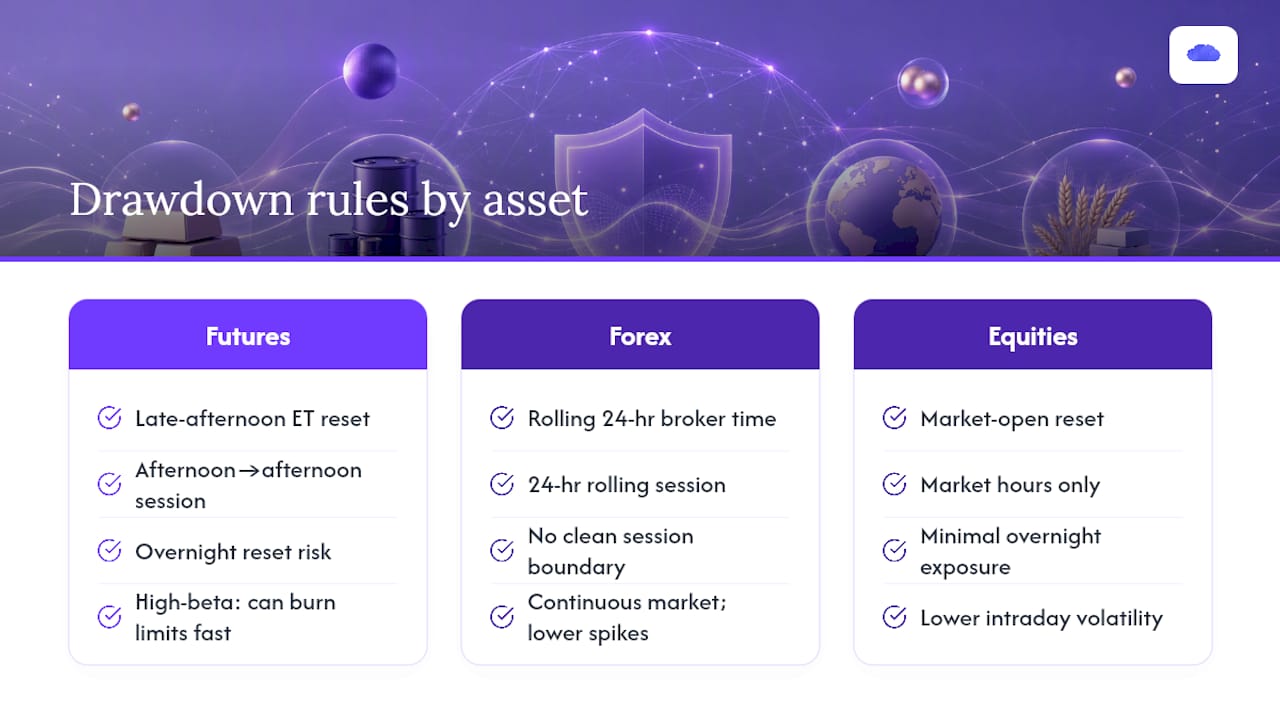
Futures accounts, which dominate the funded-trading space through brokers like Tradovate, tend to see daily limits calculated against a session that runs late afternoon to late afternoon Eastern time, aligning with the exchange's own settlement cycle. That structure means overnight futures positions carry real reset-timing risk, since a position held past the daily cutoff effectively starts fresh against a new limit.
Forex-focused funded programs often run on a rolling 24-hour clock tied to broker server time rather than a specific exchange close, and because forex trades nearly around the clock, there's less of a clean "session boundary" to manage risk around. Equities-based programs, by contrast, align naturally with market hours, and daily drawdown resets tend to sync cleanly with the opening bell, since there's no meaningful overnight trading session to complicate the calculation.
The volatility profile of the instrument matters just as much as the rule structure. A single contract in a high-beta futures product can burn through a daily allowance in minutes during a volatile open, while the same percentage limit on a lower-volatility instrument gives a trader far more room to maneuver across the session. Traders splitting size across multiple instrument types under one daily rule need to account for that volatility gap explicitly, not assume a flat percentage behaves the same way everywhere.
What Regulatory and Compliance Factors Apply to Daily Drawdown Protection?
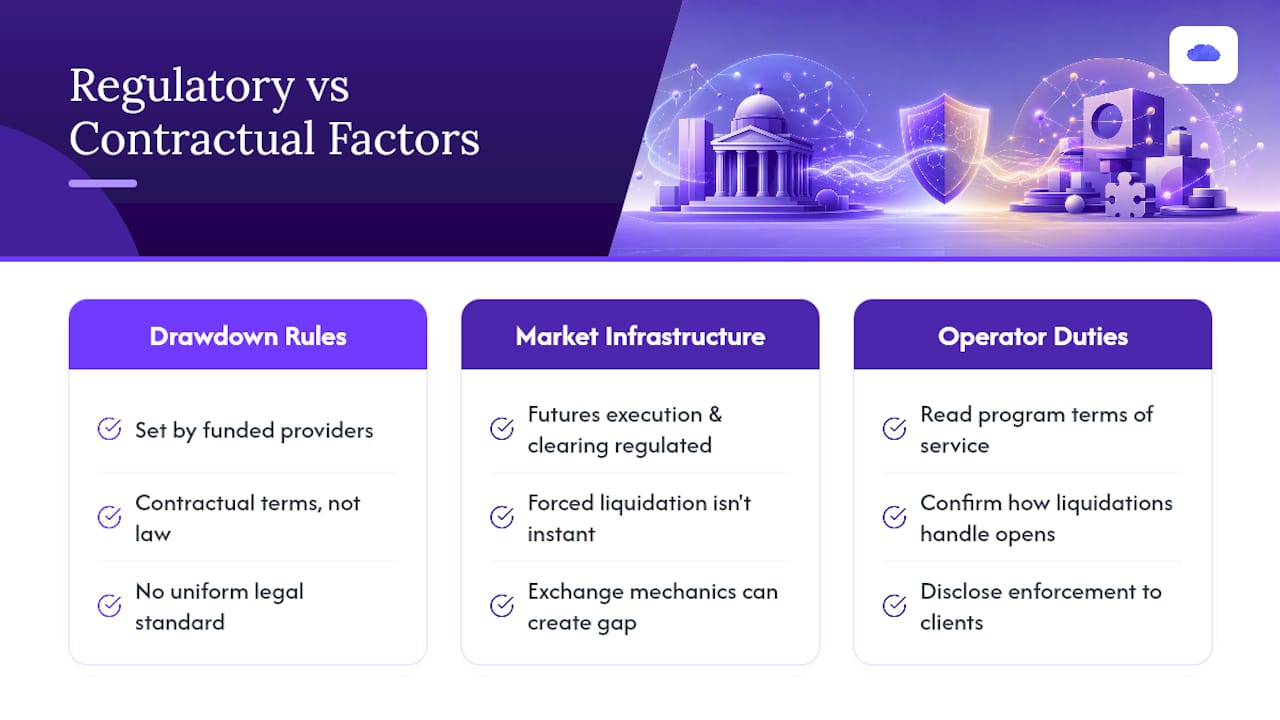
Daily drawdown rules themselves are contractual terms set by individual funded-trading providers, not government regulations, which means there's no uniform legal standard governing how a firm must calculate or enforce them. That said, the infrastructure underneath those rules, futures execution, clearing, and liquidation, does operate within a regulated framework. Understanding how futures markets clear and settle explains why a forced liquidation triggered by a drawdown breach isn't instant and why exchange mechanics can introduce a small but real gap between a trigger and a confirmed close.
For traders and firms running multi-account operations, the compliance considerations that matter most are contractual rather than statutory: reading the funded program's terms of service around daily loss enforcement, understanding what happens to open positions during a forced liquidation, and confirming whether the provider's protection language creates any liability if slippage causes a loss beyond the stated limit. Operators managing accounts on behalf of others, such as a small prop desk running multiple funded traders, also carry a duty to disclose how daily limits are enforced across the accounts they oversee, since a breach on one account can have downstream effects on shared infrastructure or shared risk capital. None of this replaces legal or compliance advice specific to a given firm's structure, but it's the baseline every operator should already understand before scaling past a single account.
Why Protection Should Set Your Ceiling, Not Your Strategy
Daily drawdown protection works best when traders treat it as a hard constraint that shapes position sizing from the first trade of the day, not as a safety net they only think about once things go wrong. The math should run backward: start from the daily limit, subtract a personal buffer, then size every trade against what's left. Automation exists to close the gap between seeing a loss and reacting to it, a gap measured in seconds that matters enormously in fast futures markets, but it was never designed to replace judgment about which trades to take in the first place.
The traders who get the most out of automated protection are the ones who test it relentlessly and assume nothing about how it behaves under stress until they've confirmed it themselves. A conservative buffer, checked against real slippage, beats an aggressive one that assumes perfect execution every time.
> — Andres
Get Automated Protection Built for Multi-Account Prop Trading
Manually watching equity across five, ten, or twenty funded accounts isn't a system. It's a countdown to a missed trigger. Some platforms are built for exactly the operational problem this article describes: mirroring trades across multiple connected accounts with low latency, while offering per-account toggles, rogue-trade detection, and auto-recovery features that help prevent one erroneous signal from cascading into a fleet-wide daily breach.
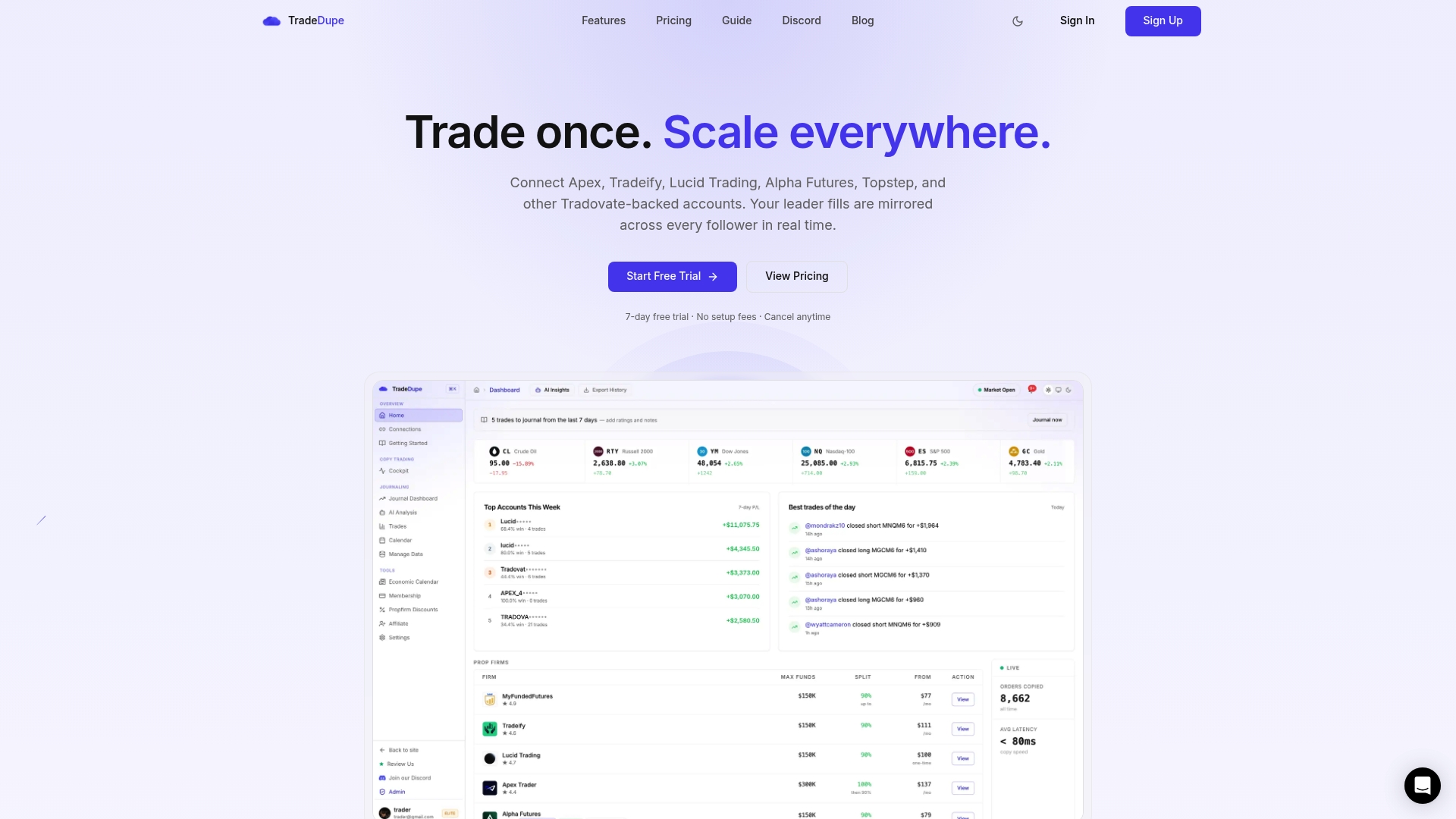
Some platforms support funded-account providers including Apex, Tradeify, Lucid Trading, and Alpha Futures, and provide dashboards with real-time equity visibility and audit logs to support drawdown protection strategies. If you're currently running multiple funded accounts through spreadsheets and manual position adjustments, the Tradovate trade copier handles the sync automatically, with the same low-latency infrastructure covered in the operational playbook above.
Setup takes about ten minutes. Walk through the getting-started guide to connect your first leader and follower accounts and see how per-account risk controls work before you scale to a full multi-account desk.
Sources
- How the Drawdown Protection works
- Drawdown Rules Explained: Daily, Max, and Trailing Drawdown for Prop Traders | AIFO
- Drawdown Definition — Investopedia