5 Layer Prop Desk Risk Controls for Operators: Sizing to Risk Engine
TradeDupe
20 min read
Operator first blueprint for prop desk risk controls: five layers from trader sizing to tick level breakers and live risk engine routing.
Every prop desk that survives past its first hundred funded accounts runs the same five-layer defense: pre-trade sizing tied to allowable loss, real-time monitoring across every account, an automatic circuit breaker that acts faster than a human ever could, behavioral detection to catch coordinated abuse, and exposure routing that caps what the firm can lose in a single bad week. Daily drawdown limits, a rules-based risk engine, and platform tooling with per-account controls all sit inside that framework. What follows covers the formulas, the architecture, and the checklist to build it.
*
> TL;DR: > > - Enforcing equity-based daily loss limits and maximum drawdowns with correct reset timing prevents gaps that could lead to unexpected losses or account bans. > - Proper pre-trade risk sizing and automated position calculation are crucial to avoid blowing through risk limits during volatile periods or multiple strategy execution. > - Real-time monitoring dashboards must track floating P&L, exposure, margin use, and account health, with tiered alerts that escalate quickly in case of breaches. > - Fail-secure, tick-level circuit breakers with layered thresholds ensure automated enforcement even during feed outages or system errors, reducing disaster risk. > - Fraud detection relies on behavioral pattern analysis across accounts, while layered exposure caps and strict administrative controls are essential for comprehensive prop desk risk management.
*
Table of Contents
- Core Rule Types: Daily Loss Limits, Maximum Drawdown, and Profit Locks
- Pre-Trade Risk Sizing: Converting Allowable Loss to Per-Trade Budgets
- What Should a Live Monitoring Dashboard Actually Track?
- Automatic Circuit Breakers: Building Fail-Safe Enforcement
- Behavioral Controls and Fraud Detection: Catching Coordinated Abuse
- Risk-Engine Architecture: A-Book Routing, Exposure Caps, and Reserves
- Policies, Audit Logs, and Testing: Making Rules Defensible
- Implementation Checklist and Recommended Tech Stack
- TradeDupe's Approach to Copy-Trading Risk Controls
- Counterparty Risk and Credit Exposure Management
- Liquidity Risk Controls and Market Impact Considerations
- Trader Authorization Levels and Access Controls
- Compliance With Regulatory Risk Requirements and Reporting Obligations
- The One Risk Task That Can't Wait
- Running Multi-Account Risk Controls Without the Manual Overhead
- Sources
Core Rule Types: Daily Loss Limits, Maximum Drawdown, and Profit Locks
Two numbers govern almost every prop trading account: the daily loss limit and the maximum drawdown. Get the calculation method wrong on either one, and you either bleed the firm through loopholes or terminate profitable traders on technicalities.
Most operators enforce a daily loss limit around 4 to 5% of the account's starting balance for that trading day, paired with a maximum drawdown ceiling commonly set between 8% and 12% of the initial or high-water balance, according to Dovar Labs' prop risk management guide. Breach either one, and the standard response is immediate account termination, not a warning email.
The calculation method matters more than the percentage itself. You have two choices:
- Balance-based: measures loss only against realized P&L, ignoring open positions until they close.
- Equity-based: includes floating, unrealized losses in the drawdown calculation the moment they occur.
Equity-based enforcement is the tighter, more defensible standard, and it's the one operator guides consistently recommend. A trader sitting on a $4,000 unrealized loss on an open futures position hasn't "lost" anything on a balance basis, but that position could still gap through a stop overnight. Ignoring floating P&L is how desks discover a $12,000 hole the next morning that a real-time equity check would have flagged hours earlier.
Reset timing is the other decision that trips up new operators. Daily limits typically reset at a fixed time tied to the broker's server clock or a defined market session boundary, not midnight in the trader's local time zone. Get this wrong across a desk with traders in different regions, and you'll have accounts resetting mid-session, creating gaps where the limit doesn't apply for stretches of active trading.
Set a warning threshold below the hard limit, triggering an alert well before the account hits termination territory. This gives traders an opportunity to close positions voluntarily before losing the account.
Profit locks work on the same logic in reverse: once floating profit crosses a defined threshold, the system locks in a portion of it as a new floor, so a winning day can't fully reverse into a losing one.
Pre-Trade Risk Sizing: Converting Allowable Loss to Per-Trade Budgets
Daily loss limits only work if position sizes are calculated backward from them, before the trade goes live. This is the step most retail-trained traders skip, and it's the single biggest reason accounts blow through limits on their first bad streak.
The math is straightforward:
- Calculate the daily risk budget: `initial balance × daily loss percentage`. On a $50,000 account with a 5% daily limit, that's $2,500.
- Divide by maximum concurrent trades allowed. If the desk permits three simultaneous positions, each trade gets a maximum risk allocation of roughly $833.
- Convert that dollar figure into contract size or lot size based on the instrument's tick value and the stop-loss distance for that specific setup.
- Subtract a buffer for spread and slippage, typically 5% to 10% of the per-trade budget, before finalizing size.
- Widen the buffer further for positions held over a weekend, since gap risk on reopen can blow past a stop that would have held during regular session hours.
A futures position size calculator that runs this math automatically removes the manual error that creeps in when a trader is sizing under pressure after a losing trade.
The step operators most often miss is guarding against hidden cross-strategy exposure. A trader running two expert advisors or two discretionary setups at once might size each one correctly in isolation, while the combined exposure across both blows past the daily budget without either system knowing about the other. A centralized sizing utility or risk aggregator that tracks exposure at the account level, not the strategy level, catches this before it becomes a drawdown breach.
Pro Tip: Build the per-trade budget calculation into the order entry workflow itself, not a spreadsheet traders check separately. If sizing requires a second application, it gets skipped on the trader's busiest, highest-risk day.
What Should a Live Monitoring Dashboard Actually Track?
A dashboard that shows account balance and nothing else is not a risk monitoring tool. It's a scoreboard. Real-time risk oversight requires tracking the gap between what an account has and what it's currently exposed to.
The core metrics every dashboard needs:
- Equity vs. balance: the delta between the two is your floating P&L, and it's the number that moves fastest in a fast market.
- Distance to daily loss limit and maximum drawdown: expressed as a percentage remaining, not just a raw dollar figure, so operators can compare accounts of different sizes at a glance.
- Open position count and instrument exposure: how concentrated is the account in one symbol or one correlated basket of instruments.
- Margin utilization: how much of available margin is currently committed, since margin calls compound drawdown problems rather than solving them.
Alerts escalate in three tiers:
- Informational: logged and visible on dashboards without active notifications.
- Warning: notifications sent to dashboard and email or app, typically below the hard limit.
- Critical: triggers automatic enforcement such as position closure and alerts to risk management immediately.
Beyond individual accounts, the dashboard needs aggregate views: exposure rolled up per account, per cohort (accounts sharing a strategy, an evaluation batch, or a funding source), and firm-wide. Automated aggregation across thousands of accounts is where manual spreadsheet review breaks down entirely. TradeDupe's risk manager dashboard approach to this problem is built around exactly this kind of rolled-up, multi-account view rather than one account at a time.
Automatic Circuit Breakers: Building Fail-Safe Enforcement
A circuit breaker that runs on a five-minute polling cycle is nearly worthless in a fast futures move. Equity checks need to happen at the tick level, evaluating the account's real-time equity against thresholds every time a price update comes in, not on a timer.
The standard enforcement pattern has three stages: a warning threshold that alerts without acting, a hard threshold that force-closes open positions immediately, and a lockout that prevents new trades from opening until a human reviews the account. Dovar Labs frames this as the layered model that actually saves accounts, because each stage buys time for the next one to act if the previous one somehow fails.
Design for these non-negotiables:
- Fail-secure by default: if the risk engine errors, crashes, or loses its data feed, the system's default behavior must be to block new trades and flag the account, never to let trading continue unchecked because the check itself failed.
- Idempotent actions: a close-position command that fires twice because of a network retry should not attempt to close a position that's already closed, and it should never open an unintended offsetting trade.
- Edge case handling: partial fills need to be tracked as their own exposure state, illiquid instruments need wider tolerance before a forced close attempts to cross a thin book, and a network failure between the risk engine and the broker gateway needs a defined fallback, not a silent gap in enforcement.
PropFirmsTech's guide puts it plainly: fail-secure design and idempotent enforcement are what keep an automated system defensible when something goes wrong at 2 a.m. with no one watching.
Pro Tip: Test your circuit breaker against a simulated feed outage, not just a simulated drawdown breach. The scenario that actually breaks most systems isn't the big loss, it's the moment the data feed itself goes quiet.
Behavioral Controls and Fraud Detection: Catching Coordinated Abuse
Some of the largest losses on a prop desk come from accounts that never technically breach a drawdown limit. Copy-trading rings, multi-accounting to bypass evaluation limits, latency arbitrage against slow price feeds, and coordinated trading around scheduled news releases all exploit the space between individual account rules.
Detection depends less on any single account's numbers and more on patterns across accounts:
- Correlation clustering: accounts that open and close trades within seconds of each other, on the same instrument, in the same direction, far more often than chance would predict.
- Sequence similarity: identical entry and exit timing patterns across accounts that shouldn't be related.
- Timing anomalies: trades executed with reaction speeds faster than human input latency, a common signature of latency-arbitrage setups.
- Cohort-based flags: comparing an account's behavior against its peer group, not just against its own history.
Axcera's analysis of fraud detection in prop trading treats correlation and cohort analysis as the differentiator between firms that catch coordinated abuse early and those that discover it only after a payout cluster drains the reserve. The response should scale with confidence: a first flag triggers manual review with exported evidence, repeated patterns justify a temporary suspension, and confirmed abuse warrants routing changes or permanent restriction. Reviewing firms with unusual consistency-rule structures is a useful exercise for understanding how policy gaps invite exactly this kind of gaming.
Risk-Engine Architecture: A-Book Routing, Exposure Caps, and Reserves
Behind every rule enforced at the account level sits a bigger decision: how the firm handles the aggregate exposure those accounts create. This is where routing strategy and reserve sizing take over from individual trade controls.
A-book vs. B-book routing determines whether a given account's flow gets hedged externally through a liquidity provider (A-book) or absorbed internally by the firm (B-book). Track360's analysis of prop firm risk management frames this as a hybrid decision rather than a binary one: consistently profitable traders or high-conviction accounts often get promoted to A-book routing to transfer their risk externally, while the broader base of evaluation accounts stays B-book, where the firm keeps the spread but also keeps the exposure.
Exposure caps need to operate in layers, not as a single firm-wide number:
- Per-account caps: the ceiling any individual account can expose the firm to.
- Per-symbol caps: preventing concentrated risk in one instrument across many accounts simultaneously.
- Cohort caps: limiting aggregate exposure across a group of accounts sharing a funding batch or strategy type.
- Aggregate net exposure: the firm-wide ceiling that triggers hedging or routing changes when breached.
Payout-reserve modeling is the part operators most often underfund. Reserves need stress testing against realistic pass-rate and payout-frequency scenarios, not just the average case, because payout clusters happen unevenly and a reserve sized for the mean will fail during the tail event. Modern risk infrastructure built for automated enforcement at scale is what makes these layered caps enforceable in real time rather than as a monthly spreadsheet exercise.
Policies, Audit Logs, and Testing: Making Rules Defensible
A risk rule that can't produce evidence of exactly why it triggered is a liability the moment a trader disputes an account termination. Every rule evaluation, every trigger, and every automated action needs a forensic log: the rule checked, the values that triggered it, the account state at that moment, the market context, and the action taken. PropFirmsTech's guide to defensible enforcement treats this level of detail as the baseline for surviving a dispute, not an optional add-on.
Build these into standard operating procedure:
- Backtest every new rule against historical account data before it goes live, checking for false positives on legitimate trading behavior.
- Run dry-run tests in a sandbox environment where the rule evaluates but doesn't execute, comparing its decisions against manual review.
- Create replay tests specifically targeting edge cases: partial fills, gap opens, and simultaneous multi-account triggers.
- Document reset timing, time zone conventions, and maintenance windows so operators across shifts apply rules consistently.
- Define an escalation path and dispute process before you need one, not after the first contested termination.
Implementation Checklist and Recommended Tech Stack
Turning these controls into a working system requires sequencing the build correctly, not just assembling the right tools.
- Define every rule in writing first, including exact formulas, reset timing, and warning thresholds, before any code gets written.
- Build or select a rule/risk engine capable of tick-level evaluation, not periodic polling.
- Connect a multi-account aggregator that rolls up exposure by account, cohort, and firm-wide totals in real time.
- Wire the order gateway to accept automated close and lockout commands directly from the risk engine.
- Deploy the monitoring dashboard with the three-tier alert structure covering informational, warning, and critical events.
- Configure webhook and SMS alerting for critical-tier events so a human is notified the instant automated action fires.
- Stand up the audit store before go-live, not after the first dispute forces you to retrofit logging.
The functional components a desk needs, at minimum:
- A rules engine that evaluates every account against defined thresholds in real time.
- A multi-account aggregator tracking cross-strategy and cross-account exposure.
- An order gateway with the authority to execute automated closes.
- A dashboard surfacing equity, exposure, and margin at account, cohort, and firm levels.
- An alerting and webhook layer tiered by severity.
- An immutable audit store for every evaluation and action.
Broker connectivity latency and data quality checks deserve their own line item: a risk engine making decisions on stale price data is worse than no risk engine at all, because it creates false confidence in numbers that no longer reflect the market. Security and reliability documentation, like TradeDupe's platform overview, is a useful reference point for what monitoring uptime and enforcement latency should look like in practice.
TradeDupe's Approach to Copy-Trading Risk Controls
Multi-account copy trading introduces a specific version of the exposure problem: one leader account's mistake replicates instantly across every follower unless something stops it. TradeDupe addresses this with controls that map directly onto the layers described throughout this article.
- Rogue-trade detection functions as a behavioral flag, catching anomalous trade patterns from the leader account before they propagate to followers.
- Per-account toggle controls give operators the pre-trade gating layer, letting a risk manager disable a specific follower account without halting the entire mirror operation.
- Auto-recovery addresses the network-failure edge case directly, restoring sync after a disconnection rather than leaving accounts in an unknown state.
- Real-time dashboards provide the live sync-status monitoring that a circuit breaker and an audit log both depend on to function correctly.
Median trade mirroring latency of 34 milliseconds matters here because enforcement speed across follower accounts depends on how fast a kill-switch decision on the leader propagates to every connected account.
Counterparty Risk and Credit Exposure Management
A prop desk's counterparty risk isn't limited to the traders on its own accounts. It extends to the brokers, liquidity providers, and clearing relationships the firm depends on to execute and settle trades in the first place.
Credit exposure to a broker or liquidity provider grows with the size of unsettled positions and the timing gap between trade execution and settlement. A desk running B-book internally still carries exposure to whichever broker or platform executes the underlying orders, and a broker outage or insolvency event doesn't discriminate between a firm's best-performing account and its worst.
Practical mitigation starts with diversifying execution across more than one broker or liquidity relationship where volume justifies it, so a single counterparty failure doesn't halt the entire desk. Setting explicit credit limits per counterparty, reviewed on a fixed schedule rather than left static for years, keeps exposure aligned with the counterparty's current financial standing rather than its standing when the relationship began.
Collateral and margin requirements from brokers should be monitored continuously, since a broker tightening margin terms mid-session can force unplanned position reductions across every account routed through that relationship simultaneously. Building counterparty risk awareness into onboarding and periodic review, rather than treating it as a one-time due-diligence checkbox, is what separates desks that survive a broker-side disruption from those that get caught holding open exposure with nowhere to route it.
Liquidity Risk Controls and Market Impact Considerations
Position sizing that looks conservative on paper can still create outsized market impact if the underlying instrument doesn't have the depth to absorb it. Liquidity risk is distinct from price risk. It's the risk that you can't exit a position at or near the price you expected to, regardless of which direction the market moves.

Illiquid instruments and thin trading sessions, such as the period immediately after a major news release or during low-volume overnight hours, widen the gap between quoted price and executable price. A circuit breaker attempting to force-close a position during one of these windows can end up executing at a materially worse price than the trigger level suggested, compounding the loss the rule was designed to prevent.
Practical controls include setting tighter position limits on instruments with historically thin order books, and building wider tolerance bands into automatic enforcement specifically for illiquid conditions rather than applying the same closure logic used for a liquid, high-volume instrument. Monitoring bid-ask spread width as a real-time input, not just price, gives the risk engine a signal for when normal enforcement thresholds need temporary adjustment.
Market impact also scales with how a position gets closed, not just when. Slicing a large forced liquidation into smaller executions, where the enforcement architecture allows for it, reduces the price concession compared to dumping the full size into a thin book at once. Desks operating across multiple prop firm accounts, where the same underlying strategy might be running in parallel across several funded accounts, need to account for the combined market impact of a coordinated close across all of them, not just each account in isolation.
Trader Authorization Levels and Access Controls
Risk controls only hold if the people who can override them are limited and their actions are tracked as carefully as the trades themselves. Access control on a prop desk isn't a technicality. It's the layer that determines whether your circuit breaker rules mean anything in practice.
A workable authorization structure typically separates traders, risk managers, and administrators into distinct permission tiers. Traders should have access to their own account's trading interface and risk dashboard, but no ability to modify the rules that govern their own limits. Risk managers need visibility across cohorts and the authority to pause or flag accounts, but overriding a hard drawdown termination should require a second layer of sign-off, not a single click.

Administrative access, the level capable of changing rule thresholds, adjusting reset timing, or disabling the circuit breaker entirely, needs the tightest restriction on the desk. Every change made at this level should generate its own audit entry, separate from the trade-level logs, because a modified threshold or a disabled rule is itself a risk event worth tracking.
Multi-factor authentication on any account with administrative or risk-manager permissions is a baseline expectation at this point, not an enhancement. Session timeouts, IP restrictions for administrative access, and a documented process for granting or revoking permissions when staff roles change all belong in the same policy document that defines the drawdown formulas and circuit breaker thresholds. A desk that carefully engineers its enforcement rules but leaves administrative access loosely controlled has built a strong lock on a door with the key sitting in plain sight.
Compliance With Regulatory Risk Requirements and Reporting Obligations
Regulatory obligations for prop trading desks vary significantly depending on jurisdiction, whether the firm handles client funds, and how the business is structured, so the specific requirements a given desk faces depend on its regulator and legal structure rather than a single universal standard. What holds across most frameworks is the expectation that risk controls are documented, consistently applied, and auditable on request.
Recordkeeping obligations tend to focus on exactly the kind of audit trail described earlier in this article: which rules governed an account, what triggered an enforcement action, and whether the action taken matched documented policy. A desk that already logs rule evaluations, trigger values, and account state for dispute resolution is, in most cases, already building the evidentiary record a regulator or auditor would expect to see.
Reporting obligations often extend beyond internal risk management into disclosures around how customer or trader funds are held, particularly where a desk operates on a B-book basis and internalizes risk rather than routing it externally. Firms should confirm their specific reporting cadence and disclosure requirements with qualified legal counsel familiar with their jurisdiction and business structure, since the rules governing an internalized B-book model differ materially from those governing a fully hedged A-book operation.
Treating compliance as a parallel track to risk engineering, rather than a separate department that reviews the work after the fact, tends to produce systems that hold up better under scrutiny. The audit logging and fail-secure design principles covered earlier serve both purposes at once: they protect the firm's capital and they satisfy the documentation standard a regulator or dispute process will eventually ask for.
The One Risk Task That Can't Wait
If a desk fixes only one thing this quarter, fix the circuit breaker. A tick-level equity check that fails secure, closing positions and locking trading the instant it can't verify account state, catches more disasters than any dashboard or policy document ever will.
Beyond that, sequence the work: in the first 30 days, get equity-based daily and drawdown limits enforced automatically with logged warning thresholds. In the next 90, build the cohort-level exposure aggregation and behavioral detection layer, since coordinated abuse gets more expensive the longer it runs undetected. By 180 days, the routing architecture, A-book promotion criteria, and payout-reserve stress testing should be running as a defined process, not an ad hoc quarterly review.
Desks that treat this as a sequence, not a single project, tend to end up with systems that hold under pressure. For more on how these pieces connect once accounts scale, TradeDupe's post on scaling funded accounts is worth the read.
> — Andres
Running Multi-Account Risk Controls Without the Manual Overhead
TradeDupe is the practical route to the per-account and behavioral controls covered throughout this article, purpose-built for desks running multiple Tradovate accounts rather than one at a time. Rogue-trade detection catches anomalous leader-account behavior before it mirrors to followers, per-account toggles let a risk manager isolate one account without pausing the whole operation, and auto-recovery handles the connection failures that would otherwise leave accounts in an unmonitored state.
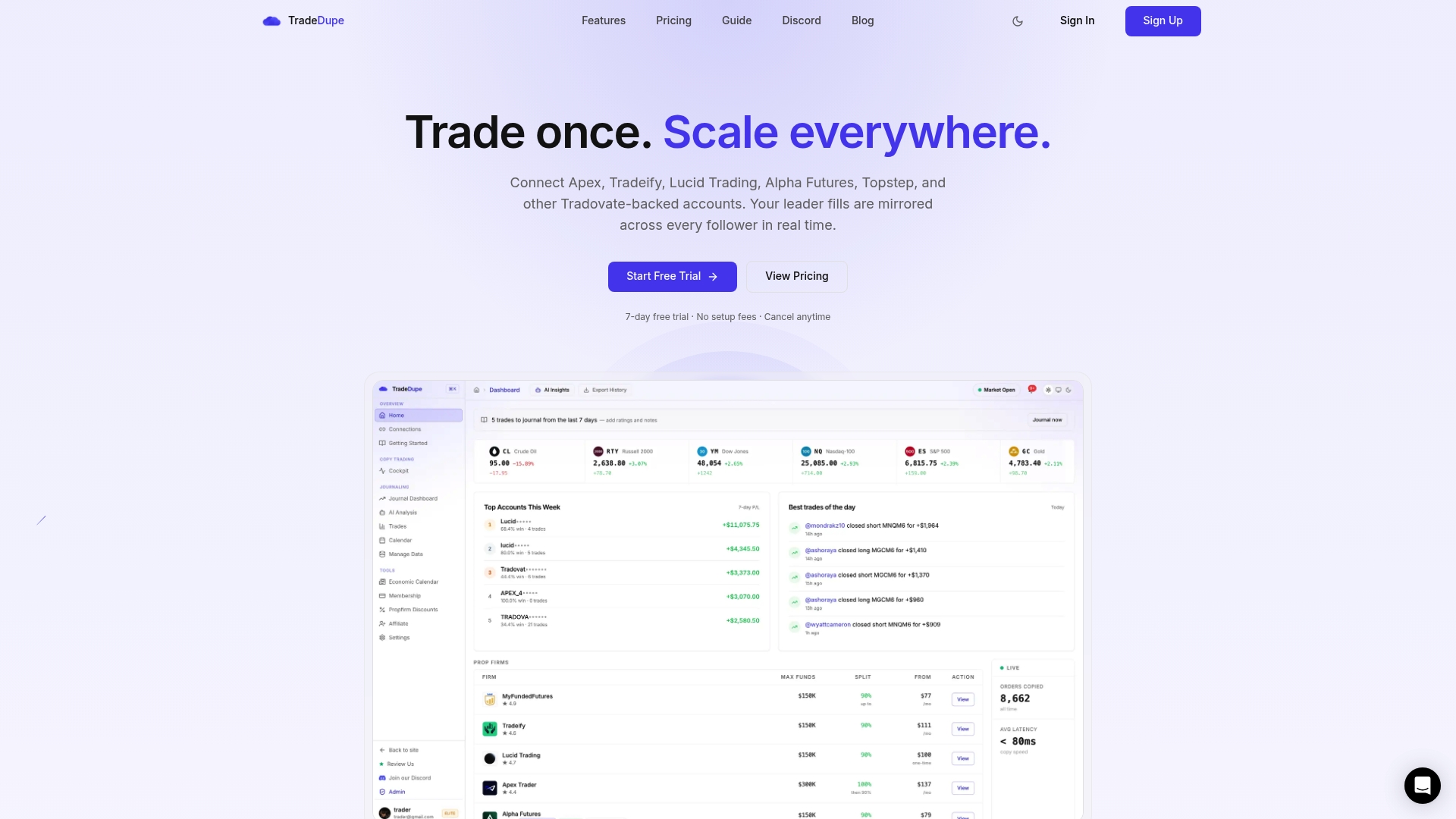
Some platforms support leading prop firm accounts including Apex, Tradeify, Lucid Trading, and Alpha Futures, with dashboards built for the aggregate, cohort-level visibility a real risk program needs. If you run funded accounts through Apex specifically, the Apex copy trading setup walks through mirroring every evaluation and PA account under one leader.
This article is published by TradeDupe, and the fairest way to judge whether these controls fit your desk is to see them running on your own accounts. Start with the 10 minute setup guide and test the toggles, dashboard, and rogue-trade detection against a real trading day before committing to a plan.
Sources
For deeper reading on drawdown formulas, see Dovar Labs; on scaling infrastructure, QTG; on fraud detection, Axcera; on trade-level hygiene, Trader Gibkey.
- Prop Firm Risk Management Guide | Drawdown Rules | Dovar Labs
- Modern Risk Infrastructure for Prop Firms · QTG
- Risk Management for Prop Firms 2026 | A-Book vs B-Book
- Safeguarding a Prop Trading Firm: Modern Risk Management and Fraud Detection
- The Complete Guide to Prop Firm Risk Management - PropFirmsTech Blog