
What a Kill Switch Trading Setup Does for Prop Desks
TradeDupe
16 min read
Discover how a kill switch trading setup enhances risk management for prop desks by instantly isolating follower accounts and preventing losses.
A copy-trading kill switch immediately isolates or flattens affected follower accounts without disrupting other linked accounts. It combines per-account toggles, rogue-trade detection, and auto-recovery to stop mirrored losses instantly across a Tradovate multi-account setup. This is not the same thing as an exchange-level circuit breaker or a general risk-management app. It is a mirroring control built specifically for firms running one leader account across dozens of funded followers.
When a follower breaches a daily loss cap, or a rogue order slips through, you need three capabilities available immediately:
- Per-account pause — halt copying to one follower while every other linked account keeps trading normally
- Auto-flatten — automatically close open positions on the affected account when a defined threshold is hit
- Rogue-trade detection — flag execution patterns that don't match the leader's order flow before they compound into losses
You reach for this feature during an emergency breach, when a rule threshold trips automatically, or when you manually isolate an account for a suspected connectivity or data issue.
*
> TL;DR: > > - Auto-flatten thresholds should be set at 85 to 90 percent of the firm's daily drawdown limits to avoid false triggers during slippage or delays. > - Per-account toggles and auto-recovery ensure that breaches are contained and resolved without affecting unaffected followers or causing desynchronization. > - Server-side execution reduces latency and race conditions, which are critical for timely kill switch responses during fast market movements. > - Testing all kill switch functions in demo mode before live trading is essential to prevent surprises during actual breaches or drawdowns. > - A comprehensive runbook defining authority levels, escalation procedures, and documentation standards is vital for effective and disciplined kill switch deployment.
*
Table of Contents
- How Kill Switch Trading Controls Work Under the Hood
- What Features Belong on a Kill Switch Feature Checklist?
- How Do You Test a Kill Switch Before Funding Accounts?
- Who Should Be Able to Trigger a Kill Switch?
- Do Prop Firm Rules Change How You Set Kill Switch Thresholds?
- What Should a Kill Switch Dashboard Track?
- Comparing Kill Switch Approaches Across Platforms
- What Real Incidents Show About Kill Switch Effectiveness
- Where Kill Switch Systems Fall Short
- How Much Can You Customize Kill Switch Behavior?
- Does a Kill Switch Change How Followers Trust the System?
- What the Runbook Approach Gets Right That Most Advice Misses
- Getting Kill Switch Controls Running on TradeDupe
- Key Takeaways
- Sources
How Kill Switch Trading Controls Work Under the Hood
The mechanics matter because a kill switch that lags by even a few seconds during a fast market move can defeat its own purpose. Server-side execution, where the mirroring logic runs on infrastructure independent of each trader's local machine, reduces race conditions that occur when multiple orders hit the same account milliseconds apart.
There's a meaningful difference between a per-account toggle, a global flatten all, and a selective pause. A global flatten liquidates every mirrored position across every follower, which is a blunt instrument you reserve for a systemic failure. A per-account toggle or selective pause isolates just the account in question, leaving the rest of your desk's positions untouched. Most real-world incidents call for the latter.
Auto-recovery is the piece operators underestimate. Re-enabling copying after a kill event isn't just flipping a switch back on. It means confirming the follower's positions reconcile with the leader's current state before resuming the mirror, so you don't resync into a stale or mismatched position.
- Server-side execution cuts latency-driven desync risk
- Per-account toggles preserve isolation without punishing unaffected accounts
- Auto-recovery re-syncs state before resuming the mirror, not just the connection
Pro Tip: Latency is not a footnote here. TradeDupe's mirroring runs with very low latency, measured in a few dozen milliseconds on average, and that speed is precisely what makes a per-account kill switch usable in a fast-moving futures session rather than theoretical.
What Features Belong on a Kill Switch Feature Checklist?
Not every trade copier ships with real kill-switch capability. Evaluating a platform, or an internal build, means checking for specific, testable functions rather than a vague "risk controls" claim on a features page.
- Configurable auto-flatten triggers — thresholds that fire on daily loss, trailing drawdown, or a manual override, scoped to a single account
- Rogue-trade detection — execution-timing correlation and position-overlap scoring that flag copy-trade abuse patterns before they become a compliance problem
- Per-account toggles and forced disconnects — the ability to sever one follower's link instantly without touching the leader or siblings
- Position-size multipliers and TP/SL randomization — controls that let each follower mirror at a different risk scale while staying aware of consistency-rule limits
- Audit trail and real-time alerts — a timestamped log of every pause, flatten, and reconnect event, visible on a live dashboard
Skip any of these and you're relying on manual intervention during exactly the moment manual intervention is slowest. The audit trail item deserves particular attention: prop firms reviewing a payout dispute will ask for logs, and a platform without one leaves you arguing from memory instead of evidence.
How Do You Test a Kill Switch Before Funding Accounts?
Testing belongs in demo mode, fully worked through, before a single funded follower account touches the mirror. Skipping this step is the single most common reason kill-switch behavior surprises a desk during a live drawdown event.
- Replicate a basic trade cycle. Send an entry, a stop-loss adjustment, and a close from the leader account and confirm each action mirrors to every follower with matching size and timing.
- Simulate a daily-loss breach on one follower only. Trigger the auto-flatten threshold on a single account and verify it flattens and disconnects without affecting the other linked followers.
- Test toggles and recovery under lag. Introduce artificial network delay, pause a follower, then re-enable it, and confirm the position reconciles rather than duplicating or dropping orders.
- Check consistency-rule alerts. Confirm the system flags a follower approaching a firm's daily-loss or consistency threshold before the hard limit triggers.
- Document every result. Log pass/fail outcomes and add edge cases to a written runbook so the next team member doesn't repeat the discovery process live.
This staged sequence follows the same order operator guides for prop-firm-safe copier setups recommend: entries and stops first, isolated failure second, recovery under stress third.
Pro Tip: Run the daily-loss simulation on your smallest follower account first. If isolation fails, you want to discover it on the account with the least capital at risk.
Who Should Be Able to Trigger a Kill Switch?
Kill-switch capability without a defined protocol just creates confusion about who acts and when. Every desk running mirrored accounts needs clear roles before the first live breach, not during it.
- Define authority levels. A risk manager or senior trader should hold global flatten-all permission; individual account owners or shift leads can trigger per-account pauses without escalation.
- Build an escalation ladder. A four-step sequence works for most desks: pause the affected account, confirm the cause with the trader on record, flatten if the cause is unresolved within a set window, then reconcile positions against the leader.
- Use short, standard communication templates. "Pausing [account ID], suspected [breach type], confirming in 2 minutes" keeps the team informed without slowing the response.
- Capture forensics immediately after any kill event. Timestamps, order IDs, and the trigger condition all need to land in the log before memory fades or the platform's retention window closes.
- Set explicit reopen criteria. A follower doesn't resume copying just because the market calmed down. Require a documented reason, a reconciled position check, and a named approver before re-enabling.
Firms that treat copy-trade risk management as a workflow rather than a single button tend to recover from incidents faster, because the ambiguity of "who decides" is already resolved before the event happens.
Do Prop Firm Rules Change How You Set Kill Switch Thresholds?
Kill-switch thresholds only work if they respect the funding rules governing each account, and those rules vary firm by firm. A daily-loss trigger set at the firm's literal published limit gives you zero buffer for slippage or a delayed cancellation.
- Confirm each firm's copying policy in writing. Some prop firms permit internal copying across accounts you own; most explicitly prohibit external copy-trading arrangements. Know which category applies before you scale a mirror.
- Keep ownership and KYC documentation accessible. If a firm's risk team flags correlated activity across accounts, having verified ownership records on hand shortens the review instead of triggering a suspension.
- Tune monitoring to reduce false positives. Shared VPS infrastructure or a common broker relay can look like abuse even when accounts are legitimately linked; documented detection signals help you and the firm tell the difference.
IOSCO's guidance on copy-trading oversight points the same direction for regulated markets: technology-enabled surveillance and clear selection and removal procedures for lead accounts reduce the kind of ambiguity that turns a routine review into a funding dispute.
What Should a Kill Switch Dashboard Track?
A kill switch is only as good as the visibility feeding it. If you can't see a threshold approaching, you're reacting to a flatten event rather than preventing one.
- Sync status per follower — confirms the mirror connection is live, not silently disconnected
- Equity versus threshold, per account — shows how close each follower sits to its daily-loss or drawdown limit in real time
- Latency readings — a rising latency trend on one connection often precedes a desync before it becomes visible anywhere else
- Correlation scoring — flags execution patterns worth a second look before they escalate into a rogue trade
Alert rules should fire on threshold breaches and on failed cancellations specifically, since a stop order that fails to cancel is often the actual cause of a blown daily limit, not the market move itself. Route both into an incident ticket rather than a Slack message that scrolls away.
Weekly or monthly reviews of these tickets let you tune thresholds instead of guessing at them, and they build the evidence trail a firm may ask for during a payout review. Refining detection over time, rather than leaving thresholds static from day one, is what separates a kill switch that protects capital from one that just interrupts good trades along with bad ones.
Comparing Kill Switch Approaches Across Platforms
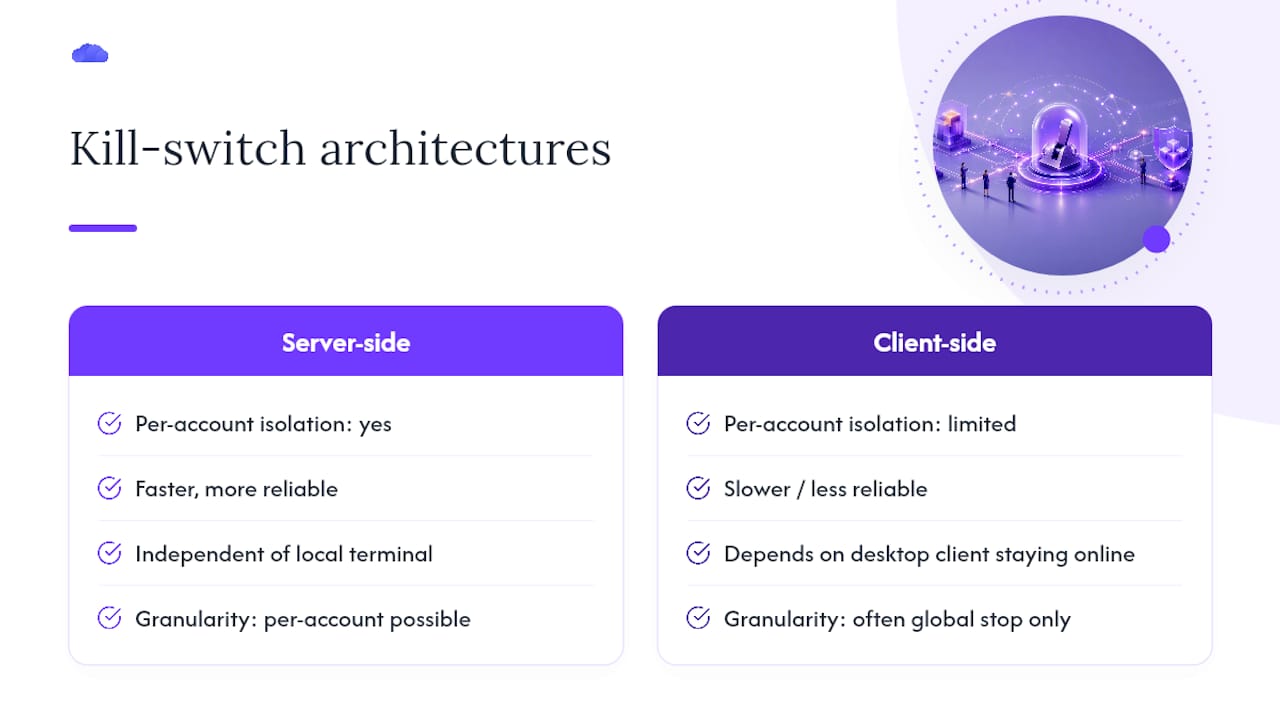
Kill-switch capability isn't uniform across the tools prop desks actually use, and the differences show up fast once you're running more than a handful of followers. Tradovate itself, as the execution venue, gives individual traders manual flatten and cancel-all controls at the account level, but it has no native concept of a "leader" and "follower" relationship, so it can't isolate one mirrored account from another on its own.
Cloud-based copy platforms vary widely in how granular their kill controls actually are. Some only offer a global stop that halts all mirroring at once, which is a poor fit for a desk running accounts across multiple funded programs like Apex, Tradeify, Lucid Trading, and Alpha Futures simultaneously. If one Apex account trips a daily-loss rule, you don't want your Tradeify and Alpha Futures followers frozen along with it.
The more relevant distinction is architectural: platforms that execute mirroring server-side, independent of each trader's local terminal, generally offer faster and more reliable per-account isolation than ones dependent on a desktop client staying connected. TradeDupe was built around this server-side model specifically because prop desks running multiple broker connectors need isolation that doesn't depend on any single machine staying online.
The practical takeaway for evaluating any system: ask specifically whether a kill event on one follower can be triggered and confirmed without touching any other linked account, and ask to see it demonstrated, not just described in a features list.
What Real Incidents Show About Kill Switch Effectiveness
The clearest illustration of kill-switch value comes not from a dramatic market crash but from the mundane failure mode that causes most funded-account blowups: a stop-loss order that fails to fill during a fast move, followed by a mirrored position that keeps compounding losses across every follower account.
Operator guidance on copy-trading for funded accounts is explicit that rehearsing pause, close, and disconnect behavior in demo mode before volatile events is what separates desks that survive a bad session from ones that don't. A desk that has never tested its flatten trigger discovers its actual behavior for the first time during the worst possible moment: live, during a breach, with real capital exposed across several accounts at once.
The pattern that shows up repeatedly in operator writeups is a desk running five or six followers off one leader account, where a single account's rule violation, caught late, forces a full-desk review because the firm couldn't tell which account actually caused the correlated activity. A working per-account kill switch turns that into a contained, single-account event with a clean log, rather than a desk-wide investigation.
The effectiveness case for a kill switch isn't about preventing every loss. It's about converting an uncontrolled, multi-account cascade into a bounded, documented, single-account event that a risk manager can close out and explain in one sentence during a firm review.
Where Kill Switch Systems Fall Short
No kill switch eliminates risk entirely, and treating it as a guaranteed backstop is where desks get into trouble. A few limitations are worth naming plainly.
Latency floors still exist. Even server-side execution at a median of 34 milliseconds means a handful of ticks can move against you between trigger and flatten during extreme volatility. A kill switch shrinks the exposure window; it doesn't erase it.
False positives carry real cost. Rogue-trade detection tuned too aggressively will pause legitimate followers over ordinary execution variance, interrupting a good trade because the system misread normal slippage as abuse.
Auto-recovery can mask an unresolved problem. If a follower re-enables copying before the underlying cause of a breach is actually understood, the same failure often repeats within the next session.
No kill switch fixes a bad strategy. A leader account generating consistent losses will still generate losses across every follower right up until the threshold trips. The switch limits the damage window; it doesn't improve the trading itself.
Human process gaps remain the biggest single point of failure. A platform with flawless technical kill-switch behavior still fails operationally if nobody on the desk knows who has authority to pull the trigger during a live event.
None of this argues against having the feature. It argues against treating it as a substitute for tested procedures, sensible thresholds, and a team that has actually rehearsed the response.
How Much Can You Customize Kill Switch Behavior?
A kill switch calibrated identically across every follower account ignores the fact that different accounts run different strategies, sizes, and rule sets. Meaningful customization tends to fall into a few categories.
Threshold tiering by account type. A scalping strategy running tight, frequent trades needs a different daily-loss trigger sensitivity than a swing approach holding overnight positions, even on accounts funded by the same firm.
Position-size multipliers per follower. Scaling a mirrored trade up or down per account lets one leader serve accounts of different funded sizes without forcing identical risk exposure across all of them.
TP/SL randomization. Introducing small variance in take-profit and stop-loss placement across followers helps avoid the kind of identical-execution pattern that correlation-based detection systems are specifically built to flag.
Selective account grouping. Segmenting followers into groups, say, by prop firm or by risk tolerance, lets you flatten or pause an entire group at once without touching accounts outside it.
Consistency-rule-aware pacing. Some setups delay or throttle mirrored entries on accounts approaching a firm's consistency threshold, rather than mirroring instantly and risking a rule violation on that account alone.
The right level of customization depends on how many prop-firm programs a desk runs simultaneously. A single-firm, single-strategy operation needs far less granularity than a desk mirroring across Apex, Tradeify, Lucid Trading, and Alpha Futures accounts with different rule sets on each.
Does a Kill Switch Change How Followers Trust the System?
Followers on a mirrored account, whether that's a junior trader on a desk or a separate funded account you manage, notice kill-switch behavior directly. An account that gets flattened without warning, with no visible reason and no log to review afterward, erodes confidence fast, even when the flatten was the correct call.
The dashboard visibility matters as much here as the kill mechanism itself. A follower who can see their own equity against threshold in real time, and who receives a clear alert the moment a pause or flatten fires, experiences the event as a safeguard working as designed. A follower who finds out after the fact, from a support ticket or a confused screenshot, experiences the same event as an unexplained malfunction.
Trust also depends on how narrowly the isolation works. A global flatten that takes down five unaffected accounts because one follower breached a limit teaches the whole desk to distrust the system, whether or not the underlying logic was sound. A per-account kill that leaves every other follower untouched, with a clean log explaining exactly what happened and when, reinforces the opposite lesson: the system does what it's supposed to do, no more and no less.
Over time, this is what determines whether a desk actually uses its kill switch or works around it. A tool that traders trust gets used promptly. One they don't trust gets ignored until it's too late.
What the Runbook Approach Gets Right That Most Advice Misses
Most guidance on copy-trading risk stops at the feature level: get a kill switch, get rogue-trade detection, move on. That's necessary but not sufficient. The desks that actually avoid multi-account disasters treat the kill switch as one component of a written runbook, not a standalone safety net they assume will work correctly under pressure.
The conventional advice underestimates two things. First, it treats testing as optional due diligence rather than a mandatory pre-funding step; demo testing across your specific broker integrations surfaces API-specific edge cases that generic advice never anticipates. Second, it treats compliance as a one-time policy read rather than an ongoing threshold-tuning exercise tied to each prop firm's actual rules.
What should come first, before evaluating any platform's feature list, is the runbook itself: who has authority, what the escalation ladder looks like, what gets logged, and what reopening a follower actually requires. A perfect kill switch operated without a protocol still produces confusion during a live breach. A modest kill switch operated with a tested, documented protocol produces a contained, explainable incident.
The gap between platforms marketing "kill switch" as a checkbox feature and platforms that treat it as an operational discipline is the real dividing line for a desk evaluating its options.
> — Andres
Getting Kill Switch Controls Running on TradeDupe
TradeDupe is built specifically around the operational model this article describes: per-account toggles, rogue-trade detection, and auto-recovery running through server-side execution at a median 34ms across every mirrored Tradovate connection. Rather than a single global stop, the dashboard gives you isolated control over each follower, with sync status, equity-versus-threshold tracking, and real-time alerts visible in one place.
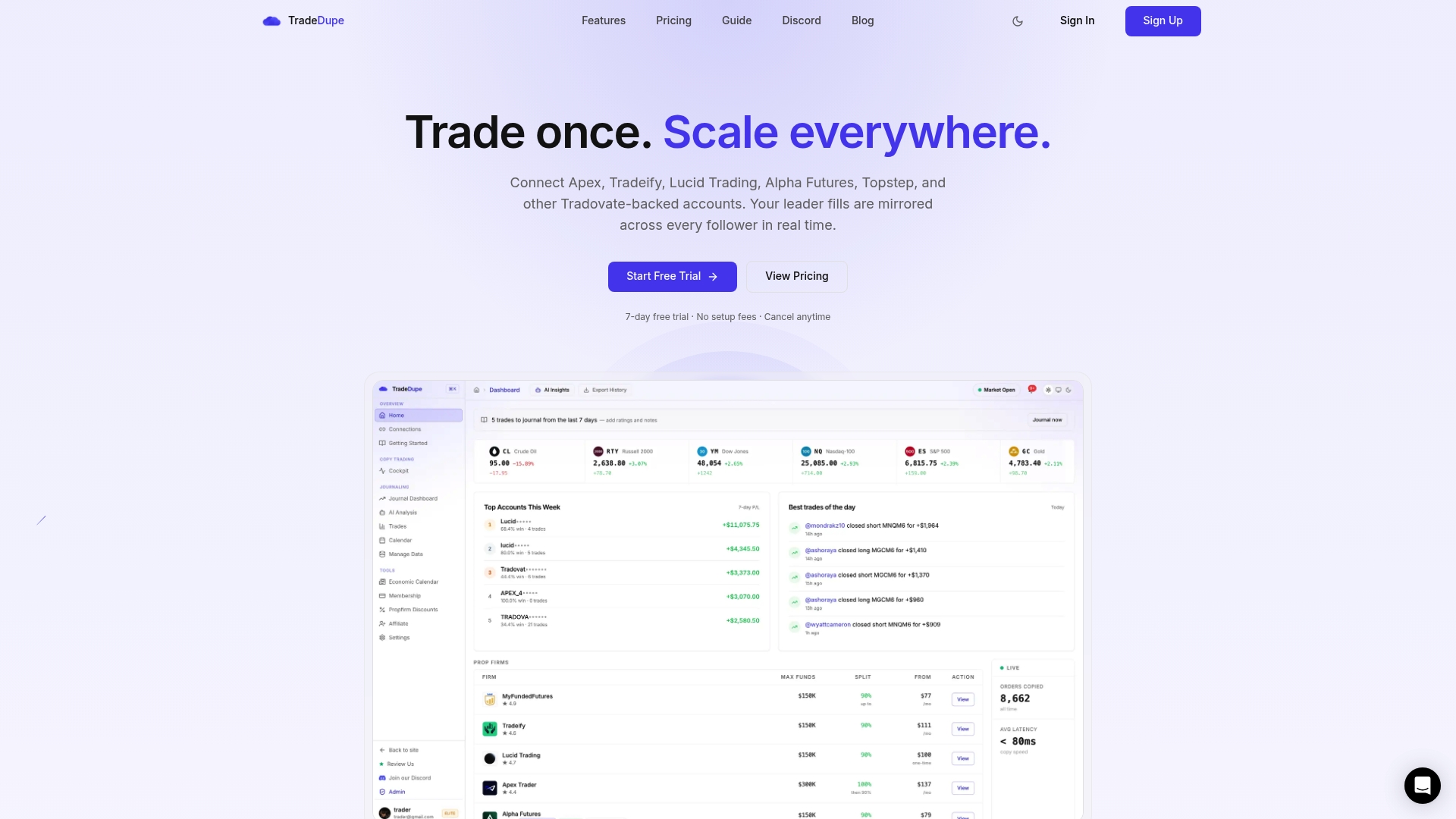
Every connector referenced in this guide, including Apex, Tradeify, Lucid Trading, and Alpha Futures, integrates directly, so a kill event on one funded account never touches the others on your desk. The dashboard also supports the exact test-and-verify workflow covered above: run demo trades, simulate a daily-loss breach on a single follower, and confirm isolation before ever connecting a funded account. TradeDupe's security and reliability documentation covers the detection logic and audit trail in more depth for teams building a compliance case.
If you're ready to see the per-account controls in action, the getting-started guide walks through setting up your first leader-follower connection on Tradovate in about ten minutes, including admin verification for firms managing several funded accounts.
Key Takeaways
A copy-trading kill switch protects a prop desk by isolating one follower's failure instantly, without disrupting the rest of the mirrored accounts.
| Point | Details |
|---|---|
| Isolation beats global flatten | Per-account toggles contain a single breach instead of stopping every mirrored account at once. |
| Test before funding | Simulate entries, stops, and a daily-loss breach in demo mode before any live account connects. |
| Set threshold buffers | Configure auto-flatten near 85 to 90 percent of the firm's stated drawdown limit, not at the exact edge. |
| Document every kill event | Logs, timestamps, and reopen criteria protect the desk during payout or compliance reviews. |
| TradeDupe implements this model | Server-side execution, per-account toggles, and rogue-trade detection run across Apex, Tradeify, Lucid Trading, and Alpha Futures connections at a median 34ms. |
Sources
- IOSCO Final Report on Copy Trading (PD793)
- How to Copy Trade Funded Accounts Safely | Plutus Trade Base
- Copy Trading Prop Firms 2026 | Trade Copier & Abuse