
What Is Counterparty Risk in Prop Trading?
TradeDupe
11 min read
Understand the implications of counterparty risk in prop trading, including how it affects payouts and operational safety for traders.
Counterparty risk in prop trading is the chance that the party on the other side of your trade, whether that's a clearinghouse, an OTC derivatives dealer, or the prop firm holding your funded account, fails to meet its obligations to you. For most funded traders, this shows up as payout risk: a profitable month means nothing if the firm behind your account can't or won't pay. Regulatory shifts since Dodd-Frank pushed more derivatives through central counterparties like the CME, but funded-account structures often sit outside that protection entirely. Platforms like Tradedupe don't eliminate this risk, but they narrow the operational gap where it tends to hide.
The exposure concentrates in three places: OTC derivatives positions, live-sim or synthetic funded accounts, and multi-account copy trading setups where one bad fill cascades.
Before doing anything else:
- Confirm whether your funded account is exchange-routed or synthetic against the firm's own book.
- Check the firm's payout history and any documented collateral or escrow arrangement.
- Review margin call procedures and settlement timing in your account agreement.
Pro Tip: Ask your prop firm directly whether client funds are segregated. A firm that hesitates to answer has already told you something.
Key Takeaways
Counterparty risk in prop trading hinges on whether your exposure runs through a clearinghouse or sits as unsecured contractual dependence on a funder's payout promise.
| Point | Details |
|---|---|
| Know your counterparty | Determine whether your funded account is exchange-routed or synthetic against the firm's own book. |
| Measure exposure quantitatively | Use current exposure, PFE, and CVA rather than gut feel to size your risk to any single counterparty. |
| Prioritize central clearing | Route through a CCP like the CME whenever a comparable OTC alternative exists to cut bilateral default risk. |
| Document everything legally | An ISDA Master Agreement and CSA define netting and collateral terms before a dispute happens, not during one. |
| Monitor copy-trading exposure continuously | Tradedupe's per-account toggles and rogue-trade detection catch desync and aggregation risk in real time across mirrored accounts. |
Table of Contents
- Counterparty Risk Definition and Key Terms for Prop Traders
- How Counterparty Exposure Shows Up in Prop Trading
- Measuring Counterparty Exposure: PFE, CVA, and Simulation Tools
- Mitigating Counterparty Risk in Trading: Structural and Legal Tools
- Operational Controls Prop Desks Should Run Daily
- How Fast Exposure Moves and What Mitigation Costs
- A Worked Example: Estimating PFE and a Rough CVA
- What Prop Traders Consistently Get Wrong About This Risk
- Why Real-Time Trade Mirroring Cuts Operational Exposure
- Frequently Asked Questions
- Sources
Counterparty Risk Definition and Key Terms for Prop Traders
Counterparty risk is the probability that the other party in a transaction fails to fulfill its contractual obligations, and it differs from generic credit or default risk in one important way: it's bilateral and transaction-specific rather than tied to a borrower's overall creditworthiness. According to the OCC, exchanges and clearinghouses shift this risk away from the bilateral relationship by stepping in as the legal counterparty to every trade. That's the core distinction between exchange-cleared futures, where the CME's clearinghouse absorbs default risk, and OTC derivatives, where you're exposed directly to whoever signed the contract.
A working glossary for prop desks:
- Current exposure: what you'd lose today if the counterparty defaulted right now.
- Potential future exposure (PFE): the worst-case exposure estimate over a future time horizon.
- Expected exposure (EE/EPE): the average exposure across possible future scenarios.
- CVA: credit valuation adjustment, the market price of counterparty default risk.
- Wrong-way risk: exposure that increases exactly when the counterparty's ability to pay decreases.
- ISDA Master Agreement and CSA: the standard legal framework and collateral annex governing bilateral derivatives.
Post-2008 reforms increased central clearing for standardized swaps specifically to reduce this bilateral exposure at scale.
How Counterparty Exposure Shows Up in Prop Trading
Exposure mechanics differ sharply depending on where your trade clears. On exchange-routed futures, the clearinghouse becomes your counterparty the moment a trade executes, absorbing the default risk of whoever took the other side. Bilateral OTC contracts skip that substitution entirely, which increases counterparty exposure compared to centrally cleared products as explained in currency trading risk for exchange operators. Investopedia notes that exposure on these contracts only materializes when your position is in-the-money, meaning the counterparty owes you money it may not deliver.
Funded-account models introduce a third exposure type that many traders overlook: contractual payout risk. When a prop firm is the actual counterparty to your synthetic or live-sim account, your profitable month becomes an unsecured claim against that firm, not a cleared trade with a clearinghouse standing behind it.
Common scenarios include:
- An OTC swap counterparty defaults mid-contract, leaving the in-the-money side unpaid.
- A funded-account firm denies a payout after a strong month, citing a rule violation.
- A copy-mirroring setup aggregates exposure across accounts, turning one rogue trade into a firm-wide problem.
Pro Tip: Treat every funded account like an unsecured loan to the firm until you've confirmed how payouts are actually funded.
Measuring Counterparty Exposure: PFE, CVA, and Simulation Tools
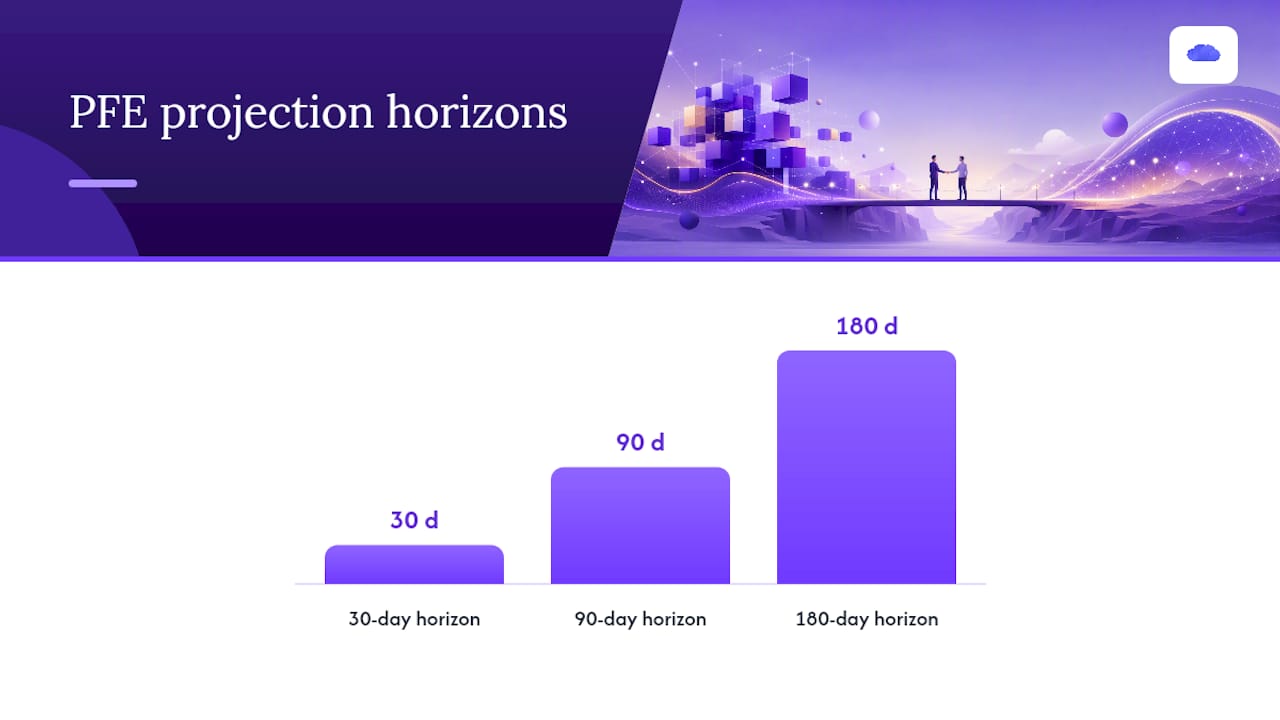
Quantifying counterparty risk starts with three related but distinct metrics. Current exposure is a snapshot: what you'd lose if default happened this instant. PFE projects that exposure forward, capturing how much a position could move against a counterparty's ability to pay over a defined horizon, often 30, 90, or 180 days out. Expected exposure (EE, sometimes averaged into EPE) sits between the two, reflecting the probability-weighted average exposure across simulated paths rather than a worst-case tail.
CVA translates all of this into a single price. It represents the market value of counterparty default risk, calculated as expected exposure multiplied by default probability and loss-given-default, then discounted across the life of the position. Desks that trade OTC derivatives regularly use CVA to adjust pricing or set aside reserves against potential losses.
Monte Carlo simulation is the standard method for estimating PFE, since it models thousands of possible market paths rather than relying on a single point estimate. VaR complements this by quantifying tail losses at a given confidence level.
A simplified PFE workflow looks like this:
- Simulate a range of future market scenarios for the underlying position.
- Calculate the exposure (positive value to you) under each scenario.
- Take a high percentile, commonly 95% or 99%, as your PFE estimate.
- Repeat across the position's life to build an exposure profile.
Pro Tip: Revalidate your model inputs, correlation assumptions especially, every time you add a new instrument or counterparty. Stale correlations are where PFE estimates quietly go wrong.
Mitigating Counterparty Risk in Trading: Structural and Legal Tools
Central clearing remains the single most effective structural mitigant available to prop desks. Routing trades through a CCP like the CME means the clearinghouse becomes the counterparty to both sides, which is why most listed futures carry dramatically less counterparty risk than bilateral OTC positions.
For anything traded bilaterally, netting and legal documentation matter just as much:
- Close-out netting under an ISDA Master Agreement lets you offset gains and losses across all trades with one counterparty instead of settling each individually.
- A Credit Support Annex (CSA) sets the collateral terms attached to that agreement, including thresholds and eligible collateral types.
- Initial margin covers potential future exposure; variation margin adjusts daily for current mark-to-market moves.
- Haircuts on posted collateral protect against the collateral itself losing value during a default scenario.
An operational checklist worth running quarterly:
- Verify settlement routing matches what your account agreement states.
- Reconcile collateral balances against counterparty statements.
- Confirm your margin waterfall and who absorbs losses first.
- Document an emergency fail procedure before you need one.
Pro Tip: If a counterparty resists putting margin terms in writing, that reluctance is itself a signal worth weighing.
Operational Controls Prop Desks Should Run Daily
Continuous monitoring is what separates managed counterparty risk from counterparty risk you discover the hard way. CFI's guidance on CCR frames this as an ongoing process, not a one-time credit check, and that framing holds especially true for prop desks running multiple accounts simultaneously.
A workable cadence includes:
- Daily comparison of P&L against margin exposure across every account.
- Weekly credit and reputation checks on any firm you hold funded accounts with.
- Trade confirmation and settlement reconciliation on every fill, not just flagged exceptions.
- Per-leader and per-follower exposure caps for any copy-mirroring setup, with a kill switch for aggregate breaches.
Multi-account mirroring adds a layer most single-account traders never think about: one rogue trade on a leader account can propagate across every follower before a human notices.
Pro Tip: Watch sync latency and desync alerts as closely as you watch P&L. A mirroring delay of even a few seconds during a fast market is where aggregated exposure gets dangerous.

How Fast Exposure Moves and What Mitigation Costs
PFE isn't static. It can swing meaningfully within a single session on a leveraged futures position, and margin calls can propagate within minutes once a threshold breaches on a volatile day.
Cost tradeoffs follow a predictable pattern:
- Posting high-quality collateral protects you but creates liquidity drag, since that capital isn't earning elsewhere.
- Funding costs on collateral scale with position size and volatility.
- Smaller prop firms without FCM backing often carry longer settlement lags than larger, exchange-member operations, which widens the pre-settlement risk window.
A Worked Example: Estimating PFE and a Rough CVA
Here's a simplified sequence for a single OTC position, say a short-dated swap:
- Establish current exposure: mark the position to market today.
- Run a basic Monte Carlo simulation, generating price paths for the underlying over 30 days.
- Calculate exposure under each simulated path, keeping only positive (in-the-money) values.
- Take a high percentile of those outcomes as your PFE over a typical short-term horizon.
- Multiply expected exposure by an assumed default probability and by (1 minus recovery rate) to approximate CVA.
The common pitfalls here are overfitting your simulation to recent volatility and ignoring wrong-way risk, where the counterparty's default probability rises in tandem with your exposure.
Pro Tip: Run this exercise in a spreadsheet before automating it. Seeing the sensitivity to your default probability assumption by hand builds intuition no dashboard will give you.
What Prop Traders Consistently Get Wrong About This Risk
Most traders spend far more energy on market risk than on counterparty risk, largely because market risk shows up on a P&L chart and counterparty risk doesn't until it's too late. The traders who manage this well treat contractual hygiene and continuous monitoring as inseparable from strategy, and they favor exchange-routed execution whenever a comparable OTC alternative exists. Platform-level controls, the kind that catch a desync or rogue trade before it compounds, matter more for operational counterparty exposure than most desks assume.
Why Real-Time Trade Mirroring Cuts Operational Exposure
Central clearing and ISDA documentation address counterparty risk on the contract side. The mirroring layer between your accounts is where operational counterparty risk actually lives day to day, and that's the gap Tradedupe is built to close for multi-account prop desks running on Tradovate.
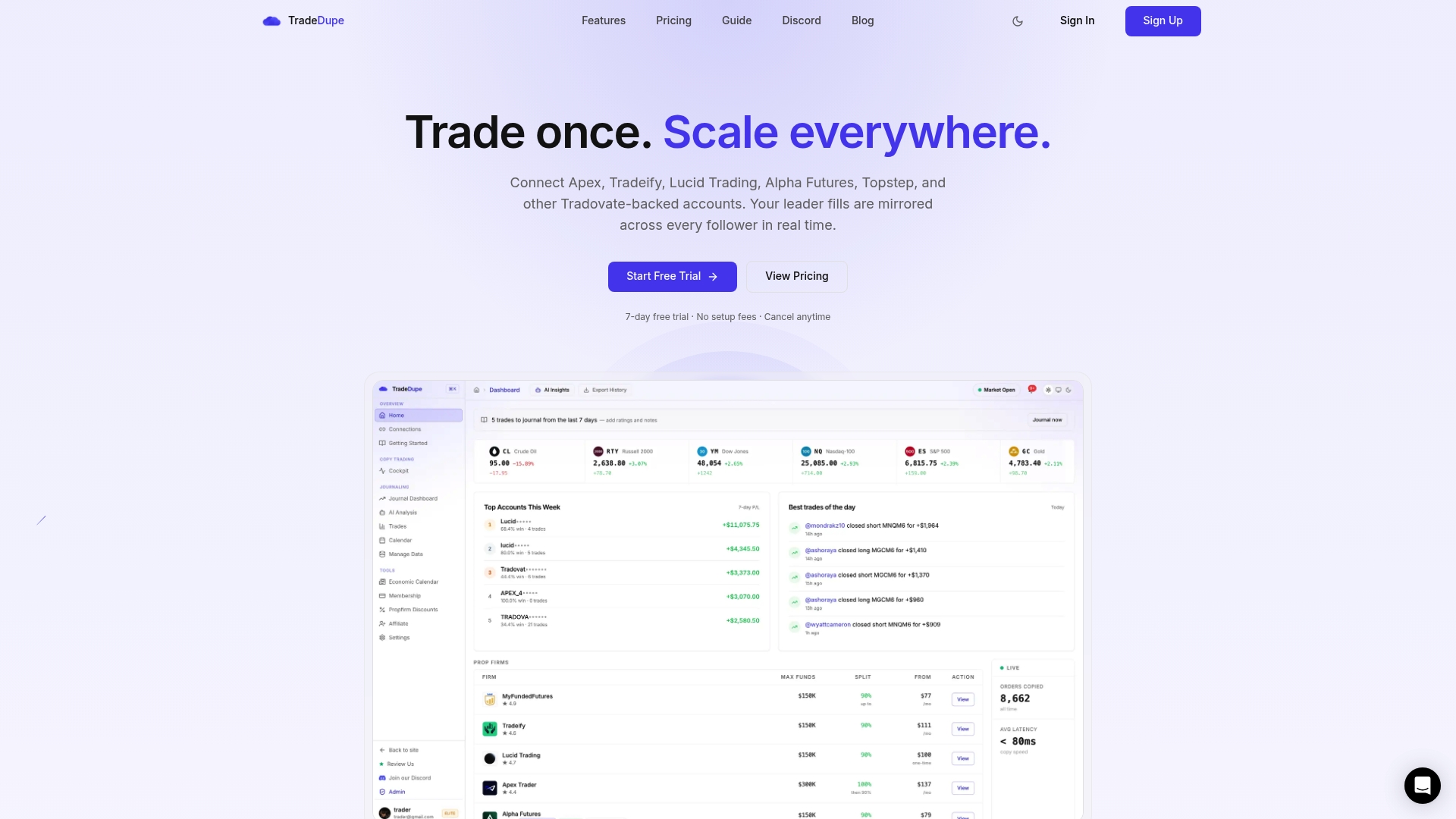
Per-account toggle controls let you isolate a single account without disrupting the rest of your book, and rogue-trade detection flags anomalous fills before they propagate across followers. Real-time sync telemetry, with a very low median latency, gives your risk team the same visibility a reconciliation desk would want: who's synced, who's lagging, and where exposure is concentrating right now. Auto-recovery handles the desync scenario automatically instead of leaving a follower account exposed while someone notices manually.
If you're running more than a couple of funded accounts across firms like Apex or Tradeify, the point where internal spreadsheets stop catching sync failures is the point to evaluate a dedicated tool. Start with the futures trade copier product page, or head straight to getting started with Tradovate copy trading to see setup in practice.
Frequently Asked Questions
What is counterparty risk in prop trading, in plain terms? It's the risk that whoever owes you money, a clearinghouse, an OTC counterparty, or the prop firm behind your funded account, fails to pay. In prop trading specifically, this most often surfaces as payout risk on funded accounts rather than classic derivatives default.
How does counterparty risk differ from market risk for a prop trader? Market risk is the chance your position moves against you. Counterparty risk is the chance the party obligated to pay you, regardless of how your position performed, doesn't.
Does trading exchange-listed futures eliminate counterparty risk? No, but it substantially reduces it. The clearinghouse becomes the legal counterparty to your trade, absorbing default risk that would otherwise sit with whoever took the other side.
Why does copy trading increase counterparty and operational risk? Mirroring multiplies a single execution across accounts, so a rogue trade, sync failure, or delayed fill on the leader account can cascade into every follower simultaneously if there's no per-account control layer.
What should a prop desk check before trusting a funded-account program? Confirm whether the account is exchange-routed or synthetic, review the firm's payout history, and read the contract's dispute and settlement procedures before funding anything.
This article is general information, not a substitute for advice from a qualified financial advisor. Consult a qualified financial professional about your own circumstances before acting on anything here.
Sources
Recommended
- How Prop Firm Rules Affect Trade Copying in 2026 | TradeDupe Blog
- Why Reliable Trade Execution Matters for Prop Firms | TradeDupe Blog
- How to Trade Prop Firms (2026): A Practical Playbook to Pass and Keep a Funded Account | TradeDupe Blog
- How to Mirror Trades Across Prop Accounts: 2026 Playbook | TradeDupe Blog