Rogue Trade Risk in Prop Firms: Detect and Stop Cascades
TradeDupe
14 min read
Discover what is rogue trade risk in prop firms and how to prevent catastrophic losses. Learn key signs and protective strategies today!
Rogue trade risk in a prop firm is any trading activity that breaches a trader's designated risk mandate, whether through deliberate fraud, psychological tilt, or a system misconfiguration, creating the potential for catastrophic capital loss that cascades instantly across every mirrored follower account. For desks running multi-account copy trading on platforms like Tradovate through integrations with Apex, Tradeify, Lucid Trading, or Alpha Futures, a single compromised leader account can terminate dozens of funded positions before a human can intervene.
The most common manifestations:
- Unauthorized position sizing: entering contracts well above the permitted lot size for the account tier
- Out-of-hours or off-instrument trading: placing orders in restricted sessions or on instruments outside the approved list
- Revenge trading: rapid re-entry after a loss, compressing trade intervals and escalating size to recover drawdown
Table of Contents
- What does rogue trading actually look like in a mirrored account?
- Why do rogue trades happen? Root causes beyond "bad discipline"
- How fast and how severe can rogue-trade losses get?
- What signals indicate a rogue trade sequence is starting?
- Which controls actually prevent rogue trades from propagating?
- How should multi-account mirror operations be architected for safety?
- Vendor and internal checklist: what to require before deployment
- Response playbook: what to do when a rogue trade is suspected
- A mirrored revenge-trade sequence: how layered controls stopped the cascade
- Legal and regulatory implications of rogue trades in prop firms
- Historical rogue trading incidents and what they cost
- Key Takeaways
- The multi-account mirror risk most desks underestimate
- Tradedupe gives your prop desk server-side protection for every mirrored account
- Useful sources and further reading
What does rogue trading actually look like in a mirrored account?
Three scenarios illustrate how these events unfold operationally.
Scenario 1: Single-trader tilt. A funded trader on an Apex evaluation account takes two consecutive losing trades. Within 90 seconds, they re-enter at 3x their normal contract size. The leader account breaches its daily loss limit at T+4 minutes. Because the leader is live in a copy-trading stack, every follower account replicates the oversized entry before the risk engine fires. Damage is done across all followers by T+5 minutes.

Scenario 2: Out-of-hours instrument trade. A trader's automation script carries a stale configuration that permits trading during the CME pre-market session. The script enters a position in a restricted instrument at 3:45 AM CT. No human is monitoring. The prop firm's consistency filter flags the trade at market open, terminating the account. Any follower accounts that mirrored the entry are also flagged.
Scenario 3: Code or execution bug in the leader. A misconfigured EA sends a market order with an incorrect multiplier, effectively entering 10x the intended size. The bug propagates to all followers at near-identical latency. By the time the error is identified, the full follower pool has absorbed the position.
Copy and mirror trading multiplies exposure because followers replicate the leader's sizing logic proportionally. A latency spike between leader and follower execution can also mean followers fill at worse prices, compounding the loss beyond what the leader itself absorbed.
Why do rogue trades happen? Root causes beyond "bad discipline"
Behavioral analytics identify tilt as the primary driver: a loss triggers faster re-entry, which triggers size creep, which triggers a breach, as detailed in psychological management for traders. The sequence is recognizable in trade logs before the breach fires.
- Behavioral tilt sequence: loss → sub-60-second re-entry → position size 2x or greater → daily loss limit breach
- Incentive misalignment: traders on aggressive payout splits have asymmetric upside from oversizing; the firm absorbs the downside
- Configuration errors: client-side risk boxes that can be overridden, stale automation configs, or misconfigured lot-size multipliers in copy stacks
- Coordinated abuse: multiple accounts operated by related parties to exploit evaluation rules or payout structures
The prop firm rule paradox compounds this. Standard retail risk practices, such as letting winners run or risking 1% per trade, can still breach a firm's drawdown or consistency filters when floating P&L is included in the calculation. Traders who manage only closed P&L are routinely surprised by terminations they did not see coming.
Pro Tip: Behavioral risk management and integrity monitoring are distinct disciplines. Behavioral monitoring detects deteriorating decision-making before a breach. Integrity monitoring catches violations at or after the moment they occur. You need both.
How fast and how severe can rogue-trade losses get?
- T+0 to T+60 seconds: Oversized order executes on the leader account.
- T+1 to T+5 minutes: Mirror propagation replicates the position across all active follower accounts.
- T+5 to T+30 minutes: Daily loss limits breach on multiple accounts; automated circuit breakers fire or accounts are terminated by the prop firm.
- T+1 to T+4 hours: Firm-level capital exposure is calculated; funded account holders are notified of terminations.
- T+1 to T+7 days: Regulatory or contractual review begins; legal exposure is assessed if fraud is suspected.
The multiplication logic is straightforward. If a leader enters 10 contracts on an instrument where the firm's per-account limit is 2 contracts, and 15 follower accounts mirror that entry proportionally, the desk's aggregate exposure is 150 contracts, not 10. Use a prop firm profit calculator to model this exposure before it becomes a live event.
Business impacts extend beyond capital loss: account terminations across the follower pool, reputational damage with prop firm partners, and potential regulatory scrutiny under CFTC oversight if the activity pattern suggests coordinated manipulation.
What signals indicate a rogue trade sequence is starting?
Proactive monitoring targets leading indicators, not just lagging limits. By the time a daily loss limit fires, the damage is already done.
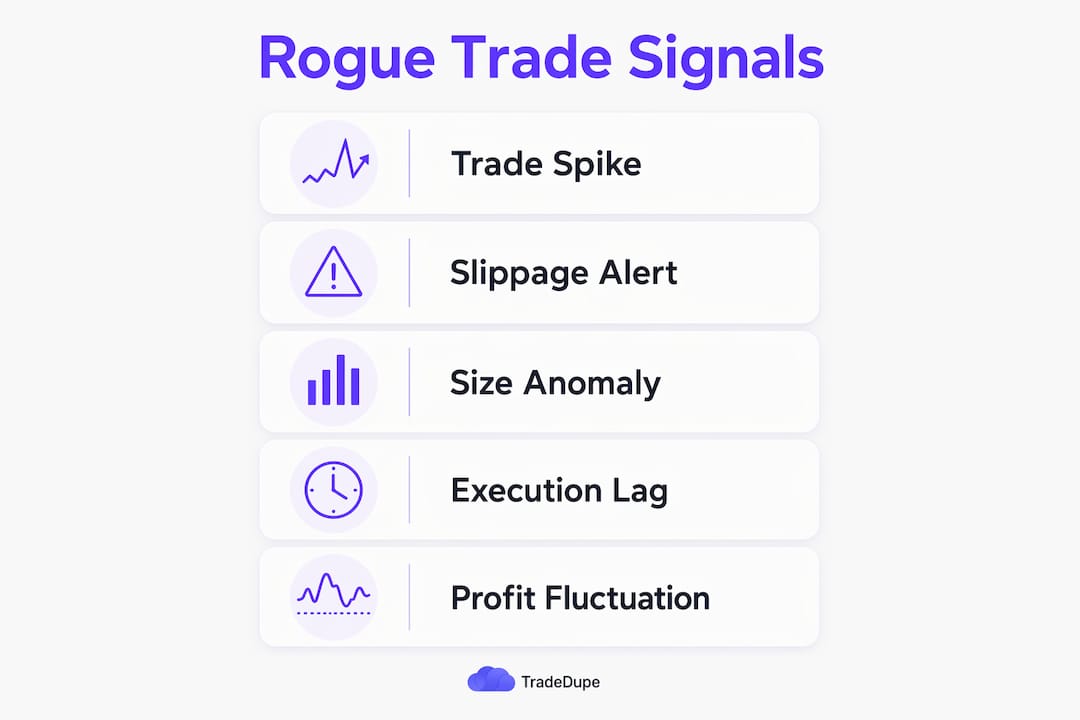
| Signal | Threshold Example | Action |
|---|---|---|
| Trade frequency spike | >5 trades in any 10-minute window | Alert risk ops, flag leader account |
| Size creep | Position size >2x the account's 30-day average | Soft block pending review |
| Inter-trade interval compression | Re-entry within 60 seconds of a losing close | Behavioral alert, optional pause |
| Follower sync anomaly | >150ms deviation from median latency | Investigate execution path |
| Instrument or session violation | Trade in restricted symbol or outside permitted hours | Hard block, log event |
A simple detection rule for size creep in pseudocode:
``` IF current_contracts > (avg_contracts_30d * 2.0) AND last_trade_result == LOSS AND seconds_since_last_trade < 60 THEN trigger_behavioral_alert(account_id) ```
Automated surveillance using pattern recognition, as recommended by Axcera's risk framework, reduces false positives compared with manual monitoring and catches complex exploit patterns that simple threshold rules miss.
Which controls actually prevent rogue trades from propagating?
Must-have controls (implement immediately):
- Server-side hard limits: position size caps and daily loss limits enforced at the execution layer, not the client application. A trader cannot override what the server rejects.
- Immutable audit logs: every order, modification, and cancellation written to a tamper-proof log with timestamps and account IDs.
- Per-account toggles: the ability to disable a single leader or follower account without affecting the rest of the copy stack.
- Pre-trade checks: validate instrument, session, size, and remaining drawdown room before any order reaches the exchange.
- Kill-switch: a single action that halts all trading across the entire account group.
Nice-to-have (medium-term improvements):
- AI-driven behavioral coaching that interrupts a tilt sequence before positions are closed
- Rollback tools for reversing erroneously propagated trades where the exchange supports it
- Dynamic margin adjustments that tighten limits automatically as drawdown room shrinks
Server-side enforcement beats client-side checks in a mirrored stack because the leader's client application is not the gatekeeper for follower execution. If limits live only on the client, a bug or override on the leader bypasses protection for every downstream account.
Pro Tip: Cap aggregate daily risk at 60% of the hard daily loss limit. This buffer absorbs slippage and gap risk before the firm's circuit breaker fires.
How should multi-account mirror operations be architected for safety?
Per-account follower isolation is the architectural principle that prevents a single compromised leader from auto-propagating to the entire follower pool.
| Requirement | Why It Matters |
|---|---|
| Per-account toggles | Quarantine one account without disrupting others |
| Per-follower risk caps | Limit each follower's maximum daily loss independently |
| Leader quarantine workflow | Require explicit re-enable after any anomaly flag |
| Real-time sync health telemetry | Detect latency spikes before they cause fill-price divergence |
| Latency SLA | Sub-100ms execution path reduces cascade fill-price divergence |
When evaluating vendors, demand server-side execution, immutable audit logs, per-account rollback capability, and real-time telemetry as non-negotiable requirements. Platforms that enforce limits only at the client layer or that lack per-account toggle controls are architecturally unsuitable for multi-account prop desk operations. Review how prop firm rules interact with trade copying before committing to any vendor stack.
Vendor and internal checklist: what to require before deployment
Vendor RFP requirements:
- Server-side limit enforcement with documented enforcement architecture
- Per-account toggles and follower isolation with explicit re-enable workflows
- Rollback APIs or manual rollback capability for erroneously propagated trades
- Immutable, exportable audit logs with sub-second timestamps
- 99.9% uptime SLA with documented incident response times
- Sub-100ms execution path on the critical order routing segment
- Incident postmortem records available on request
Internal policy requirements:
- Designated incident commander with authority to trigger the kill-switch
- Required telemetry: per-account PnL, sync status, latency, and drawdown room updated at least every 5 seconds
- Pre-deployment test plan covering oversized order rejection, out-of-hours block, and kill-switch activation
- Quarterly tabletop exercises simulating a tilt cascade event
- Daily risk report distributed to risk ops and firm management before session open
Include unrealized losses in drawdown calculations from session start, not from last closed trade. Firms that calculate drawdown on closed P&L only will terminate accounts that traders believed were within limits.
Response playbook: what to do when a rogue trade is suspected
Immediate containment (T+0 to T+5 minutes):
- Trigger the kill-switch to halt all new orders across the affected account group.
- Isolate the leader account using the per-account toggle; pause propagation to all followers.
- Snapshot current state: open positions, account equity, audit log entries, and sync status.
- Notify the incident commander and risk ops lead.
Recovery (T+5 minutes to T+4 hours):
- Execute manual rollback on erroneously propagated positions where the exchange and platform support it.
- Reconcile P&L across all affected accounts against pre-event snapshots.
- Notify funded-account holders of any terminations or position closures.
- Contact prop firm partners if account terminations trigger contractual notification requirements.
Post-incident (T+1 day onward):
- Conduct a root-cause analysis: behavioral tilt, config error, or coordinated abuse?
- Update risk box configurations and detection thresholds based on findings.
- Schedule trader remediation or coaching if tilt was the driver.
- File regulatory notifications with the CFTC or relevant authority if the pattern suggests fraud.
A mirrored revenge-trade sequence: how layered controls stopped the cascade
Timeline:
- 09:14:22: Leader account takes a losing trade on NQ futures, down 8 ticks.
- 09:14:58: Leader re-enters at 4x normal contract size (36 seconds after the loss).
- 09:14:59: Size-creep detection rule fires; behavioral alert sent to risk ops.
- 09:15:01: Server-side pre-trade check rejects the oversized order before it reaches the exchange.
- 09:15:01: Follower accounts receive no propagation signal because the leader order was rejected at the server.
- 09:15:03: Risk ops receives the alert and reviews the leader's trade log.
- 09:15:45: Per-account toggle disables the leader pending review.
Before vs. after layered controls:
- Without server-side enforcement: all follower accounts would have mirrored the 4x oversized entry within 2 seconds of the leader's attempt, exposing the full follower pool to the oversized position.
- With server-side enforcement and size-creep detection: zero follower accounts were affected; the leader was quarantined within 83 seconds of the triggering loss.
The control that prevented the worst outcome was server-side pre-trade validation, not the behavioral alert. The alert informed the human response; the server-side block stopped the cascade automatically.
Legal and regulatory implications of rogue trades in prop firms
Rogue trading in the United States carries serious legal exposure. Under CFTC jurisdiction, unauthorized trading that involves commodity futures or swaps can constitute fraud, market manipulation, or a violation of the Commodity Exchange Act. Firms that fail to maintain adequate supervisory controls may face enforcement actions independent of whether the trader acted alone.
Rogue trading encompasses not only intentional fraud but also execution errors and misconfigurations that allow traders to exceed their mandates. Regulators do not always distinguish between the two when assessing supervisory failures. Prop firms that cannot produce immutable audit logs, documented risk controls, and evidence of supervisory oversight face compounded liability.
Contractually, most prop firm agreements include clauses that void payouts and terminate accounts upon any rule violation, regardless of intent. A trader who breaches a risk box due to a config error receives the same contractual outcome as one who did so deliberately. For the firm operating the copy stack, that means multiple simultaneous account terminations and potential clawback exposure.
Historical rogue trading incidents and what they cost
The most instructive case remains Nick Leeson at Barings Bank. Leeson's unauthorized positions in Nikkei index futures accumulated a $1.3 billion loss that bankrupted a 233-year-old institution in 1995. The failure combined poor oversight, a lack of segregation between trading and settlement functions, and an incentive structure that rewarded short-term profits without scrutiny. Leeson received a 6.5-year prison sentence.
Jérôme Kerviel at Société Générale accumulated unauthorized directional positions in European equity index futures totaling approximately €50 billion in notional exposure before discovery in January 2008. The unwinding of those positions cost the bank approximately €4.9 billion. Kerviel's case demonstrated that even sophisticated risk systems can be circumvented when a trader understands their architecture well enough to exploit gaps between monitoring layers.
Both cases share a structural pattern relevant to modern prop desks: the losses were not discovered through real-time detection but through manual reconciliation or external events. The lesson for copy-trading operations is that reactive limits, whether at a bank or a prop firm, fire after the damage is done. Leading-indicator monitoring and server-side enforcement exist precisely to close that gap.
Key Takeaways
Rogue trade risk in prop firms is an operational threat that server-side enforcement, per-account isolation, and behavioral monitoring can contain before a single compromised leader account terminates an entire follower pool.
| Point | Details |
|---|---|
| Server-side enforcement is non-negotiable | Client-side limits can be bypassed; only server-side rejection stops propagation to followers. |
| Tilt follows a detectable sequence | Loss, sub-60-second re-entry, and size creep are measurable signals that precede most breaches. |
| Cap aggregate daily risk at 60% of the hard limit | This buffer absorbs slippage and gap risk before the firm's circuit breaker fires. |
| Include floating P&L in drawdown calculations | Tracking only closed P&L causes surprise terminations; equity-based calculation is the professional standard. |
| Tradedupe enforces server-side limits with per-account toggles | Its 34ms median latency and auto-recovery architecture are designed to stop copy-trade cascades at the execution layer. |
The multi-account mirror risk most desks underestimate
The conventional wisdom treats rogue trade risk as a trader discipline problem. Fix the trader, fix the risk. That framing misses the architectural reality of copy-trading stacks.
A single leader account in a mirrored setup is not just one risk unit. It is a multiplier. Every follower account that replicates its trades inherits its risk profile at near-identical speed. When the leader tilts, the entire follower pool tilts with it, often before any human can intervene. The failure mode is not slow; it is measured in seconds.
What actually changes outcomes is moving the enforcement boundary from the client to the server. Behavioral coaching, kill-switches, and audit logs all matter, but none of them stop a cascade as reliably as a server-side pre-trade check that rejects the order before it propagates. The desks that have made this architectural shift treat it as infrastructure, not a feature. The ones that have not are one tilt sequence away from a multi-account termination event.
The cultural shift that makes controls effective is treating the risk stack as a first-class engineering concern, not an afterthought bolted onto a trading workflow. That means SLAs, incident postmortems, tabletop exercises, and vendor RFPs that demand auditability by default.
Tradedupe gives your prop desk server-side protection for every mirrored account
Prop desks running multi-account copy trading on Tradovate need more than fast execution. They need enforcement that cannot be bypassed. Tradedupe's futures trade copier enforces risk limits at the server layer, not the client, so a tilted or misconfigured leader account cannot propagate an oversized position to your Apex, Tradeify, Lucid Trading, or Alpha Futures follower accounts. Per-account toggles let you quarantine a single leader in seconds. Auto-recovery and immutable audit logs give you the postmortem evidence regulators and firm partners require.
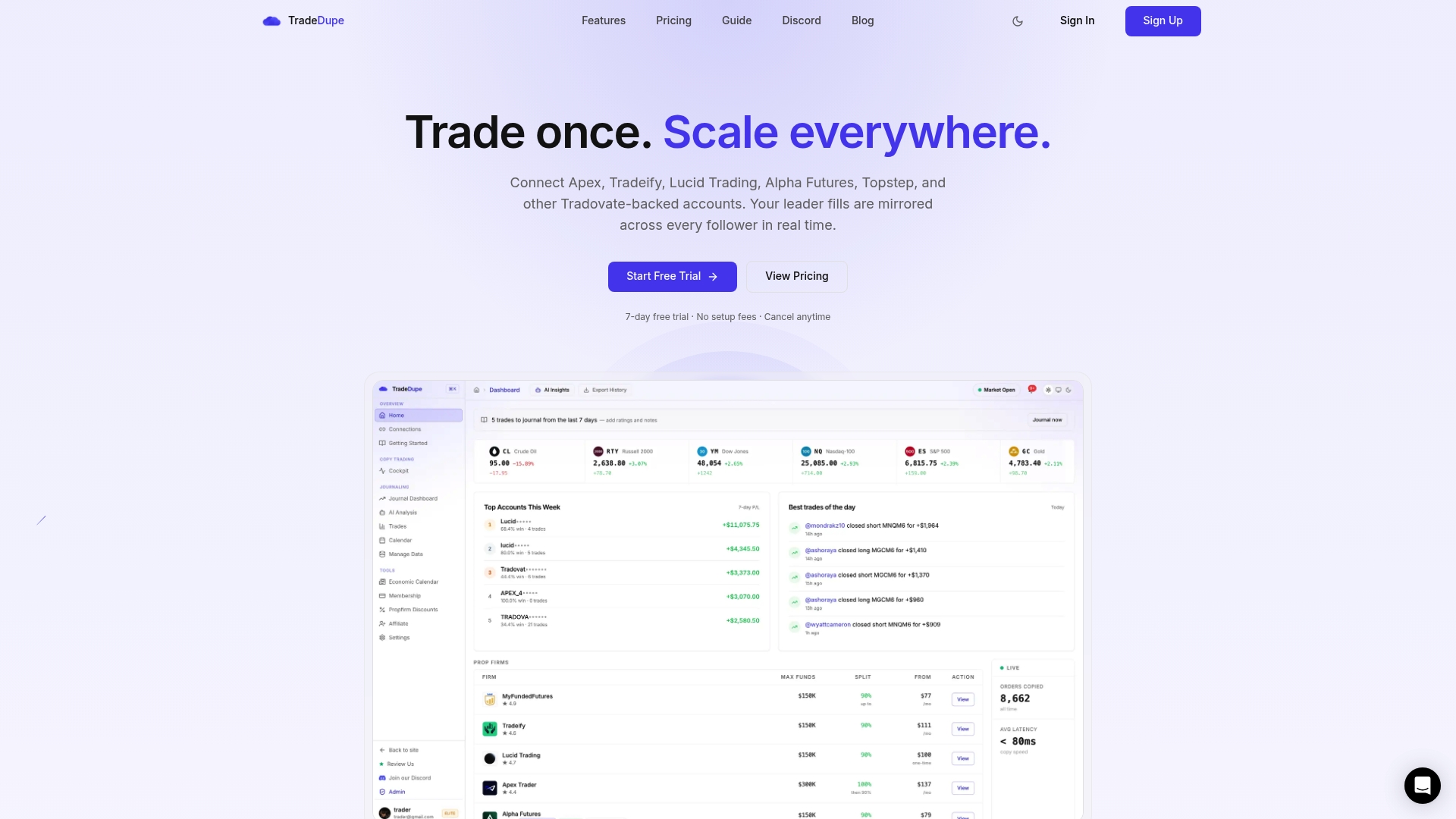
The median 34ms execution latency keeps fill-price divergence between leader and followers tight enough to matter in fast markets. Real-time telemetry surfaces sync status, per-account PnL, and latency health on a single dashboard, so your risk ops team sees anomalies before the circuit breaker fires. Start your trial or review the full security and reliability architecture to evaluate whether Tradedupe fits your desk's control requirements.
Useful sources and further reading
- PropFirmsTech: The Complete Guide to Prop Firm Risk Management — covers leading-indicator monitoring and proactive intervention frameworks
- Discentra: Behavioral Risk Management for Prop Firms — explains tilt detection, behavioral sequences, and coaching interventions distinct from integrity monitoring
- Axcera: Modern Risk Management and Fraud Detection — covers server-side enforcement, AI-driven surveillance, and coordinated fraud defense
- TradeZella: Pass a Prop Firm Challenge — practical guidance on drawdown calculation including floating P&L and buffer rules
- DovaR Labs: Prop Risk Management — per-account toggle architecture and follower isolation for copy-trading stacks
- TTTMarkets: Why Good Risk Management Still Breaks Prop Firm Rules — the paradox between retail risk practices and prop firm drawdown filters
- Transacted: What Is Rogue Trading? — definition, legal framing, and the role of auditability in compliance
- Wikipedia: Rogue Trader — historical case studies including Leeson and Kerviel with sourced loss figures
- TradeDupe Security and Reliability — platform-level documentation of fail-secure design and enforcement architecture